Toyota 4Runner vs Toyota RAV4 Plug-in Hybrid
Overview | |
MSRP$42,270 | MSRP |
Listings773 | Listings18 |
Ratings & Reviews | |
User Reviews | User Reviews |
Expert reviews6.7 out of 10 | Expert reviews7.0 out of 10 |
Pros
Cons
| Pros
Cons
|
Reviews SummaryShoppers looking for an old-school SUV should be careful what they wish for, because the 4Runner makes compromises in passenger comfort and interior space to make it one of the better off-roaders on the market. It’s offered as a hybrid, but fuel economy is never as good as a typical crossover SUVs, which will be more comfortable and more affordable. That makes mainstream crossovers better choices for most, but for those who want adventure while carrying passengers, the 4Runner makes sense. Verdict: The 4Runner’s closest rivals are the Jeep Wrangler and the Ford Bronco. Compared to them, the 4Runner can carry more passengers and offers better fuel economy thanks to an available hybrid powertrain. If adventure is a priority, then the 4Runner is a great choice, but those who want a five- or seven-passenger SUV for daily family duty would be better off with a crossover. | |
Reviews SummaryThe more powerful RAV4 PHEV is even stronger for 2026, and Toyota has introduced a new GR Sport trim to showcase its sportier side. The expanded lineup has four distinct trims, and the electric range has increased by at least 20% over the 2025 RAV4, so Toyota has furthered its lead over plug-in hybrid newcomers such as the Hyundai Tucson and Kia Sportage—and even the Lexus NX 450h+. Verdict: This is the best version of the RAV4, though we can’t recommend the slightly sportier GR Sport until we know exactly how much it will cost. With improved tech and a greater focus on electrification, as well as available DC charging (despite the charge ports changing sides between trims), the RAV4 PHEV leans forward. | |
No video found | No video found |
Popular Features & Specs | |
Seating Capacity7 | Seating Capacity |
Engine | |
Engine Name2.4L 278 hp I4 | Engine Name |
Torque317 lb-ft @ 1700 rpm | Torque |
Horsepower278 hp @ 6000 rpm | Horsepower |
Drivetrain4X2 | Drivetrain |
Interior | |
Seating Capacity7 | Seating Capacity |
Safety | |
Front Crash Overall4 | Front Crash Overall |
Side Crash Overall5 | Side Crash Overall |
Dimensions & Capacity | |
Cargo Space48.4 cu ft | Cargo Space |
Curb Weight4455 lbs | Curb Weight |
Height72.6 in | Height |
Length194.9 in | Length |
Width78.0 in | Width |
Wheelbase112.2 in | Wheelbase |
Maximum Payload895 lbs | Maximum Payload |
Number of doors4 | Number of doors |
Maximum Towing Capacity6000 lbs | Maximum Towing Capacity |
Standard Towing Capacity6000 lbs | Standard Towing Capacity |
Overview | ||
MSRP | $42,270 | |
Listings | ||
Ratings & Reviews | ||
User reviews | ||
Expert reviews | 6.7 out of 10Read full review | 7.0 out of 10Read full review |
Pros & cons | Pros
Cons
| Pros
Cons
|
Summary | Shoppers looking for an old-school SUV should be careful what they wish for, because the 4Runner makes compromises in passenger comfort and interior space to make it one of the better off-roaders on the market. It’s offered as a hybrid, but fuel economy is never as good as a typical crossover SUVs, which will be more comfortable and more affordable. That makes mainstream crossovers better choices for most, but for those who want adventure while carrying passengers, the 4Runner makes sense. Verdict: The 4Runner’s closest rivals are the Jeep Wrangler and the Ford Bronco. Compared to them, the 4Runner can carry more passengers and offers better fuel economy thanks to an available hybrid powertrain. If adventure is a priority, then the 4Runner is a great choice, but those who want a five- or seven-passenger SUV for daily family duty would be better off with a crossover. | The more powerful RAV4 PHEV is even stronger for 2026, and Toyota has introduced a new GR Sport trim to showcase its sportier side. The expanded lineup has four distinct trims, and the electric range has increased by at least 20% over the 2025 RAV4, so Toyota has furthered its lead over plug-in hybrid newcomers such as the Hyundai Tucson and Kia Sportage—and even the Lexus NX 450h+. Verdict: This is the best version of the RAV4, though we can’t recommend the slightly sportier GR Sport until we know exactly how much it will cost. With improved tech and a greater focus on electrification, as well as available DC charging (despite the charge ports changing sides between trims), the RAV4 PHEV leans forward. |
Video | No video found | No video found |
Popular Features & Specs | ||
Seating Capacity | 7 | |
Engine | ||
Engine Name | 2.4L 278 hp I4 | |
Torque | 317 lb-ft @ 1700 rpm | |
Horsepower | 278 hp @ 6000 rpm | |
Drivetrain | 4X2 | |
Interior | ||
Seating Capacity | 7 | |
Safety | ||
Front Crash Overall | 4 | |
Side Crash Overall | 5 | |
Dimensions & Capacity | ||
Cargo Space | 48.4 cu ft | |
Curb Weight | 4455 lbs | |
Height | 72.6 in | |
Length | 194.9 in | |
Width | 78.0 in | |
Wheelbase | 112.2 in | |
Maximum Payload | 895 lbs | |
Number of doors | 4 | |
Maximum Towing Capacity | 6000 lbs | |
Standard Towing Capacity | 6000 lbs | |
The 2026 Toyota RAV4 Plug-in Hybrid was available in a limited selection of trims, focusing on the Rugged and Sport designs. The Woodland trim emphasized a more adventurous aesthetic with its extended length, boxy design, and off-road features like all-terrain tires and a black roof rack. The Sport trims, including the exclusive GR Sport, showcased a racier look with gloss black accents, red brake calipers, and a prominent rear wing. The RAV4 PHEV maintained a truck-like presence with its squared-off design, vertical taillights, and integrated rear spoiler, while offering a variety of interior accents and a streamlined dashboard with a digital instrument cluster and touchscreen options.
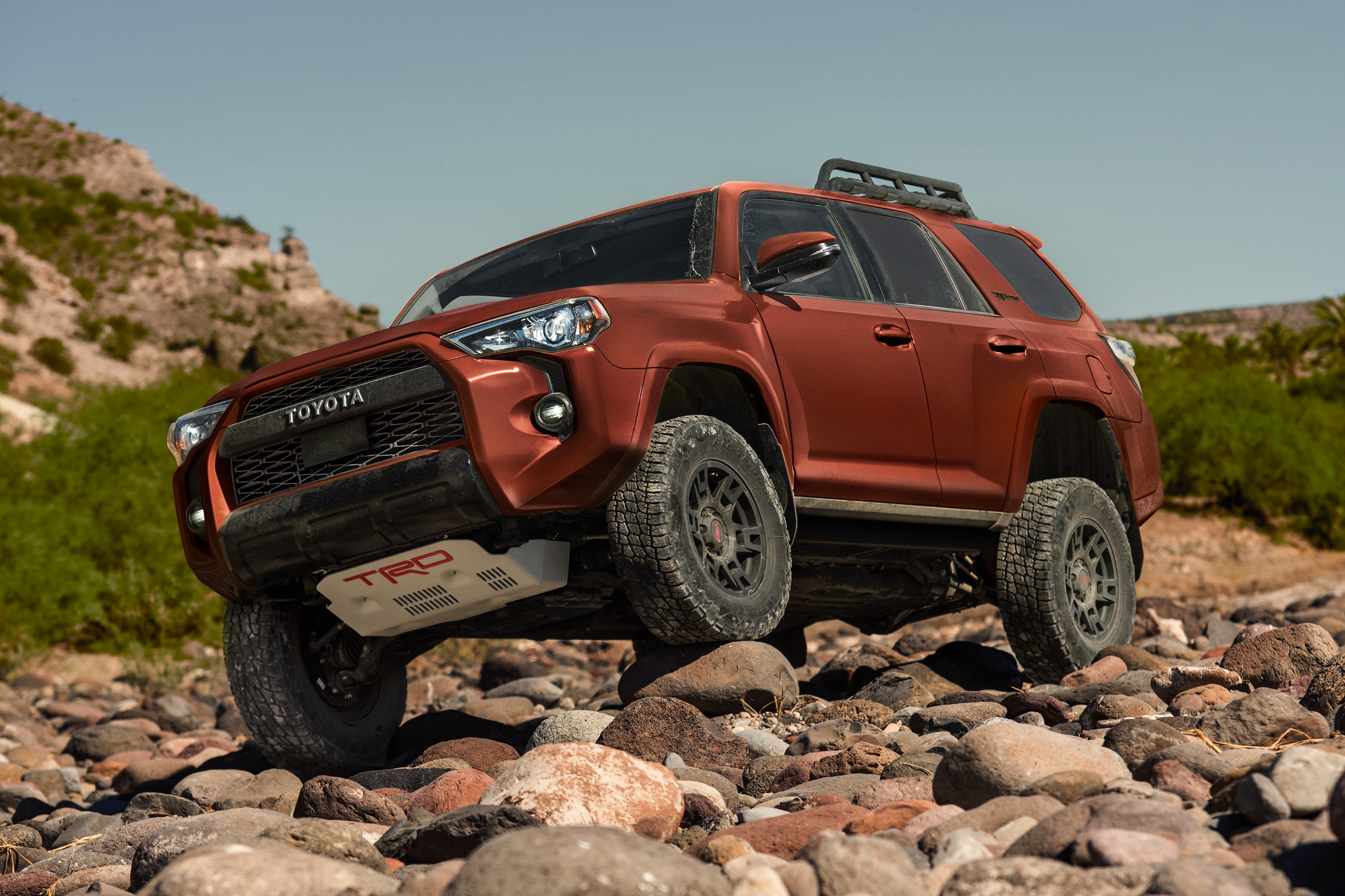
The 2026 Toyota 4Runner shared design elements with the Tacoma pickup, featuring a muscular appearance with pronounced wheel haunches and black flares for off-road models. The front grille sat high, complemented by heritage-inspired front ends on the TRD Pro and Trailhunter models. The interior was utilitarian, with chunky controls and hard plastics, though higher trims offered synthetic or leather upholstery. The 4Runner's design paid homage to its 1980s predecessor with extended rear side windows, and it offered a range of wheel sizes and off-road enhancements, including unique bumpers and increased ground clearance for specific trims.

The 2026 Toyota RAV4 Plug-in Hybrid featured an updated 2.5-liter inline four-cylinder engine, producing 186 horsepower, paired with a larger 22.7-kwh battery pack. This combination resulted in a total output of 324 horsepower, making it the most powerful RAV4 to date. The PHEV offered an estimated electric range of 52 miles and came standard with all-wheel drive. The vehicle's performance was enhanced by a seamless transition of power between the engine and electric motors, with an unofficial 0-60 mph time in the low five seconds. The GR Sport trim offered improved handling with a lower ride height, 20-inch wheels, and performance tires, providing a sportier driving experience.
The 2026 Toyota 4Runner offered two powertrains: a turbocharged 2.4-liter four-cylinder engine with 278 horsepower and the i-Force Max hybrid system, which increased output to 326 horsepower and 465 lb-ft of torque. Despite the impressive torque, the hybrid 4Runner had a 0-60 mph time in the mid-to-low seven seconds. The vehicle's off-road capabilities were enhanced by features like a part-time or full-time 4WD system, Multi-Terrain System drive modes, and various off-road enhancements on specific trims. However, the 4Runner's on-road dynamics were compromised by its body-on-frame platform, resulting in a less refined ride compared to unibody crossovers.
The 2026 Toyota RAV4 Plug-in Hybrid maintained similar dimensions to its predecessor, offering a well-equipped interior with features like a power driver's seat, heated front seats, and multiple USB ports. The interior was optimized for storage, with clever features like a dashboard shelf and a versatile center console. The RAV4 PHEV provided comfortable seating for four passengers, though five would be a squeeze, and offered 37.8 inches of rear legroom. The cargo area was slightly reduced compared to the standard RAV4, with 33.6 cubic feet of space behind the rear seats and 63.5 cubic feet with the seats folded.
The 2026 Toyota 4Runner was available with two or three rows of seats, accommodating up to seven passengers. The front seats offered the best comfort, with power adjustments and heating available on higher trims. The second-row seats provided decent space but lacked thigh support, and access was hindered by short rear doors and a high step-in height. The three-row version was less comfortable, with limited legroom and low seat bottoms. Cargo space was competitive with midsize rivals, though less accessible, with varying capacities depending on the powertrain and seating configuration.
The 2026 Toyota RAV4 Plug-in Hybrid featured a 12.3-inch digital instrument cluster and an enhanced 10.5-inch touchscreen system, with a larger 12.9-inch touchscreen available on top trims. The system included wireless Apple CarPlay and Android Auto, customizable tiles, and improved graphics thanks to Toyota's new operating system, Arene. The Voice Assistant responded to a range of commands, and a built-in dash cam recorded clips from exterior cameras. The RAV4 PHEV also offered features like a range map and charging schedules for the plug-in hybrid system.
The 2026 Toyota 4Runner came standard with a 7-inch digital instrument cluster and an 8-inch touchscreen, with larger displays available on higher trims. The 14-inch touchscreen was easy to use, though it lacked distinctive design elements. The 4Runner included a one-year trial of Remote Connect, Safety Connect, and Service Connect, as well as a Wi-Fi hotspot. The 12.3-inch digital instrument cluster provided programmable information, and the vehicle offered wireless Apple CarPlay and Android Auto, a satellite radio trial, and a JBL audio system on models with the larger touchscreen.
The 2026 Toyota RAV4 Plug-in Hybrid came equipped with Toyota Safety Sense 4.0, offering a comprehensive suite of driver-assistance features. The system included automatic emergency braking with pedestrian detection, lane-departure alert, lane-keep assist, adaptive cruise control, blind-spot monitors, and a safe-exit alert. The RAV4 PHEV also featured an enhanced rearview camera and a surround-view camera system on higher trims. The vehicle's safety record was historically strong, with a five-star rating from the NHTSA for the 2025 model, though crash-testing for the 2026 model was pending.
The 2026 Toyota 4Runner featured Toyota Safety Sense 3.0, which included forward collision warning, automatic emergency braking, adaptive cruise control, lane-departure warning, lane-keep assist, road-sign recognition, and high-beam assist. Additional standard features included blind-spot monitors, front and rear cross-traffic alert, and traffic-jam assist. The 4Runner received mixed crash scores, with a four-star overall rating from the NHTSA and a Marginal score in the IIHS moderate front overlap crash test. The vehicle did receive Good ratings in side crash tests and for its front crash prevention systems.
CarGurus highlights
According to CarGurus experts, the overall rating for the 2026 Toyota RAV4 Plug-in Hybrid is 7.0 out of 10, while the 2026 Toyota 4Runner scores 6.7 out of 10. Based on these ratings, the RAV4 Plug-in Hybrid is the recommended choice for those seeking a more efficient and technologically advanced vehicle with a sportier design and a refined driving experience.
Choose the 2026 Toyota 4Runner if:
- You need a vehicle with serious off-road capabilities, including multiple 4WD systems and off-road enhancements on specific trims.
- You require a versatile seating configuration with the option for two or three rows to accommodate up to seven passengers.
- You appreciate a rugged, utilitarian design with heritage-inspired elements and a focus on durability.


Choose the 2026 Toyota RAV4 Plug-in Hybrid if:
- You prioritize a more powerful and efficient plug-in hybrid powertrain with an estimated 52-mile electric range.
- You prefer a vehicle with a more refined on-road driving experience and a sportier design, especially in the GR Sport trim.
- You value advanced technology features, including a customizable digital instrument cluster and a built-in dash cam.


CarGurus highlights
According to CarGurus experts, the overall rating for the 2026 Toyota RAV4 Plug-in Hybrid is 7.0 out of 10, while the 2026 Toyota 4Runner scores 6.7 out of 10. Based on these ratings, the RAV4 Plug-in Hybrid is the recommended choice for those seeking a more efficient and technologically advanced vehicle with a sportier design and a refined driving experience.
Choose the 2026 Toyota 4Runner if:
Shop Now- You need a vehicle with serious off-road capabilities, including multiple 4WD systems and off-road enhancements on specific trims.
- You require a versatile seating configuration with the option for two or three rows to accommodate up to seven passengers.
- You appreciate a rugged, utilitarian design with heritage-inspired elements and a focus on durability.
Choose the 2026 Toyota RAV4 Plug-in Hybrid if:
Shop Now- You prioritize a more powerful and efficient plug-in hybrid powertrain with an estimated 52-mile electric range.
- You prefer a vehicle with a more refined on-road driving experience and a sportier design, especially in the GR Sport trim.
- You value advanced technology features, including a customizable digital instrument cluster and a built-in dash cam.

By: CarGurus + AI
At CarGurus, our team of experienced automotive writers remain at the heart of our content operation, conducting hands-on car tests and writing insightful guides that are backed by years of industry experience. To complement this, we are harnessing AI to make our content offering more diverse and more helpful to shoppers than ever. To achieve this, our AI systems are based exclusively on CarGurus content, ratings and data, so that what we produce is both unique to CarGurus, and uniquely helpful to car shoppers.

