Toyota 4Runner vs Chevrolet Bolt
Overview | |
MSRP$42,270 | MSRP$27,600 |
Listings832 | Listings3 |
Ratings & Reviews | |
User Reviews | User Reviews |
Expert reviews6.7 out of 10 | Expert reviews6.3 out of 10 |
Pros
Cons
| Pros
Cons
|
Reviews SummaryShoppers looking for an old-school SUV should be careful what they wish for, because the 4Runner makes compromises in passenger comfort and interior space to make it one of the better off-roaders on the market. It’s offered as a hybrid, but fuel economy is never as good as a typical crossover SUVs, which will be more comfortable and more affordable. That makes mainstream crossovers better choices for most, but for those who want adventure while carrying passengers, the 4Runner makes sense. Verdict: The 4Runner’s closest rivals are the Jeep Wrangler and the Ford Bronco. Compared to them, the 4Runner can carry more passengers and offers better fuel economy thanks to an available hybrid powertrain. If adventure is a priority, then the 4Runner is a great choice, but those who want a five- or seven-passenger SUV for daily family duty would be better off with a crossover. | |
Reviews SummaryWith more range, more power, and improved technology, the Chevrolet Bolt EV returns after a three-year hiatus. It also claims the title of the most affordable EV in the U.S., but is due to remain in production only until mid-2027. Verdict: The 2027 Chevrolet Bolt EV is an excellent choice for shoppers seeking an electric vehicle that won't break the bank. It may not be all that fancy or refined, but it gets the basics right when it comes to range and capabilities. | |
No video found | No video found |
Popular Features & Specs | |
Seating Capacity7 | Seating Capacity5 |
EV Battery Capacity | EV Battery Capacity65 kWh |
Battery Charge Time (120V) | Battery Charge Time (120V)64 hours |
Battery Charge Time (240V) | Battery Charge Time (240V)9.8 hours |
Engine | |
Engine Name2.4L 278 hp I4 | Engine Name210 hp Electric |
Torque317 lb-ft @ 1700 rpm | Torque |
Horsepower278 hp @ 6000 rpm | Horsepower |
Battery Charge Time (120V) | Battery Charge Time (120V)64 hours |
Battery Charge Time (240V) | Battery Charge Time (240V)9.8 hours |
Drivetrain4X2 | DrivetrainFWD |
Fuel Economy | |
EV Battery Capacity | EV Battery Capacity65 kWh |
Interior | |
Seating Capacity7 | Seating Capacity5 |
Key Features | |
Navigation System | Navigation SystemStandard |
Safety | |
Front Crash Overall4 | Front Crash Overall |
Side Crash Overall5 | Side Crash Overall |
Dimensions & Capacity | |
Cargo Space48.4 cu ft | Cargo Space16.2 cu ft |
Curb Weight4455 lbs | Curb Weight3776 lbs |
Height72.6 in | Height63.9 in |
Length194.9 in | Length169.6 in |
Width78.0 in | Width80.1 in |
Wheelbase112.2 in | Wheelbase105.3 in |
Maximum Payload895 lbs | Maximum Payload873 lbs |
Number of doors4 | Number of doors4 |
Maximum Towing Capacity6000 lbs | Maximum Towing Capacity |
Standard Towing Capacity6000 lbs | Standard Towing Capacity |
Overview | ||
MSRP | $42,270 | $27,600 |
Listings | ||
Ratings & Reviews | ||
User reviews | ||
Expert reviews | 6.7 out of 10Read full review | 6.3 out of 10Read full review |
Pros & cons | Pros
Cons
| Pros
Cons
|
Summary | Shoppers looking for an old-school SUV should be careful what they wish for, because the 4Runner makes compromises in passenger comfort and interior space to make it one of the better off-roaders on the market. It’s offered as a hybrid, but fuel economy is never as good as a typical crossover SUVs, which will be more comfortable and more affordable. That makes mainstream crossovers better choices for most, but for those who want adventure while carrying passengers, the 4Runner makes sense. Verdict: The 4Runner’s closest rivals are the Jeep Wrangler and the Ford Bronco. Compared to them, the 4Runner can carry more passengers and offers better fuel economy thanks to an available hybrid powertrain. If adventure is a priority, then the 4Runner is a great choice, but those who want a five- or seven-passenger SUV for daily family duty would be better off with a crossover. | With more range, more power, and improved technology, the Chevrolet Bolt EV returns after a three-year hiatus. It also claims the title of the most affordable EV in the U.S., but is due to remain in production only until mid-2027. Verdict: The 2027 Chevrolet Bolt EV is an excellent choice for shoppers seeking an electric vehicle that won't break the bank. It may not be all that fancy or refined, but it gets the basics right when it comes to range and capabilities. |
Video | No video found | No video found |
Popular Features & Specs | ||
Seating Capacity | 7 | 5 |
EV Battery Capacity | 65 kWh | |
Battery Charge Time (120V) | 64 hours | |
Battery Charge Time (240V) | 9.8 hours | |
Engine | ||
Engine Name | 2.4L 278 hp I4 | 210 hp Electric |
Torque | 317 lb-ft @ 1700 rpm | |
Horsepower | 278 hp @ 6000 rpm | |
Battery Charge Time (120V) | 64 hours | |
Battery Charge Time (240V) | 9.8 hours | |
Drivetrain | 4X2 | FWD |
Fuel Economy | ||
EV Battery Capacity | 65 kWh | |
Interior | ||
Seating Capacity | 7 | 5 |
Key Features | ||
Navigation System | Standard | |
Safety | ||
Front Crash Overall | 4 | |
Side Crash Overall | 5 | |
Dimensions & Capacity | ||
Cargo Space | 48.4 cu ft | 16.2 cu ft |
Curb Weight | 4455 lbs | 3776 lbs |
Height | 72.6 in | 63.9 in |
Length | 194.9 in | 169.6 in |
Width | 78.0 in | 80.1 in |
Wheelbase | 112.2 in | 105.3 in |
Maximum Payload | 895 lbs | 873 lbs |
Number of doors | 4 | 4 |
Maximum Towing Capacity | 6000 lbs | |
Standard Towing Capacity | 6000 lbs | |
The 2026 Toyota 4Runner shared a striking resemblance with the Tacoma pickup, especially from the front. It boasted a robust and muscular appearance, with pronounced haunches at each wheel and black wheel flares on the off-road models. The sheet metal was heavily creased and angled, with particularly deep creases along the sides. The grille sat high above a lower intake, giving it an underbite look, especially on the TRD Pro and Trailhunter models, which featured unique bumpers for improved approach angles. These models also had heritage-inspired front ends with "Toyota" lettering on the grille and an integrated light bar. The rear side windows extended into the roof, reminiscent of the original 4Runner from the 1980s. Wheel sizes varied from 18 to 20 inches.
Inside, the 4Runner had a simple, utilitarian design with chunky control dials that were easy to operate with gloved hands, and an abundance of hard plastic throughout the cabin. Cloth upholstery was standard, with synthetic leather available on higher trims like the TRD Pro and Trailhunter, and leather upholstery on the Limited and Platinum trims. Despite the leather, the cabin never quite achieved a high-end feel.
The 2027 Chevrolet Bolt retained a familiar look with slight styling changes, presenting a front end more akin to a conventional gas-powered car than an EV. A thin slot behind the Chevy Bowtie logo and an integrated grille insert into the bumper were notable updates. The Bolt straddled the line between a large hatchback and a subcompact SUV, with a tall and narrow stance that prioritized utility and interior space. The RS model added gloss black exterior trim for a touch of flair.
The interior underwent a more dramatic makeover, featuring a larger digital instrument panel and infotainment touchscreen. The push-button gear selector was moved to the steering column, freeing up more storage space in the center console. Hard plastic surfaces dominated the cabin, reinforcing the Bolt's budget feel, though elbow touch points had thin padding. The base LT trim came with cloth upholstery, while the RS trim upgraded to Evotex synthetic leather with red stitching. The rear seating area also featured hard plastics and lacked padding for the door armrests.

The 2026 Toyota 4Runner offered two powertrains and the choice of rear-wheel drive (RWD) or two four-wheel-drive (4WD) systems. The base engine, known as i-Force, was a turbocharged 2.4-liter four-cylinder producing 278 horsepower and 317 pound-feet of torque. The i-Force Max hybrid system added an electric motor, increasing output to 326 hp and 465 lb-ft. Our 4Runner TRD Off-Road Premium tester featured the hybrid powertrain, which, despite its impressive torque figure, wasn't particularly quick, with a mid-to-low seven-second 0–60 mph time. The eight-speed automatic transmission was well-matched to the engine, with more aggressive tuning in Sport mode. The 4Runner hybrid excelled off-road, thanks to its torque and features like the Crawl Control and Multi-Terrain System (MTS) drive modes.
The 4Runner's off-road capabilities were enhanced by features like a locking rear differential, Bilstein remote-reservoir dampers, and skid plates. The Trailhunter and TRD Pro models went even further with additional off-road enhancements. However, the 4Runner's on-road dynamics were compromised by its body-on-frame platform, resulting in a jiggly ride over bumps and notable lean in corners.
The 2027 Chevrolet Bolt featured a new 65-kilowatt-hour lithium-iron phosphate battery pack, reducing costs and reliance on rare earth minerals. A motor from Chevy's Equinox EV delivered 210 horsepower and 169 pound-feet of torque to the front wheels, with a 0-60 mph time similar to the previous Bolt EV, in the low seven-second range. While not the quickest by EV standards, the Bolt was responsive and agile, with one-pedal driving available for enhanced brake regeneration.
The Bolt's ride was firm but not overly stiff, and its low center of gravity contributed to surprising agility on curvy roads. The EPA estimated a range of up to 262 miles on a full charge, an improvement over its predecessor. The Bolt featured a Tesla-derived NACS charge port, with adapters for CCS and J1772 connectors, and a charging speed increase to 150 kW, allowing for a quick recharge from 10% to 80% in 25 minutes.
The 2026 Toyota 4Runner offered two seating configurations: a two-row setup for five passengers or a three-row setup for up to seven. The front seats were the most comfortable, with manual adjustments standard and power adjustments available on higher trims. Heated front seats were standard on all but the base trim, and Premium trims and up included a heated steering wheel. The second row provided decent space but lacked comfort due to low seat bottoms. The Platinum trim added heated and reclining second-row seats. The three-row version was less accommodating, with limited legroom and low seat bottoms.
Cargo space in the 4Runner was competitive with midsize rivals, though not as accessible. Gas-only two-row models offered 48.4 cubic feet behind the second row and 90.2 cubic feet behind the first row. The hybrid powertrain reduced cargo space slightly. The three-row configuration, available only with the base gas engine, had 12.1 cubic feet behind the third row, 44.8 behind the second row, and 84.1 with all seats folded.
The 2027 Chevrolet Bolt featured an upright driving position with ample space for larger occupants. Taller drivers might have wished for more telescoping extension from the steering wheel. The rear seats were also upright, with plenty of headroom and adequate thigh support. The flat floor reduced the penalty for center-seat passengers.
The Bolt offered 16.2 cubic feet of cargo space behind the rear seats, which was small for the class but sufficient for most users. A large bin beneath the floor provided additional storage, and the floor could be adjusted to create more luggage space. The rear seatbacks folded flat with the cargo floor, enhancing versatility. Up front, the Bolt provided ample storage for personal items, including a large bin with movable dividers, a big floor tray, and a deep center armrest bin.
The 2026 Toyota 4Runner came standard with a 7-inch digital instrument cluster and an 8-inch touchscreen, with larger screens available on higher trims. Our tester featured a 14-inch touchscreen, which, while large and easy to use, lacked distinctive design elements. The 4Runner included a one-year trial of Remote Connect, a multi-year subscription to Safety Connect, and a Wi-Fi hotspot for a month. The 12.3-inch digital instrument cluster provided programmable information, and standard tech features included wireless Apple CarPlay and Android Auto, a three-month satellite radio trial, and a wireless phone charger on all but the base model.
The 2027 Chevrolet Bolt featured an 11-inch digital instrument panel and an 11.3-inch center touchscreen, running on a Google-based operating system. Apple CarPlay and standalone Android Auto were not supported, requiring Bluetooth pairing for personal music libraries. The optional Technology package added a surround-view camera system, a digital rear-view mirror, and a wireless charging pad. The infotainment system was user-friendly, with logical menus, sharp graphics, and quick responses. The Bolt's navigation system could help drivers find charging stations and precondition the battery for optimal charging rates. The Bolt also offered vehicle-to-load charging capability.
The 2026 Toyota 4Runner was equipped with Toyota's Safety Sense 3.0 suite, including forward collision warning, automatic emergency braking, adaptive cruise control, lane-departure warning, lane-keep assist, road-sign recognition, and high-beam assist. Additional standard features included blind-spot monitors, front and rear cross-traffic alert, and traffic-jam assist. The 4Runner received mixed crash scores, with four out of five stars overall from the NHTSA and a Marginal score in the moderate front overlap crash test from the IIHS.
The 2027 Chevrolet Bolt's crash test results were not yet available, but it was expected to achieve high scores based on its platform. Standard safety features included forward collision warning, automatic emergency braking, adaptive cruise control, lane-keep assist, blind-spot monitors, and a safety alert seat. The optional Technology package added a surround-view camera system, a digital rear-view mirror, and additional safety features. GM's Super Cruise hands-free automated highway driving system was available for an additional cost.
CarGurus highlights
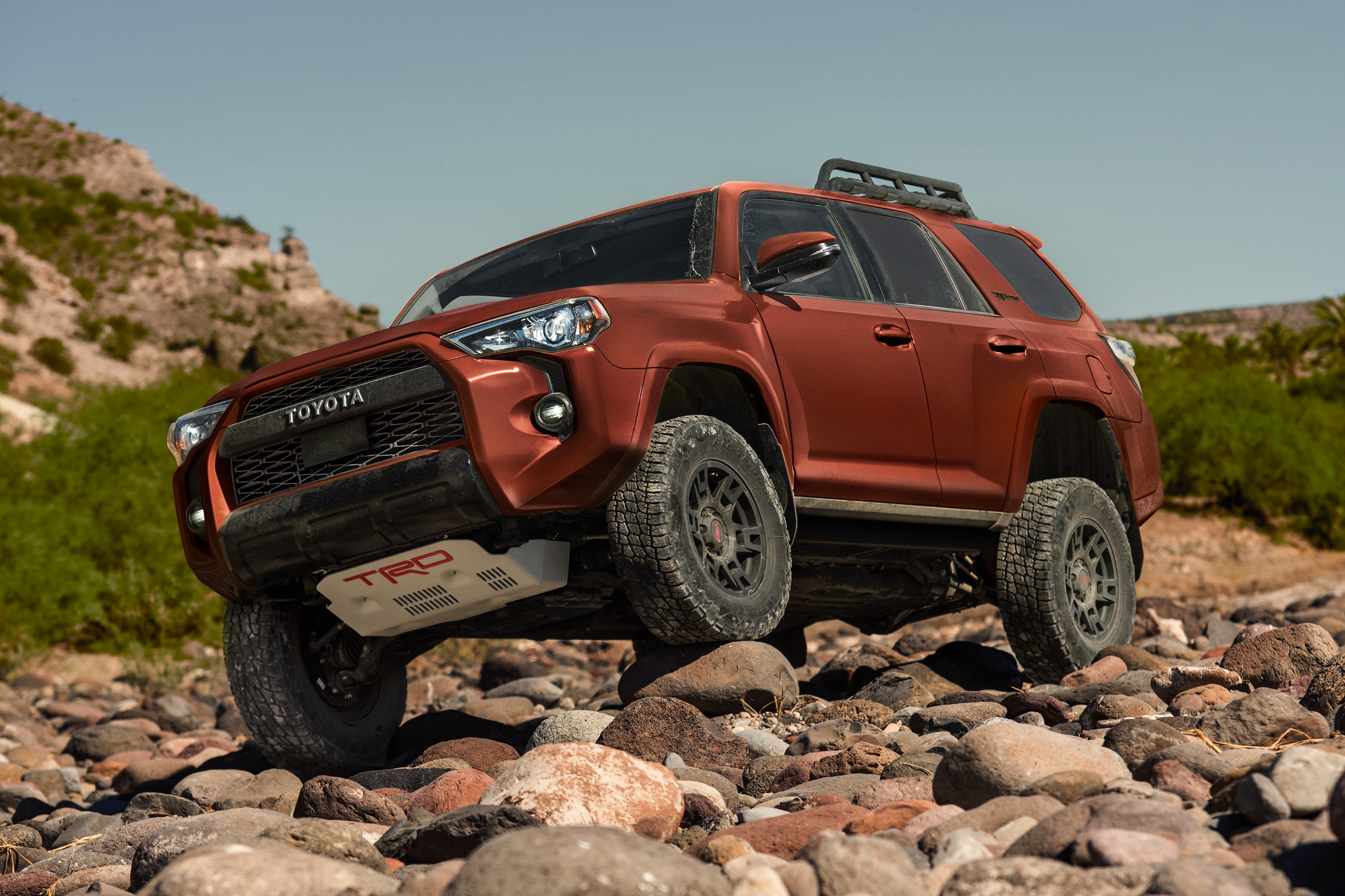
According to CarGurus experts, the overall rating for the 2026 Toyota 4Runner is 6.7 out of 10, while the 2027 Chevrolet Bolt scores 6.3 out of 10. Based on these ratings, the 2026 Toyota 4Runner is the recommended choice for those seeking a versatile and capable SUV with strong off-road credentials.
Choose the 2026 Toyota 4Runner if:
- You prioritize off-road capabilities and rugged design.
- You need a versatile SUV with multiple seating and cargo configurations.
- You value a straightforward, utilitarian interior with easy-to-use controls.


Choose the 2027 Chevrolet Bolt if:
- You want an electric vehicle with a respectable range and quick charging capabilities.
- You prefer a compact vehicle with ample interior space and storage solutions.
- You appreciate advanced technology features and a user-friendly infotainment system.


CarGurus highlights
According to CarGurus experts, the overall rating for the 2026 Toyota 4Runner is 6.7 out of 10, while the 2027 Chevrolet Bolt scores 6.3 out of 10. Based on these ratings, the 2026 Toyota 4Runner is the recommended choice for those seeking a versatile and capable SUV with strong off-road credentials.
Choose the 2026 Toyota 4Runner if:
Shop Now- You prioritize off-road capabilities and rugged design.
- You need a versatile SUV with multiple seating and cargo configurations.
- You value a straightforward, utilitarian interior with easy-to-use controls.
Choose the 2027 Chevrolet Bolt if:
Shop Now- You want an electric vehicle with a respectable range and quick charging capabilities.
- You prefer a compact vehicle with ample interior space and storage solutions.
- You appreciate advanced technology features and a user-friendly infotainment system.

By: CarGurus + AI
At CarGurus, our team of experienced automotive writers remain at the heart of our content operation, conducting hands-on car tests and writing insightful guides that are backed by years of industry experience. To complement this, we are harnessing AI to make our content offering more diverse and more helpful to shoppers than ever. To achieve this, our AI systems are based exclusively on CarGurus content, ratings and data, so that what we produce is both unique to CarGurus, and uniquely helpful to car shoppers.

