2024 Toyota 4Runner vs 2024 Genesis GV80
Overview | |
MSRP$57,700 | MSRP$40,705 |
Listings128 | Listings193 |
Ratings & Reviews | |
User Reviews | User Reviews |
Expert reviews7.7 out of 10 | Expert reviews4.5 out of 10 |
Pros
Cons
| Pros
Cons
|
2024 Genesis GV80 Reviews SummaryGenesis introduced the GV80 in 2021, and the crossover SUV is getting a minor refresh in 2025. Still, the 2024 GV80 remains a good choice unless you want to wait for the fancier styling, more high-tech interior, or new supercharged GV80 Coupe coming next year. Otherwise, today’s GV80 is pretty much the same as tomorrow’s GV80, and in some respects, it is the more elegant and traditional choice. Verdict: Based on our evaluation of the 2024 Genesis GV80, seat comfort is not what it should be. Also, to use Apple CarPlay or Android Auto, you need a USB cable. This Genesis is thirsty, too. But otherwise, we have few complaints about this stylish, safe, and mostly rewarding midsize luxury SUV. | |
2024 Toyota 4Runner Reviews SummaryVerdict: The Toyota 4Runner remains an accomplished off-road-capable vehicle with a strong reputation for reliability and durability. A new 4Runner is expected, and the current model's aging platform is in desperate need of a full redesign. It trails newer rivals when it comes to technology, safety features, fuel efficiency, and power. The 2024 Toyota 4Runner would be easier to recommend it if the price were significantly reduced. | |
No video found | |
Popular Features & Specs | |
Engine2.5L 300 hp I4 | Engine4.0L 270 hp V6 |
DrivetrainAWD | Drivetrain4X2 |
Seating Capacity5 | Seating Capacity7 |
Horsepower300 hp @ 5800 rpm | Horsepower270 hp @ 5600 rpm |
MPG City20 | MPG City16 |
MPG Highway24 | MPG Highway19 |
Engine | |
Engine Name2.5L 300 hp I4 | Engine Name4.0L 270 hp V6 |
Torque311 lb-ft @ 1650 rpm | Torque278 lb-ft @ 4400 rpm |
Horsepower300 hp @ 5800 rpm | Horsepower270 hp @ 5600 rpm |
DrivetrainAWD | Drivetrain4X2 |
Fuel Economy | |
MPG City20 | MPG City16 |
MPG Highway24 | MPG Highway19 |
Interior | |
Seating Capacity5 | Seating Capacity7 |
Key Features | |
Navigation SystemStandard | Navigation System |
Safety | |
Front Crash Overall4 | Front Crash Overall4 |
Side Crash Overall | Side Crash Overall5 |
Dimensions & Capacity | |
Cargo Space34.9 cu ft | Cargo Space47.2 cu ft |
Curb Weight4742 lbs | Curb Weight4400 lbs |
Height67.5 in | Height71.5 in |
Length194.7 in | Length190.2 in |
Width77.8 in | Width75.8 in |
Wheelbase116.3 in | Wheelbase109.8 in |
Maximum Payload1188 lbs | Maximum Payload1700 lbs |
Number of doors4 | Number of doors4 |
Maximum Towing Capacity6000 lbs | Maximum Towing Capacity5000 lbs |
Standard Towing Capacity | Standard Towing Capacity5000 lbs |
Overview | ||
MSRP | $57,700 | $40,705 |
Listings | ||
Ratings & Reviews | ||
User reviews | ||
Expert reviews | 7.7 out of 10Read full review | 4.5 out of 10Read full review |
Pros & cons | Pros
Cons
| Pros
Cons
|
Summary | Genesis introduced the GV80 in 2021, and the crossover SUV is getting a minor refresh in 2025. Still, the 2024 GV80 remains a good choice unless you want to wait for the fancier styling, more high-tech interior, or new supercharged GV80 Coupe coming next year. Otherwise, today’s GV80 is pretty much the same as tomorrow’s GV80, and in some respects, it is the more elegant and traditional choice. Verdict: Based on our evaluation of the 2024 Genesis GV80, seat comfort is not what it should be. Also, to use Apple CarPlay or Android Auto, you need a USB cable. This Genesis is thirsty, too. But otherwise, we have few complaints about this stylish, safe, and mostly rewarding midsize luxury SUV. | Verdict: The Toyota 4Runner remains an accomplished off-road-capable vehicle with a strong reputation for reliability and durability. A new 4Runner is expected, and the current model's aging platform is in desperate need of a full redesign. It trails newer rivals when it comes to technology, safety features, fuel efficiency, and power. The 2024 Toyota 4Runner would be easier to recommend it if the price were significantly reduced. |
Video | No video found | |
Popular Features & Specs | ||
Engine | 2.5L 300 hp I4 | 4.0L 270 hp V6 |
Drivetrain | AWD | 4X2 |
Seating Capacity | 5 | 7 |
Horsepower | 300 hp @ 5800 rpm | 270 hp @ 5600 rpm |
MPG City | 20 | 16 |
MPG Highway | 24 | 19 |
Engine | ||
Engine Name | 2.5L 300 hp I4 | 4.0L 270 hp V6 |
Torque | 311 lb-ft @ 1650 rpm | 278 lb-ft @ 4400 rpm |
Horsepower | 300 hp @ 5800 rpm | 270 hp @ 5600 rpm |
Drivetrain | AWD | 4X2 |
Fuel Economy | ||
MPG City | 20 | 16 |
MPG Highway | 24 | 19 |
Interior | ||
Seating Capacity | 5 | 7 |
Key Features | ||
Navigation System | Standard | |
Safety | ||
Front Crash Overall | 4 | 4 |
Side Crash Overall | 5 | |
Dimensions & Capacity | ||
Cargo Space | 34.9 cu ft | 47.2 cu ft |
Curb Weight | 4742 lbs | 4400 lbs |
Height | 67.5 in | 71.5 in |
Length | 194.7 in | 190.2 in |
Width | 77.8 in | 75.8 in |
Wheelbase | 116.3 in | 109.8 in |
Maximum Payload | 1188 lbs | 1700 lbs |
Number of doors | 4 | 4 |
Maximum Towing Capacity | 6000 lbs | 5000 lbs |
Standard Towing Capacity | 5000 lbs | |
The 2024 Genesis GV80 presented two engine choices—a 2.5T turbocharged four-cylinder and a 3.5T twin-turbocharged V6. Buyers could select from trim levels ranging from Standard to Prestige Signature, with prices spanning $57,700 to $81,750, plus a $1,350 destination fee. Our test vehicle, a GV80 3.5T in the top-tier Prestige Signature trim, featured an upgraded Matterhorn White Matte paint that raised the MSRP to $84,600, including destination.
The Prestige Signature models were available in Vik Black, Matterhorn White Matte, or the exclusive Mauna Red. They featured dark chrome trim and sleek 22-inch wheels, which, due to the black paint, were almost invisible. Despite its prestigious appeal, some felt the Signature trim was not notably more attractive than the Prestige model due to the obscured wheel details.
The interior of the GV80 3.5T was luxurious, featuring Ultramarine Blue over Dune color scheme, diamond-stitched Nappa leather, an artificial leather dashboard, matte-finish wood trim, a suede headliner, and metallic accents. Ambient lighting, a 3D digital instrument cluster, and a wide touchscreen display emphasized its luxury SUV status. Overall, the GV80 was undeniably luxurious, although the Signature trim seemed less necessary compared to the Prestige variant.
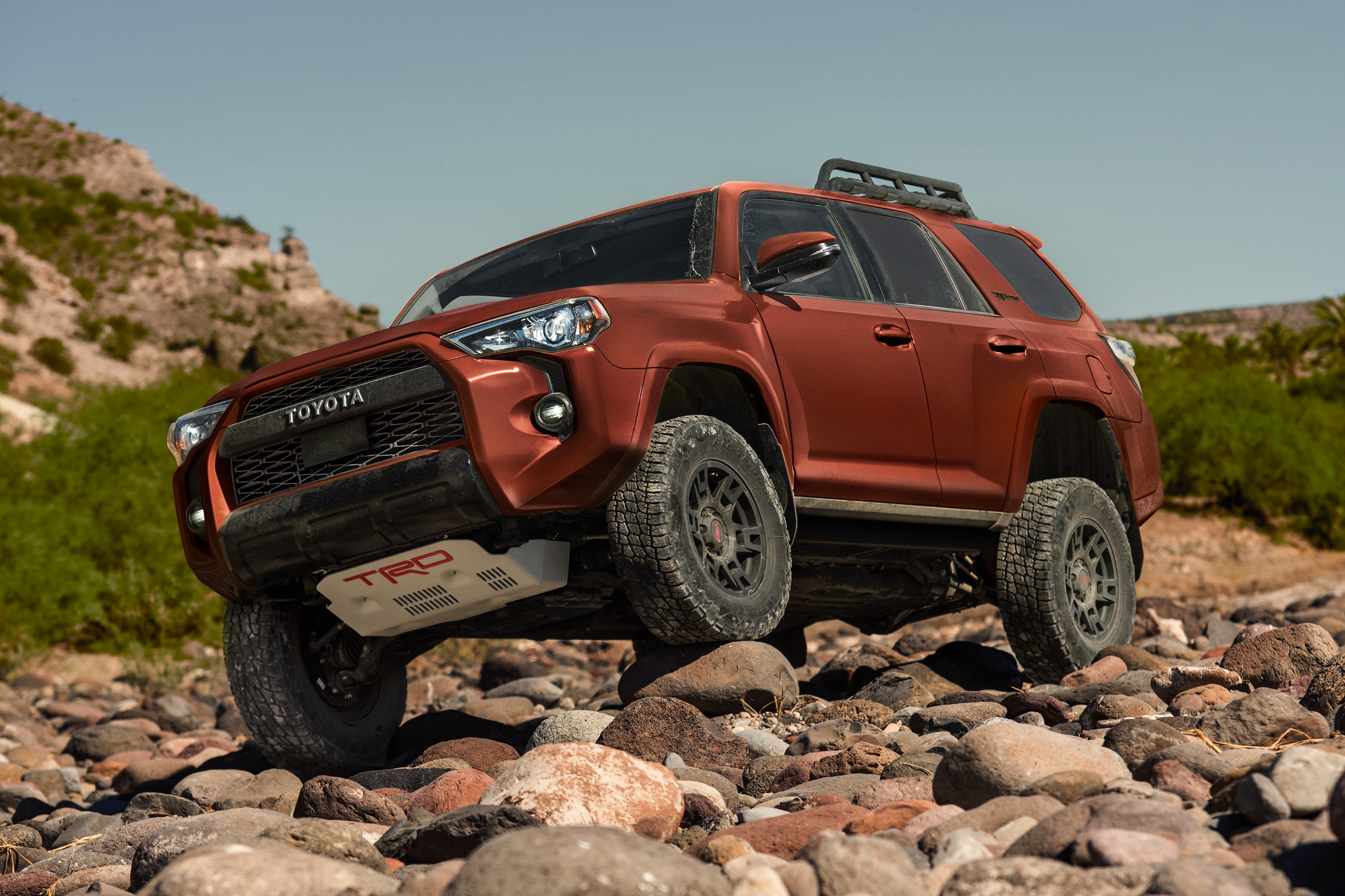
In contrast, the 2024 Toyota 4Runner was seen as a throwback with its design rooted in the 2010 model year. Although it had undergone several refreshes, it needed a significant update. Its boxy shape and flared fenders imparted a rugged, stable stance, essential for off-road capabilities. The TRD Pro trim emphasized this ruggedness with its underbody skid plates, all-terrain tires, and beefy tubular roof rack, ready to tackle any terrain.
Inside, the 4Runner showed its age with old-school styling and outdated technology features. The analog instrument panel and comparatively small eight-inch infotainment touchscreen felt antiquated. Some might find its nostalgic pieces charming, but others could mistake it for a well-maintained older vehicle. The interior featured hard plastics, as often found in off-road vehicles, with cushioned panels for comfort. The seat upholstery aimed to mimic leather but seemed more like vinyl.
The 4Runner's interior might have been dated, but its brawny look and charm remained relevant for adventure seekers.


The 2024 Genesis GV80 2.5T was powered by a turbocharged 2.5-liter four-cylinder engine delivering 300 horsepower and 311 pound-feet of torque, surpassing many of its rival V6 engines like those in the Acura MDX and Infiniti QX60. Our test model, the 3.5T, boasted a twin-turbocharged 3.5-liter V6 engine producing 375 hp and 391 lb-ft of torque. This powertrain provided a satisfying performance, albeit at the cost of fuel economy, with an observed 17.2 mpg compared to an EPA estimate of 20 mpg in combined driving.
Both engines were mated to an eight-speed automatic transmission with an all-wheel-drive system and offered five driving modes: Eco, Comfort, Sport, Custom, and Snow. The GV80 could offer 8.1 inches of ground clearance and tow up to 6,000 pounds when equipped correctly. The 3.5T version also included upgraded front brakes and an adaptive damping suspension for enhanced performance.
Driving the GV80 3.5T proved rewarding, with quiet and composed behavior that retained a good sense of the road. Swift acceleration made freeway merging and passing effortless. Despite noticeable surface irregularities, the GV80 maintained a sporty feel. Our test drive spanning Los Angeles to San Diego showcased its long-distance comfort, save for some seat discomfort. Its mountain road grip, combined with an adaptive damping suspension, powerful engine, responsive transmission, and AWD system, delivered an unexpectedly athletic experience. We appreciated the two-spoke steering wheel's comfort during extended drives, though it was set to change to a three-spoke design in 2025.
The 2024 Toyota 4Runner, meanwhile, relied on a 4.0-liter V6 engine producing 270 horsepower and 278 pound-feet of torque. Despite modest discrepancies compared to the Bronco and Wrangler, the 4Runner was held back by its five-speed automatic transmission in an era where competitors offered ten- and eight-speed options for better acceleration and fuel economy. The TRD Pro model came standard with four-wheel drive (4WD) and a two-speed transfer case, while other trims offered rear-wheel drive (RWD) with optional 4WD.
On-road, the 4Runner felt slow, needing significant throttle input to merge onto highways. Its soft suspension tuning, excellent for off-road articulation, caused rear-end squat during acceleration and significant nosedive under hard braking. This suspension resulted in considerable body roll around corners and residual bounces over ruts and bumps. However, with a well-packed cargo area, these bounces were less pronounced. Its tall tire sidewalls and soft suspension handled large road imperfections, but passengers prone to motion sickness might have needed precautions on rough routes.
In 2024, the Genesis GV80 3.5T Advanced was the only trim offering a third-row seat, unlike previous years when the Prestige included it. The Prestige Signature focused more on luxury, seating only four with heated, ventilated second-row captain's chairs.
We missed the GV80's spacious interior for a family trip to Santa Monica. Instead, we squeezed five into a Jeep Gladiator, unfortunate given the GV80 Prestige Signature’s opulence.
Depending on the trim, the GV80's seats ranged from artificial leather to premium leather. Standard features included heated front seats, a heated steering wheel, manual rear door window shades, and a power hands-free liftgate. Our test model featured a panoramic glass roof, triple-zone climate control, ventilated front seats with massage and adjustable support, and second-row powered window shades.
Despite these luxurious features, the seats felt uncomfortable on long trips. Additionally, while the rear seats reclined, they did not provide ample legroom. Storage space, however, was impressive, offering 34.9 cubic feet behind the second row, expandable to 84 cubic feet with the seats folded. With the Prestige Signature’s console, caution was necessary when loading.
The 2024 Toyota 4Runner's interior design felt outdated, featuring user-friendly large climate-control dials and driveline levers. Sturdy handles helped passengers stay secure off-road. Its layout ensured excellent outward visibility from the driver’s seat, critical for off-road maneuvers.
The front provided ample space for larger passengers, though the steering wheel's limited range hindered taller drivers. The second row offered abundant legroom and unique stadium-like seating, though headroom was limited for taller occupants. Some trims offered a third row.
Convenience was a forte with numerous spaces for snacks and drinks, like dashboard pockets, console cupholders, an armrest bin, and deep door pockets. The 4Runner accommodated 47.2 cubic feet of cargo behind the second row, expanding to 89.7 cubic feet with the seats stowed for a nearly flat load floor. Its rear sliding window and party speakers added practical and fun elements.
The 2024 Genesis GV80 featured a mix of traditional and modern digital tech. While analog gauges were available for 2024, they were set to transition to a digital display in 2025. The Prestige trims offered a 12.3-inch digital cluster with 3D effects.
A 14.5-inch touchscreen infotainment display, though distantly placed, was standard. The infotainment package included navigation, SiriusXM, wired Apple CarPlay and Android Auto, Genesis Connected Services, and a new Wi-Fi hotspot for 2024. Wireless smartphone charging was standard, with second-row capabilities in the Prestige Signature.
Using the system was intuitive, with a voice-recognition feature simplifying searches. The digital key system allowed smartphone-based unlocking and starting, complementing the high-quality Lexicon sound system, which Genesis planned to upgrade to Bang & Olufsen in 2025. The Prestige trims also featured a helpful head-up display (HUD).
The 2024 Toyota 4Runner's infotainment system included Apple CarPlay and Android Auto, albeit on a small eight-inch touchscreen. It lacked off-road-specific apps found in competitors, and its eight-inch display was challenging to use on the go.
The TRD Pro came equipped with a 15-speaker JBL audio system, which struggled against the loud engine and road noise while moving. Off-road controls were situated in the headliner console, requiring familiarization from the owner’s manual. Dials controlled Crawl Control and Multi-Terrain Select systems, enhancing the 4Runner's rough terrain capabilities.
The 2024 Genesis GV80 came with an array of advanced safety features, including a Blind-Spot View Monitor, Remote Smart Parking Assist, and Highway Driving Assist (HDA). Our drive to San Diego highlighted HDA’s capabilities, although it was less ideal in moderate to heavy traffic.
The Blind-Spot View Monitor provided real-time video feeds in the digital instrument panel during lane changes. The GV80’s Remote Smart Parking Assist allowed the SUV to park itself while the driver stood nearby, using remote control.
In crash tests, the GV80 earned top marks: an IIHS Top Safety Pick+ rating and a five-star overall NHTSA rating, though it received a four-star rating in frontal impacts.
The 2024 Toyota 4Runner earned mixed safety ratings. NHTSA awarded it four stars overall and in frontal crashes, five stars for side impacts, and three for rollovers. IIHS gave it "Good" ratings for moderate overlap and side tests but worrying "Marginal" and "Poor" results in newer tests.
The 4Runner included adaptive cruise control, forward collision warning with automatic emergency braking, lane-departure warning, and a blind-spot monitor with rear cross-traffic alert. The TRD Pro featured a surround-view camera system only available in the Limited trim, which also had parking sensors. However, its safety alerts could be oversensitive.
CarGurus highlights

According to CarGurus experts, the overall rating for the 2024 Genesis GV80 is 7.7 out of 10, while the 2024 Toyota 4Runner scores 4.5 out of 10. Given these ratings, the 2024 Genesis GV80 emerges as the clear choice for those seeking a blend of luxury, advanced technology, and top-notch safety features. The 4Runner, while rugged and capable off-road, falls short in terms of modern amenities and overall driving experience. Therefore, for the best balance of performance, comfort, and sophistication, the Genesis GV80 is the recommended option.
Choose the 2024 Toyota 4Runner if:
- Off-road-oriented design with rugged features like all-terrain tires and sturdy roof racks.
- Simple and durable interior layout with plenty of practical storage spaces.
- Excellent visibility and off-road technology to help tackle challenging terrain.


Choose the 2024 Genesis GV80 if:
- Luxurious interior with high-quality materials and advanced comfort features.
- Advanced technological integrations, including a robust infotainment system and digital key system.
- Top-tier safety ratings and sophisticated driver assistance systems.


CarGurus highlights
According to CarGurus experts, the overall rating for the 2024 Genesis GV80 is 7.7 out of 10, while the 2024 Toyota 4Runner scores 4.5 out of 10. Given these ratings, the 2024 Genesis GV80 emerges as the clear choice for those seeking a blend of luxury, advanced technology, and top-notch safety features. The 4Runner, while rugged and capable off-road, falls short in terms of modern amenities and overall driving experience. Therefore, for the best balance of performance, comfort, and sophistication, the Genesis GV80 is the recommended option.
Choose the 2024 Toyota 4Runner if:
Shop Now- Off-road-oriented design with rugged features like all-terrain tires and sturdy roof racks.
- Simple and durable interior layout with plenty of practical storage spaces.
- Excellent visibility and off-road technology to help tackle challenging terrain.
Choose the 2024 Genesis GV80 if:
Shop Now- Luxurious interior with high-quality materials and advanced comfort features.
- Advanced technological integrations, including a robust infotainment system and digital key system.
- Top-tier safety ratings and sophisticated driver assistance systems.

By: CarGurus + AI
At CarGurus, our team of experienced automotive writers remain at the heart of our content operation, conducting hands-on car tests and writing insightful guides that are backed by years of industry experience. To complement this, we are harnessing AI to make our content offering more diverse and more helpful to shoppers than ever. To achieve this, our AI systems are based exclusively on CarGurus content, ratings and data, so that what we produce is both unique to CarGurus, and uniquely helpful to car shoppers.

