2022 Volkswagen Taos vs 2021 Volvo XC40

Overview | |
MSRP$33,700 | MSRP$23,495 |
Listings158 | Listings1650 |
Ratings & Reviews | |
User Reviews | User Reviews |
Expert reviews8.0 out of 10 | Expert reviews7.0 out of 10 |
Pros
Cons
| Pros
Cons
|
2021 Volvo XC40 Reviews SummaryIntroduced for the 2019 model year, the Volvo XC40 enters 2021 with one major change—the addition of an all-electric powertrain option. The 2021 Volvo XC40 Recharge is the Swedish automaker’s first mass-market electric vehicle, in fact. The Recharge will be sold alongside gasoline versions of the XC40, which carry over largely unchanged, and compete against small luxury crossovers like the Audi Q3, BMW X1, Mercedes-Benz GLA-Class, and Lexus UX. With its electric powertrain, the Recharge is a de facto Tesla Model Y competitor. It’s also priced similar to high-end versions of the Ford Mustang Mach-E, although the two electric crossovers have somewhat different philosophies. In addition to that zero-emission powertrain, the Recharge gets an Android-based operating system, over-the-air (OTA) software update capability for all vehicle systems, and some updates to driver-assist tech. These changes don’t apply to gasoline 2021 XC40 models, but Volvo does plan to add the Android operating system to more vehicles in the future. Since the Recharge is the main new thing for the 2021 XC40, that’s what we focused on for this review. While the gasoline XC40 is available in three trim levels—Momentum, R-Design, and Inscription—with front-wheel drive (FWD) or all-wheel drive (AWD), the Recharge is only offered in a single trim level, with standard AWD. | |
2022 Volkswagen Taos Reviews SummaryCar companies are becoming SUV companies. People want crossovers, and automakers are fleshing out their lineups to meet customer demand. One of the latest new models to join the mix is the 2022 Volkswagen Taos. Bigger than most small SUVs but smaller than most compact SUVs, the Taos is a tweener that should prove appealing to people seeking space and utility at an affordable price. | |
No video found | |
Popular Features & Specs | |
Engine2.0L 187 hp I4 | Engine1.5L 158 hp I4 |
Drive TrainFWD | Drive TrainFWD |
Seating Capacity5 | Seating Capacity5 |
Horsepower187 hp @ 4700 rpm | Horsepower |
MPG City23 | MPG City28 |
MPG Highway32 | MPG Highway36 |
Engine | |
Engine Name2.0L 187 hp I4 | Engine Name1.5L 158 hp I4 |
Torque221 lb-ft @ 1400 rpm | Torque |
Horsepower187 hp @ 4700 rpm | Horsepower |
DrivetrainFWD | DrivetrainFWD |
Fuel Economy | |
MPG City23 | MPG City28 |
MPG Highway32 | MPG Highway36 |
Interior | |
Leather SeatsStandard | Leather Seats |
Seating Capacity5 | Seating Capacity5 |
Safety | |
Front Crash Overall5 | Front Crash Overall4 |
Side Crash Overall5 | Side Crash Overall5 |
Dimensions & Capacity | |
Cargo Space20.7 cu ft | Cargo Space27.9 cu ft |
Curb Weight3627 lbs | Curb Weight3175 lbs |
Height65.3 in | Height64.4 in |
Length174.2 in | Length175.8 in |
Width80.1 in | Width72.5 in |
Wheelbase106.4 in | Wheelbase105.9 in |
Maximum Payload1133 lbs | Maximum Payload937 lbs |
Number of doors4 | Number of doors4 |
Maximum Towing Capacity3500 lbs | Maximum Towing Capacity |
Overview | ||
MSRP | $33,700 | $23,495 |
Listings | ||
Ratings & Reviews | ||
User reviews | ||
Expert reviews | 8.0 out of 10Read full review | 7.0 out of 10Read full review |
Pros & cons | Pros
Cons
| Pros
Cons
|
Summary | Introduced for the 2019 model year, the Volvo XC40 enters 2021 with one major change—the addition of an all-electric powertrain option. The 2021 Volvo XC40 Recharge is the Swedish automaker’s first mass-market electric vehicle, in fact. The Recharge will be sold alongside gasoline versions of the XC40, which carry over largely unchanged, and compete against small luxury crossovers like the Audi Q3, BMW X1, Mercedes-Benz GLA-Class, and Lexus UX. With its electric powertrain, the Recharge is a de facto Tesla Model Y competitor. It’s also priced similar to high-end versions of the Ford Mustang Mach-E, although the two electric crossovers have somewhat different philosophies. In addition to that zero-emission powertrain, the Recharge gets an Android-based operating system, over-the-air (OTA) software update capability for all vehicle systems, and some updates to driver-assist tech. These changes don’t apply to gasoline 2021 XC40 models, but Volvo does plan to add the Android operating system to more vehicles in the future. Since the Recharge is the main new thing for the 2021 XC40, that’s what we focused on for this review. While the gasoline XC40 is available in three trim levels—Momentum, R-Design, and Inscription—with front-wheel drive (FWD) or all-wheel drive (AWD), the Recharge is only offered in a single trim level, with standard AWD. | Car companies are becoming SUV companies. People want crossovers, and automakers are fleshing out their lineups to meet customer demand. One of the latest new models to join the mix is the 2022 Volkswagen Taos. Bigger than most small SUVs but smaller than most compact SUVs, the Taos is a tweener that should prove appealing to people seeking space and utility at an affordable price. |
Video | No video found | |
Popular Features & Specs | ||
Engine | 2.0L 187 hp I4 | 1.5L 158 hp I4 |
Drive Train | FWD | FWD |
Seating Capacity | 5 | 5 |
Horsepower | 187 hp @ 4700 rpm | |
MPG City | 23 | 28 |
MPG Highway | 32 | 36 |
Engine | ||
Engine Name | 2.0L 187 hp I4 | 1.5L 158 hp I4 |
Torque | 221 lb-ft @ 1400 rpm | |
Horsepower | 187 hp @ 4700 rpm | |
Drivetrain | FWD | FWD |
Fuel Economy | ||
MPG City | 23 | 28 |
MPG Highway | 32 | 36 |
Interior | ||
Leather Seats | Standard | |
Seating Capacity | 5 | 5 |
Safety | ||
Front Crash Overall | 5 | 4 |
Side Crash Overall | 5 | 5 |
Dimensions & Capacity | ||
Cargo Space | 20.7 cu ft | 27.9 cu ft |
Curb Weight | 3627 lbs | 3175 lbs |
Height | 65.3 in | 64.4 in |
Length | 174.2 in | 175.8 in |
Width | 80.1 in | 72.5 in |
Wheelbase | 106.4 in | 105.9 in |
Maximum Payload | 1133 lbs | 937 lbs |
Number of doors | 4 | 4 |
Maximum Towing Capacity | 3500 lbs | |
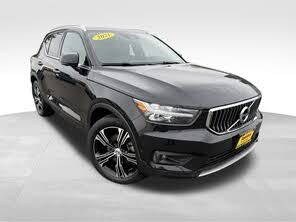
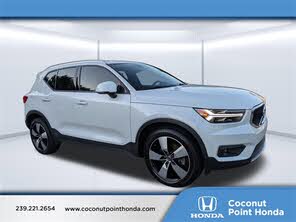
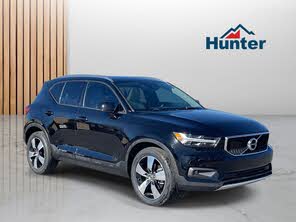
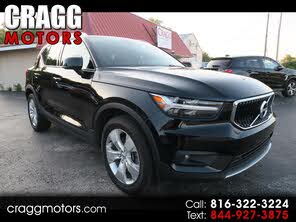
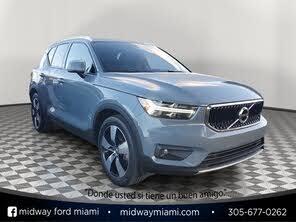
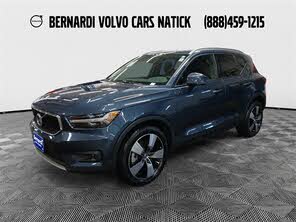
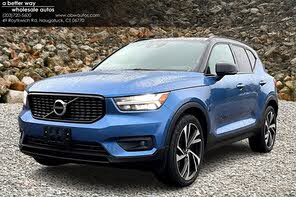
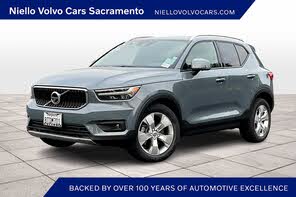
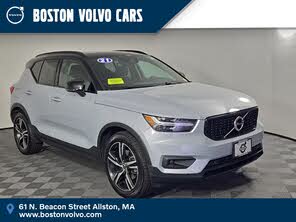
The 2021 Volvo XC40 boasted a more traditional SUV aesthetic compared to other small luxury crossovers, featuring a tall, flat roof and a distinct upright rear hatch. This vehicle seamlessly aligned with the rest of Volvo’s lineup, showcasing familial design cues such as the “Thor’s Hammer” LED headlights and an understated oval grille. For those opting for gasoline XC40 models, a white contrasting roof was available, offering a retro flair.
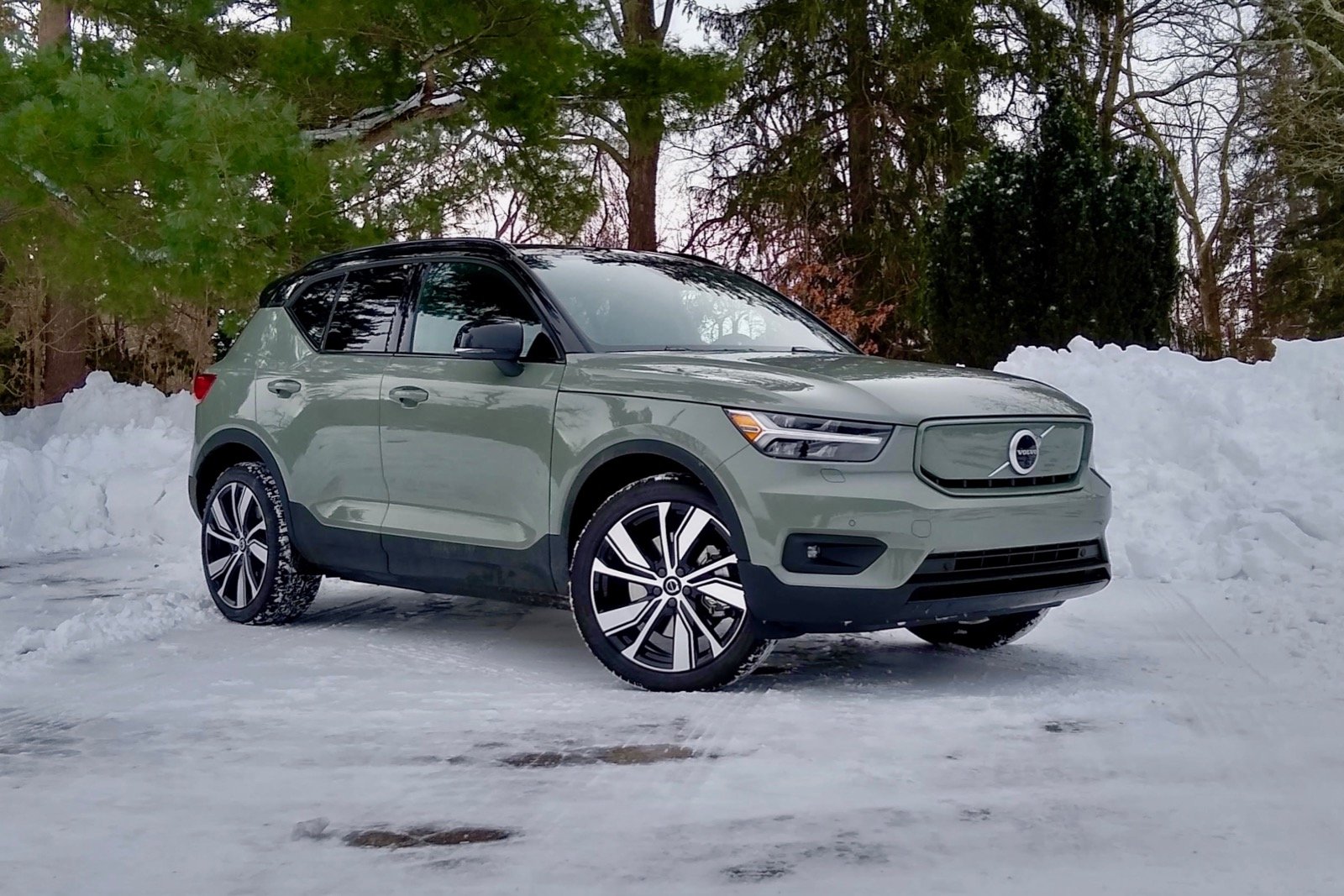
The electric XC40 Recharge set itself apart with minor yet noticeable differences, including a blanked-off grille, subtle “Recharge” badging, and unique alloy wheels (standard at 19 inches, with an optional 20-inch upgrade). This variant also sported a gloss black roof and mirror caps, a tweaked rear bumper devoid of exhaust tips, and an exclusive Sage Green Metallic color. Its charging port was positioned where the fuel filler typically resided, making the Recharge an appealing choice for drivers seeking a less ostentatious electric vehicle.
Underlying the XC40 was Volvo’s Compact Modular Architecture (CMA) platform, which also supported the Polestar 2 electric car. Designed to accommodate both gasoline and electric powertrains from the get-go, this wasn’t a case of retrofitting an electric system into a gasoline-engineered chassis.
The XC40’s interior embraced a minimalist approach, enriched with high-quality materials that imparted a premium feel. Real metal trim adorned the dashboard, and the upholstery combined Nappa leather with Nubuck textile, further enhancing its luxurious ambiance. The cabin design was coherent, with elements like the portrait-oriented touchscreen and air vents blending seamlessly into a pleasant, unified aesthetic. Unlike many competitors, Volvo did not compromise on interior complexity to meet specific price points.
Meanwhile, the 2022 Volkswagen Taos, according to Volkswagen, aimed to complement the compact SUV segment, positioned at the lower end compared to its sibling, the Tiguan. VW’s goal was to compete with models like the Kia Seltos, Jeep Compass, and Subaru Crosstrek—vehicles straddling the subcompact or compact crossover SUV categories.
On the surface, the Taos maintained a straightforward design ethos, but the nuances were in the details. Offered in S, SE, and SEL trims, with a starting price from $22,995 to $33,045, the Taos catered to various preferences. The inclusion of 4Motion AWD in the Taos came with additional enhancements such as a dual-clutch automated manual transmission, an independent multilink rear suspension, and new driving modes. The SEL 4Motion variant also featured 19-inch wheels and ventilated front seats.
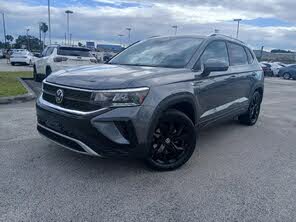
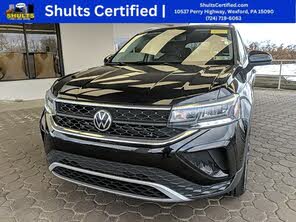
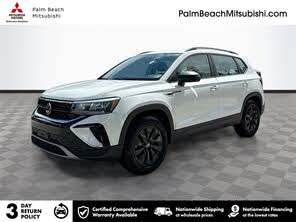
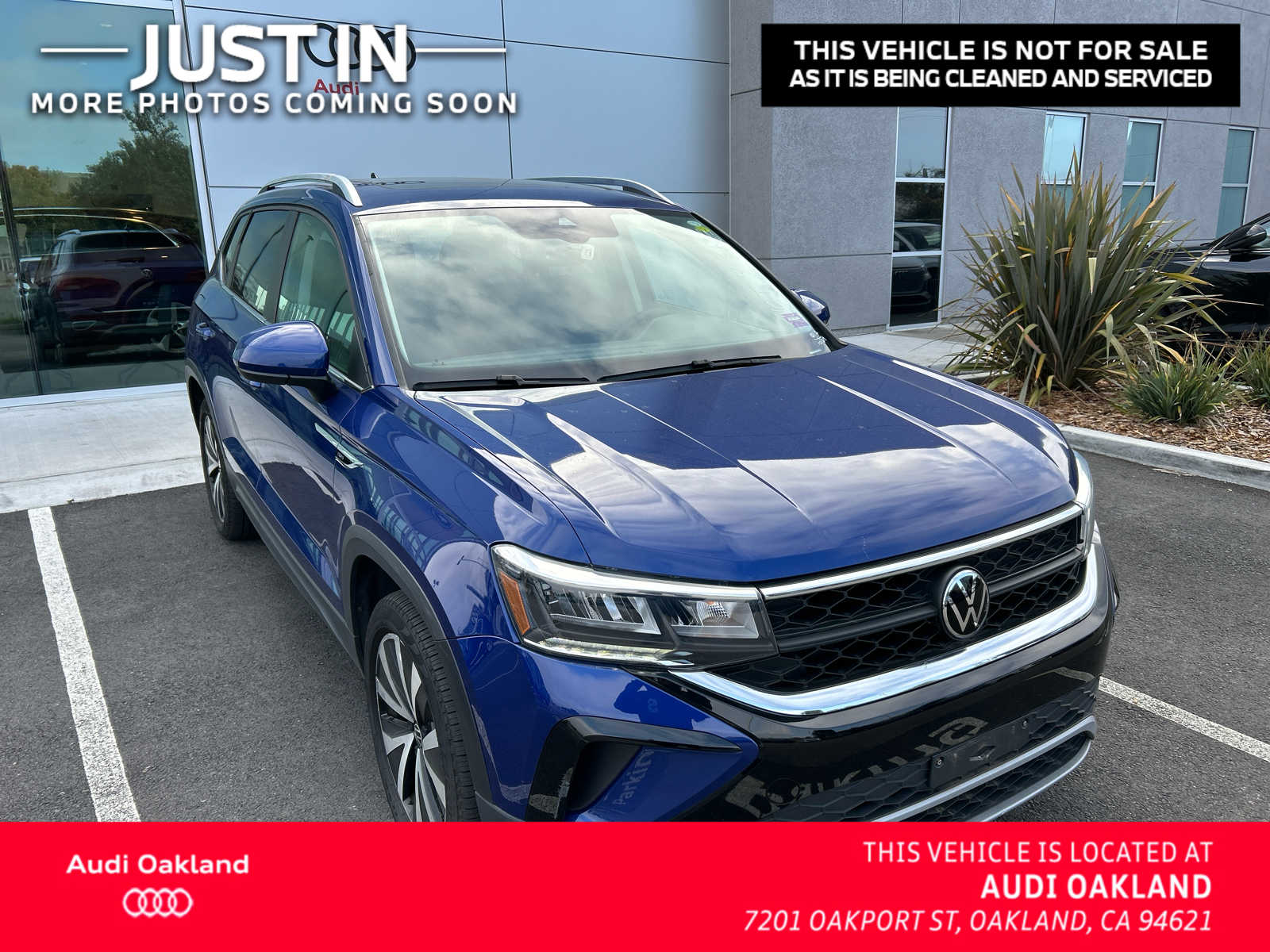
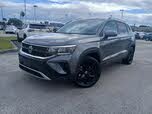
In terms of exterior styling, the Taos seamlessly fit into Volkswagen’s lineup. Notably, the SEL 4Motion test vehicle’s 19-inch machined-finish aluminum wheels and Cornflower Blue paint accentuated its presence and personality. Standard SUV elements such as roof rails, grey plastic cladding, and skid plates were present. The only questionable styling element was the blacked-out front bumper.
Internally, the Taos employed a mix of hard and sometimes hollow-sounding plastic materials. However, VW ensured that essential areas had soft surfaces, creating a pleasing tonal and textural balance across the cabin. The higher-end SEL trim offered two-tone perforated leather with contrast stitching, enhancing its upscale feel with stitched dashboard material and matching door panel inserts.


The 2021 Volvo XC40 provided three powertrain options. Gasoline models were equipped with a 2.0-liter turbocharged four-cylinder engine paired with an eight-speed automatic transmission. The front-wheel-drive T4 model generated 187 horsepower and 221 pound-feet of torque, while the all-wheel-drive T5 produced a stronger 248 hp and 258 lb-ft of torque.
The electric Recharge model stood out, sharing its powertrain with the Polestar 2. It featured dual electric motors, producing a combined 402 hp and 486 lb-ft of torque, powered by a 78-kilowatt-hour battery pack (with 75 kWh usable capacity). This setup enabled a swift 0-60 mph time of 4.7 seconds, out-performing many rivals, though it wasn’t engineered to compete with performance-centric models like the Tesla Model Y Performance. The gasoline T5 and T4 achieved 0-60 mph times of 6.1 seconds and 8.1 seconds, respectively. All versions were capped at a top speed of 112 mph, a Volvo safety initiative.
The Recharge model excelled with a tranquil and comfortable driving experience, capable of one-pedal driving through regenerative braking. It also offered a more traditional braking mode and could tow up to 2,000 pounds when properly equipped. The ride quality, even on challenging New Jersey roads and with 20-inch wheels, remained excellent.
The 2022 Volkswagen Taos, on the other hand, featured a turbocharged 1.5-liter four-cylinder engine delivering 158 horsepower at 5,500 rpm and 184 pound-feet of torque starting at 1,750 rpm. Despite the robust torque, the Taos experienced delayed throttle response due to turbo lag, with sudden bursts of power once the torque kicked in.
The seven-speed dual-clutch transmission (DCT) paired with the 4Motion AWD system provided energetic performance but often resulted in erratic and harsh shifts, frustrating drivers unfamiliar with DCT mechanics. In contrast, the standard eight-speed automatic transmission offered smoother, consistent behavior but only came with front-wheel drive and a less sophisticated rear suspension.
The SEL 4Motion's Sport mode improved drivability by maintaining higher engine revs, though some powertrain issues remained. Drivers often encountered turbo lag and abrupt acceleration when navigating corners or low-speed situations.
Despite these quirks, the Taos delivered an enjoyable driving experience, characterized by light, compliant handling, responsive steering, effective braking, and solid road grip on its Pirelli Scorpion all-season tires. However, its maximum ground clearance of 6.6 inches fell short compared to off-road-oriented competitors like the Jeep Compass Trailhawk and Subaru Crosstrek.
Fuel economy for the Taos SEL 4Motion was estimated at 28 mpg combined by the EPA, with real-world testing averaging slightly lower at 27.1 mpg.
Both the gasoline and electric versions of the 2021 Volvo XC40 reportedly offered the same passenger and cargo space, though overall spaciousness was lacking compared to competitors like the Tesla Model Y and Ford Mustang Mach-E. The XC40 fell short in front and rear legroom, headroom, and cargo capacity, with a notably small frunk due to powertrain hardware occupying significant under-hood space.
Nevertheless, Volvo mitigated the space limitations with clever storage solutions. The center console housed a removable trash bin, and the glovebox door featured a built-in bag hook. The Harman Kardon system’s speakers were mounted on the dashboard, freeing up room for large door bins. A well-designed cubby ahead of the shifter accommodated phones securely, with an optional wireless charging pad, though second-row occupants lacked phone-charging options.
In contrast, the 2022 Volkswagen Taos aimed to impress with its roomy interior. Both front and rear seating areas offered ample space, catering to taller individuals with adjustable seating positions and generous leg and foot room. The Taos SEL 4Motion added features like heated and ventilated front seats and a heated steering wheel, enhancing comfort during colder seasons.
The Taos fell short in cargo space, especially in the 4Motion version due to the independent rear suspension. Front-wheel-drive models offered more storage, with 27.9 cubic feet behind the rear seats and 65.9 cubic feet with seats folded. The 4Motion variant’s cargo capacity was slightly reduced to 24.9 and 60.2 cubic feet, respectively, but still provided a ski-friendly center pass-through.
The 2021 Volvo XC40 Recharge featured the Android Automotive OS infotainment system, using built-in Google apps like Google Assistant and Google Maps for navigation and control, providing a seamless experience for Android phone users. Standard Apple CarPlay, Android Auto, and Bluetooth connectivity were still available. The system included a 9-inch touchscreen and a 12.3-inch digital instrument cluster, with OTA updates enabling software enhancements without dealer visits. A unique feature was the absence of a start button, relying instead on the presence of the key fob for activation.
Volkswagen equipped every 2022 Taos with its Digital Cockpit instrumentation paired with a touchscreen infotainment system. The S trim came with a 6.5-inch display, while SE and SEL trims featured an 8-inch touchscreen running the MIB3 software, though user experiences varied.
Standard connectivity included Apple CarPlay, Android Auto, and Car-Net services with an available Wi-Fi hotspot. Higher trims added wireless charging, SiriusXM satellite radio, and a BeatsAudio premium sound system. However, issues with voice recognition and usability of the system’s features were noted, highlighting some drawbacks in the user interface and advanced controls.
The gasoline-powered 2021 Volvo XC40 garnered top safety ratings, earning the IIHS “Top Safety Pick+” and a five-star overall rating from the NHTSA. Standard safety features included lane-keep assist, blind-spot monitoring, automatic emergency braking, and more, with optional features enhancing driver support. While the electric XC40 Recharge had not been rated at the time, Volvo’s safety measures suggested optimism for robust crash test performance.
Volkswagen’s 2022 Taos democratized IQ Drive safety technologies across its trims. The standard IQ Drive package on the S trim ($995) included forward-collision warning, automatic emergency braking, blind-spot warning, and more. The Taos SEL had these features standard along with rain-sensing wipers and road sign recognition. Emergency Assist, a standout feature, could safely stop the vehicle if the driver became incapacitated. Notably, the Taos had not been crash-tested by the NHTSA or IIHS at the time of review.
CarGurus highlights
According to CarGurus experts, the overall rating for the 2021 Volvo XC40 is 8.0 out of 10, while the 2022 Volkswagen Taos scores 7.0 out of 10. Given these evaluations, the 2021 Volvo XC40 emerges as the better vehicle. Its luxurious interior, advanced safety features, and multiple powertrains offer a more refined and versatile driving experience, making it the recommended choice.
Choose the 2022 Volkswagen Taos if:
- You seek a spacious, accommodating cabin for both front and rear passengers.
- You value comprehensive digital instrumentation and standard advanced connectivity features.
- Budget-friendly options with available AWD and dynamic driving modes are a must for you.




Choose the 2021 Volvo XC40 if:
- You prioritize a luxurious and minimalist interior design with high-quality materials.
- You need advanced safety features and top-tier crash-test ratings.
- You prefer multiple powertrain options, including a high-performing electric model.

CarGurus highlights
According to CarGurus experts, the overall rating for the 2021 Volvo XC40 is 8.0 out of 10, while the 2022 Volkswagen Taos scores 7.0 out of 10. Given these evaluations, the 2021 Volvo XC40 emerges as the better vehicle. Its luxurious interior, advanced safety features, and multiple powertrains offer a more refined and versatile driving experience, making it the recommended choice.
Choose the 2022 Volkswagen Taos if:
Shop Now- You seek a spacious, accommodating cabin for both front and rear passengers.
- You value comprehensive digital instrumentation and standard advanced connectivity features.
- Budget-friendly options with available AWD and dynamic driving modes are a must for you.







Choose the 2021 Volvo XC40 if:
Shop Now- You prioritize a luxurious and minimalist interior design with high-quality materials.
- You need advanced safety features and top-tier crash-test ratings.
- You prefer multiple powertrain options, including a high-performing electric model.











By: CarGurus + AI
At CarGurus, our team of experienced automotive writers remain at the heart of our content operation, conducting hands-on car tests and writing insightful guides that are backed by years of industry experience. To complement this, we are harnessing AI to make our content offering more diverse and more helpful to shoppers than ever. To achieve this, our AI systems are based exclusively on CarGurus content, ratings and data, so that what we produce is both unique to CarGurus, and uniquely helpful to car shoppers.