2022 BMW X3 vs 2021 Volkswagen ID.4

Overview | |
MSRP$39,995 | MSRP$43,700 |
Listings337 | Listings1217 |
Ratings & Reviews | |
User Reviews | User Reviews |
Expert reviews7.3 out of 10 | Expert reviews7.8 out of 10 |
Pros
Cons
| Pros
Cons
|
2021 Volkswagen ID.4 Reviews SummaryThe “Dieselgate” emissions scandal forced Volkswagen to double down on electric cars, and now we’re finally seeing the first result of that: the 2021 Volkswagen ID.4 electric crossover. VW has made an electric car before, but its last attempt, the e-Golf, was built to satisfy emissions standards, not rack up sales. It was barely advertised, and it was sold only in certain states. That’s not the case with the ID.4, which will be available nationwide and will even be built in Tennessee starting in 2022. Volkswagen views the ID.4 as a rival not to other EVs, but to mainstream gasoline vehicles like the Honda CR-V and Toyota RAV4. Being late to the party means there are already several other EVs trying to coax new-car buyers away from internal combustion, however. If you want a reasonably-priced EV, the Nissan Leaf, Hyundai Kona Electric, and Kia Niro EV already exist, and General Motors just announced the 2022 Chevrolet Bolt EUV—a new variant of the Chevy Bolt EV with a crossover body style similar to the Volkswagen. We tested an ID.4 1st Edition, which commemorates the car’s launch, and an ID.4 PRO S with all-wheel drive (AWD). The 1st Edition is a limited-edition model that has already sold out, but it’s mechanically identical to the ID.4 Pro S AWD, albeit with power sent only to the rear wheels. | |
2022 BMW X3 Reviews SummarySince its inception in 2003, the BMW X3 has grown to become one of the brand’s top sellers. And starting with its second generation (circa 2010), the luxury compact crossover has been built at BMW Spartanburg—the automaker’s only United States manufacturing facility. Incidentally, because Spartanburg is the global producer of every gas-powered BMW crossover besides the X1 and X2, the plant also boasts the highest production numbers of any BMW plant worldwide. One can speculate that the popular X3 has a lot to do with that. Last redesigned for 2018, the X3 receives a rather hefty mid-cycle refresh for 2022. Although the xDrive30e plug-in hybrid has been dropped from the lineup, updates to the remaining models include design tweaks, new engines, more technology, and an expanded suite of safety features. | |
No video found | |
Popular Features & Specs | |
Engine201 hp Electric | Engine2.0L 248 hp I4 |
Drive TrainRWD | Drive TrainRWD |
Seating Capacity5 | Seating Capacity5 |
Horsepower | Horsepower248 hp @ 5200 rpm |
EV Battery Capacity82 kWh | EV Battery Capacity |
MPG City104 | MPG City23 |
MPG Highway89 | MPG Highway29 |
Battery Charge Time (240V)8 hours | Battery Charge Time (240V) |
Engine | |
Engine Name201 hp Electric | Engine Name2.0L 248 hp I4 |
Torque | Torque258 lb-ft @ 1450 rpm |
Horsepower | Horsepower248 hp @ 5200 rpm |
Battery Charge Time (240V)8 hours | Battery Charge Time (240V) |
DrivetrainRWD | DrivetrainRWD |
Fuel Economy | |
EV Battery Capacity82 kWh | EV Battery Capacity |
MPG City104 | MPG City23 |
MPG Highway89 | MPG Highway29 |
Interior | |
Seating Capacity5 | Seating Capacity5 |
Key Features | |
Navigation System | Navigation SystemStandard |
Safety | |
Front Crash Overall5 | Front Crash Overall5 |
Side Crash Overall5 | Side Crash Overall5 |
Dimensions & Capacity | |
Cargo Space30.3 cu ft | Cargo Space28.7 cu ft |
Curb Weight4517 lbs | Curb Weight4079 lbs |
Height64.4 in | Height66.0 in |
Length180.5 in | Length185.9 in |
Width72.9 in | Width84.2 in |
Wheelbase108.9 in | Wheelbase112.8 in |
Maximum Payload1347 lbs | Maximum Payload904 lbs |
Number of doors4 | Number of doors4 |
Maximum Towing Capacity | Maximum Towing Capacity4400 lbs |
Overview | ||
MSRP | $39,995 | $43,700 |
Listings | ||
Ratings & Reviews | ||
User reviews | ||
Expert reviews | 7.3 out of 10Read full review | 7.8 out of 10Read full review |
Pros & cons | Pros
Cons
| Pros
Cons
|
Summary | The “Dieselgate” emissions scandal forced Volkswagen to double down on electric cars, and now we’re finally seeing the first result of that: the 2021 Volkswagen ID.4 electric crossover. VW has made an electric car before, but its last attempt, the e-Golf, was built to satisfy emissions standards, not rack up sales. It was barely advertised, and it was sold only in certain states. That’s not the case with the ID.4, which will be available nationwide and will even be built in Tennessee starting in 2022. Volkswagen views the ID.4 as a rival not to other EVs, but to mainstream gasoline vehicles like the Honda CR-V and Toyota RAV4. Being late to the party means there are already several other EVs trying to coax new-car buyers away from internal combustion, however. If you want a reasonably-priced EV, the Nissan Leaf, Hyundai Kona Electric, and Kia Niro EV already exist, and General Motors just announced the 2022 Chevrolet Bolt EUV—a new variant of the Chevy Bolt EV with a crossover body style similar to the Volkswagen. We tested an ID.4 1st Edition, which commemorates the car’s launch, and an ID.4 PRO S with all-wheel drive (AWD). The 1st Edition is a limited-edition model that has already sold out, but it’s mechanically identical to the ID.4 Pro S AWD, albeit with power sent only to the rear wheels. | Since its inception in 2003, the BMW X3 has grown to become one of the brand’s top sellers. And starting with its second generation (circa 2010), the luxury compact crossover has been built at BMW Spartanburg—the automaker’s only United States manufacturing facility. Incidentally, because Spartanburg is the global producer of every gas-powered BMW crossover besides the X1 and X2, the plant also boasts the highest production numbers of any BMW plant worldwide. One can speculate that the popular X3 has a lot to do with that. Last redesigned for 2018, the X3 receives a rather hefty mid-cycle refresh for 2022. Although the xDrive30e plug-in hybrid has been dropped from the lineup, updates to the remaining models include design tweaks, new engines, more technology, and an expanded suite of safety features. |
Video | No video found | |
Popular Features & Specs | ||
Engine | 201 hp Electric | 2.0L 248 hp I4 |
Drive Train | RWD | RWD |
Seating Capacity | 5 | 5 |
Horsepower | 248 hp @ 5200 rpm | |
EV Battery Capacity | 82 kWh | |
MPG City | 104 | 23 |
MPG Highway | 89 | 29 |
Battery Charge Time (240V) | 8 hours | |
Engine | ||
Engine Name | 201 hp Electric | 2.0L 248 hp I4 |
Torque | 258 lb-ft @ 1450 rpm | |
Horsepower | 248 hp @ 5200 rpm | |
Battery Charge Time (240V) | 8 hours | |
Drivetrain | RWD | RWD |
Fuel Economy | ||
EV Battery Capacity | 82 kWh | |
MPG City | 104 | 23 |
MPG Highway | 89 | 29 |
Interior | ||
Seating Capacity | 5 | 5 |
Key Features | ||
Navigation System | Standard | |
Safety | ||
Front Crash Overall | 5 | 5 |
Side Crash Overall | 5 | 5 |
Dimensions & Capacity | ||
Cargo Space | 30.3 cu ft | 28.7 cu ft |
Curb Weight | 4517 lbs | 4079 lbs |
Height | 64.4 in | 66.0 in |
Length | 180.5 in | 185.9 in |
Width | 72.9 in | 84.2 in |
Wheelbase | 108.9 in | 112.8 in |
Maximum Payload | 1347 lbs | 904 lbs |
Number of doors | 4 | 4 |
Maximum Towing Capacity | 4400 lbs | |
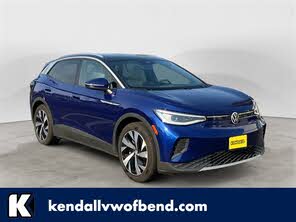
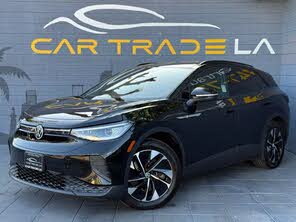
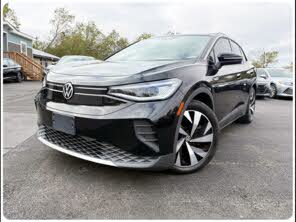
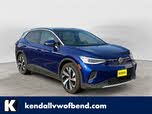
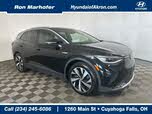
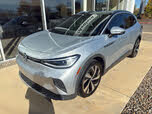
The 2021 Volkswagen ID.4 was designed from the ground up as an electric vehicle (EV), showcasing a distinctive look that set it apart from Volkswagen’s gasoline models. It replaced the straight lines and sharp angles of the Tiguan and Atlas crossovers with a streamlined profile and wheels pushed out to the corners of the body. The ID.4 was part of VW’s EV-specific MEB platform, following the European-market ID.3 hatchback. While it boasted a unique design, it didn’t quite look like an SUV, which could be a potential issue for buyers seeking traditional SUV aesthetics.
Inside, the ID.4 blended Volkswagen’s minimalism with a smartphone-inspired aesthetic. The base ID.4 Pro featured a leather-wrapped steering wheel and cloth seats, while the Pro S and 1st Edition models offered leatherette upholstery. The interior was characterized by piano black and matte plastic finishes, evoking a tech-centric theme. Despite its modern design, the ID.4’s interior had some practical shortcomings, such as limited storage space in the center console and subpar rearward visibility due to thick rear pillars and a small back window.
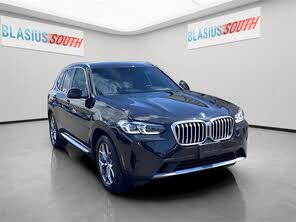
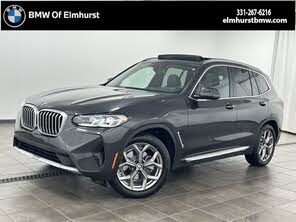
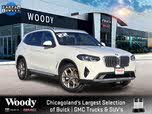
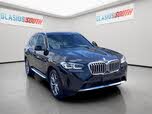
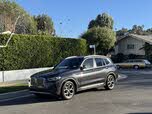
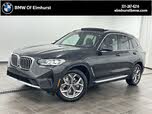
The 2022 BMW X3, available in four variants, featured a revised exterior design with a more aggressive stance. The kidney grille was larger, and the headlights were slimmer, accommodating new vertical air intakes and a redesigned front bumper. The rear taillights were all new, featuring a black surround and pincer claw-shaped brake light LEDs. The updated rear included larger redesigned exhaust tips and a new bumper, complemented by an M Sport Package for sDrive30i and xDrive30i models, offering specialized aero wheels and new paint options.
Inside, the X3 presented a clean and efficient design, with dark oak wood trim, an anthracite headliner, and eight-way power-adjustable front sport seats. The well-appointed interior featured adjustable side bolsters, reclinable rear seatbacks, tri-zone automatic climate control, and new perforated SensaTec synthetic leather upholstery. The X3 offered a range of interior color choices and ambient lighting with 11 color combinations, providing a comfortable and customizable environment for occupants.


The 2021 Volkswagen ID.4 launched with a single rear-mounted electric motor producing 201 horsepower and 229 pound-feet of torque, powered by an 82-kilowatt-hour battery pack. It was the first rear-wheel-drive (RWD) Volkswagen passenger car sold in the United States since the Beetle. An all-wheel-drive (AWD) version, with a second electric motor powering the front wheels, arrived later in 2021, boosting power output to 295 horsepower and 339 pound-feet of torque. While the ID.4 wasn’t sporty, it offered a smooth ride and balanced handling, with RWD providing a more engaging driving experience compared to its front-wheel-drive (FWD) rivals.
The ID.4’s electric motor provided ample grunt, and instantaneous torque made it fun to drive in city traffic. However, it was tuned for comfort rather than handling, with noticeable body roll in corners. Volkswagen chose not to implement aggressive regenerative braking, opting for a more familiar driving experience for those transitioning from gasoline cars. The ID.4 relied on friction brakes in its default setting, with added regen in “B” mode, but it didn’t allow for one-pedal driving.
The 2022 BMW X3 featured an eight-speed automatic transmission with steering-wheel-mounted paddle shifters as standard. The X3 sDrive30i and xDrive30i were powered by a 2.0-liter turbocharged four-cylinder engine, producing 248 horsepower and 258 pound-feet of torque, with a 0-60 mph time of 6 seconds. Fuel economy for the sDrive30i was 23 mpg city, 29 mpg highway, and 25 mpg combined, while the xDrive30i offered 21 mpg city, 28 mpg highway, and 24 mpg combined.
The X3 M40i added a 3.0-liter turbocharged six-cylinder engine with a mild-hybrid system, producing 382 horsepower and 369 pound-feet of torque. It achieved a 0-60 mph time of 4.4 seconds. The M40i featured a flap-controlled sports exhaust system, sport brakes, an adaptive suspension, and an AWD system tuned for a rear-oriented torque split. The mild-hybrid system offered an additional 11 horsepower during acceleration but didn’t improve fuel economy, with the M40i rated at 21 mpg city, 26 mpg highway, and 23 mpg combined.
The 2021 Volkswagen ID.4 offered more front and rear headroom than competitor EVs, although legroom was average for the segment. It provided 30.3 cubic feet of cargo space with the rear seats in place and 64.2 cubic feet with the rear seats folded. While it lacked a “frunk” for extra cargo storage, the interior felt spacious from the driver’s seat, with good forward visibility. However, rearward visibility was substandard due to thick rear pillars and a small back window. The ID.4 featured a unique twist-grip gear selector on the dashboard, freeing up space on the center console, but the console itself was narrow and close to the floor, limiting storage for larger items.
The 2022 BMW X3 offered seating for five and ample storage space. The rear seats featured a standard 40/20/40-split, providing enough cargo room for backpacks and additional carry-on suitcases. A power tailgate was standard, with an optional hands-free opening available. The SensaTec faux-leather seats were comfortable, with the upgraded Vernasca leather adding more softness and pliability. The X3’s sport seats were supportive, but the thigh-support cushion control handle could be intrusive for some drivers. The redesigned center console featured a larger infotainment system, with push-button and rocker-style controls for climate and audio functions, and a matte finish for a smudge-free appearance.
The 2021 Volkswagen ID.4 came with a standard 10-inch touchscreen infotainment system (a 12-inch screen was optional) with wireless Apple CarPlay and Android Auto. A 5.3-inch display screen served as the instrument cluster, and haptic touchpads replaced nearly all switchgear. While the setup looked modern, it was difficult to use due to the lack of tactile feedback. The ID.4 also featured a natural-language voice-control system and ID.Light, a light strip at the base of the windshield that communicated information to the driver. Despite some gimmicky features, the touchscreen was well-positioned, with smart-looking graphics and easy-to-navigate menus.
The 2022 BMW X3 featured BMW Live Cockpit Plus with iDrive 7 telematics as standard, including a 5.1-inch color display instrument panel and a 10.25-inch infotainment screen. The system included navigation, Android Auto and Apple CarPlay compatibility, Amazon Alexa integration, two USB ports, a 4G LTE WiFi hotspot, and various connected digital features. An optional Live Cockpit Professional enlarged both screens to 12.3 inches, providing a fully-digital experience. The X3 also offered a 12-speaker 205-watt HiFi sound system, with an optional Harman Kardon surround sound system for M40i models. Additional tech options included a Convenience Package and a Premium Package, adding features like a panoramic sunroof, heated seats, and a head-up display.
The 2021 Volkswagen ID.4 received the highest-level Top Safety Pick+ designation from the Insurance Institute for Highway Safety (IIHS) and a five-star rating from the National Highway Traffic Safety Administration (NHTSA) for the RWD model. Standard safety features included forward-collision warning, automatic emergency braking, blind-spot monitoring, lane-keep assist, park distance control, automatic high beams, and adaptive cruise control. The ID.4 also introduced Travel Assist and Emergency Assist, enhancing highway driving and driver incapacitation detection.
The 2022 BMW X3 received a five-star crash safety rating from the NHTSA. While crash test results from the IIHS were not yet available, the 2018 X3 was named a Top Safety Pick+, and the 2022 model added more safety features. Standard features included adaptive LED headlights, a rearview camera, adaptive cruise control, lane departure warning, active blind-spot monitoring, rear cross-traffic alert, rear collision avoidance, park distance control, forward-collision warning, and active pre-collision protection systems. Optional packages added parking assistance, 360-degree surround camera view, traffic jam assistance, and active lane-keep assist with lane centering and side collision avoidance.
CarGurus highlights
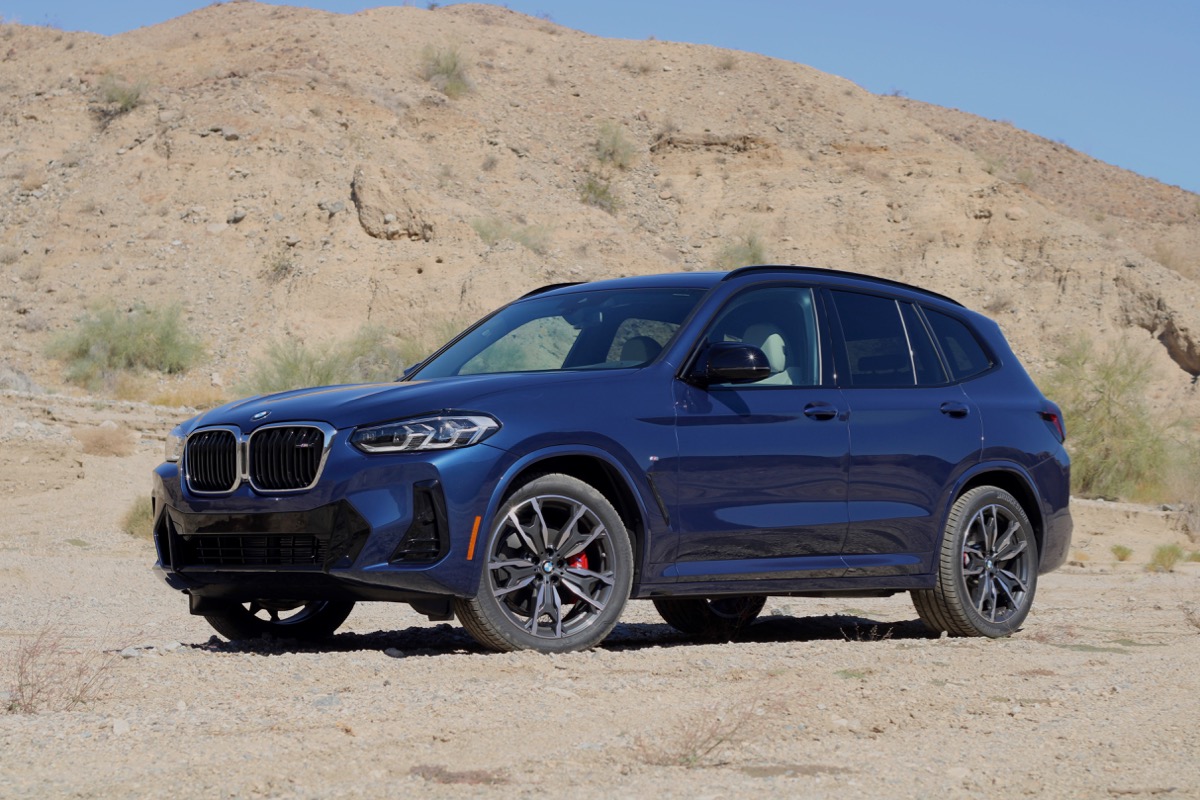
According to CarGurus experts, the overall rating for the 2021 Volkswagen ID.4 is 7.3 out of 10, while the 2022 BMW X3 scores 7.8 out of 10. Based on these ratings, the 2022 BMW X3 is the recommended choice, offering a more powerful engine, a sportier driving experience, and a well-appointed interior with advanced technology and safety features.
Choose the 2022 BMW X3 if:
- You seek a more powerful engine and a sportier driving experience.
- You need a spacious and well-appointed interior with customizable tech features.
- You prioritize a comprehensive suite of safety and driver-assistance systems.






Choose the 2021 Volkswagen ID.4 if:
- You prefer a distinctive, modern design with a tech-centric interior.
- You want a smooth and comfortable ride with balanced handling.
- You value advanced safety features and top safety ratings.





CarGurus highlights
According to CarGurus experts, the overall rating for the 2021 Volkswagen ID.4 is 7.3 out of 10, while the 2022 BMW X3 scores 7.8 out of 10. Based on these ratings, the 2022 BMW X3 is the recommended choice, offering a more powerful engine, a sportier driving experience, and a well-appointed interior with advanced technology and safety features.
Choose the 2022 BMW X3 if:
Shop Now- You seek a more powerful engine and a sportier driving experience.
- You need a spacious and well-appointed interior with customizable tech features.
- You prioritize a comprehensive suite of safety and driver-assistance systems.




Choose the 2021 Volkswagen ID.4 if:
Shop Now- You prefer a distinctive, modern design with a tech-centric interior.
- You want a smooth and comfortable ride with balanced handling.
- You value advanced safety features and top safety ratings.




By: CarGurus + AI
At CarGurus, our team of experienced automotive writers remain at the heart of our content operation, conducting hands-on car tests and writing insightful guides that are backed by years of industry experience. To complement this, we are harnessing AI to make our content offering more diverse and more helpful to shoppers than ever. To achieve this, our AI systems are based exclusively on CarGurus content, ratings and data, so that what we produce is both unique to CarGurus, and uniquely helpful to car shoppers.