2021 Volkswagen Atlas Cross Sport vs 2021 Volkswagen ID.4

Overview | |
MSRP$30,855 | MSRP$39,995 |
Listings490 | Listings396 |
Ratings & Reviews | |
User Reviews | User Reviews |
Expert reviews5.8 out of 10 | Expert reviews7.3 out of 10 |
Pros
Cons
| Pros
Cons
|
2021 Volkswagen Atlas Cross Sport Reviews SummaryLaunched for the 2020 model year, the Volkswagen Atlas Cross Sport is a two-row, five-seat version of the Volkswagen Atlas family crossover, itself a fairly new model, having launched for the 2018 model year. The two-row midsize crossover segment is experiencing a resurgence, with newer models like the Cross Sport, Toyota Venza, Honda Passport, and Chevrolet Blazer joining the aging Ford Edge and Nissan Murano. VW also named the Jeep Grand Cherokee as a competitor to the Cross Sport, but the Jeep is a more traditional SUV. Typically for a model entering its sophomore year, the Cross Sport doesn’t get many updates for 2021. The only changes are VW’s new MIB3 infotainment system for most trim levels, and two new driver-assist features: Travel Assist and Emergency Assist. The 2021 Volkswagen Atlas Cross Sport is available in eight trim levels: S, SE, SE with Technology, SE with Technology R-Line, SEL, SEL R-Line, SEL Premium, and SEL Premium R-Line. Buyers must also choose between front-wheel drive (FWD) and 4Motion all-wheel drive (AWD), and four-cylinder or six-cylinder engines. Our test car was a six-cylinder SEL Premium model with 4Motion. | |
2021 Volkswagen ID.4 Reviews SummaryThe “Dieselgate” emissions scandal forced Volkswagen to double down on electric cars, and now we’re finally seeing the first result of that: the 2021 Volkswagen ID.4 electric crossover. VW has made an electric car before, but its last attempt, the e-Golf, was built to satisfy emissions standards, not rack up sales. It was barely advertised, and it was sold only in certain states. That’s not the case with the ID.4, which will be available nationwide and will even be built in Tennessee starting in 2022. Volkswagen views the ID.4 as a rival not to other EVs, but to mainstream gasoline vehicles like the Honda CR-V and Toyota RAV4. Being late to the party means there are already several other EVs trying to coax new-car buyers away from internal combustion, however. If you want a reasonably-priced EV, the Nissan Leaf, Hyundai Kona Electric, and Kia Niro EV already exist, and General Motors just announced the 2022 Chevrolet Bolt EUV—a new variant of the Chevy Bolt EV with a crossover body style similar to the Volkswagen. We tested an ID.4 1st Edition, which commemorates the car’s launch, and an ID.4 PRO S with all-wheel drive (AWD). The 1st Edition is a limited-edition model that has already sold out, but it’s mechanically identical to the ID.4 Pro S AWD, albeit with power sent only to the rear wheels. | |
No video found | |
Popular Features & Specs | |
Engine2.0L 235 hp I4 | Engine201 hp Electric |
Drive TrainFWD | Drive TrainRWD |
Seating Capacity5 | Seating Capacity5 |
Horsepower235 hp @ 5000 rpm | Horsepower |
EV Battery Capacity | EV Battery Capacity82 kWh |
MPG City21 | MPG City104 |
MPG Highway24 | MPG Highway89 |
Battery Charge Time (240V) | Battery Charge Time (240V)8 hours |
Engine | |
Engine Name2.0L 235 hp I4 | Engine Name201 hp Electric |
Torque258 lb-ft @ 1600 rpm | Torque |
Horsepower235 hp @ 5000 rpm | Horsepower |
Battery Charge Time (240V) | Battery Charge Time (240V)8 hours |
DrivetrainFWD | DrivetrainRWD |
Fuel Economy | |
EV Battery Capacity | EV Battery Capacity82 kWh |
MPG City21 | MPG City104 |
MPG Highway24 | MPG Highway89 |
Interior | |
Seating Capacity5 | Seating Capacity5 |
Safety | |
Front Crash Overall4 | Front Crash Overall5 |
Side Crash Overall5 | Side Crash Overall5 |
Dimensions & Capacity | |
Cargo Space40.3 cu ft | Cargo Space30.3 cu ft |
Curb Weight4098 lbs | Curb Weight4517 lbs |
Height68.3 in | Height64.4 in |
Length195.5 in | Length180.5 in |
Width78.4 in | Width72.9 in |
Wheelbase117.3 in | Wheelbase108.9 in |
Maximum Payload1080 lbs | Maximum Payload1347 lbs |
Number of doors4 | Number of doors4 |
Overview | ||
MSRP | $30,855 | $39,995 |
Listings | ||
Ratings & Reviews | ||
User reviews | ||
Expert reviews | 5.8 out of 10Read full review | 7.3 out of 10Read full review |
Pros & cons | Pros
Cons
| Pros
Cons
|
Summary | Launched for the 2020 model year, the Volkswagen Atlas Cross Sport is a two-row, five-seat version of the Volkswagen Atlas family crossover, itself a fairly new model, having launched for the 2018 model year. The two-row midsize crossover segment is experiencing a resurgence, with newer models like the Cross Sport, Toyota Venza, Honda Passport, and Chevrolet Blazer joining the aging Ford Edge and Nissan Murano. VW also named the Jeep Grand Cherokee as a competitor to the Cross Sport, but the Jeep is a more traditional SUV. Typically for a model entering its sophomore year, the Cross Sport doesn’t get many updates for 2021. The only changes are VW’s new MIB3 infotainment system for most trim levels, and two new driver-assist features: Travel Assist and Emergency Assist. The 2021 Volkswagen Atlas Cross Sport is available in eight trim levels: S, SE, SE with Technology, SE with Technology R-Line, SEL, SEL R-Line, SEL Premium, and SEL Premium R-Line. Buyers must also choose between front-wheel drive (FWD) and 4Motion all-wheel drive (AWD), and four-cylinder or six-cylinder engines. Our test car was a six-cylinder SEL Premium model with 4Motion. | The “Dieselgate” emissions scandal forced Volkswagen to double down on electric cars, and now we’re finally seeing the first result of that: the 2021 Volkswagen ID.4 electric crossover. VW has made an electric car before, but its last attempt, the e-Golf, was built to satisfy emissions standards, not rack up sales. It was barely advertised, and it was sold only in certain states. That’s not the case with the ID.4, which will be available nationwide and will even be built in Tennessee starting in 2022. Volkswagen views the ID.4 as a rival not to other EVs, but to mainstream gasoline vehicles like the Honda CR-V and Toyota RAV4. Being late to the party means there are already several other EVs trying to coax new-car buyers away from internal combustion, however. If you want a reasonably-priced EV, the Nissan Leaf, Hyundai Kona Electric, and Kia Niro EV already exist, and General Motors just announced the 2022 Chevrolet Bolt EUV—a new variant of the Chevy Bolt EV with a crossover body style similar to the Volkswagen. We tested an ID.4 1st Edition, which commemorates the car’s launch, and an ID.4 PRO S with all-wheel drive (AWD). The 1st Edition is a limited-edition model that has already sold out, but it’s mechanically identical to the ID.4 Pro S AWD, albeit with power sent only to the rear wheels. |
Video | No video found | |
Popular Features & Specs | ||
Engine | 2.0L 235 hp I4 | 201 hp Electric |
Drive Train | FWD | RWD |
Seating Capacity | 5 | 5 |
Horsepower | 235 hp @ 5000 rpm | |
EV Battery Capacity | 82 kWh | |
MPG City | 21 | 104 |
MPG Highway | 24 | 89 |
Battery Charge Time (240V) | 8 hours | |
Engine | ||
Engine Name | 2.0L 235 hp I4 | 201 hp Electric |
Torque | 258 lb-ft @ 1600 rpm | |
Horsepower | 235 hp @ 5000 rpm | |
Battery Charge Time (240V) | 8 hours | |
Drivetrain | FWD | RWD |
Fuel Economy | ||
EV Battery Capacity | 82 kWh | |
MPG City | 21 | 104 |
MPG Highway | 24 | 89 |
Interior | ||
Seating Capacity | 5 | 5 |
Safety | ||
Front Crash Overall | 4 | 5 |
Side Crash Overall | 5 | 5 |
Dimensions & Capacity | ||
Cargo Space | 40.3 cu ft | 30.3 cu ft |
Curb Weight | 4098 lbs | 4517 lbs |
Height | 68.3 in | 64.4 in |
Length | 195.5 in | 180.5 in |
Width | 78.4 in | 72.9 in |
Wheelbase | 117.3 in | 108.9 in |
Maximum Payload | 1080 lbs | 1347 lbs |
Number of doors | 4 | 4 |
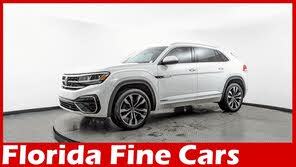
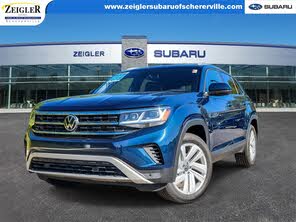
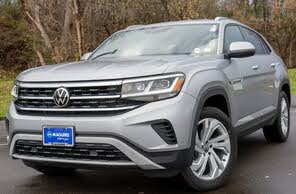
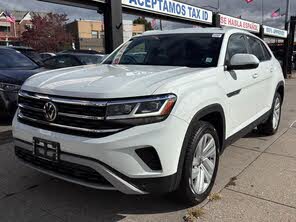
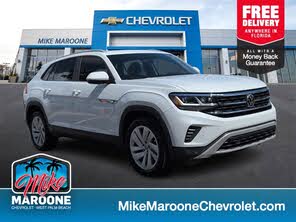
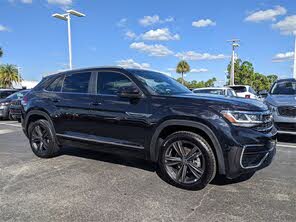
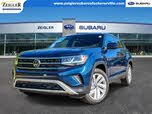
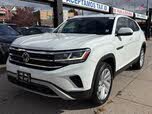
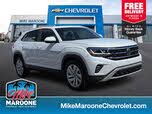
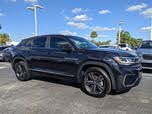
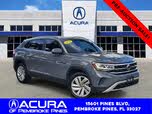
The 2021 Volkswagen Atlas Cross Sport carried over most of the same sheet metal from the regular Atlas. However, it featured a lower roofline and an aggressively-raked rear hatch, akin to the "crossover coupes" offered by luxury brands. This design blend resulted in an odd mix of SUV ruggedness and car-like features. Notably, the fake exhaust tips carved into the rear bumper of the SEL Premium test vehicle appeared tacky.
The Cross Sport was 5.2 inches shorter and 2.2 inches lower than its three-row sibling, yet maintained the same 117.3-inch wheelbase. Both models rode on VW's MQB platform, shared with other vehicles in the lineup like the Jetta and Golf.
Every Cross Sport model included standard LED exterior lighting comprising headlights, taillights, and daytime running lights. Wheel sizes varied by trim: 18 inches for the S and SE, 20 inches for the SE with Technology, and 21 inches for the SEL R-Line and SEL Premium R-Line. The R-Line added sportier exterior elements such as unique front and rear bumpers, a fake rear diffuser, and side skirts.
Inside, the Cross Sport's minimalist design was visually pleasing and functional but marred by subpar materials. The SEL Premium's leather upholstery and contrast stitching couldn't disguise the abundance of hard and shiny plastics prone to fingerprint smudges. The multi-color interior scheme was subtle, leading to some elements blending together indistinguishably. Dark colors dominated the interior, detracting from a welcoming ambiance. The flat-bottom steering wheel seemed out of place in a non-performance vehicle.
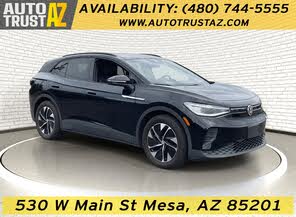
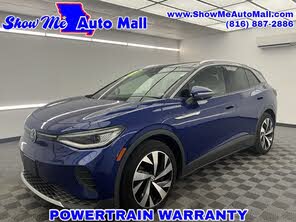
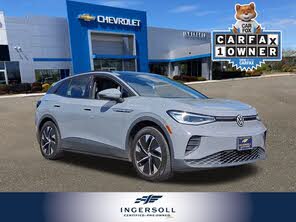
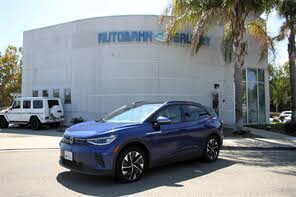
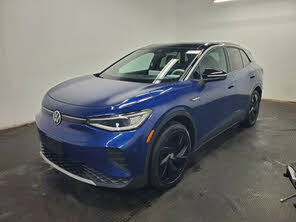
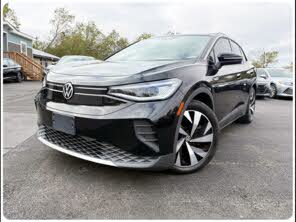
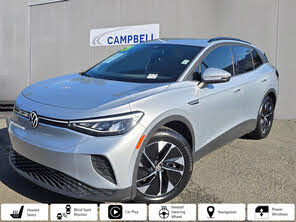
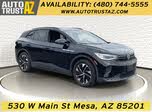
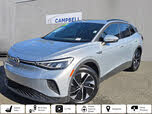
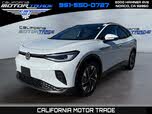
Conversely, the 2021 Volkswagen ID.4, designed from the ground up as an EV, showcased a more distinctive look. Ditching the fake toughness of the gasoline Tiguan and Atlas, the ID.4 sported a streamlined profile with wheels pushed to the corners. It sat on VW's EV-specific MEB platform, following the ID.3 hatchback sold in Europe.
The ID.4, with its slightly taller ride height and plastic body cladding, didn't embody traditional SUV styling, similar to other EV crossovers like the Chevy Bolt EUV and Hyundai Kona Electric. The interior combined VW's minimalism with a smartphone aesthetic, featuring piano black and matte plastic elements. A standard leather-wrapped steering wheel and cloth seats on the base Pro, with leatherette upholstery on the Pro S and 1st Edition models, aimed to blend tech-savviness with functionality.


The 2021 Volkswagen Atlas Cross Sport offered the same engine options as the seven-seat Atlas: a 2.0-liter turbocharged inline-four and an optional 3.6-liter V6. Both were paired with an eight-speed automatic transmission and start-stop systems for improved fuel economy.
The turbocharged inline-four belonged to the EA888 family and produced 235 horsepower and 258 pound-feet of torque on premium fuel. The V6, or VR6, delivered 276 horsepower and 266 pound-feet of torque. The VR6 enabled appreciable liveliness when accelerating from a stop, complemented by a pleasant engine sound. However, midrange acceleration felt lackluster, and the transmission was somewhat sluggish unless manually shifted.
The Cross Sport's ride quality left much to be desired, with noticeable bumps and potholes. The cabin allowed significant wind and tire noise. Despite its “Sport” moniker, the Atlas Cross Sport handled like a truck with abundant body roll and detached steering. The VR6 model’s 5,000-pound towing capacity was commendable for its class, while the four-cylinder variant could only tow 2,000 pounds.
The 2021 Volkswagen ID.4 debuted with a single rear-mounted electric motor producing 201 horsepower and 229 pound-feet of torque, powered by an 82-kilowatt-hour battery pack. It was Volkswagen’s first rear-wheel-drive passenger car sold in the U.S. since the Beetle. An all-wheel-drive version, with a front motor, arrived later in the year, delivering 295 horsepower and 339 pound-feet of torque.
RWD afforded balanced handling with enough power for spirited driving. Instantaneous torque made it fun to drive in urban settings, while the AWD version added traction and performance. Despite its power, the ID.4 wasn’t a sporty vehicle, focusing instead on comfort with significant body roll in corners but a smooth ride over rough surfaces. Unlike many EVs, the ID.4 used mainly friction brakes, and even with regenerative braking modes, it didn’t enable “one-pedal” driving.
The 2021 Volkswagen Atlas Cross Sport, with its substantial footprint, offered competitive interior space for a two-row midsize crossover. Both front and rear legroom were near the top of the class, with above-average front headroom. However, the rear headroom was compromised by the sloping roofline, making it tight for even medium-height passengers.
Cargo space was relatively generous, with 40.3 cubic feet available behind the rear seats, expanding to 77.8 cubic feet when folded. This was above average but still trailed behind competitors like the Honda Passport. The second-row seats had a 60/40 split-fold and a 14-degree backrest recline, with the SE with Technology trim adding a foot-activated tailgate. The array of storage solutions included cargo nets, cupholders, and bins, with a large, useful cubbyhole ahead of the shifter.
The 2021 Volkswagen ID.4, though more spacious compared to other EVs, didn't match gasoline crossovers like the Honda CR-V and Toyota RAV4 in rear headroom and legroom. The ID.4 offered 30.3 cubic feet of cargo space with the rear seats in use and 64.2 cubic feet with them folded. While this was better than some EV rivals, it lagged behind traditional crossovers.
Lacking a front trunk ("frunk"), the ID.4 maximized cabin space, which felt spacious from the driver's seat. The steeply-raked windshield provided good forward visibility, though rearward visibility was hindered by thick rear pillars and a small back window. The motorcycle-like twist-grip gear selector on the dashboard freed up console space, though the narrow center console offered limited storage. VW made heated steering wheels and front seats standard to efficiently maintain cabin heat in cold conditions.
The 2021 Volkswagen Atlas Cross Sport came with two infotainment options. The base S trim featured the MIB2 system with a 6.5-inch touchscreen, while other trims offered the new MIB3 system with an 8-inch screen. Both systems supported Apple CarPlay and Android Auto, with MIB3 adding multiple-device pairing and enhanced voice recognition. SE and higher trims included additional USB ports and SiriusXM radio. The SEL trims featured the VW Digital Cockpit and, in Premium versions, a 12-speaker Fender audio system.
Despite these upgrades, the MIB3 system didn’t vastly improve on the MIB2. It was slow to load, and the Fender audio system didn't impress. The Digital Cockpit was a highlight, allowing customizable information display. Thankfully, basic functions remained accessible through well-designed analog controls.
The 2021 Volkswagen ID.4 featured a standard 10-inch touchscreen, upgradeable to a 12-inch, with wireless Apple CarPlay and Android Auto. A 5.3-inch display served as the instrument cluster, and haptic touchpads replaced most traditional controls. This futuristic setup looked sleek but proved impractical without tactile feedback.
The ID.4’s voice-control system, activated by "Hello ID," mitigated some of these issues, allowing natural language commands for various functions. However, response times were slow. The ID.4 also introduced ID.Light, a visual feedback system for driver information, but it felt more like a novelty than a necessity. Despite these quirks, the infotainment basics like graphics and menu design were well-executed.
The 2021 Volkswagen Atlas Cross Sport earned high safety ratings, with top "Good" scores from the Insurance Institute for Highway Safety (IIHS) in all crash tests but mixed results for headlights and child-seat anchor ease of use. The National Highway Traffic Safety Administration (NHTSA) gave it a five-star overall rating, with a five-star side crash rating and four-star frontal and rollover ratings.
Standard safety features included forward-collision warning, automatic emergency braking, blind-spot monitoring, and rear cross-traffic alert. Optional features such as adaptive cruise control, lane-keep assist, and traffic-sign recognition were available, though some competitors offered these as standard. Unique to the Cross Sport were systems like Automatic Post-Collision Braking and Intelligent Crash Response.
New for 2021, Travel Assist and Emergency Assist brought semi-automated driving and incapacitated-driver detection, respectively. However, Travel Assist struggled with curves and required frequent steering corrections on highways.
The 2021 Volkswagen ID.4 was awarded the highest Top Safety Pick+ rating by IIHS and a five-star crash-test rating from NHTSA for its RWD version. The AWD variant hadn’t been tested by NHTSA at that time.
The ID.4 came with standard features such as forward-collision warning, automatic emergency braking, blind-spot monitoring, lane-keep assist, park distance control, and adaptive cruise control. The 2021 lineup introduced Travel Assist for automated lane centering and Emergency Assist for monitoring driver incapacitation. Travel Assist performed admirably, especially on curves, which was an improvement over similar systems in gasoline VWs.
CarGurus highlights

According to CarGurus experts, the overall rating for the 2021 Volkswagen Atlas Cross Sport is 5.8 out of 10, while the 2021 Volkswagen ID.4 scores 7.3 out of 10. Given these evaluations, we recommend the 2021 Volkswagen ID.4 for its higher overall rating, advanced technology, and impressive safety features, making it the better choice for most consumers.
Choose the 2021 Volkswagen Atlas Cross Sport if:
- You prioritize high towing capacity without opting for a truck.
- You prefer a traditional gasoline engine with familiar driving dynamics.
- You need a spacious cargo area and ample legroom for passengers.




Choose the 2021 Volkswagen ID.4 if:
- You seek a more futuristic design and modern interior aesthetics.
- You want an all-electric vehicle with balanced performance and smooth torque.
- You value advanced infotainment features and adaptive technology.



CarGurus highlights
According to CarGurus experts, the overall rating for the 2021 Volkswagen Atlas Cross Sport is 5.8 out of 10, while the 2021 Volkswagen ID.4 scores 7.3 out of 10. Given these evaluations, we recommend the 2021 Volkswagen ID.4 for its higher overall rating, advanced technology, and impressive safety features, making it the better choice for most consumers.
Choose the 2021 Volkswagen Atlas Cross Sport if:
Shop Now- You prioritize high towing capacity without opting for a truck.
- You prefer a traditional gasoline engine with familiar driving dynamics.
- You need a spacious cargo area and ample legroom for passengers.





Choose the 2021 Volkswagen ID.4 if:
Shop Now- You seek a more futuristic design and modern interior aesthetics.
- You want an all-electric vehicle with balanced performance and smooth torque.
- You value advanced infotainment features and adaptive technology.








By: CarGurus + AI
At CarGurus, our team of experienced automotive writers remain at the heart of our content operation, conducting hands-on car tests and writing insightful guides that are backed by years of industry experience. To complement this, we are harnessing AI to make our content offering more diverse and more helpful to shoppers than ever. To achieve this, our AI systems are based exclusively on CarGurus content, ratings and data, so that what we produce is both unique to CarGurus, and uniquely helpful to car shoppers.