2021 Ford Explorer vs 2022 Ford Explorer

Overview | |
MSRP$32,925 | MSRP$35,510 |
Listings2284 | Listings5182 |
Ratings & Reviews | |
User Reviews | User Reviews |
Expert reviews7.5 out of 10 | Expert reviews7.5 out of 10 |
Pros
Cons
| Pros
Cons
|
2021 Ford Explorer Reviews SummaryThere was a time when everybody in America seemingly drove an Explorer. That may be an exaggeration, but not by much. In its first four years of production, Ford sold over a million examples. In 1998, Ford was selling its second-generation Explorer at a rate of nearly 440,000 per year. Whether your family purchased an Explorer or not, this was the nameplate that invented the midsize SUV segment. Fast forward to the 2021 model year and the Explorer is in its sixth generation. It's now a three-row SUV that clocks in at a maximum of 4,700 pounds, with a price tag north of $50,000 for the Explorer Platinum trim level. Long gone are the days when it was the only game in town. Almost every automaker has a competitor. So how does the Explorer shake out for 2021? | |
2022 Ford Explorer Reviews SummaryTwo years ago, Ford redesigned its popular Explorer midsize three-row SUV. It moved to a rear-drive platform, added an optional hybrid powertrain, and offered everything from a value-rich base model to a luxurious Platinum trim level. Since then, Ford has added ST-Line, Timberline, and King Ranch trim levels while simultaneously honing the Explorer’s packaging to appeal to the broadest cross-section of Americans possible. | |
No video found | No video found |
Popular Features & Specs | |
Engine2.3L 300 hp I4 | Engine2.3L 300 hp I4 |
Drive TrainRWD | Drive TrainRWD |
Seating Capacity7 | Seating Capacity7 |
MPG City21 | MPG City20 |
MPG Highway28 | MPG Highway28 |
Engine | |
Engine Name2.3L 300 hp I4 | Engine Name2.3L 300 hp I4 |
DrivetrainRWD | DrivetrainRWD |
Fuel Economy | |
MPG City21 | MPG City20 |
MPG Highway28 | MPG Highway28 |
Interior | |
Seating Capacity7 | Seating Capacity7 |
Safety | |
Front Crash Overall5 | Front Crash Overall |
Side Crash Overall5 | Side Crash Overall5 |
Dimensions & Capacity | |
Cargo Space18.2 cu ft | Cargo Space18.2 cu ft |
Curb Weight4345 lbs | Curb Weight4345 lbs |
Height69.9 in | Height69.9 in |
Length198.8 in | Length198.8 in |
Width89.3 in | Width89.3 in |
Wheelbase119.1 in | Wheelbase119.1 in |
Maximum Payload1425 lbs | Maximum Payload1425 lbs |
Number of doors4 | Number of doors4 |
Maximum Towing Capacity5300 lbs | Maximum Towing Capacity5300 lbs |
Overview | ||
MSRP | $32,925 | $35,510 |
Listings | ||
Ratings & Reviews | ||
User reviews | ||
Expert reviews | 7.5 out of 10Read full review | 7.5 out of 10Read full review |
Pros & cons | Pros
Cons
| Pros
Cons
|
Summary | There was a time when everybody in America seemingly drove an Explorer. That may be an exaggeration, but not by much. In its first four years of production, Ford sold over a million examples. In 1998, Ford was selling its second-generation Explorer at a rate of nearly 440,000 per year. Whether your family purchased an Explorer or not, this was the nameplate that invented the midsize SUV segment. Fast forward to the 2021 model year and the Explorer is in its sixth generation. It's now a three-row SUV that clocks in at a maximum of 4,700 pounds, with a price tag north of $50,000 for the Explorer Platinum trim level. Long gone are the days when it was the only game in town. Almost every automaker has a competitor. So how does the Explorer shake out for 2021? | Two years ago, Ford redesigned its popular Explorer midsize three-row SUV. It moved to a rear-drive platform, added an optional hybrid powertrain, and offered everything from a value-rich base model to a luxurious Platinum trim level. Since then, Ford has added ST-Line, Timberline, and King Ranch trim levels while simultaneously honing the Explorer’s packaging to appeal to the broadest cross-section of Americans possible. |
Video | No video found | No video found |
Popular Features & Specs | ||
Engine | 2.3L 300 hp I4 | 2.3L 300 hp I4 |
Drive Train | RWD | RWD |
Seating Capacity | 7 | 7 |
MPG City | 21 | 20 |
MPG Highway | 28 | 28 |
Engine | ||
Engine Name | 2.3L 300 hp I4 | 2.3L 300 hp I4 |
Drivetrain | RWD | RWD |
Fuel Economy | ||
MPG City | 21 | 20 |
MPG Highway | 28 | 28 |
Interior | ||
Seating Capacity | 7 | 7 |
Safety | ||
Front Crash Overall | 5 | |
Side Crash Overall | 5 | 5 |
Dimensions & Capacity | ||
Cargo Space | 18.2 cu ft | 18.2 cu ft |
Curb Weight | 4345 lbs | 4345 lbs |
Height | 69.9 in | 69.9 in |
Length | 198.8 in | 198.8 in |
Width | 89.3 in | 89.3 in |
Wheelbase | 119.1 in | 119.1 in |
Maximum Payload | 1425 lbs | 1425 lbs |
Number of doors | 4 | 4 |
Maximum Towing Capacity | 5300 lbs | 5300 lbs |
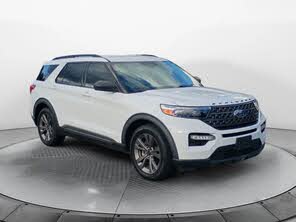
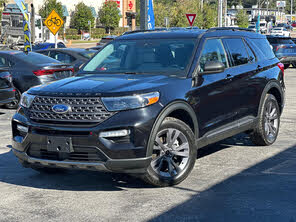
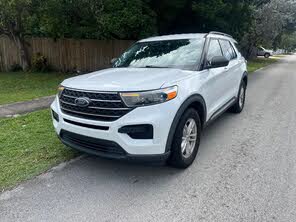
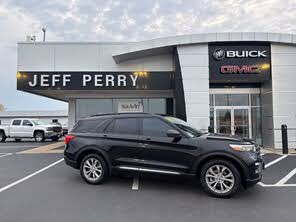
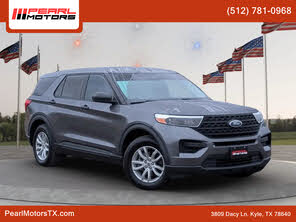
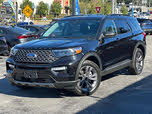
The 2021 Ford Explorer had a striking family resemblance to other Ford SUVs, with its sporty, raked belt lines and distinctive visages. Depending on the trim, the exterior featured various grille designs, ranging from black to full chrome. The Explorer offered six trim levels, with prices ranging from $32,925 to $52,730. Inside, it provided three rows of seats as standard, with cloth upholstery on the base model. The dash was clean, featuring an 8-inch LCD touchscreen and a rotary gearshift that freed up storage space. Most consumers opted for the XLT trim, which offered better equipment and finishes.
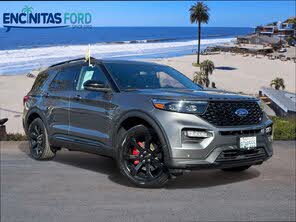
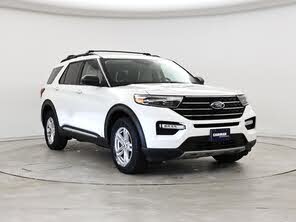
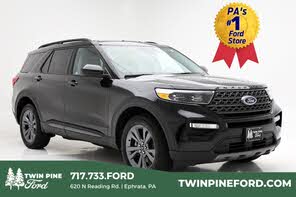
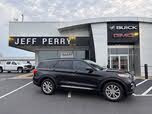
In contrast, the 2022 Ford Explorer expanded its lineup to eight models, priced from $33,745 to $54,495, excluding the $1,495 destination charge. The new ST-Line trim added a sporty look to the popular XLT version. The King Ranch model, our test vehicle, featured exclusive Del Rio leather seating and King Ranch branding. The cabin exhibited a mix of quality and questionable materials, but mostly felt worthy of its near $60,000 price tag. The exterior design included a long and tall hood, rakish roofline, and tapering greenhouse, giving it a taut, athletic appearance. The King Ranch also had shiny 20-inch wheels and quad exhaust outlets.


The 2021 Ford Explorer, at its lightest, weighed 4,345 pounds. Its base 2.3-liter EcoBoost turbocharged four-cylinder engine delivered 300 horsepower and 310 pound-feet of torque. The Limited Hybrid trim offered a V6 hybrid drivetrain with 310 hp and 331 lb-ft of torque. Higher trims featured a 3.0-liter EcoBoost twin-turbo V6, delivering 365 hp and 380 lb-ft of torque, while the sport-oriented ST trim offered 400 hp and 415 lb-ft of torque. The Explorer's towing capacity ranged from 5,000 to 5,600 pounds, depending on the trim and engine.
For the 2022 Ford Explorer, Ford offered three powertrains. The base, XLT, ST-Line, Limited, and Timberline trims came with a turbocharged 2.3-liter four-cylinder engine generating 300 hp and 310 lb-ft of torque. The Limited trim also had an efficient hybrid drivetrain option, based on a 3.3-liter V6 engine, making a combined 318 hp and 322 lb-ft of torque. The twin-turbocharged 3.0-liter V6 engine, standard on the ST, Platinum, and King Ranch trims, generated 400 hp and 415 lb-ft of torque. The King Ranch 4WD test vehicle averaged 20.6 mpg on the testing loop. The Explorer's ride felt robust, and the King Ranch model handled off-roading well with its 7.9 inches of ground clearance.
The 2021 Ford Explorer had seating for seven in the base trim, while other trims featured second-row captain’s chairs, reducing seating capacity to six. It offered 39 inches of legroom for second-row passengers and 21 cubic feet of cargo space with the third row deployed. With the rear seats folded, the total cargo volume was 81 cubic feet.
The 2022 Ford Explorer provided comfort for families of four, with the option to carry five people with a second-row bench seat. The King Ranch model featured triple-zone automatic climate control, heated and ventilated front seats, and heated second-row captain’s chairs. The third-row seat was difficult for adults to access and lacked legroom. The King Ranch had 18.2 cubic feet of cargo space behind the third-row seat, 47.9 cubic feet with the third row folded, and a maximum of 87.8 cubic feet with both rear rows folded.
The 2021 Ford Explorer offered an 8-inch touchscreen as standard, with features like AM/FM radio, SiriusXM satellite radio, Apple CarPlay, Android Auto, a 4G WiFi hotspot, and Ford’s Sync 3 infotainment system. Higher trims offered a 10.1-inch touchscreen and up to 14 speakers in the Bang & Olufsen sound system. Charging access included two USB ports and five 12-volt power points.
The 2022 Ford Explorer featured two versions of its Sync 3 infotainment system: an 8-inch touchscreen and a 10.1-inch touchscreen. The King Ranch model included FordPass Connect services, a 4G LTE WiFi hotspot, Ford+Alexa functionality, Apple CarPlay, Android Auto, satellite radio, and a navigation system. It also had wireless smartphone charging, a surround-view camera system, and a 14-speaker Bang and Olufsen premium sound system. However, the Sync 3 system had limitations, such as poor voice recognition and the need for manual adjustments for certain functions.
The 2021 Ford Explorer was rated as a Top Safety Pick+ by the IIHS, with top “Good” scores on all crash tests and an “Acceptable” rating for adaptive headlights. It offered the Ford Co-Pilot360 suite of safety features, including auto high-beam headlights, blind-spot monitoring, rear cross-traffic alert, lane keeping assist, forward-collision warning, pedestrian detection, automatic emergency braking, and dynamic brake support. The Co-Pilot360 Assist+ suite, available on higher trims, included adaptive cruise control, lane centering, evasive steering assist, and speed sign recognition.
The 2022 Ford Explorer also earned a Top Safety Pick+ rating from the IIHS. It came with Ford Co-Pilot360, which included forward-collision warning, automatic emergency braking, lane-departure warning, lane-keeping assist, blind-spot monitoring, and rear cross-traffic alert. The Co-Pilot360 Assist+ suite added adaptive cruise control, lane-centering assist, and evasive steering assist. The Explorer also had a post-collision braking system and MyKey programmable vehicle functions. The Co-Pilot360 and Co-Pilot360 Assist+ systems operated smoothly and accurately, though the lane-centering assist system occasionally shut off on sharper bends.
CarGurus highlights

According to CarGurus experts, the overall rating for the 2021 Ford Explorer is 7.5 out of 10, while the 2022 Ford Explorer scores 7.5 out of 10. Given these identical ratings, the choice between the two models depends on your specific needs. If you prefer the latest features and trim options, the 2022 Ford Explorer is the better choice. However, if you are looking for a more affordable option with a proven track record, the 2021 Ford Explorer remains a solid pick.
Choose the 2021 Ford Explorer if:
- You prefer a more affordable entry price.
- You value a simpler trim lineup with fewer choices.
- You want a proven model with a solid safety rating.




Choose the 2022 Ford Explorer if:
- You desire the latest trim options, including the sporty ST-Line and luxurious King Ranch.
- You need the most advanced technology and infotainment features.
- You require a higher towing capacity and more powerful engine options.








CarGurus highlights
According to CarGurus experts, the overall rating for the 2021 Ford Explorer is 7.5 out of 10, while the 2022 Ford Explorer scores 7.5 out of 10. Given these identical ratings, the choice between the two models depends on your specific needs. If you prefer the latest features and trim options, the 2022 Ford Explorer is the better choice. However, if you are looking for a more affordable option with a proven track record, the 2021 Ford Explorer remains a solid pick.
Choose the 2021 Ford Explorer if:
Shop Now- You prefer a more affordable entry price.
- You value a simpler trim lineup with fewer choices.
- You want a proven model with a solid safety rating.








Choose the 2022 Ford Explorer if:
Shop Now- You desire the latest trim options, including the sporty ST-Line and luxurious King Ranch.
- You need the most advanced technology and infotainment features.
- You require a higher towing capacity and more powerful engine options.











By: CarGurus + AI
At CarGurus, our team of experienced automotive writers remain at the heart of our content operation, conducting hands-on car tests and writing insightful guides that are backed by years of industry experience. To complement this, we are harnessing AI to make our content offering more diverse and more helpful to shoppers than ever. To achieve this, our AI systems are based exclusively on CarGurus content, ratings and data, so that what we produce is both unique to CarGurus, and uniquely helpful to car shoppers.