2021 Subaru Forester vs 2021 Ford Edge

Overview | |
MSRP$32,750 | MSRP$24,795 |
Listings206 | Listings193 |
Ratings & Reviews | |
User Reviews | User Reviews |
Expert reviews7.2 out of 10 | Expert reviews7.5 out of 10 |
Pros
Cons
| Pros
Cons
|
2021 Ford Edge Reviews SummaryThe Ford Edge proves that trends run in cycles. Launched in the early 2000s, the original Edge was one of the first midsize crossover SUVs, sporting car-like styling that sharply contrasted the more traditional-looking Ford Explorer of the time. However, new-car buyers realized they liked the roominess of three-row SUVs like the Explorer more, and interest in the two-row Edge waned. Now, however, car shoppers are once again eyeing two-row midsize SUVs, this time as an alternative to sedans. The Edge is now part of a growing market segment that includes the Chevrolet Blazer, Honda Passport, Hyundai Santa Fe, Jeep Grand Cherokee, Nissan Murano, and Volkswagen Atlas Cross Sport. Yet while market dynamics have changed, the Edge hasn’t. The current second-generation Edge dates back to the 2015 model year, and even a substantial update undertaken for the 2019 model year is quickly receding in the rearview mirror. The Edge now sits between the much newer Explorer and Ford Escape in the automaker's SUV-heavy lineup. Aside from some new tech features, the 2021 Ford Edge doesn’t get many significant changes, so we can evaluate it based on our experience with previous model years. As with the 2020 model year, trim levels include SE, SEL, ST-Line, Titanium, and ST. | |
2021 Subaru Forester Reviews SummaryThe Subaru Forester was one of the original compact crossover SUVs. Along with the Ford Escape, Honda CR-V, and Toyota RAV4, it helped introduce a vehicular genre that is now displacing traditional sedans from American driveways. That means the Forester has more competition than ever. What was once a small market segment has swelled with the addition of compact SUVs like the Hyundai Tucson, Kia Sportage, Mazda CX-5, Nissan Rogue, Volkswagen Tiguan, and the modern version of the Jeep Cherokee. To keep pace with the competition, the Forester has packed on technology—and pounds. While the first-generation Forester (affectionately nicknamed “toaster” by fans because of its boxy shape) was genuinely compact, the current version has the footprint of a midsize SUV from two decades ago. This version was introduced for the 2019 model year, so it doesn’t change much for 2021. The only news is the addition of three standard safety features—steering-responsive LED headlights, automatic high beams, and a rear seatbelt reminder—standard fog lights and keyless access with push-button start for the Premium trim level, and additional equipment reshuffling on other trim levels. The 2021 Subaru Forester is available in five trim levels—Base, Premium, Sport, Limited, and Touring—all with standard all-wheel drive (AWD). Our test car was the mid-range Sport model. | |
No video found | |
Popular Features & Specs | |
Engine2.0L 250 hp I4 | Engine2.5L 182 hp H4 |
Drive TrainFWD | Drive TrainAWD |
Seating Capacity5 | Seating Capacity5 |
Horsepower250 hp @ 5500 rpm | Horsepower182 hp @ 5800 rpm |
MPG City21 | MPG City26 |
MPG Highway29 | MPG Highway33 |
Engine | |
Engine Name2.0L 250 hp I4 | Engine Name2.5L 182 hp H4 |
Torque280 lb-ft @ 3000 rpm | Torque178 lb-ft @ 4400 rpm |
Horsepower250 hp @ 5500 rpm | Horsepower182 hp @ 5800 rpm |
DrivetrainFWD | DrivetrainAWD |
Fuel Economy | |
MPG City21 | MPG City26 |
MPG Highway29 | MPG Highway33 |
Interior | |
Seating Capacity5 | Seating Capacity5 |
Safety | |
Front Crash Overall5 | Front Crash Overall5 |
Side Crash Overall5 | Side Crash Overall5 |
Dimensions & Capacity | |
Cargo Space39.2 cu ft | Cargo Space31.1 cu ft |
Curb Weight3960 lbs | Curb Weight3453 lbs |
Height68.3 in | Height67.5 in |
Length188.8 in | Length182.1 in |
Width85.8 in | Width80.9 in |
Wheelbase112.2 in | Wheelbase105.1 in |
Maximum Payload1310 lbs | Maximum Payload1438 lbs |
Number of doors4 | Number of doors4 |
Maximum Towing Capacity1500 lbs | Maximum Towing Capacity1500 lbs |
Overview | ||
MSRP | $32,750 | $24,795 |
Listings | ||
Ratings & Reviews | ||
User reviews | ||
Expert reviews | 7.2 out of 10Read full review | 7.5 out of 10Read full review |
Pros & cons | Pros
Cons
| Pros
Cons
|
Summary | The Ford Edge proves that trends run in cycles. Launched in the early 2000s, the original Edge was one of the first midsize crossover SUVs, sporting car-like styling that sharply contrasted the more traditional-looking Ford Explorer of the time. However, new-car buyers realized they liked the roominess of three-row SUVs like the Explorer more, and interest in the two-row Edge waned. Now, however, car shoppers are once again eyeing two-row midsize SUVs, this time as an alternative to sedans. The Edge is now part of a growing market segment that includes the Chevrolet Blazer, Honda Passport, Hyundai Santa Fe, Jeep Grand Cherokee, Nissan Murano, and Volkswagen Atlas Cross Sport. Yet while market dynamics have changed, the Edge hasn’t. The current second-generation Edge dates back to the 2015 model year, and even a substantial update undertaken for the 2019 model year is quickly receding in the rearview mirror. The Edge now sits between the much newer Explorer and Ford Escape in the automaker's SUV-heavy lineup. Aside from some new tech features, the 2021 Ford Edge doesn’t get many significant changes, so we can evaluate it based on our experience with previous model years. As with the 2020 model year, trim levels include SE, SEL, ST-Line, Titanium, and ST. | The Subaru Forester was one of the original compact crossover SUVs. Along with the Ford Escape, Honda CR-V, and Toyota RAV4, it helped introduce a vehicular genre that is now displacing traditional sedans from American driveways. That means the Forester has more competition than ever. What was once a small market segment has swelled with the addition of compact SUVs like the Hyundai Tucson, Kia Sportage, Mazda CX-5, Nissan Rogue, Volkswagen Tiguan, and the modern version of the Jeep Cherokee. To keep pace with the competition, the Forester has packed on technology—and pounds. While the first-generation Forester (affectionately nicknamed “toaster” by fans because of its boxy shape) was genuinely compact, the current version has the footprint of a midsize SUV from two decades ago. This version was introduced for the 2019 model year, so it doesn’t change much for 2021. The only news is the addition of three standard safety features—steering-responsive LED headlights, automatic high beams, and a rear seatbelt reminder—standard fog lights and keyless access with push-button start for the Premium trim level, and additional equipment reshuffling on other trim levels. The 2021 Subaru Forester is available in five trim levels—Base, Premium, Sport, Limited, and Touring—all with standard all-wheel drive (AWD). Our test car was the mid-range Sport model. |
Video | No video found | |
Popular Features & Specs | ||
Engine | 2.0L 250 hp I4 | 2.5L 182 hp H4 |
Drive Train | FWD | AWD |
Seating Capacity | 5 | 5 |
Horsepower | 250 hp @ 5500 rpm | 182 hp @ 5800 rpm |
MPG City | 21 | 26 |
MPG Highway | 29 | 33 |
Engine | ||
Engine Name | 2.0L 250 hp I4 | 2.5L 182 hp H4 |
Torque | 280 lb-ft @ 3000 rpm | 178 lb-ft @ 4400 rpm |
Horsepower | 250 hp @ 5500 rpm | 182 hp @ 5800 rpm |
Drivetrain | FWD | AWD |
Fuel Economy | ||
MPG City | 21 | 26 |
MPG Highway | 29 | 33 |
Interior | ||
Seating Capacity | 5 | 5 |
Safety | ||
Front Crash Overall | 5 | 5 |
Side Crash Overall | 5 | 5 |
Dimensions & Capacity | ||
Cargo Space | 39.2 cu ft | 31.1 cu ft |
Curb Weight | 3960 lbs | 3453 lbs |
Height | 68.3 in | 67.5 in |
Length | 188.8 in | 182.1 in |
Width | 85.8 in | 80.9 in |
Wheelbase | 112.2 in | 105.1 in |
Maximum Payload | 1310 lbs | 1438 lbs |
Number of doors | 4 | 4 |
Maximum Towing Capacity | 1500 lbs | 1500 lbs |
The 2021 Ford Edge boasted a design that remained largely unchanged since its 2019 refresh. This update succeeded in aligning the Edge’s look with contemporary Ford aesthetics, providing a cleaner alternative to more flamboyant models like the Chevy Blazer and Hyundai Santa Fe. The Edge Titanium distinguished itself with additional chrome accents, while the Edge ST sported a blacked-out grille, 20-inch wheels, and a body kit for a more aggressive stance. The ST-Line shared the ST’s styling cues but lacked the latter’s high-performance features, offering buyers sporty looks at a lower cost.
Inside, the Edge’s cabin started to show its age, with a design that seemed to lag behind the exterior. Over the years, tweaks like a larger touchscreen appeared awkwardly integrated. The Titanium trim featured leather upholstery, and the sporty ST model received bolstered front seats and a leather-wrapped steering wheel with contrast stitching for added flair.
Conversely, the 2021 Subaru Forester, despite its redesign in 2019, retained an older aesthetic based on the previous generation’s design. It adopted a boxy and upright shape, appealing to SUV traditionalists. The most noticeable styling update was the distinctive cross-shaped taillights. This conservative approach likely reflected Subaru’s strategy of not altering a successful formula.
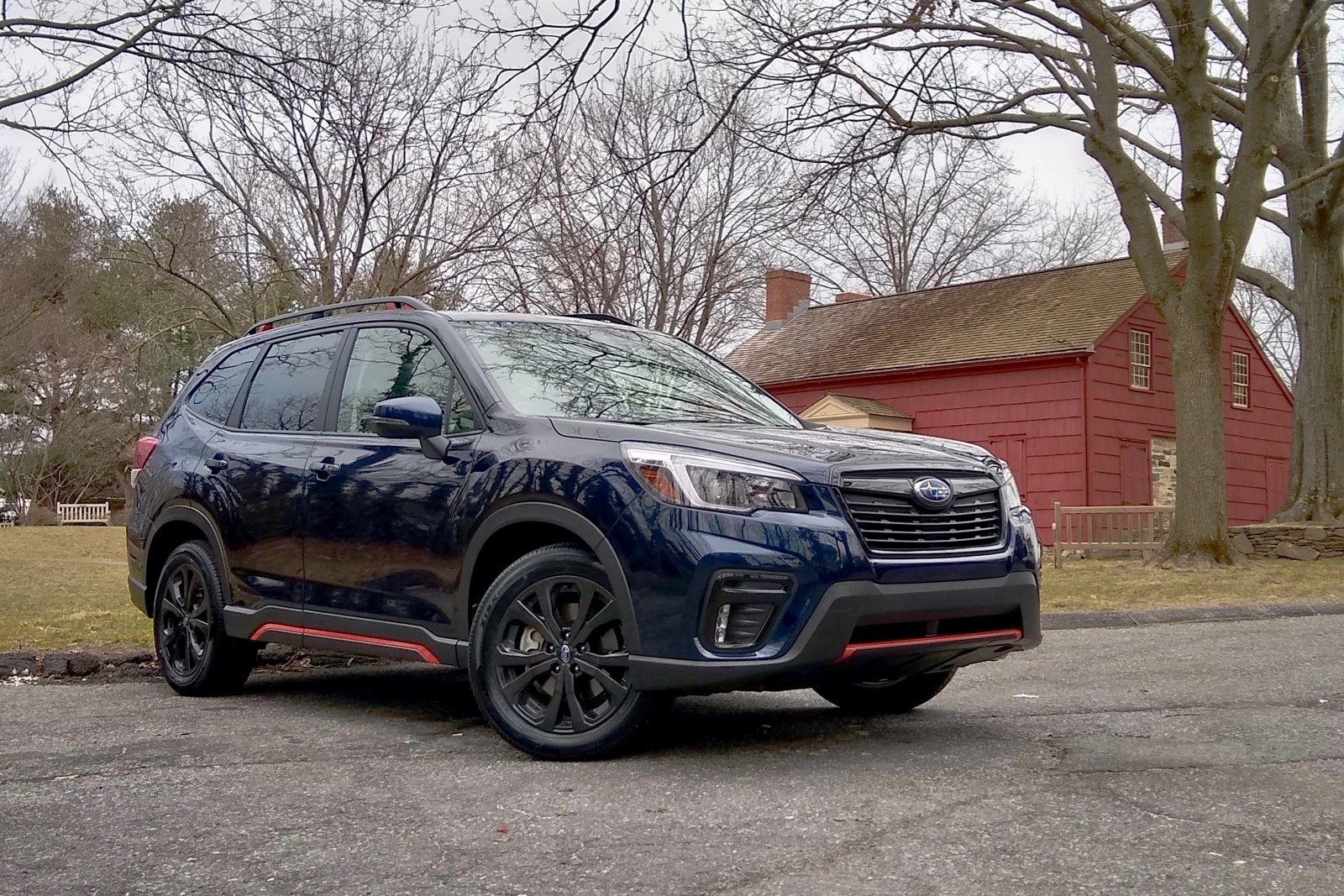
The Forester Sport stood out with orange trim accents around the body’s lower edges and roof rails, a rear spoiler, and black 18-inch alloy wheels. These subtle changes made a substantial impact, especially when paired with colors like the Dark Blue Pearl. Underneath, the Forester shared the same Subaru Global Platform as other models, blending rugged SUV aspirations with shared underpinnings from sedans, hatchbacks, and wagons.
The Forester’s no-frills interior mixed durable materials, practical for daily use and outdoor adventures depicted in Subaru ads. Orange trim and cross-stitching spiced up the Sport trim. Base, Premium, and Sport models featured cloth upholstery, while the Limited and Touring versions offered leather. Heated front seats, mirrors, and windshield wipers came with the All-Weather Package, standard on Premium and higher trims.




The 2021 Ford Edge provided two primary engine choices. Most models came with a 2.0-liter turbocharged EcoBoost four-cylinder engine producing 250 horsepower and 275 pound-feet of torque, paired with an eight-speed automatic transmission. This setup was available with either front-wheel drive (FWD) or optional all-wheel drive (AWD).
For those craving more power, the Edge ST featured an EcoBoost twin-turbo 2.7-liter V6 delivering 335 horsepower and 380 pound-feet of torque on 93-octane fuel. The ST boasted standard AWD, an eight-speed automatic transmission, and specialized suspension tuning. An optional package included upgraded brakes and 21-inch wheels with summer tires.
Despite some initial skepticism about placing the ST badge on an SUV, Ford claimed engineers used performance SUVs like the Porsche Macan as benchmarks. While the Porsche comparison might have seemed ambitious, especially considering its aging platform, the Edge ST still offered a spirited drive, unlike any of its primary competitors focusing on performance. Towing capacities ranged from 3,958 pounds for the FWD four-cylinder model to 4,525 pounds for the AWD V6-powered ST, decent but shy of the 5,000-pound capacities of the Honda Passport and Volkswagen Atlas Cross Sport.
The 2021 Subaru Forester came with one powertrain: a 2.5-liter four-cylinder boxer engine producing 182 horsepower and 176 pound-feet of torque. This engine was mated to a continuously variable automatic transmission (CVT), with paddle shifters and manual mode on certain trims. Subaru's choice of a boxer engine resulted in a lower center of gravity compared to traditional inline engines. The Forester’s maximum towing capacity was 1,500 pounds, supported by standard Trailer Stability Assist.
Subaru’s lack of a turbocharged engine option might have disappointed those seeking more power. The engine felt adequate for daily driving but lacked the punch needed for confident highway merging and overtaking. Wind noise was also noticeable at higher speeds. The suspension tuning favored comfort over handling, resulting in considerable body roll in corners and a bouncy ride over uneven roads.
All Forester models came with standard AWD, a hallmark of Subaru’s identity, and the more sophisticated X-Mode system that optimized the drivetrain for various surfaces. Higher trims featured Dual X-Mode for even more terrain adaptability. Standard ground clearance stood at 8.7 inches, enhancing the Forester’s off-road credentials, though more rugged competitors like the Jeep Cherokee Trailhawk or the Ford Bronco Sport offered better off-road capabilities.
The 2021 Ford Edge excelled in interior space, offering the most rear-seat headroom in its segment. Both the front and rear legroom ranked highly, second only to the Hyundai Santa Fe. Standard dual-zone automatic climate control added to passenger comfort. The Edge provided 39.2 cubic feet of cargo space with all seats up and 73.4 cubic feet with the rear seats folded, trailing only the Honda Passport and Volkswagen Atlas Cross Sport. A foot-activated power liftgate was available on higher trims, adding convenience.
Ford’s rotary shift knob aimed to free up console space, but the narrow width of the console meant the actual usable space remained average. The raised design allowed for a lower storage nook, though its awkward-to-reach location made it less practical for everyday items.
The 2021 Subaru Forester also offered commendable interior space, with ample headroom and legroom in both rows, thanks to its tall, flat roof. This design contributed to excellent outward visibility and a roomy feel, although it also let in considerable sunlight, which could quickly heat up the cabin.
Cargo space in the Forester measured 35.4 cubic feet with the rear seats up and an impressive 76.1 cubic feet with the seats down. Although this topped competitors like the Honda CR-V and Hyundai Tucson when the rear seats were folded, it fell short with the seats in place and did not feature the sliding second-row bench found in rivals like the Ford Escape and Nissan Rogue. The power liftgate was optional on the Sport trim and standard on the Limited and Touring trims.
While the Forester lacked the Ascent’s 19 cupholders, its existing cupholders were adequately sized. The center console was functional, although the phone-storage cubby was too small for most modern phones, and there was no wireless charging option. The power-adjustable driver’s seat required an upgrade from the Base to Premium trim. Though the large knobs for volume, tuning, and climate control were appreciated, the plethora of buttons on the steering wheel could be confusing.
Ford equipped the 2021 Edge with the latest technology, featuring the Sync 4 infotainment system. This included wireless Apple CarPlay and Android Auto on a 12-inch touchscreen, ensuring convenience and connectivity. Other standard features were Bluetooth, SiriusXM with 360L (including a three-month free trial), and a built-in 4G LTE WiFi hotspot. The Edge ST model boasted a high-quality 12-speaker Bang & Olufsen audio system for enhanced audio experiences.
Adding to the tech appeal were four USB ports, with two rear USB ports (including one USB-C) introduced in 2021. While not everyone had the opportunity to drive a Sync 4-equipped Edge, experiences with other models suggested user-friendly graphics and straightforward menu layouts, making it easy for users to navigate the system.
Subaru’s Starlink infotainment system in the 2021 Forester featured a standard 6.5-inch touchscreen, Apple CarPlay, Android Auto, Bluetooth, SiriusXM satellite radio, front-row USB ports, and even a CD player. The Sport trim upgraded to an 8-inch touchscreen and a Harman Kardon audio system, while Limited and Touring models added navigation and rear center console USB ports.
The Forester's infotainment system was praised for its simplicity and user-friendly design, featuring well-designed graphics and backup analog controls. However, the screen displayed sluggish responsiveness when the car started. It also included a secondary screen on the dashboard and another in the instrument cluster, providing additional information like fuel economy and tire pressure, though the redundancy seemed overly complex.
The Edge came equipped with Ford Co-Pilot360, a suite of standard safety features such as automatic high beams, blind-spot monitoring, lane-keep assist, forward-collision warning, automatic emergency braking (with pedestrian detection), post-collision braking, dynamic brake support, and rear parking sensors. Adaptive cruise control (with stop-and-go and lane centering) and Evasive Steering Assist were standard on all trims except the base SE, providing enhanced safety.
The Forester came with Subaru’s EyeSight system, which used a pair of cameras near the rearview mirror to provide adaptive cruise control, automatic emergency braking, lane-departure warning, and lead-vehicle start alert. Subaru also led mainstream brands by offering a driver-monitoring system, ensuring drivers remained attentive. Additional features like steering-responsive headlights, automatic high beams, and a rear seatbelt reminder were standard, though not part of EyeSight.
Optional features included blind-spot monitoring, rear-cross traffic alert, lane-keep assist, and reverse automatic braking. The Forester’s blind-spot monitoring system, with its large, easily visible mirror-mounted warning lights, was particularly user-friendly.
CarGurus highlights
According to CarGurus experts, the overall rating for the 2021 Ford Edge was 7.2 out of 10, while the 2021 Subaru Forester scored 7.5 out of 10. Based on these ratings and considering the advantages each vehicle offers, the overall recommendation leans towards the 2021 Subaru Forester. It not only edges out the Ford Edge in the expert evaluation but also provides superior safety features, practical all-wheel-drive capability, and a more versatile cargo space. Therefore, for consumers prioritizing safety, reliability, and utility, the 2021 Subaru Forester represents a more compelling choice.
Choose the 2021 Subaru Forester if:
- You’re looking for a vehicle with excellent safety ratings and comprehensive standard driver-assist features.
- You need AWD capability and substantial ground clearance for off-road adventures.
- You appreciate a no-nonsense interior design that's durable and practical for daily and outdoor activities.


Choose the 2021 Ford Edge if:
- You prefer a vehicle with both standard and high-performance engine options, including a powerful V6 in the Edge ST.
- You prioritize cargo space and headroom in a midsize crossover.
- You value advanced infotainment technology with a large touchscreen and wireless Apple CarPlay/Android Auto.


CarGurus highlights
According to CarGurus experts, the overall rating for the 2021 Ford Edge was 7.2 out of 10, while the 2021 Subaru Forester scored 7.5 out of 10. Based on these ratings and considering the advantages each vehicle offers, the overall recommendation leans towards the 2021 Subaru Forester. It not only edges out the Ford Edge in the expert evaluation but also provides superior safety features, practical all-wheel-drive capability, and a more versatile cargo space. Therefore, for consumers prioritizing safety, reliability, and utility, the 2021 Subaru Forester represents a more compelling choice.
Choose the 2021 Subaru Forester if:
Shop Now- You’re looking for a vehicle with excellent safety ratings and comprehensive standard driver-assist features.
- You need AWD capability and substantial ground clearance for off-road adventures.
- You appreciate a no-nonsense interior design that's durable and practical for daily and outdoor activities.
Choose the 2021 Ford Edge if:
Shop Now- You prefer a vehicle with both standard and high-performance engine options, including a powerful V6 in the Edge ST.
- You prioritize cargo space and headroom in a midsize crossover.
- You value advanced infotainment technology with a large touchscreen and wireless Apple CarPlay/Android Auto.

By: CarGurus + AI
At CarGurus, our team of experienced automotive writers remain at the heart of our content operation, conducting hands-on car tests and writing insightful guides that are backed by years of industry experience. To complement this, we are harnessing AI to make our content offering more diverse and more helpful to shoppers than ever. To achieve this, our AI systems are based exclusively on CarGurus content, ratings and data, so that what we produce is both unique to CarGurus, and uniquely helpful to car shoppers.

