2020 Land Rover Range Rover Sport vs 2021 Subaru Forester

Overview | |
MSRP$68,650 | MSRP$24,795 |
Listings244 | Listings199 |
Ratings & Reviews | |
User Reviews | User Reviews |
Expert reviews6.7 out of 10 | Expert reviews7.5 out of 10 |
Pros
Cons
| Pros
Cons
|
2020 Land Rover Range Rover Sport Reviews SummaryWhen you think of a plug-in hybrid electric vehicle (PHEV), the image of a dorky little hatchback car probably pops into your mind. The new 2020 Land Rover Range Rover Sport PHEV, however, is an entirely different kind of electrified vehicle. Land Rover says it retains all of its traditional land-roving capabilities while delivering greater efficiency. Based on our week-long test in this SUV’s natural habitat (the swanky suburbs of a big city), it does get remarkably good fuel economy. | |
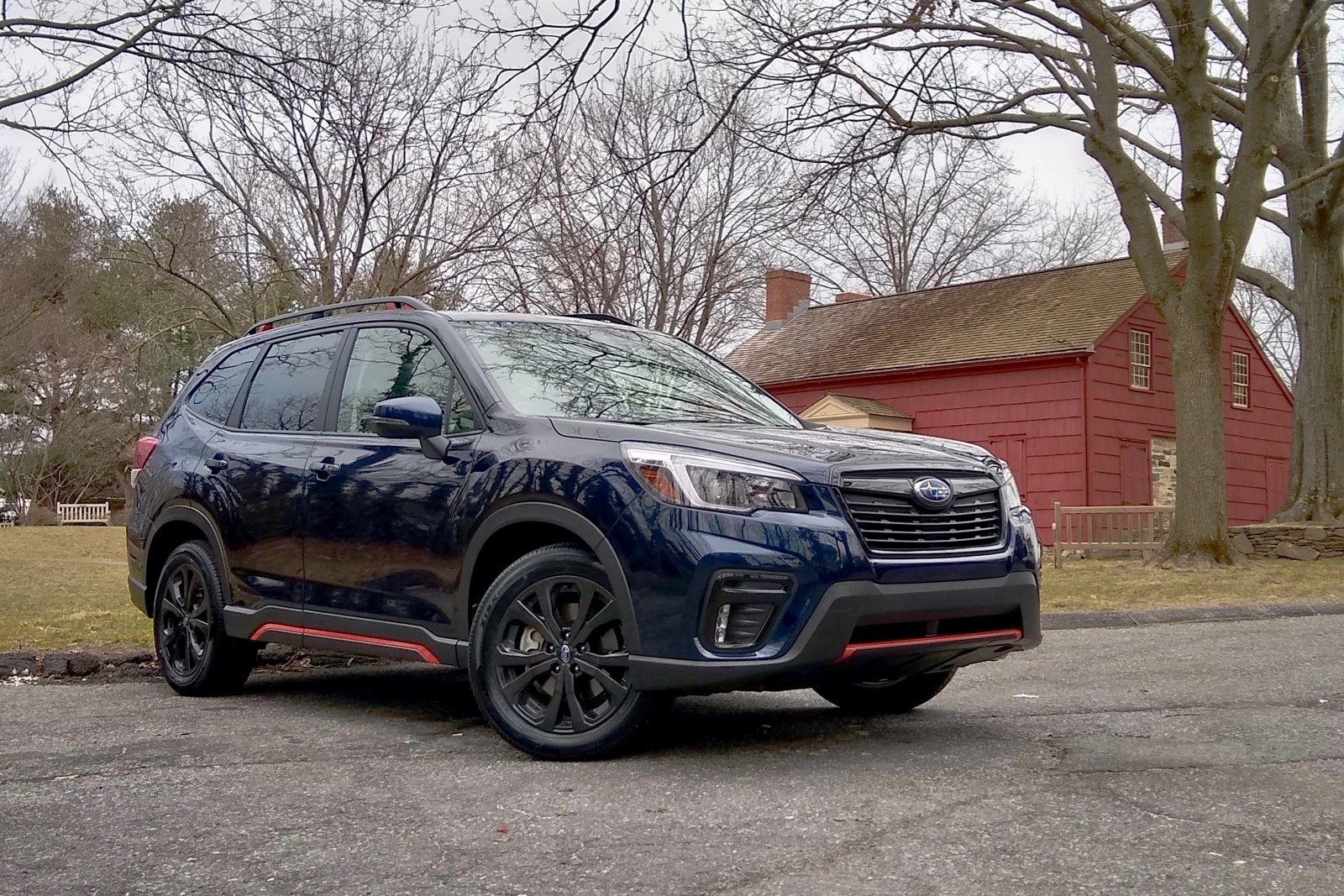
2021 Subaru Forester Reviews SummaryThe Subaru Forester was one of the original compact crossover SUVs. Along with the Ford Escape, Honda CR-V, and Toyota RAV4, it helped introduce a vehicular genre that is now displacing traditional sedans from American driveways. That means the Forester has more competition than ever. What was once a small market segment has swelled with the addition of compact SUVs like the Hyundai Tucson, Kia Sportage, Mazda CX-5, Nissan Rogue, Volkswagen Tiguan, and the modern version of the Jeep Cherokee. To keep pace with the competition, the Forester has packed on technology—and pounds. While the first-generation Forester (affectionately nicknamed “toaster” by fans because of its boxy shape) was genuinely compact, the current version has the footprint of a midsize SUV from two decades ago. This version was introduced for the 2019 model year, so it doesn’t change much for 2021. The only news is the addition of three standard safety features—steering-responsive LED headlights, automatic high beams, and a rear seatbelt reminder—standard fog lights and keyless access with push-button start for the Premium trim level, and additional equipment reshuffling on other trim levels. The 2021 Subaru Forester is available in five trim levels—Base, Premium, Sport, Limited, and Touring—all with standard all-wheel drive (AWD). Our test car was the mid-range Sport model. | |
Popular Features & Specs | |
Engine3.0L 355 hp I6 | Engine2.5L 182 hp H4 |
DrivetrainAWD | DrivetrainAWD |
Seating Capacity7 | Seating Capacity5 |
Horsepower355 hp @ 5500 rpm | Horsepower182 hp @ 5800 rpm |
EV Battery Capacity0.2 kWh | EV Battery Capacity |
MPG City19 | MPG City26 |
MPG Highway24 | MPG Highway33 |
Engine | |
Engine Name3.0L 355 hp I6 | Engine Name2.5L 182 hp H4 |
Torque365 lb-ft @ 2000 rpm | Torque178 lb-ft @ 4400 rpm |
Horsepower355 hp @ 5500 rpm | Horsepower182 hp @ 5800 rpm |
DrivetrainAWD | DrivetrainAWD |
Fuel Economy | |
EV Battery Capacity0.2 kWh | EV Battery Capacity |
MPG City19 | MPG City26 |
MPG Highway24 | MPG Highway33 |
Interior | |
Leather SeatsStandard | Leather Seats |
Seating Capacity7 | Seating Capacity5 |
Key Features | |
Navigation SystemStandard | Navigation System |
Safety | |
Front Crash Overall | Front Crash Overall5 |
Side Crash Overall | Side Crash Overall5 |
Dimensions & Capacity | |
Cargo Space27.5 cu ft | Cargo Space31.1 cu ft |
Curb Weight4870 lbs | Curb Weight3453 lbs |
Height71.0 in | Height67.5 in |
Length192.1 in | Length182.1 in |
Width87.4 in | Width80.9 in |
Wheelbase115.1 in | Wheelbase105.1 in |
Maximum Payload1850 lbs | Maximum Payload1438 lbs |
Number of doors4 | Number of doors4 |
Maximum Towing Capacity7716 lbs | Maximum Towing Capacity1500 lbs |
Overview | ||
MSRP | $68,650 | $24,795 |
Listings | ||
Ratings & Reviews | ||
User reviews | ||
Expert reviews | 6.7 out of 10Read full review | 7.5 out of 10Read full review |
Pros & cons | Pros
Cons
| Pros
Cons
|
Summary | When you think of a plug-in hybrid electric vehicle (PHEV), the image of a dorky little hatchback car probably pops into your mind. The new 2020 Land Rover Range Rover Sport PHEV, however, is an entirely different kind of electrified vehicle. Land Rover says it retains all of its traditional land-roving capabilities while delivering greater efficiency. Based on our week-long test in this SUV’s natural habitat (the swanky suburbs of a big city), it does get remarkably good fuel economy. | The Subaru Forester was one of the original compact crossover SUVs. Along with the Ford Escape, Honda CR-V, and Toyota RAV4, it helped introduce a vehicular genre that is now displacing traditional sedans from American driveways. That means the Forester has more competition than ever. What was once a small market segment has swelled with the addition of compact SUVs like the Hyundai Tucson, Kia Sportage, Mazda CX-5, Nissan Rogue, Volkswagen Tiguan, and the modern version of the Jeep Cherokee. To keep pace with the competition, the Forester has packed on technology—and pounds. While the first-generation Forester (affectionately nicknamed “toaster” by fans because of its boxy shape) was genuinely compact, the current version has the footprint of a midsize SUV from two decades ago. This version was introduced for the 2019 model year, so it doesn’t change much for 2021. The only news is the addition of three standard safety features—steering-responsive LED headlights, automatic high beams, and a rear seatbelt reminder—standard fog lights and keyless access with push-button start for the Premium trim level, and additional equipment reshuffling on other trim levels. The 2021 Subaru Forester is available in five trim levels—Base, Premium, Sport, Limited, and Touring—all with standard all-wheel drive (AWD). Our test car was the mid-range Sport model. |
Video | ||
Popular Features & Specs | ||
Engine | 3.0L 355 hp I6 | 2.5L 182 hp H4 |
Drivetrain | AWD | AWD |
Seating Capacity | 7 | 5 |
Horsepower | 355 hp @ 5500 rpm | 182 hp @ 5800 rpm |
EV Battery Capacity | 0.2 kWh | |
MPG City | 19 | 26 |
MPG Highway | 24 | 33 |
Engine | ||
Engine Name | 3.0L 355 hp I6 | 2.5L 182 hp H4 |
Torque | 365 lb-ft @ 2000 rpm | 178 lb-ft @ 4400 rpm |
Horsepower | 355 hp @ 5500 rpm | 182 hp @ 5800 rpm |
Drivetrain | AWD | AWD |
Fuel Economy | ||
EV Battery Capacity | 0.2 kWh | |
MPG City | 19 | 26 |
MPG Highway | 24 | 33 |
Interior | ||
Leather Seats | Standard | |
Seating Capacity | 7 | 5 |
Key Features | ||
Navigation System | Standard | |
Safety | ||
Front Crash Overall | 5 | |
Side Crash Overall | 5 | |
Dimensions & Capacity | ||
Cargo Space | 27.5 cu ft | 31.1 cu ft |
Curb Weight | 4870 lbs | 3453 lbs |
Height | 71.0 in | 67.5 in |
Length | 192.1 in | 182.1 in |
Width | 87.4 in | 80.9 in |
Wheelbase | 115.1 in | 105.1 in |
Maximum Payload | 1850 lbs | 1438 lbs |
Number of doors | 4 | 4 |
Maximum Towing Capacity | 7716 lbs | 1500 lbs |
The 2020 Land Rover Range Rover Sport PHEV maintained a seamless design, indistinguishable from its non-hybrid counterparts, save for a discreet “P400e” badge on the tailgate. The charging port was cleverly integrated into the grille, avoiding any unnecessary styling changes that could detract from its appeal. This approach underscored Land Rover's understanding of the importance of design in vehicle selection, ensuring the PHEV remained attractive despite its higher price point. The test vehicle, adorned with nearly $13,000 in options, including a striking Firenze Red paint and 21-inch aluminum wheels, exuded a commanding presence. Inside, the cabin was a testament to quality, with premium materials reflecting the vehicle's price tag, although some functional aspects left room for improvement.
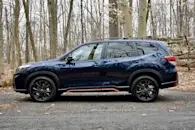
The 2021 Subaru Forester, despite its 2019 redesign, retained a familiar look, with styling largely carried over from its predecessor. The most notable change was the distinctive cross-shaped taillights. Subaru's decision to maintain the Forester's boxy, upright shape resonated with SUV shoppers seeking practicality. The Forester Sport model, with its orange accents and black 18-inch alloy wheels, offered a subtle yet impactful visual upgrade. Built on the Subaru Global Platform, the Forester shared its underpinnings with other Subaru models, ensuring a rugged yet familiar driving experience. Inside, the Forester's no-nonsense interior, accented with orange trim in the Sport model, promised durability over aesthetics, catering to active lifestyles.




The 2020 Land Rover Range Rover Sport PHEV combined a turbocharged 2.0-liter 4-cylinder engine with a 141-hp electric motor and a 13-kWh battery, producing a total of 398 horsepower and 472 pound-feet of torque. Despite Land Rover's claim of a 31-mile all-electric range, the test vehicle struggled to maintain EV mode, possibly due to climate control usage or hilly terrain. The SUV averaged 41.9 mpg over 28.4 miles in EV mode and 25.5 mpg over a 60-mile loop, outperforming previous models but potentially overshadowed by the new mild-hybrid inline 6-cylinder engine. The Range Rover Sport PHEV offered quick acceleration and a comfortable ride, thanks to its adaptive air suspension and various driving modes. However, the regenerative brakes were grabby, and the SUV's off-roading capabilities remained intact, with a 4WD system and multiple traction settings. Recharging the battery proved frustrating, with inconsistent results from a standard outlet.
The 2021 Subaru Forester featured a 2.5-liter four-cylinder engine with 182 horsepower and 176 pound-feet of torque, paired with a CVT. While adequate for most situations, the engine lacked the desired power for highway merging and overtaking. The Forester's suspension prioritized comfort over handling, resulting in noticeable body roll and bounce on uneven surfaces. Standard AWD and X-Mode enhanced its off-road capabilities, with Dual X-Mode available on Sport models. The Forester's 8.7 inches of ground clearance and hill-descent control on higher trims further bolstered its rugged appeal, though it fell short of more off-road-focused competitors.
The 2020 Land Rover Range Rover Sport PHEV's cargo space was compromised by the battery placement, reducing the already limited 27.5-cubic-foot area behind the rear seats. Despite this, the SUV comfortably accommodated five passengers, with excellent front-seat comfort and a panoramic glass roof enhancing the interior ambiance. However, practical storage was limited, and the optional refrigerated center console bin further reduced space. Rear-seat passengers enjoyed a high seating position and good thigh support, with 4-zone automatic climate control adding to the comfort.
The 2021 Subaru Forester offered generous headroom and legroom, thanks to its tall, flat roofline, which also provided excellent visibility. With 35.4 cubic feet of cargo space behind the rear seats and 76.1 cubic feet with them folded, the Forester surpassed many competitors. While it lacked a sliding second-row bench, a power liftgate was available on higher trims. The Forester's interior featured practical storage solutions, though the phone cubby was small, and wireless charging was unavailable. The infotainment system was user-friendly, with large knobs for audio and climate control, though the steering wheel's numerous buttons could be confusing.
The 2020 Land Rover Range Rover Sport's InControl Touch Pro Duo infotainment system was complex, requiring time to master. Despite efforts to customize settings, the system occasionally behaved unpredictably, with delayed responses and a lack of haptic feedback. While the technology managed the vehicle's complexity, it could frustrate even tech-savvy drivers, making it unsuitable for technophobes.
The 2021 Subaru Forester's Starlink infotainment system was straightforward, with a 6.5-inch touchscreen, Apple CarPlay, and Android Auto. Higher trims added an 8-inch screen and premium audio. The system's graphics and analog controls were well-designed, though the screen was slow to start. Additional displays provided secondary information, but the setup felt overly complex, with redundant information across screens.
The 2020 Land Rover Range Rover Sport included numerous ADAS features, though the steering-assist system could be intrusive. The SUV's high center of gravity and adaptive air suspension contributed to head-toss, requiring smooth driving to mitigate. Crash-test ratings were unavailable, but the vehicle's substantial weight offered some reassurance in collisions.
The 2021 Subaru Forester excelled in safety, earning a "Top Safety Pick+" from the IIHS and a five-star rating from the NHTSA. Standard EyeSight technology included adaptive cruise control and automatic emergency braking, with optional features like blind-spot monitoring. The Forester's driver-monitoring system, DriverFocus, ensured attentive driving, setting it apart from competitors.
CarGurus highlights
According to CarGurus experts, the overall rating for the 2020 Land Rover Range Rover Sport is 6.7 out of 10, while the 2021 Subaru Forester scores 7.5 out of 10. Based on these ratings, the Subaru Forester is the recommended choice, offering superior safety, practicality, and value for most consumers.
Choose the 2020 Land Rover Range Rover Sport if:
- You prioritize luxury and a commanding presence on the road.
- Off-roading capability is a must-have feature.
- You desire a powerful hybrid powertrain with quick acceleration.


Choose the 2021 Subaru Forester if:
- Safety is your top priority, with excellent crash-test ratings and advanced driver-assist features.
- You need ample cargo space and a practical, durable interior.
- Standard AWD and off-road capability are important for your lifestyle.


CarGurus highlights
According to CarGurus experts, the overall rating for the 2020 Land Rover Range Rover Sport is 6.7 out of 10, while the 2021 Subaru Forester scores 7.5 out of 10. Based on these ratings, the Subaru Forester is the recommended choice, offering superior safety, practicality, and value for most consumers.
Choose the 2020 Land Rover Range Rover Sport if:
Shop Now- You prioritize luxury and a commanding presence on the road.
- Off-roading capability is a must-have feature.
- You desire a powerful hybrid powertrain with quick acceleration.
Choose the 2021 Subaru Forester if:
Shop Now- Safety is your top priority, with excellent crash-test ratings and advanced driver-assist features.
- You need ample cargo space and a practical, durable interior.
- Standard AWD and off-road capability are important for your lifestyle.

By: CarGurus + AI
At CarGurus, our team of experienced automotive writers remain at the heart of our content operation, conducting hands-on car tests and writing insightful guides that are backed by years of industry experience. To complement this, we are harnessing AI to make our content offering more diverse and more helpful to shoppers than ever. To achieve this, our AI systems are based exclusively on CarGurus content, ratings and data, so that what we produce is both unique to CarGurus, and uniquely helpful to car shoppers.

