2021 Volkswagen Tiguan vs 2020 Hyundai Santa Fe
Overview | |
MSRP$26,275 | MSRP$25,245 |
Listings1148 | Listings1325 |
Ratings & Reviews | |
User Reviews | User Reviews |
Expert reviews8.8 out of 10 | Expert reviews7.3 out of 10 |
Pros
Cons
| Pros
Cons
|
2020 Hyundai Santa Fe Reviews SummaryLast year, Hyundai changed its approach to the Santa Fe. The smaller five-passenger Santa Fe Sport got drop-kicked from the automaker’s lineup, replaced by this completely redesigned version of the SUV. The larger seven-passenger Santa Fe got a new name for one year (Santa Fe XL), and then the all-new 2020 Hyundai Palisade replaced that vehicle. With the Palisade’s arrival, there is just one Santa Fe for 2020, a five-passenger crossover that resides in a sweet spot between traditional compact and midsize models. It gets several updates, too, including a standard rear-seat reminder system, an available camera-based Blind-Spot View Monitor system, and new design accents to better distinguish the top trim level. | |
2021 Volkswagen Tiguan Reviews SummaryYou may have noticed that crossover SUVs are popular. Among them, compact models dominate, having essentially replaced the traditional midsize sedan in American driveways. Offering room for five people, available all-wheel drive (AWD), and more cargo than any family car, they are the preferred method of transportation for a broad cross section of new vehicle buyers. But that’s not the only explanation for the runaway success of the 2021 Volkswagen Tiguan. | |
No video found | |
Popular Features & Specs | |
Engine2.4L 185 hp I4 | Engine2.0L 184 hp I4 |
Drive TrainFWD | Drive TrainFWD |
Seating Capacity5 | Seating Capacity7 |
Horsepower185 hp @ 6000 rpm | Horsepower184 hp @ 4400 rpm |
MPG City22 | MPG City23 |
MPG Highway29 | MPG Highway29 |
Engine | |
Engine Name2.4L 185 hp I4 | Engine Name2.0L 184 hp I4 |
Torque178 lb-ft @ 4000 rpm | Torque221 lb-ft @ 1600 rpm |
Horsepower185 hp @ 6000 rpm | Horsepower184 hp @ 4400 rpm |
DrivetrainFWD | DrivetrainFWD |
Fuel Economy | |
MPG City22 | MPG City23 |
MPG Highway29 | MPG Highway29 |
Interior | |
Seating Capacity5 | Seating Capacity7 |
Safety | |
Front Crash Overall4 | Front Crash Overall4 |
Side Crash Overall5 | Side Crash Overall5 |
Dimensions & Capacity | |
Cargo Space35.9 cu ft | Cargo Space12.0 cu ft |
Curb Weight3591 lbs | Curb Weight3735 lbs |
Height66.1 in | Height66.3 in |
Length187.8 in | Length185.1 in |
Width74.4 in | Width72.4 in |
Wheelbase108.9 in | Wheelbase109.8 in |
Maximum Payload1138 lbs | Maximum Payload1146 lbs |
Number of doors4 | Number of doors4 |
Maximum Towing Capacity2000 lbs | Maximum Towing Capacity1500 lbs |
Overview | ||
MSRP | $26,275 | $25,245 |
Listings | ||
Ratings & Reviews | ||
User reviews | ||
Expert reviews | 8.8 out of 10Read full review | 7.3 out of 10Read full review |
Pros & cons | Pros
Cons
| Pros
Cons
|
Summary | Last year, Hyundai changed its approach to the Santa Fe. The smaller five-passenger Santa Fe Sport got drop-kicked from the automaker’s lineup, replaced by this completely redesigned version of the SUV. The larger seven-passenger Santa Fe got a new name for one year (Santa Fe XL), and then the all-new 2020 Hyundai Palisade replaced that vehicle. With the Palisade’s arrival, there is just one Santa Fe for 2020, a five-passenger crossover that resides in a sweet spot between traditional compact and midsize models. It gets several updates, too, including a standard rear-seat reminder system, an available camera-based Blind-Spot View Monitor system, and new design accents to better distinguish the top trim level. | You may have noticed that crossover SUVs are popular. Among them, compact models dominate, having essentially replaced the traditional midsize sedan in American driveways. Offering room for five people, available all-wheel drive (AWD), and more cargo than any family car, they are the preferred method of transportation for a broad cross section of new vehicle buyers. But that’s not the only explanation for the runaway success of the 2021 Volkswagen Tiguan. |
Video | No video found | |
Popular Features & Specs | ||
Engine | 2.4L 185 hp I4 | 2.0L 184 hp I4 |
Drive Train | FWD | FWD |
Seating Capacity | 5 | 7 |
Horsepower | 185 hp @ 6000 rpm | 184 hp @ 4400 rpm |
MPG City | 22 | 23 |
MPG Highway | 29 | 29 |
Engine | ||
Engine Name | 2.4L 185 hp I4 | 2.0L 184 hp I4 |
Torque | 178 lb-ft @ 4000 rpm | 221 lb-ft @ 1600 rpm |
Horsepower | 185 hp @ 6000 rpm | 184 hp @ 4400 rpm |
Drivetrain | FWD | FWD |
Fuel Economy | ||
MPG City | 22 | 23 |
MPG Highway | 29 | 29 |
Interior | ||
Seating Capacity | 5 | 7 |
Safety | ||
Front Crash Overall | 4 | 4 |
Side Crash Overall | 5 | 5 |
Dimensions & Capacity | ||
Cargo Space | 35.9 cu ft | 12.0 cu ft |
Curb Weight | 3591 lbs | 3735 lbs |
Height | 66.1 in | 66.3 in |
Length | 187.8 in | 185.1 in |
Width | 74.4 in | 72.4 in |
Wheelbase | 108.9 in | 109.8 in |
Maximum Payload | 1138 lbs | 1146 lbs |
Number of doors | 4 | 4 |
Maximum Towing Capacity | 2000 lbs | 1500 lbs |
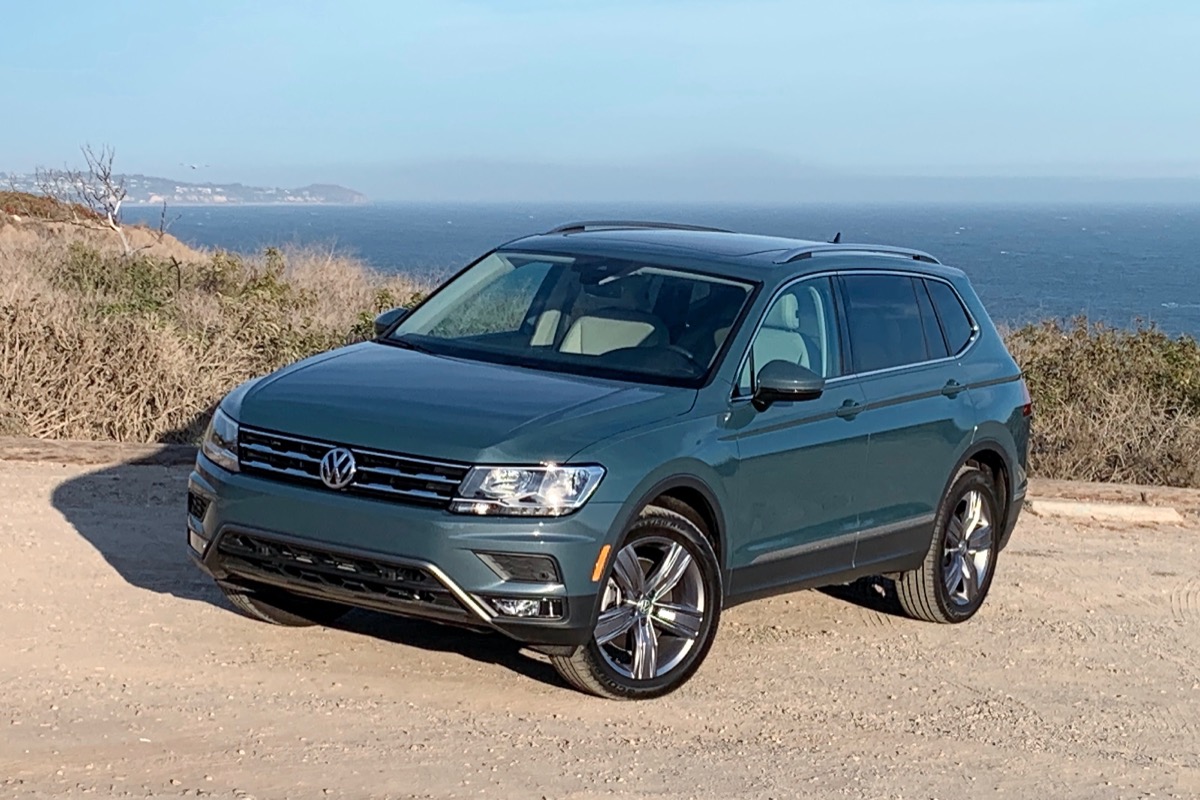
When comparing the 2020 Hyundai Santa Fe and the 2021 Volkswagen Tiguan, aesthetics and design sensibilities came to the forefront.
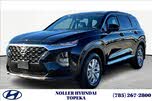
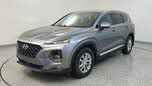
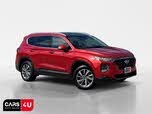
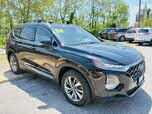
The 2020 Hyundai Santa Fe offered SE, SEL, and Limited trims, with an enhanced turbocharged engine available on the 2.0T models. Whether drivers opted for all-wheel drive (AWD) or front-wheel drive (FWD), the Santa Fe provided choices for paint and interior color, along with dealer-installed accessories. The final cost of the test vehicle, a Limited 2.0T with some extras, was $39,170.
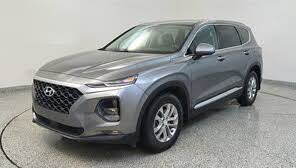
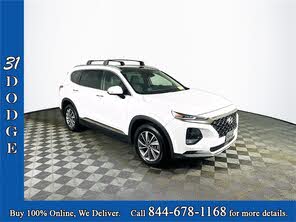
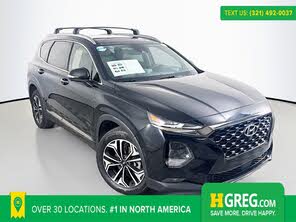
The Santa Fe exhibited a bold and avant-garde exterior design. Its grille shape, stacked lighting elements, asymmetrical fender stampings, and an oversized rear skid plate trim were likely polarizing. Inside, a dual-cowl dashboard design, diamond-textured speaker grilles, and colors like gray or beige offered a high-contrast visual treat. Though the quality of materials and stiffness of leather seats fell short of luxurious standards, the build quality and control functions were impressive. Those who appreciated daring design would likely approve of the Santa Fe.
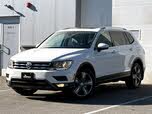
The 2021 Volkswagen Tiguan, however, boasted clean lines and balanced proportions, representing a more conservative but timeless aesthetic. It was larger for its class due to a long-wheelbase version that made it almost as spacious inside as the Hyundai Santa Fe.
Volkswagen's simplistic and practical design sensibility prevailed in the Tiguan, with large doors and comfortable entry points for passengers. The sophisticated yet straightforward layout included modern geometric forms and no-nonsense controls. The SEL trim, with a $35,040 sticker price, featured a clean, upscale look but suffered from too much hard plastic and flimsy steering wheel stalks.


Delving into performance metrics, the 2020 Hyundai Santa Fe and 2021 Volkswagen Tiguan had differing strengths and weaknesses.
The Santa Fe offered a base 2.4-liter four-cylinder engine producing 185 horsepower, which was not ideal for its curb weight ranging from 3,591 to 3,946 pounds. The better choice was the turbocharged 2.0-liter four-cylinder engine delivering 235 horsepower and 260 lb-ft of torque. This turbocharged engine performed significantly better and was more responsive.
The Santa Fe's eight-speed automatic transmission directed power either to the front wheels or the optional AWD system, effectively eliminating torque steer issues present in FWD configurations. Fuel economy for the 2.0T was estimated by the EPA at 23 mpg in combined driving, with the test model fetching 22.1 mpg. A smooth ride, decent handling, and a relatively quiet interior with the Limited trim made it a solid daily driver, albeit one that did not inspire spirited driving.
The 2021 Volkswagen Tiguan came equipped with a turbocharged 2.0-liter four-cylinder engine producing 184 horsepower and 221 lb-ft of torque at a low 1,600 rpm. The engine was matched to an eight-speed automatic transmission, sending power to the front wheels by default, with the optional 4Motion AWD available for $1,400 on most trims.
While the engine had sufficient torque, it suffered from turbo lag, affecting responsiveness. Passing power and mid-range acceleration felt lacking, particularly with the vehicle’s nearly 4,000-pound curb weight. Fuel economy was estimated by the EPA at 25 mpg for FWD and 24 mpg for AWD; however, the test vehicle averaged 22.6 mpg.
Despite the lackluster powertrain, the Tiguan did provide a responsive steering, comfortable ride quality, nimble handling for urban driving, and commendable highway composure. However, crossing sharper speed bumps or railroad tracks revealed its suspension limitations, resulting in unrefined experiences.
When assessing the form and function, both the Hyundai Santa Fe and the Volkswagen Tiguan offered thoughtful interiors designed for comfort and practicality, but with some distinct differences in cargo capabilities.
The 2020 Hyundai Santa Fe was designed with family needs in mind. The test vehicle featured eight-way power-adjustable, heated, and ventilated front seats, plus additional adjustments for lumbar support and thigh extension. The back seat was comfortable for adults, with amenities like air conditioning vents, rear side-window sunshades, and heated bottom cushions in the Limited trim. The panoramic sunroof added to the overall spacious feel.
Cargo space in the Santa Fe was moderately expansive, offering 35.9 cubic feet behind the rear seat and up to 71.3 cubic feet with the seats folded. It also had large underfloor storage compartments and a smart liftgate that opened automatically with proximity key sensing.
The 2021 Volkswagen Tiguan excelled in interior comfort and ease of access, with tall seating points and wide adjustments for front seats covered in V-Tex leatherette upholstery. The rear seat provided excellent legroom and foot space, with air conditioning vents and USB charging ports. Parents with reverse-facing child seats found ample space.
The Tiguan's cargo space varied based on the seating configuration. Models with the optional third-row seat provided 33 cubic feet behind the second row, while two-row models offered up to 37.6 cubic feet. Maximum capacity ranged from 65.7 to 73.5 cubic feet, with practical storage solutions for daily needs.
Technology was a crucial aspect of both vehicles, and they both provided modern infotainment systems, but the approach differed significantly.
The 2020 Hyundai Santa Fe featured an excellent infotainment setup with a touchscreen atop the dashboard, complete with stereo control knobs and shortcut buttons for ease of use. All models had Bluetooth connectivity and Apple CarPlay and Android Auto. The SEL trim added SiriusXM satellite radio, Blue Link connected services (with three free years), and remote engine start.
The Limited trim bumped up to an 8-inch display with navigation, a surround-view camera, wireless smartphone charging, and a premium 12-speaker Infinity sound system. Non-infotainment technology included a comprehensive head-up display and a sophisticated voice recognition system.
In contrast, the 2021 Volkswagen Tiguan employed the MIB3 platform starting with the SE trim. This new system provided an 8-inch touchscreen, faster processing times, wireless Apple CarPlay and Android Auto, WiFi for multiple devices, SiriusXM 360L, Amazon Alexa compatibility, and a suite of Car-Net connected services.
Despite these enhancements, the Tiguan’s voice recognition struggled, and the standard six-speaker audio system was inadequate at higher volumes. Only the SEL Premium R-Line featured a nine-speaker Fender premium audio system. Both the SEL and SEL Premium R-Line had Volkswagen Digital Cockpit instrumentation, offering critical vehicle information in a clear and understated manner.
Safety features were robust in both vehicles, but there were distinctions in their offerings and ratings.
The 2020 Hyundai Santa Fe was lauded as a safe choice, earning a five-star overall crash-test rating from the NHTSA and a Top Safety Pick from the IIHS. Standard safety features included adaptive cruise control, forward collision warning, automatic emergency braking, lane-departure warning, lane-keeping assist, and a driver monitoring system. The SEL trim added blind-spot and rear cross-traffic warning systems, as well as a safe exit assist feature.
Additionally, the ultrasonic occupant alert system in SEL Convenience Package and above helped prevent forgotten children or pets inside the vehicle. The Limited trim introduced a Blind-Spot View Monitor, displaying live video feeds in the instrument cluster for enhanced situational awareness.
Volkswagen’s 2021 Tiguan included the IQ Drive system with standard forward-collision warning, pedestrian detection, automatic emergency braking, blind-spot monitoring, and rear cross-traffic alert. The SE trim added adaptive cruise control, while higher trims introduced lane-departure warning, lane-keep assist, automatic high-beam headlights, and parking sensors.
In test conditions, adaptive cruise control and lane-keeping aids exhibited smooth but occasionally delayed responses. The blind-spot warning indicators were clear and effective. The Tiguan also included standard automatic post-collision braking and an optional top-down surround-view camera system for the SEL Premium R-Line.
According to IIHS, the Tiguan earned a Top Safety Pick rating for its SEL and SEL Premium R-Line trims, thanks to their high-performing LED headlights. Meanwhile, the NHTSA had not yet completed crash-test results for the 2021 Tiguan.
CarGurus highlights
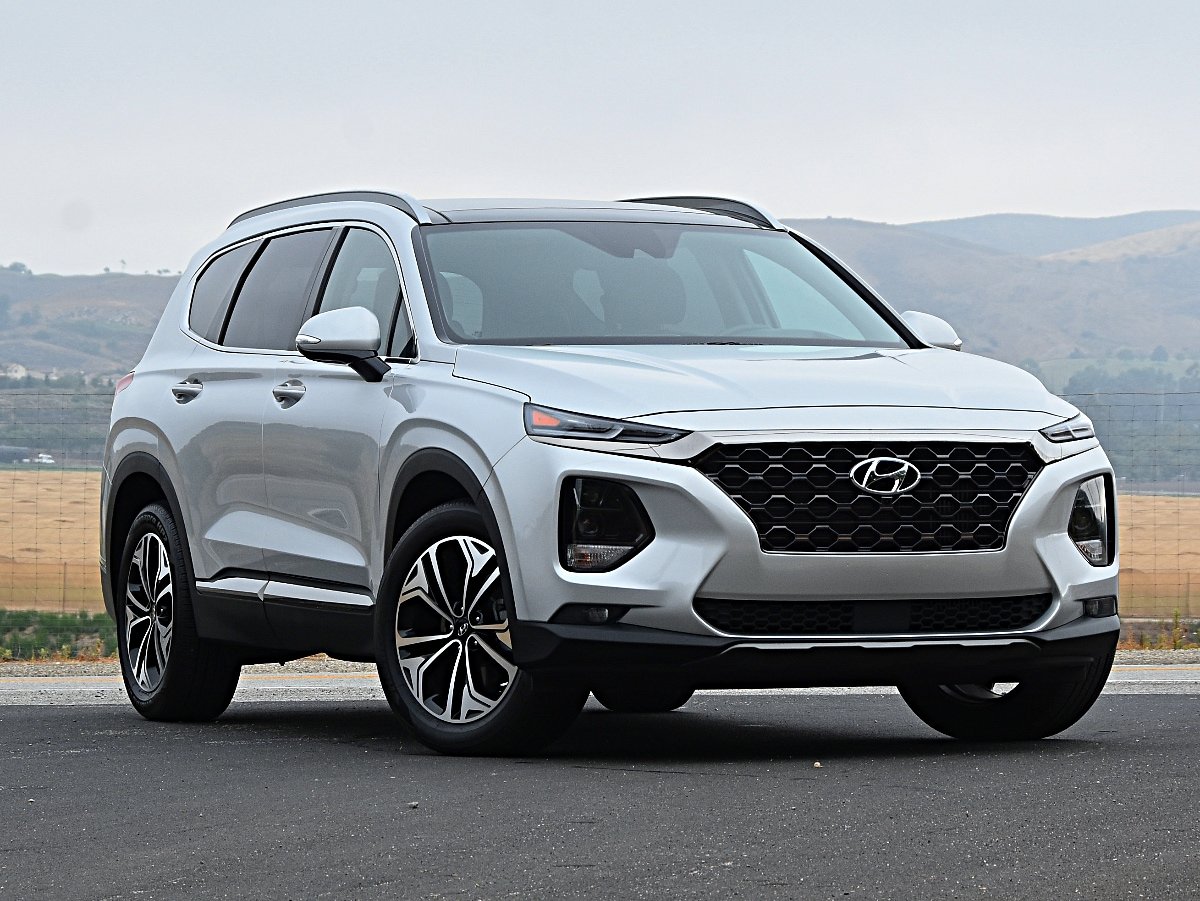
According to CarGurus experts, the overall rating for the 2020 Hyundai Santa Fe was 8.8 out of 10, while the 2021 Volkswagen Tiguan scored 7.3 out of 10. The Santa Fe’s combination of innovative design, excellent safety ratings, robust performance, and practical features gave it a clear edge in this comparison. Therefore, for most consumers, the 2020 Hyundai Santa Fe would be the more advisable choice based on these expert ratings.
Choose the 2021 Volkswagen Tiguan if:
- You prefer a conservative and upscale design that stands the test of time.
- You need an SUV with versatile interior configurations, including an optional third-row for additional passenger capacity.
- You want a practical and functional vehicle with effective daily driving dynamics and improved technology with the MIB3 infotainment system.



Choose the 2020 Hyundai Santa Fe if:
- You appreciate bold and innovative design, both inside and out.
- You require a turbocharged engine with robust performance and good torque for various driving conditions.
- You value strong safety ratings and comprehensive safety features, including modern innovations like the Blind-Spot View Monitor and ultrasonic occupant alert system.




CarGurus highlights
According to CarGurus experts, the overall rating for the 2020 Hyundai Santa Fe was 8.8 out of 10, while the 2021 Volkswagen Tiguan scored 7.3 out of 10. The Santa Fe’s combination of innovative design, excellent safety ratings, robust performance, and practical features gave it a clear edge in this comparison. Therefore, for most consumers, the 2020 Hyundai Santa Fe would be the more advisable choice based on these expert ratings.
Choose the 2021 Volkswagen Tiguan if:
Shop Now- You prefer a conservative and upscale design that stands the test of time.
- You need an SUV with versatile interior configurations, including an optional third-row for additional passenger capacity.
- You want a practical and functional vehicle with effective daily driving dynamics and improved technology with the MIB3 infotainment system.






Choose the 2020 Hyundai Santa Fe if:
Shop Now- You appreciate bold and innovative design, both inside and out.
- You require a turbocharged engine with robust performance and good torque for various driving conditions.
- You value strong safety ratings and comprehensive safety features, including modern innovations like the Blind-Spot View Monitor and ultrasonic occupant alert system.





By: CarGurus + AI
At CarGurus, our team of experienced automotive writers remain at the heart of our content operation, conducting hands-on car tests and writing insightful guides that are backed by years of industry experience. To complement this, we are harnessing AI to make our content offering more diverse and more helpful to shoppers than ever. To achieve this, our AI systems are based exclusively on CarGurus content, ratings and data, so that what we produce is both unique to CarGurus, and uniquely helpful to car shoppers.