Volkswagen Atlas vs Hyundai Venue

Overview | |
MSRP$39,310 | MSRP$20,550 |
Listings594 | Listings138 |
Ratings & Reviews | |
User Reviews | User Reviews |
Expert reviews6.8 out of 10 | Expert reviews5.2 out of 10 |
Pros
Cons
| Pros
Cons
|
Reviews SummaryThe 2026 Volkswagen Atlas continues as VW’s American-market three-row SUV (a two-row Atlas Cross Sport is also available, but we’ll cover that separately), largely unchanged from its substantial 2024 refresh. For 2026, Volkswagen adds a factory-installed HomeLink rearview mirror to all but the base Atlas SE trim level–hardly groundbreaking stuff. What remains, however, is a vehicle that impresses with its upscale appearance and a genuinely spacious interior. A stiff ride and poorly executed technology will fight and frustrate you every step of the way, but the Atlas will nonetheless make you look good. Verdict: The 2026 Volkswagen Atlas delivers on its core promise of style and space at a non-luxury price point. If you can tolerate its subpar ride quality and maddening infotainment system—or if you simply plan to rely on Apple CarPlay and ignore the native tech—this handsome three-row SUV offers compelling value for shoppers prioritizing looks and space. | |
Reviews SummaryAutomakers have traditionally had a hard time making money on entry-level subcompact cars, because they have low profit margins, but America has largely moved away from cars to crossover SUVs—and higher prices. That allows car companies to offer an entry-level subcompact SUV for thousands more than a similar sedan or hatchback. Such is the case with the Hyundai Venue, which costs more than its predecessor, the subcompact Accent that was dropped after the 2022 model year. While the price is higher, the advantage for buyers is a vehicle that generally has more cargo space and is more practical. We recently drove the 2026 Hyundai Venue SEL w/2-Tone Roof (yes, that’s the trim level name) to find out if a subcompact crossover is a better buy than a cheaper subcompact car. Verdict: The Hyundai Venue sacrifices refinement for a price point that isn’t as low as a comparable subcompact car. We’d be tempted to spend a little more for a slightly larger compact car with more power, features, and refinement. | |
No video found | No video found |
Popular Features & Specs | |
Engine2.0L 269 hp I4 | Engine1.6L 121 hp I4 |
DrivetrainFWD | DrivetrainFWD |
Seating Capacity7 | Seating Capacity5 |
Horsepower | Horsepower121 hp @ 6300 rpm |
MPG City20 | MPG City29 |
MPG Highway27 | MPG Highway33 |
Engine | |
Engine Name2.0L 269 hp I4 | Engine Name1.6L 121 hp I4 |
Torque | Torque113 lb-ft @ 4500 rpm |
Horsepower | Horsepower121 hp @ 6300 rpm |
DrivetrainFWD | DrivetrainFWD |
Fuel Economy | |
MPG City20 | MPG City29 |
MPG Highway27 | MPG Highway33 |
Interior | |
Seating Capacity7 | Seating Capacity5 |
Safety | |
Front Crash Overall4 | Front Crash Overall4 |
Side Crash Overall5 | Side Crash Overall5 |
Dimensions & Capacity | |
Cargo Space20.6 cu ft | Cargo Space18.7 cu ft |
Curb Weight4317 lbs | Curb Weight2612 lbs |
Height70.4 in | Height61.6 in |
Length200.7 in | Length159.1 in |
Width88.5 in | Width69.7 in |
Wheelbase117.3 in | Wheelbase99.2 in |
Maximum Payload1102 lbs | Maximum Payload1158 lbs |
Number of doors4 | Number of doors4 |
Maximum Towing Capacity2000 lbs | Maximum Towing Capacity |
Overview | ||
MSRP | $39,310 | $20,550 |
Listings | ||
Ratings & Reviews | ||
User reviews | ||
Expert reviews | 6.8 out of 10Read full review | 5.2 out of 10Read full review |
Pros & cons | Pros
Cons
| Pros
Cons
|
Summary | The 2026 Volkswagen Atlas continues as VW’s American-market three-row SUV (a two-row Atlas Cross Sport is also available, but we’ll cover that separately), largely unchanged from its substantial 2024 refresh. For 2026, Volkswagen adds a factory-installed HomeLink rearview mirror to all but the base Atlas SE trim level–hardly groundbreaking stuff. What remains, however, is a vehicle that impresses with its upscale appearance and a genuinely spacious interior. A stiff ride and poorly executed technology will fight and frustrate you every step of the way, but the Atlas will nonetheless make you look good. Verdict: The 2026 Volkswagen Atlas delivers on its core promise of style and space at a non-luxury price point. If you can tolerate its subpar ride quality and maddening infotainment system—or if you simply plan to rely on Apple CarPlay and ignore the native tech—this handsome three-row SUV offers compelling value for shoppers prioritizing looks and space. | Automakers have traditionally had a hard time making money on entry-level subcompact cars, because they have low profit margins, but America has largely moved away from cars to crossover SUVs—and higher prices. That allows car companies to offer an entry-level subcompact SUV for thousands more than a similar sedan or hatchback. Such is the case with the Hyundai Venue, which costs more than its predecessor, the subcompact Accent that was dropped after the 2022 model year. While the price is higher, the advantage for buyers is a vehicle that generally has more cargo space and is more practical. We recently drove the 2026 Hyundai Venue SEL w/2-Tone Roof (yes, that’s the trim level name) to find out if a subcompact crossover is a better buy than a cheaper subcompact car. Verdict: The Hyundai Venue sacrifices refinement for a price point that isn’t as low as a comparable subcompact car. We’d be tempted to spend a little more for a slightly larger compact car with more power, features, and refinement. |
Video | No video found | No video found |
Popular Features & Specs | ||
Engine | 2.0L 269 hp I4 | 1.6L 121 hp I4 |
Drivetrain | FWD | FWD |
Seating Capacity | 7 | 5 |
Horsepower | 121 hp @ 6300 rpm | |
MPG City | 20 | 29 |
MPG Highway | 27 | 33 |
Engine | ||
Engine Name | 2.0L 269 hp I4 | 1.6L 121 hp I4 |
Torque | 113 lb-ft @ 4500 rpm | |
Horsepower | 121 hp @ 6300 rpm | |
Drivetrain | FWD | FWD |
Fuel Economy | ||
MPG City | 20 | 29 |
MPG Highway | 27 | 33 |
Interior | ||
Seating Capacity | 7 | 5 |
Safety | ||
Front Crash Overall | 4 | 4 |
Side Crash Overall | 5 | 5 |
Dimensions & Capacity | ||
Cargo Space | 20.6 cu ft | 18.7 cu ft |
Curb Weight | 4317 lbs | 2612 lbs |
Height | 70.4 in | 61.6 in |
Length | 200.7 in | 159.1 in |
Width | 88.5 in | 69.7 in |
Wheelbase | 117.3 in | 99.2 in |
Maximum Payload | 1102 lbs | 1158 lbs |
Number of doors | 4 | 4 |
Maximum Towing Capacity | 2000 lbs | |
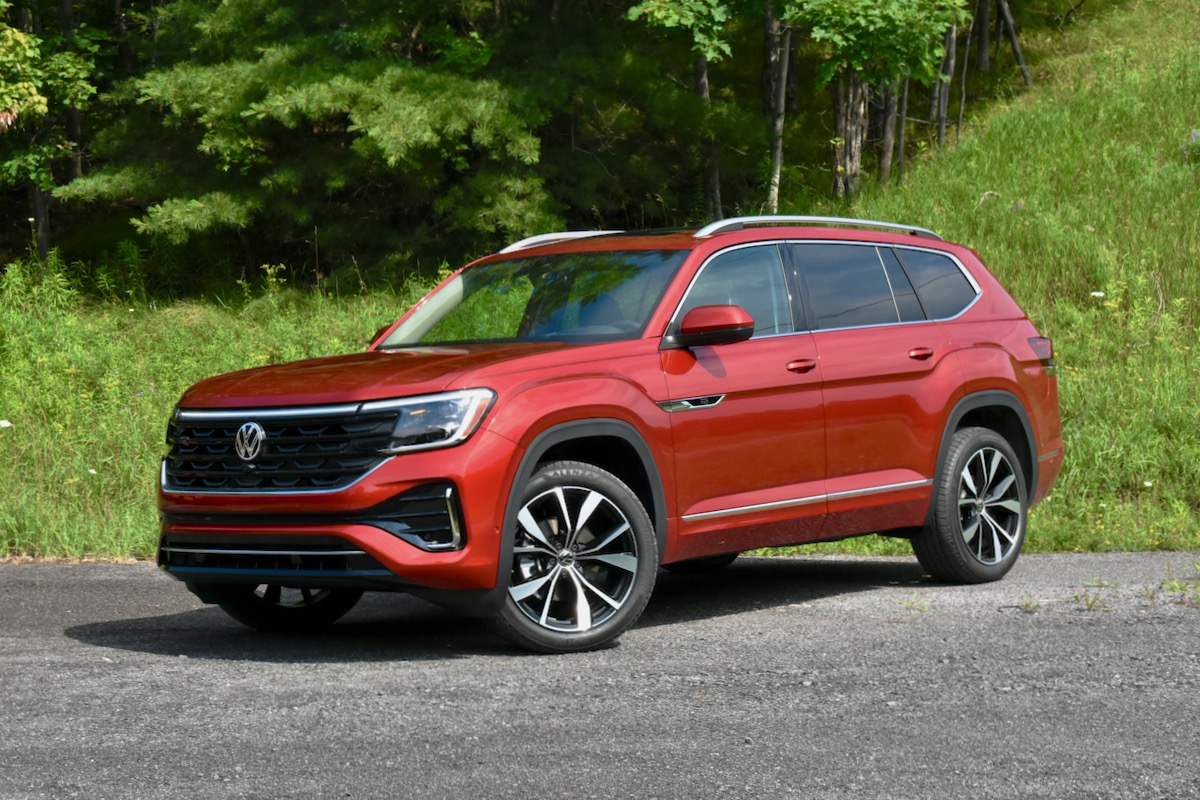
The 2026 Volkswagen Atlas exuded an air of luxury, particularly in the SEL Premium R-Line trim, which bordered on the territory of high-end crossovers. Starting from the base SE trim, the Atlas featured full-LED lighting, power-adjustable heated side mirrors, and roof rails, all contributing to a sophisticated silhouette that had aged gracefully since its 2018 debut. The SE with Technology trim added an illuminated logo, a trailer hitch, and larger 20-inch wheels, while the Peak Edition introduced rugged elements like unique bumpers and blackout trim. The SEL Premium R-Line further enhanced the exterior with power-folding side mirrors and 21-inch alloy wheels. Inside, the Atlas impressed with quilted diamond-pattern leather seats, metallic accents, and a 12-inch touchscreen, although the latter was more about aesthetics than functionality. Despite some functional shortcomings, the Atlas maintained an upscale appearance, rivaling more expensive models like the BMW X5.
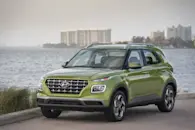
In contrast, the 2026 Hyundai Venue presented a more compact and utilitarian design, often resembling a tall hatchback rather than a traditional crossover SUV. Its design leaned towards a European aesthetic, with a bluff nose, upright windshield, and standard roof rails. The Venue's small size and narrow profile made it ideal for urban environments, while its high nose and black wheel flares added SUV-like cues. Inside, the Venue offered a simple and functional layout, with a digital instrument cluster and an 8-inch touchscreen that felt adequate for its class. The Venue's interior was characterized by hard black plastic surfaces, with limited soft-touch materials, reflecting its budget-friendly nature. Despite its modest appearance, the Venue provided essential features and a practical design for everyday use.

The 2026 Volkswagen Atlas was powered by a turbocharged 2.0-liter inline four-cylinder engine, producing 269 horsepower and 273 pound-feet of torque. This engine, paired with an eight-speed automatic transmission, offered a balance of refinement and efficiency. While front-wheel drive was standard on lower trims, all-wheel drive was available across the lineup and standard on higher trims. The Atlas delivered a smooth driving experience, with a wide torque band that made it feel capable, especially during highway merging. However, initial acceleration was not particularly quick, with a 0-60 mph time of 8.3 seconds for the AWD model. The Atlas achieved 22 miles per gallon during testing, slightly better than the EPA's estimate. The 4Motion AWD system performed well in various conditions, although it wasn't designed for serious off-roading. The Atlas had a maximum towing capacity of 5,000 pounds, competitive within its segment. However, ride quality was a concern, particularly with the larger wheels on the SEL Premium R-Line trim, which transmitted vibrations on rough surfaces.
The 2026 Hyundai Venue, on the other hand, was equipped with a naturally aspirated 1.6-liter four-cylinder engine, generating 121 horsepower and 113 pound-feet of torque. This engine was paired with a continuously variable transmission (CVT) and front-wheel drive. The Venue's performance was modest, with a 0-60 mph time in the 8.5–8.8-second range, aided by its lightweight construction. While it felt peppy in city traffic, highway acceleration required planning due to the limited torque. The CVT provided stepped gear ratios, but heavy throttle caused engine noise. The Venue's small size and low weight contributed to agile handling, making it easy to maneuver in tight spaces. However, the ride could be jiggly on uneven surfaces due to its solid rear axle.
The 2026 Volkswagen Atlas excelled in accommodating passengers and cargo. The SEL Premium R-Line's front seats offered heating, ventilation, and massage functions, ensuring comfort on long drives. The second row featured captain's chairs that folded flat and tipped forward for easy access to the third row. The third-row seats provided decent leg support, and with the second row slid forward, taller passengers could ride comfortably. The Atlas boasted a competitive cargo capacity, with 20.6 cubic feet behind the third row, expanding to 55.5 cubic feet with the third row folded, and a total of 96.6 cubic feet. This made it an excellent choice for families needing ample space for passengers and belongings.
In contrast, the 2026 Hyundai Venue offered a more compact interior. The cloth and H-Tex seats provided adequate comfort, with six-way manual adjustments for the driver. While headroom was plentiful, legroom was limited for taller occupants. The rear seat accommodated average-sized adults, but taller passengers might find it cramped. The Venue's cargo space was modest, with 18.7 cubic feet behind the rear seats and 31.9 cubic feet with the seats folded. The lack of sound deadening in the cargo area highlighted cost-cutting measures. Overall, the Venue's interior was functional but limited in space compared to larger crossovers.
The 2026 Volkswagen Atlas featured a 12-inch touchscreen with the MIB3 operating system, offering wireless Apple CarPlay and Android Auto, wireless charging, and a 10.25-inch Digital Cockpit Pro instrument cluster. The SEL Premium R-Line trim added a Harman Kardon audio system, a head-up display, and a surround-view camera system. However, the MIB3 system was frustrating to use, with complex menus and touch-sensitive controls that were invisible at night. The voice control system was unreliable, making Apple CarPlay and Android Auto preferable options. Despite its attractive graphics, the Atlas's tech prioritized form over function.
The 2026 Hyundai Venue came with an 8-inch touchscreen for basic infotainment features, including wireless Apple CarPlay and Android Auto. While the screen felt small by modern standards, it was functional and responsive. The Venue lacked advanced features like navigation and a premium audio system, but its simplicity suited its budget-friendly nature. The digital instrument cluster displayed limited information and was not programmable. Overall, the Venue's tech offerings were basic but adequate for its class.
The 2026 Volkswagen Atlas received a five-star overall safety rating from the NHTSA and was named a Top Safety Pick+ by the IIHS for the 2025 model. The Atlas came standard with Volkswagen's IQ.Drive suite of driver assistance features, including forward-collision warning, automatic emergency braking, blind-spot monitors, lane-keep assist, and adaptive cruise control. These systems performed reliably during testing, enhancing the Atlas's safety credentials.
The 2026 Hyundai Venue offered a good set of standard safety features, including forward-collision warning, automatic emergency braking, lane-keep assist, and a driver-attention monitor. However, it lacked adaptive cruise control. The Venue received a four-star safety rating from the NHTSA, with some areas still unrated by the IIHS. The driver attention monitor was overly sensitive, but the safety systems generally worked well.
CarGurus highlights
According to CarGurus experts, the overall rating for the 2026 Volkswagen Atlas is 6.8 out of 10, while the 2026 Hyundai Venue scores 5.2 out of 10. Based on these ratings, the Volkswagen Atlas is the recommended choice for those seeking a more refined and spacious SUV with advanced safety features and a luxurious feel.
Choose the 2026 Volkswagen Atlas if:
- You need a spacious SUV with ample cargo capacity and comfortable seating for long trips.
- You value advanced safety features and a high safety rating.
- You prefer a vehicle with a luxurious appearance and upscale interior materials.


Choose the 2026 Hyundai Venue if:
- You want a budget-friendly vehicle with essential safety features.
- You need a compact and maneuverable car for urban environments.
- You prioritize simplicity and functionality over advanced tech features.


CarGurus highlights
According to CarGurus experts, the overall rating for the 2026 Volkswagen Atlas is 6.8 out of 10, while the 2026 Hyundai Venue scores 5.2 out of 10. Based on these ratings, the Volkswagen Atlas is the recommended choice for those seeking a more refined and spacious SUV with advanced safety features and a luxurious feel.
Choose the 2026 Volkswagen Atlas if:
Shop Now- You need a spacious SUV with ample cargo capacity and comfortable seating for long trips.
- You value advanced safety features and a high safety rating.
- You prefer a vehicle with a luxurious appearance and upscale interior materials.
Choose the 2026 Hyundai Venue if:
Shop Now- You want a budget-friendly vehicle with essential safety features.
- You need a compact and maneuverable car for urban environments.
- You prioritize simplicity and functionality over advanced tech features.

By: CarGurus + AI
At CarGurus, our team of experienced automotive writers remain at the heart of our content operation, conducting hands-on car tests and writing insightful guides that are backed by years of industry experience. To complement this, we are harnessing AI to make our content offering more diverse and more helpful to shoppers than ever. To achieve this, our AI systems are based exclusively on CarGurus content, ratings and data, so that what we produce is both unique to CarGurus, and uniquely helpful to car shoppers.

