Ford Edge vs Hyundai Venue
Overview | |
MSRP$32,750 | MSRP$18,750 |
Listings889 | Listings139 |
Ratings & Reviews | |
User Reviews | User Reviews |
Expert reviews7.2 out of 10 | Expert reviews7.3 out of 10 |
Pros
Cons
| Pros
Cons
|
Reviews SummaryThe Ford Edge proves that trends run in cycles. Launched in the early 2000s, the original Edge was one of the first midsize crossover SUVs, sporting car-like styling that sharply contrasted the more traditional-looking Ford Explorer of the time. However, new-car buyers realized they liked the roominess of three-row SUVs like the Explorer more, and interest in the two-row Edge waned. Now, however, car shoppers are once again eyeing two-row midsize SUVs, this time as an alternative to sedans. The Edge is now part of a growing market segment that includes the Chevrolet Blazer, Honda Passport, Hyundai Santa Fe, Jeep Grand Cherokee, Nissan Murano, and Volkswagen Atlas Cross Sport. Yet while market dynamics have changed, the Edge hasn’t. The current second-generation Edge dates back to the 2015 model year, and even a substantial update undertaken for the 2019 model year is quickly receding in the rearview mirror. The Edge now sits between the much newer Explorer and Ford Escape in the automaker's SUV-heavy lineup. Aside from some new tech features, the 2021 Ford Edge doesn’t get many significant changes, so we can evaluate it based on our experience with previous model years. As with the 2020 model year, trim levels include SE, SEL, ST-Line, Titanium, and ST. | |
Reviews SummaryThis is the future of basic transportation. Shoppers are shifting from sedans and hatchbacks to crossovers and SUVs, but the bigger the car, the bigger the price tag. Enter the Hyundai Venue. Roughly the same shape as a typical crossover, but impossibly small, the Venue offers the look and feel of a crossover while maintaining the footprint (and, very nearly, the price) of a hatchback. | |
No video found | |
Popular Features & Specs | |
Engine2.0L 250 hp I4 | Engine1.6L 121 hp I4 |
DrivetrainFWD | DrivetrainFWD |
Seating Capacity5 | Seating Capacity5 |
Horsepower250 hp @ 5500 rpm | Horsepower121 hp @ 6300 rpm |
MPG City21 | MPG City30 |
MPG Highway29 | MPG Highway33 |
Engine | |
Engine Name2.0L 250 hp I4 | Engine Name1.6L 121 hp I4 |
Torque280 lb-ft @ 3000 rpm | Torque113 lb-ft @ 4500 rpm |
Horsepower250 hp @ 5500 rpm | Horsepower121 hp @ 6300 rpm |
DrivetrainFWD | DrivetrainFWD |
Fuel Economy | |
MPG City21 | MPG City30 |
MPG Highway29 | MPG Highway33 |
Interior | |
Seating Capacity5 | Seating Capacity5 |
Safety | |
Front Crash Overall5 | Front Crash Overall4 |
Side Crash Overall5 | Side Crash Overall5 |
Dimensions & Capacity | |
Cargo Space39.2 cu ft | Cargo Space18.7 cu ft |
Curb Weight3960 lbs | Curb Weight2612 lbs |
Height68.3 in | Height61.6 in |
Length188.8 in | Length159.0 in |
Width85.8 in | Width69.7 in |
Wheelbase112.2 in | Wheelbase99.2 in |
Maximum Payload1310 lbs | Maximum Payload1158 lbs |
Number of doors4 | Number of doors4 |
Maximum Towing Capacity1500 lbs | Maximum Towing Capacity |
Overview | ||
MSRP | $32,750 | $18,750 |
Listings | ||
Ratings & Reviews | ||
User reviews | ||
Expert reviews | 7.2 out of 10Read full review | 7.3 out of 10Read full review |
Pros & cons | Pros
Cons
| Pros
Cons
|
Summary | The Ford Edge proves that trends run in cycles. Launched in the early 2000s, the original Edge was one of the first midsize crossover SUVs, sporting car-like styling that sharply contrasted the more traditional-looking Ford Explorer of the time. However, new-car buyers realized they liked the roominess of three-row SUVs like the Explorer more, and interest in the two-row Edge waned. Now, however, car shoppers are once again eyeing two-row midsize SUVs, this time as an alternative to sedans. The Edge is now part of a growing market segment that includes the Chevrolet Blazer, Honda Passport, Hyundai Santa Fe, Jeep Grand Cherokee, Nissan Murano, and Volkswagen Atlas Cross Sport. Yet while market dynamics have changed, the Edge hasn’t. The current second-generation Edge dates back to the 2015 model year, and even a substantial update undertaken for the 2019 model year is quickly receding in the rearview mirror. The Edge now sits between the much newer Explorer and Ford Escape in the automaker's SUV-heavy lineup. Aside from some new tech features, the 2021 Ford Edge doesn’t get many significant changes, so we can evaluate it based on our experience with previous model years. As with the 2020 model year, trim levels include SE, SEL, ST-Line, Titanium, and ST. | This is the future of basic transportation. Shoppers are shifting from sedans and hatchbacks to crossovers and SUVs, but the bigger the car, the bigger the price tag. Enter the Hyundai Venue. Roughly the same shape as a typical crossover, but impossibly small, the Venue offers the look and feel of a crossover while maintaining the footprint (and, very nearly, the price) of a hatchback. |
Video | No video found | |
Popular Features & Specs | ||
Engine | 2.0L 250 hp I4 | 1.6L 121 hp I4 |
Drivetrain | FWD | FWD |
Seating Capacity | 5 | 5 |
Horsepower | 250 hp @ 5500 rpm | 121 hp @ 6300 rpm |
MPG City | 21 | 30 |
MPG Highway | 29 | 33 |
Engine | ||
Engine Name | 2.0L 250 hp I4 | 1.6L 121 hp I4 |
Torque | 280 lb-ft @ 3000 rpm | 113 lb-ft @ 4500 rpm |
Horsepower | 250 hp @ 5500 rpm | 121 hp @ 6300 rpm |
Drivetrain | FWD | FWD |
Fuel Economy | ||
MPG City | 21 | 30 |
MPG Highway | 29 | 33 |
Interior | ||
Seating Capacity | 5 | 5 |
Safety | ||
Front Crash Overall | 5 | 4 |
Side Crash Overall | 5 | 5 |
Dimensions & Capacity | ||
Cargo Space | 39.2 cu ft | 18.7 cu ft |
Curb Weight | 3960 lbs | 2612 lbs |
Height | 68.3 in | 61.6 in |
Length | 188.8 in | 159.0 in |
Width | 85.8 in | 69.7 in |
Wheelbase | 112.2 in | 99.2 in |
Maximum Payload | 1310 lbs | 1158 lbs |
Number of doors | 4 | 4 |
Maximum Towing Capacity | 1500 lbs | |
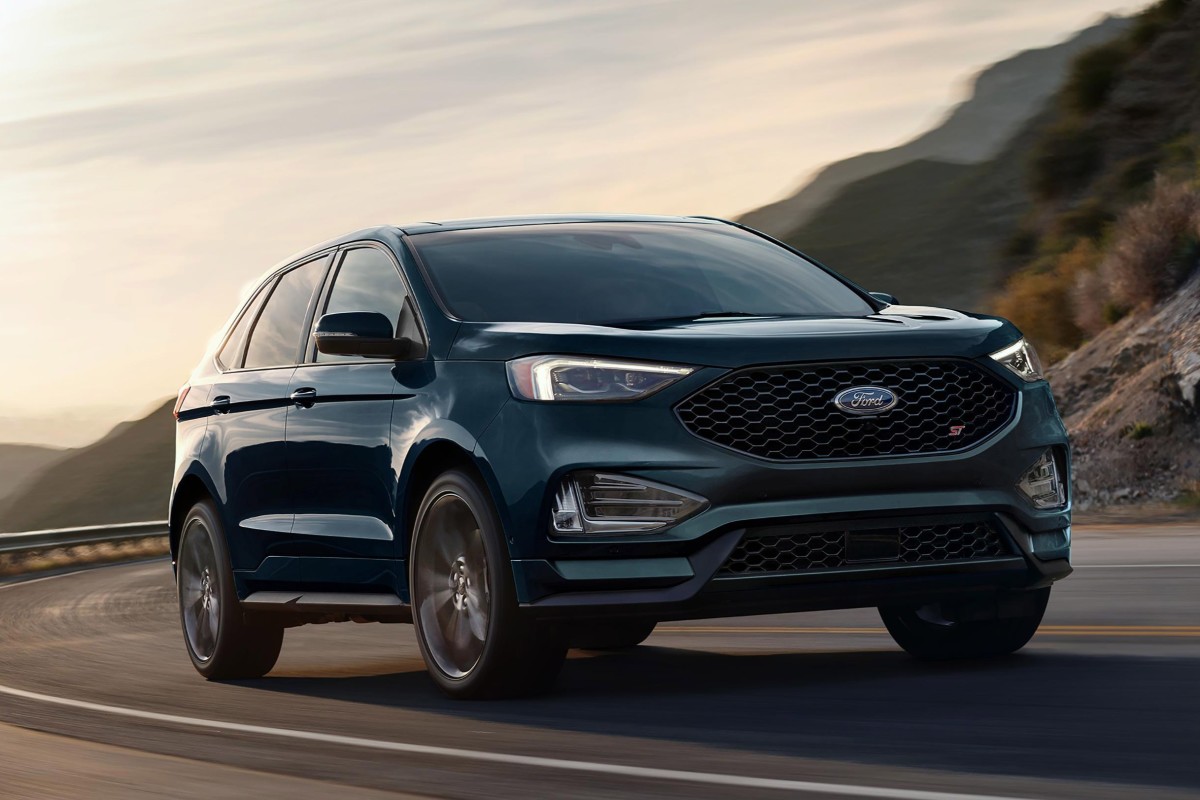
The 2021 Ford Edge maintained a familiar styling since its 2019 refresh, which successfully aligned its exterior with Ford's contemporary design language. This refresh gave the Edge a cleaner appearance compared to the more elaborate designs of competitors like the Chevy Blazer and Hyundai Santa Fe. The Edge Titanium models featured additional chrome accents to signify their premium status, while the ST trim boasted a blacked-out grille, standard 20-inch wheels, and a sporty body kit. The interior, however, began to show signs of aging, with a design that struggled to keep up with the exterior's freshness. Despite updates to accommodate new features like a larger touchscreen, the interior felt less modern. The Titanium models offered leather upholstery, and the ST models included sporty front seats with added bolstering and a leather-wrapped steering wheel with contrast stitching.
The 2021 Hyundai Venue, on the other hand, presented a timeless design that seemed unlikely to age poorly. Its upright stance, nearly horizontal roofline, and steeply dropping tailgate gave it a distinctive look that belied its small size. The Venue's grille was appropriately sized, drawing attention without overwhelming the design. Roof rails added a practical touch, and the rear featured wide-spaced letters spelling out the Venue's name. The headlights were split into two pieces, and the taillights showcased an intriguing pattern of triangles and diagonal elements. The Venue's exterior saw minimal changes from the 2020 model, with updates like 15-inch alloys replacing the previous steel wheels on the base SE trim, and 17-inch alloys becoming standard on the SEL and Denim trims. The top-line Denim trim stood out with its white roof and unique paint job, while the SEL trim offered better value with standard features previously part of the Convenience Package.

The 2021 Ford Edge offered a 2.0-liter turbocharged EcoBoost four-cylinder engine, delivering 250 horsepower and 275 pound-feet of torque. This engine was paired with an eight-speed automatic transmission, available in both front-wheel drive (FWD) and optional all-wheel drive (AWD). The Edge ST performance model featured a more powerful EcoBoost twin-turbo 2.7-liter V6 engine, producing 335 horsepower and 380 pound-feet of torque on 93-octane fuel. The ST came with standard AWD, an eight-speed automatic transmission, and model-specific suspension tuning. An optional package added upgraded brakes and 21-inch wheels with summer tires. The Edge ST aimed to compete with performance SUVs like the Porsche Macan, although some found this comparison ambitious. The Edge's towing capacities ranged from 3,958 pounds for the base FWD model to 4,525 pounds for the V6-powered Edge ST.
In contrast, the 2021 Hyundai Venue housed a 1.6-liter four-cylinder engine under its hood, producing 121 horsepower and 113 pound-feet of torque. This engine was designed for efficiency rather than power, with no turbocharger or alternative powertrain options available. The Venue's performance was comparable to rivals like the Nissan Kicks, Ford EcoSport, and Toyota C-HR, although it was smaller and lighter. The Venue offered only front-wheel drive (FWD), with no all-wheel drive (AWD) option, but included a selectable drive mode for snowy conditions. A continuously variable automatic transmission (CVT) managed the power, as Hyundai discontinued the six-speed manual transmission from the base SE trim. Despite its modest power, the Venue's lightweight design allowed for nimble handling in lower-speed areas, making it feel lively when accelerating from a stoplight.
The 2021 Ford Edge remained competitive in terms of interior space, offering the most rear-seat headroom among two-row midsize crossovers. Legroom in both the first and second rows was second only to the Hyundai Santa Fe. The Edge provided 39.2 cubic feet of cargo space with the rear seats in place, expanding to 73.4 cubic feet with the seats folded, trailing only the Honda Passport and Volkswagen Atlas Cross Sport. A foot-activated power liftgate was available on higher trims. The Edge's rotary shift knob was designed to free up space on the center console, but the narrow console width limited the available space. A storage nook below the raised console was difficult to reach and easy to forget.
The 2021 Hyundai Venue, given its compact size, offered ample headroom and legroom in the front seats, along with decent storage space. A tray ahead of the gear selector provided space for a phone or wallet, while a tray ahead of the front passenger added convenience. The center console's bin was small but sufficient for essentials like a notebook and pen. Automatic climate control efficiently managed the Venue's small cabin. The back seat was tighter, with limited legroom for adults on longer drives, though headroom was adequate. Cargo space was limited, with 18.7 cubic feet behind the rear seats and 31.9 cubic feet with the seats folded. The Venue's cargo capacity lagged behind competitors like the Nissan Kicks, Toyota C-HR, and Ford EcoSport, making it less suitable for those prioritizing cargo space.
The 2021 Ford Edge was equipped with Ford's latest Sync 4 infotainment system, featuring a 12-inch touchscreen and standard wireless Apple CarPlay and Android Auto. Bluetooth, SiriusXM with 360L satellite radio, and a built-in 4G LTE WiFi hotspot were also standard. The Edge ST models included a 12-speaker Bang & Olufsen audio system. The Edge featured four USB ports, with two rear USB ports added for the 2021 model year. Sync 4's simple graphics and straightforward menu layouts were user-friendly, and the Edge stood out for offering wireless Apple CarPlay and Android Auto, a feature not available in all competitors.
The 2021 Hyundai Venue showcased Hyundai's commitment to technology, offering an 8-inch touchscreen with high resolution and responsive swipe functionality. The interface included physical buttons for quick access to media sources, navigation, and settings, along with a customizable starred button. The Venue's infotainment system allowed for driver profiles with customized radio presets, appealing to families with multiple drivers. Bluetooth, Apple CarPlay, and Android Auto were standard, with wireless CarPlay planned for the base SE trim in the future. The Venue's infotainment system was designed for simplicity and ease of use, with charming details like classic tube-amp-style bulbs for radio station numbers.
The 2021 Ford Edge earned the Insurance Institute for Highway Safety (IIHS) "Top Safety Pick" designation, with top "Good" ratings in all crash tests and a "Superior" rating for vehicle-to-vehicle front crash prevention. However, it received an "Advanced" rating for vehicle-to-pedestrian front crash prevention, an "Acceptable" rating for LATCH child-seat anchor ease of use, and varying headlight ratings. The National Highway Traffic Safety Administration (NHTSA) awarded the Edge a five-star overall safety rating, with five stars in frontal and side crash tests and four stars in rollover tests. The Edge included standard safety features under the Ford Co-Pilot360 banner, such as automatic high beams, blind-spot monitoring, lane-keep assist, forward-collision warning, and more. Adaptive cruise control and Evasive Steering Assist were standard on all but the base SE trim.
The 2021 Hyundai Venue, despite its small size, offered a commendable suite of safety features. Standard equipment included automatic emergency braking, lane-keeping assist, and driver-attention warning. The SEL and Denim trims added blind-spot monitoring with rear cross-traffic alert. Hyundai's advanced driver-assistance systems (ADAS) were seamlessly integrated, avoiding distracting alerts. In crash tests, the Venue received four out of five stars in NHTSA's driver-side and passenger-side front collision tests, as well as for rollover.
CarGurus highlights

According to CarGurus experts, the overall rating for the 2021 Ford Edge is 7.2 out of 10, while the 2021 Hyundai Venue scores 7.3 out of 10. Based on these ratings, the Hyundai Venue is the recommended choice, offering a better balance of style, technology, and safety features at a more affordable price point.
Choose the 2021 Ford Edge if:
- You prioritize a more powerful engine and higher towing capacity.
- You value a spacious interior with ample rear-seat headroom and cargo space.
- You want advanced technology features like wireless Apple CarPlay and Android Auto.


Choose the 2021 Hyundai Venue if:
- You seek a stylish, compact crossover with a timeless design.
- You prefer a budget-friendly vehicle with a strong focus on technology and user-friendly infotainment.
- You need a car with standard safety features and seamless ADAS integration.


CarGurus highlights
According to CarGurus experts, the overall rating for the 2021 Ford Edge is 7.2 out of 10, while the 2021 Hyundai Venue scores 7.3 out of 10. Based on these ratings, the Hyundai Venue is the recommended choice, offering a better balance of style, technology, and safety features at a more affordable price point.
Choose the 2021 Ford Edge if:
Shop Now- You prioritize a more powerful engine and higher towing capacity.
- You value a spacious interior with ample rear-seat headroom and cargo space.
- You want advanced technology features like wireless Apple CarPlay and Android Auto.
Choose the 2021 Hyundai Venue if:
Shop Now- You seek a stylish, compact crossover with a timeless design.
- You prefer a budget-friendly vehicle with a strong focus on technology and user-friendly infotainment.
- You need a car with standard safety features and seamless ADAS integration.

By: CarGurus + AI
At CarGurus, our team of experienced automotive writers remain at the heart of our content operation, conducting hands-on car tests and writing insightful guides that are backed by years of industry experience. To complement this, we are harnessing AI to make our content offering more diverse and more helpful to shoppers than ever. To achieve this, our AI systems are based exclusively on CarGurus content, ratings and data, so that what we produce is both unique to CarGurus, and uniquely helpful to car shoppers.

