2024 Genesis GV80 vs 2025 Toyota Sequoia
Overview | |
MSRP$57,700 | MSRP$62,425 |
Listings761 | Listings452 |
Ratings & Reviews | |
User Reviews | User Reviews |
Expert reviews7.7 out of 10 | Expert reviews5.5 out of 10 |
Pros
Cons
| Pros
Cons
|
2024 Genesis GV80 Reviews SummaryGenesis introduced the GV80 in 2021, and the crossover SUV is getting a minor refresh in 2025. Still, the 2024 GV80 remains a good choice unless you want to wait for the fancier styling, more high-tech interior, or new supercharged GV80 Coupe coming next year. Otherwise, today’s GV80 is pretty much the same as tomorrow’s GV80, and in some respects, it is the more elegant and traditional choice. Verdict: Based on our evaluation of the 2024 Genesis GV80, seat comfort is not what it should be. Also, to use Apple CarPlay or Android Auto, you need a USB cable. This Genesis is thirsty, too. But otherwise, we have few complaints about this stylish, safe, and mostly rewarding midsize luxury SUV. | |
2025 Toyota Sequoia Reviews SummaryThe 2025 Sequoia is Toyota’s full-size SUV, based on the same platform as the Tundra pickup truck and using the same i-Force Max hybrid powertrain. It seats up to eight people, holds up to 86.9 cubic feet of cargo, carries up to 1,730 pounds of payload, and tows up to 9,520 pounds of trailer. The new Sequoia 1794 Edition slots into the lineup as a Texas-themed luxury model, and it certainly is nice. But it cannot mask this SUV’s fundamental flaws. Verdict: People buy full-size SUVs to carry lots of people, haul lots of cargo, and tow lots of weight. However, due to its packaging requirements, the Sequoia is a rock star only if you’re attaching a trailer to it, and even then, it’s not class-leading in capability. | |
No video found | No video found |
Popular Features & Specs | |
Engine2.5L 300 hp I4 | Engine3.4L 437 hp V6 Hybrid |
DrivetrainAWD | Drivetrain4X2 |
Seating Capacity5 | Seating Capacity8 |
Horsepower300 hp @ 5800 rpm | Horsepower437 hp @ 5200 rpm |
EV Battery Capacity | EV Battery Capacity1.9 kWh |
MPG City20 | MPG City21 |
MPG Highway24 | MPG Highway24 |
Engine | |
Engine Name2.5L 300 hp I4 | Engine Name3.4L 437 hp V6 Hybrid |
Torque311 lb-ft @ 1650 rpm | Torque583 lb-ft @ 2400 rpm |
Horsepower300 hp @ 5800 rpm | Horsepower437 hp @ 5200 rpm |
DrivetrainAWD | Drivetrain4X2 |
Fuel Economy | |
EV Battery Capacity | EV Battery Capacity1.9 kWh |
MPG City20 | MPG City21 |
MPG Highway24 | MPG Highway24 |
Interior | |
Seating Capacity5 | Seating Capacity8 |
Key Features | |
Navigation SystemStandard | Navigation System |
Sunroof/Moonroof | Sunroof/MoonroofStandard |
Safety | |
Front Crash Overall4 | Front Crash Overall |
Dimensions & Capacity | |
Cargo Space34.9 cu ft | Cargo Space22.3 cu ft |
Curb Weight4742 lbs | Curb Weight5620 lbs |
Height67.5 in | Height74.5 in |
Length194.7 in | Length208.1 in |
Width77.8 in | Width79.8 in |
Wheelbase116.3 in | Wheelbase122.0 in |
Maximum Payload1188 lbs | Maximum Payload1730 lbs |
Number of doors4 | Number of doors4 |
Maximum Towing Capacity6000 lbs | Maximum Towing Capacity9520 lbs |
Standard Towing Capacity | Standard Towing Capacity9520 lbs |
Overview | ||
MSRP | $57,700 | $62,425 |
Listings | ||
Ratings & Reviews | ||
User reviews | ||
Expert reviews | 7.7 out of 10Read full review | 5.5 out of 10Read full review |
Pros & cons | Pros
Cons
| Pros
Cons
|
Summary | Genesis introduced the GV80 in 2021, and the crossover SUV is getting a minor refresh in 2025. Still, the 2024 GV80 remains a good choice unless you want to wait for the fancier styling, more high-tech interior, or new supercharged GV80 Coupe coming next year. Otherwise, today’s GV80 is pretty much the same as tomorrow’s GV80, and in some respects, it is the more elegant and traditional choice. Verdict: Based on our evaluation of the 2024 Genesis GV80, seat comfort is not what it should be. Also, to use Apple CarPlay or Android Auto, you need a USB cable. This Genesis is thirsty, too. But otherwise, we have few complaints about this stylish, safe, and mostly rewarding midsize luxury SUV. | The 2025 Sequoia is Toyota’s full-size SUV, based on the same platform as the Tundra pickup truck and using the same i-Force Max hybrid powertrain. It seats up to eight people, holds up to 86.9 cubic feet of cargo, carries up to 1,730 pounds of payload, and tows up to 9,520 pounds of trailer. The new Sequoia 1794 Edition slots into the lineup as a Texas-themed luxury model, and it certainly is nice. But it cannot mask this SUV’s fundamental flaws. Verdict: People buy full-size SUVs to carry lots of people, haul lots of cargo, and tow lots of weight. However, due to its packaging requirements, the Sequoia is a rock star only if you’re attaching a trailer to it, and even then, it’s not class-leading in capability. |
Video | No video found | No video found |
Popular Features & Specs | ||
Engine | 2.5L 300 hp I4 | 3.4L 437 hp V6 Hybrid |
Drivetrain | AWD | 4X2 |
Seating Capacity | 5 | 8 |
Horsepower | 300 hp @ 5800 rpm | 437 hp @ 5200 rpm |
EV Battery Capacity | 1.9 kWh | |
MPG City | 20 | 21 |
MPG Highway | 24 | 24 |
Engine | ||
Engine Name | 2.5L 300 hp I4 | 3.4L 437 hp V6 Hybrid |
Torque | 311 lb-ft @ 1650 rpm | 583 lb-ft @ 2400 rpm |
Horsepower | 300 hp @ 5800 rpm | 437 hp @ 5200 rpm |
Drivetrain | AWD | 4X2 |
Fuel Economy | ||
EV Battery Capacity | 1.9 kWh | |
MPG City | 20 | 21 |
MPG Highway | 24 | 24 |
Interior | ||
Seating Capacity | 5 | 8 |
Key Features | ||
Navigation System | Standard | |
Sunroof/Moonroof | Standard | |
Safety | ||
Front Crash Overall | 4 | |
Dimensions & Capacity | ||
Cargo Space | 34.9 cu ft | 22.3 cu ft |
Curb Weight | 4742 lbs | 5620 lbs |
Height | 67.5 in | 74.5 in |
Length | 194.7 in | 208.1 in |
Width | 77.8 in | 79.8 in |
Wheelbase | 116.3 in | 122.0 in |
Maximum Payload | 1188 lbs | 1730 lbs |
Number of doors | 4 | 4 |
Maximum Towing Capacity | 6000 lbs | 9520 lbs |
Standard Towing Capacity | 9520 lbs | |
The 2024 Genesis GV80 presented a choice between two engines: the 2.5T turbocharged four-cylinder and the 3.5T twin-turbocharged V6. Buyers could select from Standard, Advanced, Prestige, or Prestige Signature trims, with prices ranging from $57,700 to $81,750, plus a $1,350 destination charge. Our test vehicle, a GV80 3.5T in the top-tier Prestige Signature trim, featured an optional Matterhorn White Matte paint, bringing the MSRP to $84,600, including destination. The Prestige Signature trim offered exclusive exterior colors like Vik Black, Matterhorn White Matte, and Mauna Red, complemented by dark chrome trim and nearly invisible 22-inch wheels. Despite its luxurious appeal, the Prestige Signature's exterior was relatively plain compared to its interior, which boasted Ultramarine Blue over Dune decor, diamond-stitched Nappa leather, and a host of high-end features like ambient lighting and a 3D digital instrument cluster.
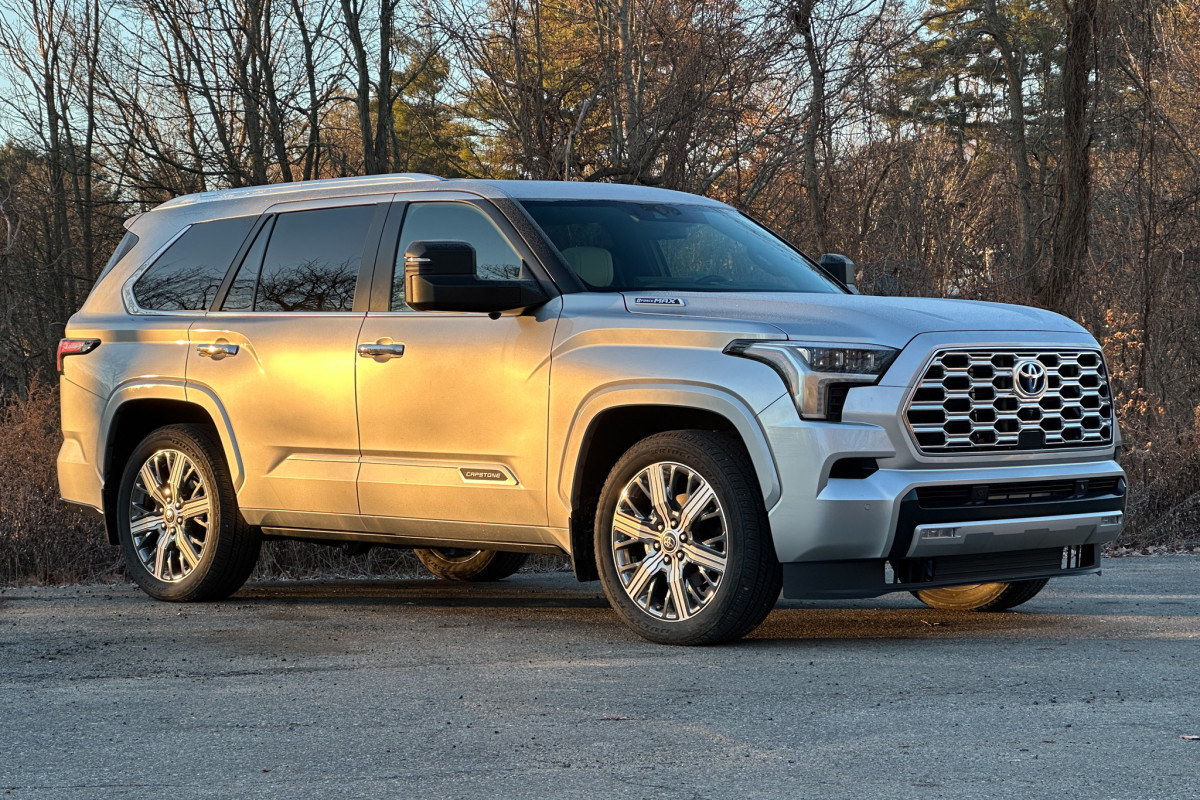
In contrast, the 2025 Toyota Sequoia 1794 Edition took inspiration from the Tundra's 1794 Edition, named after the ranch where the assembly plant stands. Building on the Sequoia Platinum, it featured machined-finish 20-inch wheels, more chrome, Saddle Tan leather upholstery, and American walnut wood trim. Prices ranged from $62,425 to $83,915, plus a destination charge. Our test vehicle, equipped with the TRD Off-Road Package, had a MSRP of $85,700, including a $1,945 destination charge. The Sequoia's Lunar Rock paint and black TRD off-road wheels made it stand out, despite its rarity on the road. Inside, the Saddle Tan leather and walnut wood trim contrasted with the black interior, but the use of typical Toyota-grade plastic detracted from the luxury feel. The TRD Off-Road Package added red accents and logos, which seemed out of place, though the aluminum pedals were a nice touch.

The 2024 Genesis GV80 offered two engine options: a turbocharged 2.5-liter four-cylinder engine producing 300 horsepower and 311 pound-feet of torque, and a twin-turbocharged 3.5-liter V6 engine delivering 375 horsepower and 391 pound-feet of torque. Our test vehicle featured the latter, providing a more satisfying performance despite its thirstiness on the road. The EPA estimated a combined fuel economy of 20 mpg, but our observations showed 17.2 mpg. Both engines were paired with an eight-speed automatic transmission and standard all-wheel drive, with five driving modes available: Eco, Comfort, Sport, Custom, and Snow. The GV80 boasted 8.1 inches of ground clearance and a towing capacity of up to 6,000 pounds. The 3.5T model included upgraded front brakes and an adaptive damping suspension, offering a rewarding driving experience with swift acceleration and commendable grip from its P265/40R22 all-season tires.
The 2025 Toyota Sequoia came standard with an i-Force Max hybrid powertrain, combining a twin-turbocharged 3.4-liter V6 engine, an electric motor, a 1.87-kilowatt-hour nickel metal hydride battery pack, and a 10-speed automatic transmission. This setup produced 437 horsepower and 583 pound-feet of torque, with a part-time four-wheel-drive system standard on the 1794 Edition. Despite its 6,150-pound weight, the Sequoia offered quick acceleration and a robust engine note, though fuel economy fell short of expectations. The EPA estimated 20 mpg in combined driving, but our test vehicle averaged only 16.2 mpg. The 1794 Edition's towing and payload capacities were 9,010 pounds and 1,410 pounds, respectively, surpassing several rivals. However, the Sequoia's packaging and driving dynamics were compromised by the battery pack's rear placement and a solid rear axle, affecting rear-seat room and cargo space. The optional TRD Off-Road Package added off-road capabilities, but the standard front air dam limited its approach angle.
In 2024, the Genesis GV80 3.5T Advanced was the only model with a third-row seat, while the Prestige Signature trim offered seating for four with power-adjustable, heated, and ventilated second-row captain’s chairs. This limited passenger capacity meant leaving the GV80 at home for family trips. Depending on the trim, the GV80 featured artificial leather, real leather, or premium leather, with standard heated front seats, a heated steering wheel, and a power hands-free liftgate. Our test vehicle included a panoramic glass roof, triple-zone climate control, and ventilated front seats with massage programs. However, the seats were uncomfortable on long trips, and second-row legroom was unimpressive. Cargo space measured 34.9 cubic feet behind the second row, expanding to 84 cubic feet with the seats folded, though the rear center console in the Prestige Signature required careful loading.
The 2025 Toyota Sequoia accommodated up to eight people, though seven or six would be more comfortable, especially in the third row. The 1794 Edition's front seats offered 10-way power adjustment, heating, ventilation, and massage, with a heated steering wheel standard. Long rear doors facilitated access to the second and third rows, but were cumbersome in tight parking spaces. The second-row captain’s chairs were comfortable but lacked sliding and a console, offering only floor-mounted cupholders and a tray. The third row's high floor and low roof made entry and exit awkward, with limited headroom and a tendency for passengers to bounce on bumps. Cargo space was limited to 11.5 cubic feet with the third row in use, expanding to 49 cubic feet with it folded, and 86.9 cubic feet with both rear rows down. These figures were less than rival full-size SUVs, and even Toyota’s Grand Highlander offered more room.
The 2024 Genesis GV80 featured a 14.5-inch touchscreen infotainment display, though its distance from the driver encouraged use of the center console's control dial. Standard features included a navigation system, SiriusXM satellite radio, and wired Apple CarPlay and Android Auto. A Wi-Fi hotspot was new for 2024, and wireless smartphone charging was standard, with the Prestige Signature adding it in the second row. The GV80's infotainment system was user-friendly, with a pleasing display and intuitive interface. A digital key system allowed smartphone access, and most trims had a Lexicon premium sound system, with a head-up display on the Prestige and Prestige Signature.
The 2025 Toyota Sequoia 1794 Edition came with a 12.3-inch digital instrumentation panel and a 14-inch touchscreen infotainment system. Five connected services plans were available, with trial subscriptions ranging from one to ten years. Wireless Apple CarPlay and Android Auto were standard, and a 14-speaker JBL premium sound system was included. The oversized volume knob was convenient, but the lack of a tuning knob was frustrating. The Drive Connect’s natural voice recognition system, Intelligent Assistant, had limitations, struggling with some commands. The 1794 Edition also featured a surround-view camera system and a digital rearview mirror, both useful in tight parking situations.
The 2024 Genesis GV80 came equipped with numerous advanced driving-assistance systems (ADAS) and safety features, including a camera-based Blind-Spot View Monitor, Remote Smart Parking Assist, and Highway Driving Assist (HDA). HDA combined adaptive cruise control with lane-centering and lane-change assist, working well in light or slow-moving traffic but less so in moderate to heavy traffic. The Blind-Spot View Monitor displayed video feeds within the digital instrument panel, enhancing safety during lane changes. The Remote Smart Parking Assist allowed the GV80 to park itself, even with the driver outside the vehicle. The GV80 received a Top Safety Pick+ rating from the IIHS and a five-star overall rating from the NHTSA, though frontal-impact tests earned four stars for driver and passenger positions.
The 2025 Toyota Sequoia featured Toyota Safety Sense 2.5 (TSS 2.5), which included adaptive cruise control, forward collision warning, automatic emergency braking, lane departure warning, lane keep assist, lane-centering assist, and automatic high-beam headlights. Blind-spot monitoring and rear cross-traffic alert were also standard. While TSS 2.5 provided essential safety features, the lane assist systems could be aggravating, with frequent false warnings and noticeable lane keep assist activity. At the time of publication, neither the IIHS nor the NHTSA had released crash-test ratings for the Sequoia.
CarGurus highlights

According to CarGurus experts, the overall rating for the 2024 Genesis GV80 is 7.7 out of 10, while the 2025 Toyota Sequoia scores 5.5 out of 10. Based on these ratings, the Genesis GV80 is the recommended choice, offering a more luxurious experience, better safety ratings, and a more satisfying driving experience.
Choose the 2024 Genesis GV80 if:
- You prioritize a luxurious interior with high-end materials and advanced technology features.
- You seek a vehicle with a strong safety record, including top ratings from IIHS and NHTSA.
- You desire a more engaging driving experience with a choice of powerful engines and adaptive suspension.


Choose the 2025 Toyota Sequoia if:
- You need a full-size SUV with significant towing capacity and off-road capabilities.
- You prefer a hybrid powertrain with impressive horsepower and torque figures.
- You value a spacious interior with comfortable seating for up to eight passengers.


CarGurus highlights
According to CarGurus experts, the overall rating for the 2024 Genesis GV80 is 7.7 out of 10, while the 2025 Toyota Sequoia scores 5.5 out of 10. Based on these ratings, the Genesis GV80 is the recommended choice, offering a more luxurious experience, better safety ratings, and a more satisfying driving experience.
Choose the 2024 Genesis GV80 if:
Shop Now- You prioritize a luxurious interior with high-end materials and advanced technology features.
- You seek a vehicle with a strong safety record, including top ratings from IIHS and NHTSA.
- You desire a more engaging driving experience with a choice of powerful engines and adaptive suspension.
Choose the 2025 Toyota Sequoia if:
Shop Now- You need a full-size SUV with significant towing capacity and off-road capabilities.
- You prefer a hybrid powertrain with impressive horsepower and torque figures.
- You value a spacious interior with comfortable seating for up to eight passengers.

By: CarGurus + AI
At CarGurus, our team of experienced automotive writers remain at the heart of our content operation, conducting hands-on car tests and writing insightful guides that are backed by years of industry experience. To complement this, we are harnessing AI to make our content offering more diverse and more helpful to shoppers than ever. To achieve this, our AI systems are based exclusively on CarGurus content, ratings and data, so that what we produce is both unique to CarGurus, and uniquely helpful to car shoppers.

