2024 Genesis GV80 vs 2024 Toyota Sienna
Overview | |
MSRP$57,700 | MSRP$37,685 |
Listings127 | Listings103 |
Ratings & Reviews | |
User Reviews | User Reviews |
Expert reviews7.7 out of 10 | Expert reviews7.5 out of 10 |
Pros
Cons
| Pros
Cons
|
2024 Genesis GV80 Reviews SummaryGenesis introduced the GV80 in 2021, and the crossover SUV is getting a minor refresh in 2025. Still, the 2024 GV80 remains a good choice unless you want to wait for the fancier styling, more high-tech interior, or new supercharged GV80 Coupe coming next year. Otherwise, today’s GV80 is pretty much the same as tomorrow’s GV80, and in some respects, it is the more elegant and traditional choice. Verdict: Based on our evaluation of the 2024 Genesis GV80, seat comfort is not what it should be. Also, to use Apple CarPlay or Android Auto, you need a USB cable. This Genesis is thirsty, too. But otherwise, we have few complaints about this stylish, safe, and mostly rewarding midsize luxury SUV. | |
2024 Toyota Sienna Reviews SummaryNow in its fourth generation, the latest family hauler is offered only as a fuel-sipping hybrid model with three rows of seating and power sliding doors. Plus the Sienna comes standard with plenty of safety features and it’s comfy to boot. Why even both with an SUV? Verdict: The 2024 Toyota Sienna delivers impressive fuel efficiency, thanks to its standard hybrid engine. Toyota also offers optional all-wheel drive, and many shoppers may appreciate the Sienna's dramatic exterior styling. Performance, while efficient, isn't thrilling, and the Sienna's tech is looking a bit outdated. Otherwise, this minivan delivers great value. | |
No video found | No video found |
Popular Features & Specs | |
Engine2.5L 300 hp I4 | Engine2.5L 245 hp I4 Hybrid |
Drive TrainAWD | Drive TrainFWD |
Seating Capacity5 | Seating Capacity8 |
Horsepower300 hp @ 5800 rpm | Horsepower |
EV Battery Capacity | EV Battery Capacity1.9 kWh |
MPG City20 | MPG City36 |
MPG Highway24 | MPG Highway36 |
Engine | |
Engine Name2.5L 300 hp I4 | Engine Name2.5L 245 hp I4 Hybrid |
Torque311 lb-ft @ 1650 rpm | Torque |
Horsepower300 hp @ 5800 rpm | Horsepower |
DrivetrainAWD | DrivetrainFWD |
Fuel Economy | |
EV Battery Capacity | EV Battery Capacity1.9 kWh |
MPG City20 | MPG City36 |
MPG Highway24 | MPG Highway36 |
Interior | |
Seating Capacity5 | Seating Capacity8 |
Key Features | |
Navigation SystemStandard | Navigation System |
Safety | |
Front Crash Overall4 | Front Crash Overall4 |
Side Crash Overall | Side Crash Overall5 |
Dimensions & Capacity | |
Cargo Space34.9 cu ft | Cargo Space33.5 cu ft |
Curb Weight4742 lbs | Curb Weight4610 lbs |
Height67.5 in | Height68.5 in |
Length194.7 in | Length203.7 in |
Width77.8 in | Width78.5 in |
Wheelbase116.3 in | Wheelbase120.5 in |
Maximum Payload1188 lbs | Maximum Payload1560 lbs |
Number of doors4 | Number of doors4 |
Maximum Towing Capacity6000 lbs | Maximum Towing Capacity3500 lbs |
Overview | ||
MSRP | $57,700 | $37,685 |
Listings | ||
Ratings & Reviews | ||
User reviews | ||
Expert reviews | 7.7 out of 10Read full review | 7.5 out of 10Read full review |
Pros & cons | Pros
Cons
| Pros
Cons
|
Summary | Genesis introduced the GV80 in 2021, and the crossover SUV is getting a minor refresh in 2025. Still, the 2024 GV80 remains a good choice unless you want to wait for the fancier styling, more high-tech interior, or new supercharged GV80 Coupe coming next year. Otherwise, today’s GV80 is pretty much the same as tomorrow’s GV80, and in some respects, it is the more elegant and traditional choice. Verdict: Based on our evaluation of the 2024 Genesis GV80, seat comfort is not what it should be. Also, to use Apple CarPlay or Android Auto, you need a USB cable. This Genesis is thirsty, too. But otherwise, we have few complaints about this stylish, safe, and mostly rewarding midsize luxury SUV. | Now in its fourth generation, the latest family hauler is offered only as a fuel-sipping hybrid model with three rows of seating and power sliding doors. Plus the Sienna comes standard with plenty of safety features and it’s comfy to boot. Why even both with an SUV? Verdict: The 2024 Toyota Sienna delivers impressive fuel efficiency, thanks to its standard hybrid engine. Toyota also offers optional all-wheel drive, and many shoppers may appreciate the Sienna's dramatic exterior styling. Performance, while efficient, isn't thrilling, and the Sienna's tech is looking a bit outdated. Otherwise, this minivan delivers great value. |
Video | No video found | No video found |
Popular Features & Specs | ||
Engine | 2.5L 300 hp I4 | 2.5L 245 hp I4 Hybrid |
Drive Train | AWD | FWD |
Seating Capacity | 5 | 8 |
Horsepower | 300 hp @ 5800 rpm | |
EV Battery Capacity | 1.9 kWh | |
MPG City | 20 | 36 |
MPG Highway | 24 | 36 |
Engine | ||
Engine Name | 2.5L 300 hp I4 | 2.5L 245 hp I4 Hybrid |
Torque | 311 lb-ft @ 1650 rpm | |
Horsepower | 300 hp @ 5800 rpm | |
Drivetrain | AWD | FWD |
Fuel Economy | ||
EV Battery Capacity | 1.9 kWh | |
MPG City | 20 | 36 |
MPG Highway | 24 | 36 |
Interior | ||
Seating Capacity | 5 | 8 |
Key Features | ||
Navigation System | Standard | |
Safety | ||
Front Crash Overall | 4 | 4 |
Side Crash Overall | 5 | |
Dimensions & Capacity | ||
Cargo Space | 34.9 cu ft | 33.5 cu ft |
Curb Weight | 4742 lbs | 4610 lbs |
Height | 67.5 in | 68.5 in |
Length | 194.7 in | 203.7 in |
Width | 77.8 in | 78.5 in |
Wheelbase | 116.3 in | 120.5 in |
Maximum Payload | 1188 lbs | 1560 lbs |
Number of doors | 4 | 4 |
Maximum Towing Capacity | 6000 lbs | 3500 lbs |
When shopping for a 2024 Genesis GV80, buyers chose between the 2.5T (turbocharged four-cylinder) and 3.5T (twin-turbocharged V6) models. Trim levels included Standard, Advanced, Prestige, or Prestige Signature. Prices ranged from $57,700 to $81,750, plus a $1,350 destination charge.
Our GV80 3.5T test vehicle arrived in the top-tier Prestige Signature trim with an optional Matterhorn White Matte paint job. This upgrade brought the MSRP to $84,600, including destination.
Prestige Signature models came in Vik Black, Matterhorn White Matte, or exclusive Mauna Red exterior colors, paired with dark chrome trim and a stylish 22-inch wheel design rendered nearly invisible by the black paint. While the Prestige Signature version had its appeal, it wasn’t inherently more attractive than the Prestige model. Wheel design was critical to the vehicle's overall appearance, but the details on these wheels were nearly invisible.
The GV80’s plain exterior contrasted starkly with its luxurious Ultramarine Blue over Dune interior. Diamond-stitched Nappa premium leather, an artificial leather dashboard wrap, matte-finish wood trim, a suede headliner, and metallic-finish accents oozed luxury. Ambient lighting, a 3D digital instrument cluster, and a wide touchscreen display for the infotainment system emphasized the GV80’s status as Genesis’s flagship SUV.
There was no mistaking the GV80 Prestige Signature for anything but a luxury vehicle, but many would find the Prestige trim to offer sufficient appeal.
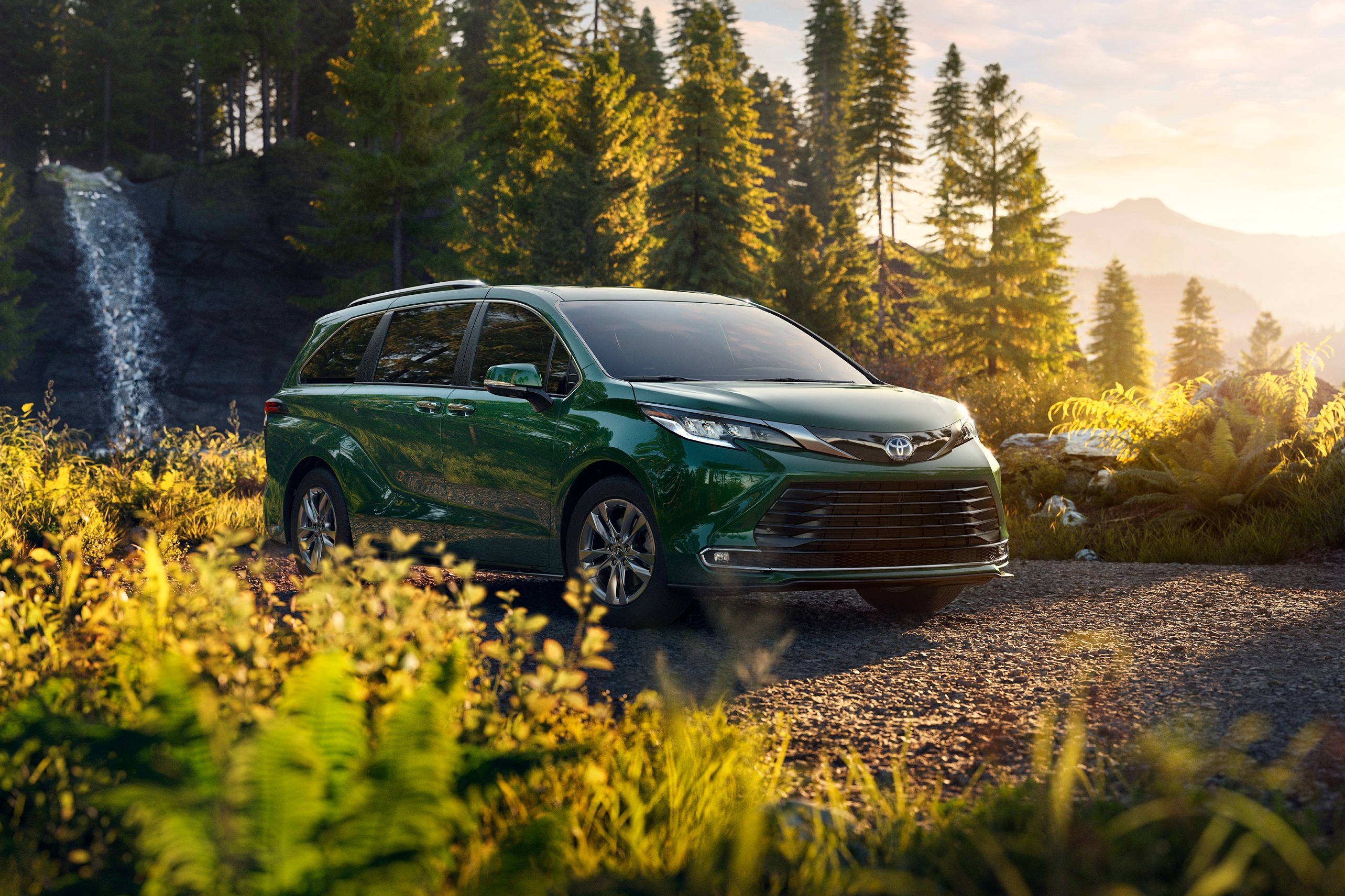
Meanwhile, the 2024 Toyota Sienna came in LE, XLE, XSE, Woodland Edition, Limited, and Platinum trims, offering a distinctive look. Toyota's "swagger wagon" vibe lived on despite the commercials being discontinued. Though the Kia Carnival rivaled the Sienna in style points, Toyota’s family-friendly machine featured sleek front and rear fascias and was available in striking colors like deep blue, red, or green.
LED lighting was standard across all trims, with upper trims benefiting from Bi-LED projector headlamps. Our XSE model was dubbed the “sporty” trim, with a black metallic mesh front grille, black heated side mirrors, and 20-inch dark wheels.
The Woodland Edition, with exclusive Cement or Midnight Black Metallic colors, was designed to be more off-road-ready. It featured roof rails with crossbars, a tow hitch, and a half-inch more ground clearance, sitting 6.9 inches off the ground. This extra clearance could make a difference on trips to remote destinations.
Standard features included cloth seats, three-zone climate control, and room for eight passengers. Our XSE trim with the optional Premium package replaced the second-row bench seat with two captain’s chairs. Leather-trimmed front seats were heated and cooled, and the leather-trimmed power steering wheel added helpful controls.
The Sienna’s horizontal design lines gave a sense of spaciousness. The fixed center console featured stylish satin accents, with cup holders and shifter easily accessible. Though not luxurious, the interior was functional and convenient for families. Upper trims even offered a built-in vacuum cleaner for easy cleanup.

In the GV80 2.5T, a turbocharged 2.5-liter four-cylinder engine delivered 300 horsepower and 311 pound-feet of torque. Remarkably, this four-cylinder engine outperformed the larger V6 engines in some rivals like the Acura MDX and Infiniti QX60.
Our 3.5T test vehicle featured a twin-turbocharged 3.5-liter V6 engine, producing 375 horsepower and 391 pound-feet of torque for a more satisfying performance, though it proved to be thirsty. The EPA estimated 20 mpg in combined driving, but our observations in Southern California showed a lower 17.2 mpg.
Both engines paired with an eight-speed automatic transmission and a standard all-wheel-drive system. Drivers could choose from five driving modes: Eco, Comfort, Sport, Custom, and Snow. The GV80 provided 8.1 inches of ground clearance and could tow up to 6,000 pounds when properly equipped. The 3.5T version included upgraded front brakes and an adaptive damping suspension.
Our GV80 3.5T offered a rewarding driving experience. It was quiet, composed, and provided a good sense of the road surface. While it had a sporty feel and swift acceleration, it also made the driver aware of surface irregularities. On the evaluation loop from Los Angeles to San Diego, the GV80 performed admirably, though seat comfort became an issue during long drives.
For mountain roads, the P265/40R22 all-season tires provided commendable grip. Combined with the adaptive damping suspension, powerful twin-turbo V6, snappy eight-speed automatic transmission, and AWD system, the GV80 proved more athletic than expected. The larger front brakes resisted fade after repeated hard use. However, the steering was unremarkable but acceptable.
In the 2024 Toyota Sienna, every model was a hybrid, combining a 2.5-liter four-cylinder engine with two electric motors powering the front wheels and a small battery pack. AWD models featured one electric motor for the rear wheels, resulting in a total of 245 horsepower.
Performance enthusiasts wouldn’t find excitement in the Sienna. Despite our tester's sport-tuned suspension and Sport mode button, the minivan felt sluggish off the line. The continuously variable transmission (CVT) didn’t help, delivering smooth but slow acceleration, especially when merging onto highways or climbing mountain passes. Additionally, the CVT could become noisy.
Driving around town in the Sienna was a mostly pleasant but forgettable experience. Normal or Eco modes were best for city driving, and an EV mode was useful for low-speed areas. The brakes, however, were grabby, spilling drinks occasionally. Visibility was excellent, and steering was light and accurate.
For those seeking more driving pleasure, alternatives like the Honda Odyssey, Kia Carnival, or Chrysler Pacifica with strong V6 engines might be preferable.
In 2024, only the GV80 3.5T Advanced featured a third-row seat. Previously, the Prestige trim offered extra passenger capacity, but this was no longer the case. The Prestige Signature trim further reduced capacity, holding only four people due to power-adjustable, heated, and ventilated second-row captain’s chairs with a large console.
This limitation meant we had to leave the Genesis at home for a family trip to Santa Monica, opting instead for a five-person Jeep Gladiator. This was unfortunate given the luxurious interior of the Prestige Signature.
Depending on the trim, the GV80 featured artificial leather, real leather, or premium leather. Standard features included heated front seats, a heated steering wheel, manual rear door window shades, and a power hands-free liftgate. Our test vehicle boasted a panoramic glass roof, triple-zone climate control, and ventilated front seats with massage programs and power-adjustable thigh support and side bolsters. The rear captain’s chairs had one-touch Relax Mode and power-operated side window shades.
Despite promising features, the GV80’s seats were uncomfortable during long drives. The diamond-stitched surfaces felt like bubble wrap, and the rear seats didn’t recline far enough for true relaxation. Second-row legroom was unimpressive, although the cabin offered decent storage space. With the second row up, cargo space was 34.9 cubic feet, expanding to 84 cubic feet with seats folded. The rear center console in the Prestige Signature required careful navigation when loading cargo.
The 2024 Toyota Sienna excelled in seating and storage. The lower storage pass-through up front could fit bulkier items like purses or small backpacks. There were four cup holders, additional holders in the front doors, and a shelf above the glovebox housing the optional wireless charging pad.
Second-row passengers enjoyed powered doors, easily closed by an interior handle or B-pillar button. The captain’s chairs could slide fore and aft 25 inches, offering up to 40 inches of legroom equivalent to the front row. However, the sliding function was complicated, and the seats couldn’t be removed, limiting maximum cargo space compared to other minivans.
The second row featured cup holders and a net pocket on the aisle side of the seat. Window shades protected young passengers from the sun. Adults and children alike could easily access the third row, which offered substantial legroom when the second row was not fully extended. The third-row seats could tilt for added comfort, and like the second row, included window shades and cup holders.
The Sienna came standard with tri-zone climate control, and our XSE tester added a fourth zone for the front passenger. A rear liftgate activated by a quick kick revealed 33.5 cubic feet of cargo space. The third row could be stowed easily, not locking into place flush with the floor. With the third row stowed, cargo space increased to 75 cubic feet, expanding further to 101 cubic feet with the second row folded.
The 2024 Genesis GV80 featured traditional analog gauges for the last time. Next year, a digital instrument display would replace them. Higher trims boasted a 12.3-inch digital display with a 3D appearance. All GV80 models included a 14.5-inch touchscreen infotainment display, which was positioned far from the driver, often necessitating the use of a control dial on the center console.
Standard infotainment included a navigation system, SiriusXM satellite radio, and wired Apple CarPlay and Android Auto. Genesis Connected Services and a Wi-Fi hotspot were also included. Wireless smartphone charging was standard, with second-row charging added in the Prestige Signature trim.
While Apple CarPlay and Android Auto required a USB cable, Bluetooth streaming worked seamlessly. The voice-recognition system was user-friendly for navigation and points of interest. The infotainment display offered pleasing graphics with minimal glare, and the interface was intuitive.
Genesis equipped the GV80 with a digital key system, allowing a smartphone to unlock and start the vehicle. Most trims included a Lexicon premium sound system, which would be replaced by Bang & Olufsen components in 2025. The Prestige and Prestige Signature trims featured a head-up display, particularly useful for blind-spot warnings.
In contrast, the Toyota Sienna's infotainment system felt outdated. It had a nine-inch touchscreen with wired Apple CarPlay and Android Auto. While the newer system would offer better graphics and features, the physical buttons for common menus like audio, navigation, phone, and home page were useful.
The backup camera's grainy view seemed out of place in a 2024 model. Analog gauges featured a seven-inch digital display in the instrument cluster showing speed, fuel economy, and audio. Tech enthusiasts might find the Sienna lacking.
However, standard features included a Wi-Fi hotspot, SiriusXM radio, and an optional 12-speaker JBL stereo system. An available rear-camera mirror streamed wide-angle video directly to the center rear-view mirror, though our tester lacked this feature. Navigation was included in most trims, though drivers might prefer Google Maps.
Numerous USB ports were scattered around the cabin, and our tester included a 1500-watt inverter with a 120-volt outlet in the second row and rear cargo area. This required a button near the driver’s seat to activate, essential for charging laptops.
Optional features worth noting were the 11.6-inch rear-seat entertainment system and a 10-inch color head-up display, not included in our tester.
The Genesis GV80 came with numerous standard and available advanced driving-assistance systems (ADAS). Highlights included a camera-based Blind-Spot View Monitor, Remote Smart Parking Assist, and Highway Driving Assist, which combined adaptive cruise control with lane-centering and lane-change assist.
Highway Driving Assist (HDA) worked well during our drive to San Diego, though it was less effective in moderate to heavy, high-speed traffic, where frequent lane changes caused excessive braking and power surges. In lighter or dense, slow-moving traffic, HDA performed beautifully, showing potential for hands-free driving capability.
The Blind-Spot View Monitor used cameras to display video feeds within the 12.3-inch digital instrument panel when signaling a lane change. The head-up display also showed blind-spot warnings.
The Remote Smart Parking Assist system could take full control to park the SUV in parallel or perpendicular spaces, even allowing the driver to command the vehicle from outside using the remote key fob.
The Genesis GV80 received a Top Safety Pick+ rating from the IIHS, the highest possible. The NHTSA awarded the GV80 a five-star overall rating, though the frontal-impact test received a four-star rating for the driver and passenger seating positions.
In the 2024 Toyota Sienna, the Toyota Safety Sense suite of driver’s aids was standard. It included lane departure alert, automatic emergency braking with pedestrian and cyclist detection, road sign recognition, full-speed adaptive cruise control, and automatic high beams. Blind-spot monitoring and rear cross-traffic alert were also standard.
Most systems worked effectively, with adaptive cruise control reducing commuting stress. However, despite a lane-keeping assist feature, we experienced some side-to-side movement. Fortunately, the function was easy to toggle on and off from the steering wheel.
The Sienna offered multiple airbags, including side curtain airbags for all three rows, and a seat belt reminder for rear passengers. There was also a reminder to check the second and third rows when turning off the vehicle.
The 2024 Sienna received a four-star rating from the NHTSA for frontal crash and rollover protection, and five stars for side crash protection. The IIHS rated it "Good" in crashworthiness and child restraint systems but only "Average" in front crash prevention.
CarGurus highlights

According to CarGurus experts, the overall rating for the 2024 Genesis GV80 was 7.7 out of 10, while the 2024 Toyota Sienna scored 7.5 out of 10. With these scores in mind, the Genesis GV80 edges out the Sienna for its combination of luxury, performance, and advanced safety features. While the Sienna excels as a family-friendly minivan with impressive space and efficiency, the GV80 offers a more refined and versatile driving experience. For those seeking a high-end SUV with the latest in comfort and technology, the Genesis GV80 stands as the better choice.
Choose the 2024 Genesis GV80 if:
- Luxurious interior details and premium finishes are high on your list.
- Robust performance and the ability to tow up to 6,000 pounds are essential.
- Advanced safety technologies and high safety ratings are a priority.


Choose the 2024 Toyota Sienna if:
- You need a practical and spacious family vehicle with versatile seating options.
- Fuel efficiency and hybrid powertrain are important considerations.
- Standard, comprehensive safety features with good crash test ratings are crucial for your peace of mind.


CarGurus highlights
According to CarGurus experts, the overall rating for the 2024 Genesis GV80 was 7.7 out of 10, while the 2024 Toyota Sienna scored 7.5 out of 10. With these scores in mind, the Genesis GV80 edges out the Sienna for its combination of luxury, performance, and advanced safety features. While the Sienna excels as a family-friendly minivan with impressive space and efficiency, the GV80 offers a more refined and versatile driving experience. For those seeking a high-end SUV with the latest in comfort and technology, the Genesis GV80 stands as the better choice.
Choose the 2024 Genesis GV80 if:
Shop Now- Luxurious interior details and premium finishes are high on your list.
- Robust performance and the ability to tow up to 6,000 pounds are essential.
- Advanced safety technologies and high safety ratings are a priority.
Choose the 2024 Toyota Sienna if:
Shop Now- You need a practical and spacious family vehicle with versatile seating options.
- Fuel efficiency and hybrid powertrain are important considerations.
- Standard, comprehensive safety features with good crash test ratings are crucial for your peace of mind.

By: CarGurus + AI
At CarGurus, our team of experienced automotive writers remain at the heart of our content operation, conducting hands-on car tests and writing insightful guides that are backed by years of industry experience. To complement this, we are harnessing AI to make our content offering more diverse and more helpful to shoppers than ever. To achieve this, our AI systems are based exclusively on CarGurus content, ratings and data, so that what we produce is both unique to CarGurus, and uniquely helpful to car shoppers.

