2020 Ford Explorer vs 2021 Subaru Ascent
Overview | |
MSRP$32,765 | MSRP$32,295 |
Listings530 | Listings128 |
Ratings & Reviews | |
User Reviews | User Reviews |
Expert reviews7.2 out of 10 | Expert reviews8.5 out of 10 |
Pros
Cons
| Pros
Cons
|
2020 Ford Explorer Reviews SummaryFor nearly 30 years, the Ford Explorer has settled into the American lexicon like Cheerios. We've gobbled up millions of them, from the rock-crawling Eddie Bauers of the 1990s to the brand-new ST that can take down sports cars. The 2020 Explorer brings an all-new chassis, cranks up the technology, and introduces hybrid and high-performance powertrains in a space the size of a small living room. The Explorer's also getting very expensive while other automakers catch on to Ford's winning formula—for a lot less money. | |
2021 Subaru Ascent Reviews SummaryFew automakers have the brand loyalty enjoyed by Subaru—and with good reason. Its cars, wagons, and SUVs are safe, reliable, and provide features like standard all-wheel drive (AWD). A three-row SUV with all of these benefits seems like a no-brainer, and so the 2021 Subaru Ascent is ideally positioned to differentiate itself from the rest of this family-hauling segment. In addition to its spacious cabin and a long list of standard features, the Ascent gains a few key safety features as newly standard equipment. | |
No video found | |
Popular Features & Specs | |
Engine2.3L 300 hp I4 | Engine2.4L 260 hp H4 |
Drive TrainRWD | Drive TrainAWD |
Seating Capacity7 | Seating Capacity8 |
Horsepower | Horsepower260 hp @ 5600 rpm |
MPG City21 | MPG City21 |
MPG Highway28 | MPG Highway27 |
Engine | |
Engine Name2.3L 300 hp I4 | Engine Name2.4L 260 hp H4 |
Torque | Torque277 lb-ft @ 2000 rpm |
Horsepower | Horsepower260 hp @ 5600 rpm |
DrivetrainRWD | DrivetrainAWD |
Fuel Economy | |
MPG City21 | MPG City21 |
MPG Highway28 | MPG Highway27 |
Interior | |
Seating Capacity7 | Seating Capacity8 |
Safety | |
Front Crash Overall5 | Front Crash Overall5 |
Side Crash Overall5 | Side Crash Overall5 |
Dimensions & Capacity | |
Cargo Space18.2 cu ft | Cargo Space17.8 cu ft |
Curb Weight4345 lbs | Curb Weight4430 lbs |
Height69.9 in | Height71.6 in |
Length198.8 in | Length196.8 in |
Width89.3 in | Width85.7 in |
Wheelbase119.1 in | Wheelbase113.8 in |
Maximum Payload1425 lbs | Maximum Payload1570 lbs |
Number of doors4 | Number of doors4 |
Maximum Towing Capacity5300 lbs | Maximum Towing Capacity2000 lbs |
Overview | ||
MSRP | $32,765 | $32,295 |
Listings | ||
Ratings & Reviews | ||
User reviews | ||
Expert reviews | 7.2 out of 10Read full review | 8.5 out of 10Read full review |
Pros & cons | Pros
Cons
| Pros
Cons
|
Summary | For nearly 30 years, the Ford Explorer has settled into the American lexicon like Cheerios. We've gobbled up millions of them, from the rock-crawling Eddie Bauers of the 1990s to the brand-new ST that can take down sports cars. The 2020 Explorer brings an all-new chassis, cranks up the technology, and introduces hybrid and high-performance powertrains in a space the size of a small living room. The Explorer's also getting very expensive while other automakers catch on to Ford's winning formula—for a lot less money. | Few automakers have the brand loyalty enjoyed by Subaru—and with good reason. Its cars, wagons, and SUVs are safe, reliable, and provide features like standard all-wheel drive (AWD). A three-row SUV with all of these benefits seems like a no-brainer, and so the 2021 Subaru Ascent is ideally positioned to differentiate itself from the rest of this family-hauling segment. In addition to its spacious cabin and a long list of standard features, the Ascent gains a few key safety features as newly standard equipment. |
Video | No video found | |
Popular Features & Specs | ||
Engine | 2.3L 300 hp I4 | 2.4L 260 hp H4 |
Drive Train | RWD | AWD |
Seating Capacity | 7 | 8 |
Horsepower | 260 hp @ 5600 rpm | |
MPG City | 21 | 21 |
MPG Highway | 28 | 27 |
Engine | ||
Engine Name | 2.3L 300 hp I4 | 2.4L 260 hp H4 |
Torque | 277 lb-ft @ 2000 rpm | |
Horsepower | 260 hp @ 5600 rpm | |
Drivetrain | RWD | AWD |
Fuel Economy | ||
MPG City | 21 | 21 |
MPG Highway | 28 | 27 |
Interior | ||
Seating Capacity | 7 | 8 |
Safety | ||
Front Crash Overall | 5 | 5 |
Side Crash Overall | 5 | 5 |
Dimensions & Capacity | ||
Cargo Space | 18.2 cu ft | 17.8 cu ft |
Curb Weight | 4345 lbs | 4430 lbs |
Height | 69.9 in | 71.6 in |
Length | 198.8 in | 196.8 in |
Width | 89.3 in | 85.7 in |
Wheelbase | 119.1 in | 113.8 in |
Maximum Payload | 1425 lbs | 1570 lbs |
Number of doors | 4 | 4 |
Maximum Towing Capacity | 5300 lbs | 2000 lbs |
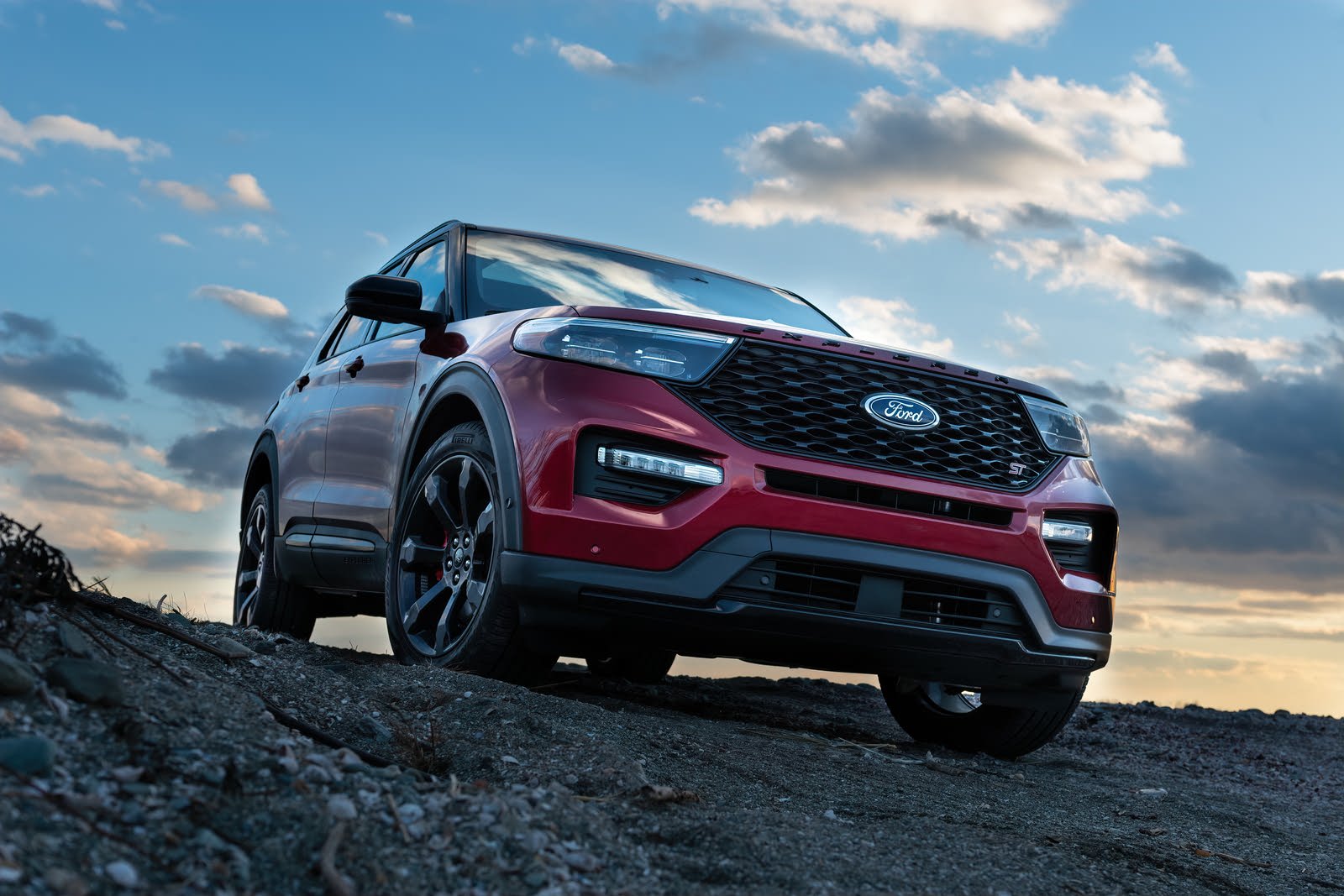
The 2020 Ford Explorer showcased an impressive exterior design that captivated many eyes on the road. Ford's refresh of the Explorer involved slimming down the body panels, especially towards the rear, which gave it a sleek and athletic appearance. The dominant front fascia, featuring widened headlights and an extra-large grille complemented by the iconic italic "Explorer" lettering on the hood, established a prominent and recognizable presence. The blacked-out trim, 21-inch rims, red brake calipers, and quad exhaust pipes on the ST version added a sporty flair, making the Explorer a head-turner. However, the beauty of the Explorer's exterior did not translate into the interior experience.
Inside, the Explorer failed to match the premium feel its price tag suggested, especially when compared to rivals. The materials felt subpar, with surfaces awash in hard, rough-grained plastics reminiscent of municipal garbage cans. Though there were some attempts to add luxury touches, such as aluminum speaker covers and white stitching, these were not enough to elevate the overall feel. The seating material, though named "leather," felt more like low-grade vinyl. The drab, all-black interior of the ST model further added to the uninspired cabin ambiance. Given its price range, closer to some luxury brands, the Explorer's interior felt like it fell significantly short in delivering the premium experience consumers expected.
In contrast, the 2021 Subaru Ascent brought a look and feel that aligned closely with the rest of the Subaru family. Melding design elements from the smaller Forester and the Outback, the Ascent expanded these familiar characteristics into a three-row SUV. Its cab-forward design ensured that the Ascent presented itself as practical yet robust, ready to tackle both urban and rugged terrains.
Inside, the Ascent cultivated a familiar Subaru environment. The dashboard design presented a clear, functional, and intuitive setup, likely a strategic choice to make loyal Subaru drivers feel at home. While standard trims brought solid equipment levels, such as a 6.5-inch touchscreen, tri-zone climate control, and multiple USB ports, the higher trims like Limited and Touring introduced additional comforts. From power-adjustable seats to a panoramic sunroof and the premium 14-speaker Harman Kardon stereo system, these features contributed to an elevated driving experience. The thoughtful placement of storage trays and an impressive total of 19 cupholders emphasized Subaru's commitment to practical family-friendly design, enhancing the overall feel of the cabin.


Performance was where the 2020 Ford Explorer truly shined. With a variety of powertrains tailored to different consumer preferences, the Explorer offered an impressive driving experience. The standout configuration was the ST's 3.0-liter twin-turbo V6 engine, delivering a robust 400 horsepower and 415 pound-feet of torque. This engine, paired with a 10-speed automatic transmission, provided seamless and addictive power delivery. The available rear-wheel-drive (RWD) chassis contributed significantly to this performance, offering a balanced weight distribution and nimble handling that was a marked improvement over its predecessor's front-wheel-drive (FWD) platform.
The Explorer ST’s enhanced suspension and steering calibrated by Ford Performance delivered a sporty yet controlled ride. Its ability to stay composed even on uneven surfaces without adaptive dampers was commendable. For those looking for a more refined drive, the Platinum trim featured the same 3.0-liter engine slightly detuned to 365 horsepower and 380 pound-feet of torque. Moreover, the Explorer offered a 2.3-liter turbocharged inline-four engine that delivered 300 horsepower and 310 pound-feet of torque, suitable for the majority of drivers.
Ford's hybrid variant combined a 3.3-liter V6 with an electric motor, offering 318 net horsepower. However, the fuel economy gains were negligible, and the extra cost made it a less appealing option. The Explorer’s versatile powertrains allowed for towing capacities ranging from 5,000 to 5,600 pounds, depending on the engine and drivetrain configuration. Additionally, Ford's seven drive modes catered to various driving conditions, from normal and sport to snow and towing, making it a competent performer in diverse environments.
The 2021 Subaru Ascent relied on a single, robust powertrain to meet varying consumer needs. Equipped with a 2.4-liter turbocharged boxer four-cylinder engine, the Ascent produced 260 horsepower and 277 pound-feet of torque. This engine, linked to a continuously variable transmission (CVT), delivered a smooth and efficient drive characteristic of Subaru's engineering philosophy. Its symmetrical all-wheel-drive system was particularly advantageous for traction and stability in adverse weather conditions, a notable benefit for areas prone to snow and rain.
The Ascent’s ride was primarily tuned for comfort, providing a serene cruising experience ideal for family travels. Its ability to absorb road imperfections ensured a pleasant ride over long distances. Despite not being a sports car, the Ascent handled corners responsively and remained composed, making it a reliable partner for both daily commutes and weekend getaways. With 8.7 inches of ground clearance and Subaru’s X-Mode, the Ascent could handle soft off-roading and snowy terrains effectively, reinforcing its reputation as a versatile family SUV.
In terms of towing, the Ascent boasted a respectable capacity of up to 5,000 pounds. This, combined with standard Trailer Stability Assist, made it capable of handling recreational tasks such as towing boats or trailers with ease. The Ascent's performance package aimed at providing a balanced approach combining power, efficiency, and reliability.
Interior space was a strong suit for the 2020 Ford Explorer. Taking it on a road trip to Maine proved that the Explorer could comfortably accommodate a family of four along with all their gear. The second row featured ample air vents, USB ports, a convenient center console, and a panoramic moonroof that contributed to a luxurious atmosphere. The third-row space improved notably from previous models, allowing six-foot-tall adults to fit comfortably for shorter trips. However, the flatness of the bench seat made long journeys somewhat less comfortable.
Ford’s design prioritized passenger space, resulting in a slight reduction in cargo space behind the third row to 18 cubic feet compared to the predecessor’s 21 cubic feet. However, this trade-off meant increased overall storage capacity, with 48 cubic feet available with the second row folded and a generous 88 cubic feet with all rear seats down. These figures positioned the Explorer as one of the class leaders in cargo space.
The Explorer refrained from over-complicated touch-sensitive controls, opting instead for physical knobs and switches for climate and stereo adjustments. This user-friendly approach was somewhat marred by thick D-pillars that impeded rear visibility and fuzzy 360-degree camera resolution, creating potential blind spots. Nevertheless, the Explorer’s overall ease of use and practicality made daily driving stress-free.
The 2021 Subaru Ascent offered an impressive blend of passenger and cargo capacity. With 17.8 cubic feet of cargo space behind the third row and up to 86.5 cubic feet with all seats folded down, the Ascent was near the top of its class. While not the largest—Volkswagen Atlas and Chevrolet Traverse offering more—the Ascent’s cargo capabilities were more than sufficient for most family needs.
The base configuration accommodated up to eight passengers, with an option for second-row captain's chairs reducing this to seven. Both layouts provided generous space in the first two rows, ensuring adult passengers enjoyed plenty of headroom and legroom. The third row, while tighter, was practical for kids on longer trips and adults on shorter journeys. Practical storage solutions across all three rows, including a staggering 19 cupholders, reinforced the Ascent’s family-oriented design.
While the Ascent came standard with a power liftgate, it did not offer a hands-free option, a minor drawback given the increasing popularity of this feature. Still, the Ascent’s pragmatic interior design and thoughtful features emphasized functionality and convenience.
The 2020 Ford Explorer came well-equipped with an array of standard and optional technological features aimed at enhancing the driving experience. A standard 8-inch touchscreen displayed Ford's Sync 3 infotainment system, compatible with Apple CarPlay, Android Auto, and featuring 4G WiFi. Higher trims came with factory navigation, keyless entry, remote start, tri-zone climate control, and SiriusXM satellite radio. Ford's innovative keyless entry keypad, despite being an older technology, remained a handy feature for those who engaged in activities where carrying keys was inconvenient.
The Premium Technology Package, available on the ST and Platinum trims, included a 10-inch vertical touchscreen and a 12-inch digital instrument cluster. This larger touchscreen provided better map visualization and facilitated easy access to vehicle settings, improving overall usability. However, the digital instrument panel’s lack of customization options and underutilized screen real estate were noted drawbacks. The high-resolution interface, while user-friendly, limited its full potential, reflecting an unfinished feel.
Ford's Co-Pilot360 Assist+ offered a semi-automated driving system that was serviceable but not as refined as competitors’. The system enjoyed detailed animations and different lead-car icons based on driving modes, adding a playful touch. However, it lagged in lane-keeping precision, highlighting the need for future software updates to enhance functionality and user satisfaction.
The 2021 Subaru Ascent featured the StarLink infotainment system, which was user-friendly with simplified menu layouts and large, legible icons. Both available touchscreens were complemented by physical buttons and dials for quick access, alongside a dedicated home button. Standard features included Apple CarPlay, Android Auto, dual USB ports for the front and second rows, satellite radio, and Bluetooth connectivity.
For tech-savvy buyers, the Ascent offered additional features such as third-row USB ports, a WiFi hotspot, and a premium 14-speaker Harman Kardon stereo system, enhancing connectivity and in-car entertainment. The system’s intuitive design ensured an easy learning curve, optimizing convenience, and practicality for everyday use.
Ford incorporated its Co-Pilot360 suite as standard in the 2020 Explorer, including forward emergency braking, blind-spot monitoring, automatic high beams, and lane-keep assist. The Assist+ package extended features to include adaptive cruise control with steering assist and reverse braking, although the latter occasionally activated erroneously.
Safety ratings were somewhat mixed for the Explorer. While it had not yet been fully tested by the National Highway Traffic Safety Administration (NHTSA), it scored an "Acceptable" rating in the small overlap test on the driver's side by the Insurance Institute for Highway Safety (IIHS). This outcome was not ideal for a new model but did not overly detract from the vehicle's overall safety perception, though it suggested room for improvement in crash performance.
Achieving a commendable status, the 2021 Subaru Ascent earned the IIHS Top Safety Pick+ designation, reflecting its strong crash test performances and comprehensive safety features. Subaru’s EyeSight system equipped the Ascent with automatic emergency braking, adaptive cruise control, and lane departure warning. Additionally, a unique alert informed drivers when the car ahead moved away from a stop.
For 2021, automatic high beams and adaptive headlights, which pivoted with the steering angle, became standard, enhancing night-time driving safety. Optional features included reverse automatic emergency braking, rain-sensing windshield wipers, blind-spot monitoring, and rear cross-traffic alert, providing a thorough suite of driver aids to ensure maximum safety for occupants.
CarGurus highlights

According to CarGurus experts, the overall rating for the 2020 Ford Explorer was 7.2 out of 10, while the 2021 Subaru Ascent scored 8.5 out of 10. Based on these ratings, the Subaru Ascent emerged as the preferred choice. Its blend of practical features, strong safety ratings, and balanced performance made it an excellent family SUV. The Ascent's higher score reflected its ability to meet and exceed expectations across various categories, particularly in interior comfort, technology, and safety. Therefore, considering CarGurus ratings and the detailed comparison, the 2021 Subaru Ascent is the recommended vehicle.
Choose the 2020 Ford Explorer if:
- You prioritize a powerful and dynamic driving experience with robust engine options.
- You need ample cargo space, especially with all seats folded, for large hauls or extended trips.
- You value a well-equipped infotainment system with advanced features like a large touchscreen and a digital instrument cluster.


Choose the 2021 Subaru Ascent if:
- You desire a family-friendly SUV with practical features such as multiple USB ports, numerous cupholders, and comfortable seating for eight.
- Safety is a top priority, and you appreciate the extensive safety suite that has earned top ratings.
- You're looking for a reliable vehicle with a balanced performance capable of handling diverse weather conditions and moderate off-road adventures.


CarGurus highlights
According to CarGurus experts, the overall rating for the 2020 Ford Explorer was 7.2 out of 10, while the 2021 Subaru Ascent scored 8.5 out of 10. Based on these ratings, the Subaru Ascent emerged as the preferred choice. Its blend of practical features, strong safety ratings, and balanced performance made it an excellent family SUV. The Ascent's higher score reflected its ability to meet and exceed expectations across various categories, particularly in interior comfort, technology, and safety. Therefore, considering CarGurus ratings and the detailed comparison, the 2021 Subaru Ascent is the recommended vehicle.
Choose the 2020 Ford Explorer if:
Shop Now- You prioritize a powerful and dynamic driving experience with robust engine options.
- You need ample cargo space, especially with all seats folded, for large hauls or extended trips.
- You value a well-equipped infotainment system with advanced features like a large touchscreen and a digital instrument cluster.
Choose the 2021 Subaru Ascent if:
Shop Now- You desire a family-friendly SUV with practical features such as multiple USB ports, numerous cupholders, and comfortable seating for eight.
- Safety is a top priority, and you appreciate the extensive safety suite that has earned top ratings.
- You're looking for a reliable vehicle with a balanced performance capable of handling diverse weather conditions and moderate off-road adventures.

By: CarGurus + AI
At CarGurus, our team of experienced automotive writers remain at the heart of our content operation, conducting hands-on car tests and writing insightful guides that are backed by years of industry experience. To complement this, we are harnessing AI to make our content offering more diverse and more helpful to shoppers than ever. To achieve this, our AI systems are based exclusively on CarGurus content, ratings and data, so that what we produce is both unique to CarGurus, and uniquely helpful to car shoppers.

