2026 Honda CR-V Hybrid Reviews, Pricing & Specs



Pros & cons
What we like
Great ride quality
Efficient hybrid powertrain
Easy-to-use technology
What to consider
Underwhelming off-road chops
No SiriusXM radio
Limited tech features
Expert review
Honda’s best-selling vehicle receives a light refresh and a new TrailSport trim level for 2026.
Competition amongst small crossover SUVs is fierce. The 2026 Honda CR-V faces off against the Toyota RAV4, Subaru Forester, Hyundai Tucson, and roughly a dozen other strong-selling compact SUVs from nearly every automaker. And, on balance, the Honda CR-V has handled the competition well. With over 400,000 units sold in 2024–more than half of which were CR-V Hybrids–Honda has plenty to feel good about with the CR-V. But while the CR-V has been thriving, Honda has been finding success with another name, too: TrailSport. This year, the two success stories finally met.
Verdict: The CR-V is one of the best compact crossovers on the market, and the hybrid powertrain only makes it better. If adventure and off-road driving are truly in the cards for you, however, the CR-V TrailSport may not be the right choice.
out of 10 expert review
Look & feel
The current, sixth-generation CR-V has been on sale since 2023. It received a light refresh this year, but the big news for 2026 is the new TrailSport trim level.
Honda introduced the TrailSport name with the Passport in 2022, and since then it’s been added to the trim walk for the three-row Pilot and the Ridgeline pickup, not to mention expanding to an additional TrailSport Elite trim level for the redesigned 2026 Passport.
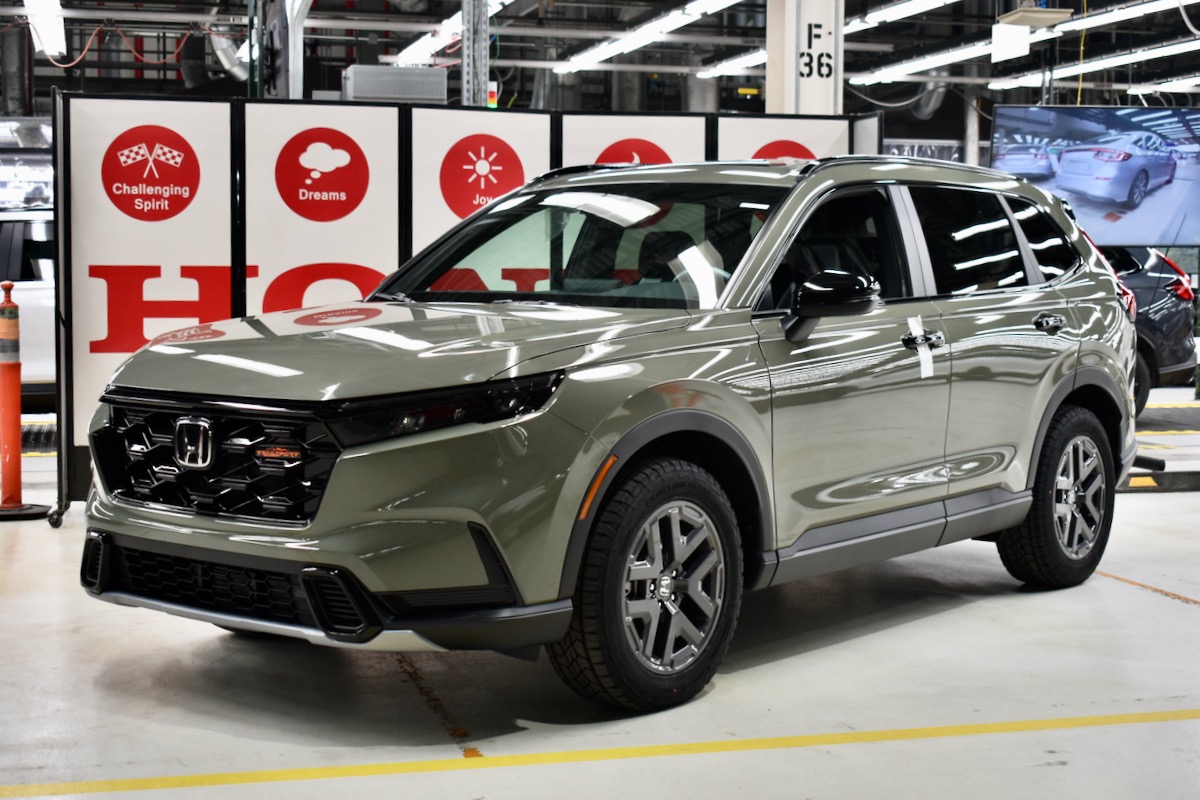
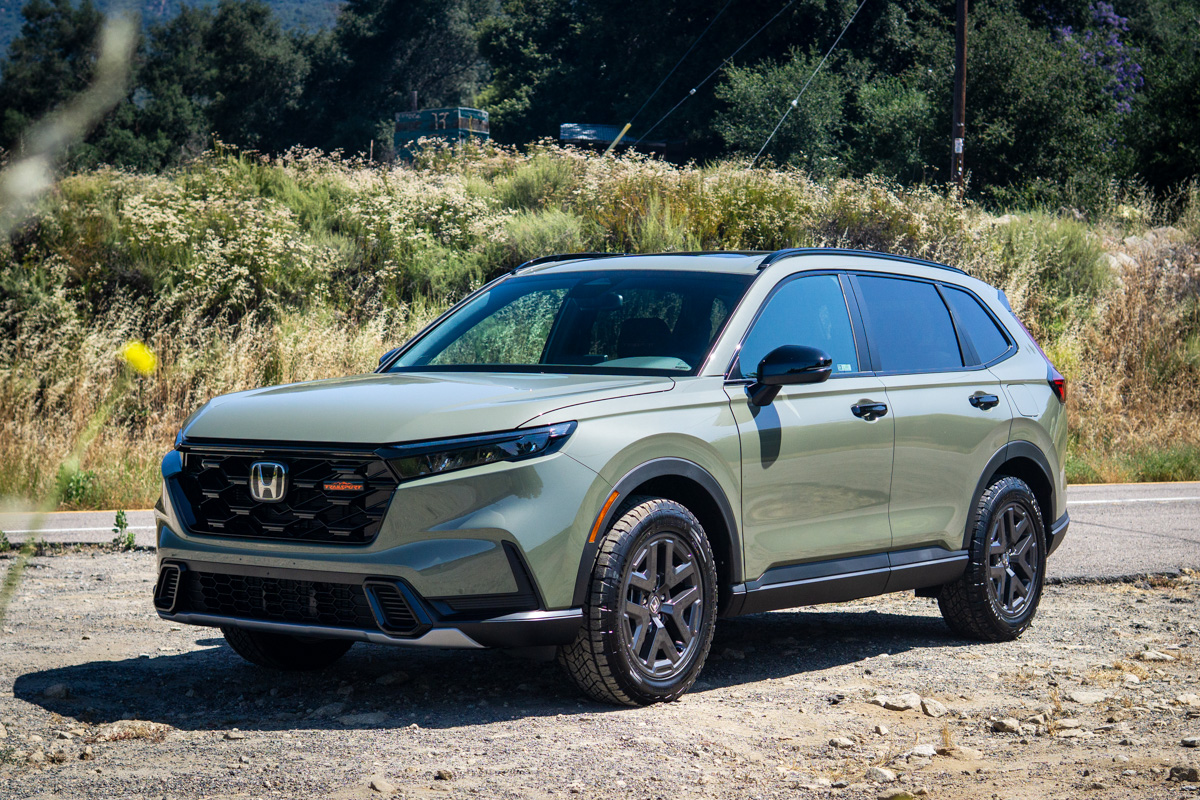
On the CR-V, the TrailSport trim adds orange badges to the front and rear, Shark Gray 18-inch wheels, and a set of Continental CrossContact ATR tires for added traction. The 2026 CR-V TrailSport also boasts a silver skid-plate-style trim piece below the front fascia, but don’t be fooled: if you bash this on a rock, you’re going to sustain damage.
The TrailSport receives black door handles, and every hybrid CR-V now has black window surrounds. Honda sells the 2026 CR-V in seven trim levels. The three lower-tier trims–LX, EX, and EX-L–are gas-powered vehicles, while all the “Sport” trims–Sport, TrailSport, Sport-L, and Sport Touring–are exclusively hybrid-powered.
Eight color options, including the TrailSport-exclusive Ash Green, are available, but most of the colors aren’t overly exciting. Choices range from Radiant Red, Canyon River Blue, and the Ash Green, to Solar Silver, Meteorite Gray, Urban Gray, Crystal Black, and Platinum White.
The new CR-V’s exterior design otherwise carries over with minimal changes from 2025, but there are some notable updates on the interior. In the TrailSport vehicles, orange contrast stitching and embroidered headrests shout “TrailSport” at onlookers, and a set of all-season floor mats for the first and second row are also included.
Performance
A 1.5-liter turbocharged four-cylinder powers the three lower trim levels–the LX, EX, and EX-L. Making 190 horsepower and 179 pound-feet of torque, it’s a capable, if unremarkable, powerplant. Honda has used this 1.5-liter turbo-four in many different vehicles, and although it did suffer from oil-dilution issues in earlier CR-Vs, that problem has since been remedied.
Interestingly, most CR-V buyers now skip the gas-powered versions in favor of Honda’s excellent hybrid system. In the Sport, Sport-L, TrailSport, and Sport Touring trims, a 2.0-liter Atkinson-cycle engine partners with two electric motors for 204 hp and 247 lb-ft of torque.
While the 1.5-liter CR-V employs a continuously variable transmission (CVT), the CR-V Hybrid relies on its clever two-motor system to take the place of a traditional transmission. During acceleration and deceleration, the larger electric traction motor takes over, with the gas engine kicking in for support and at high speed. Because the effort used to get going and slow down is courtesy of an electric motor, the CR-V Hybrid can offer multiple regenerative braking settings and a one-pedal driving option, like a full battery electric vehicle.
The downside to this system is that the CR-V makes a bit more noise than other crossovers when charging up a steep hill, which is made worse by a surprising amount of wind noise and the TrailSport trim’s increased tire noise (an inevitable result of all-terrain tires). But the upsides are that the handoff between electric and gasoline power is nearly seamless, and low-speed acceleration feels effortless. Like most Hondas, the CR-V Hybrid demonstrates exceptional steering feel, with very little play off-center and an admirable amount of feedback, considering the vehicle’s class. Ride comfort is outstanding thanks to a compliant, yet not too soft suspension. All-in-all, driving a CR-V Hybrid is a very gratifying experience.
Not only does the hybrid CR-V make more power than the all-gas alternative, but it’s significantly more fuel efficient, too.
Fuel economy for the hybrid comes in at 40 mpg in combined driving on front-wheel-drive (FWD) models, 37 mpg combined on all-wheel-drive (AWD) ones. The TrailSport hybrid and its knobbier tires receive an extra penalty, but at 35 mpg combined, it’s still one of the most efficient adventure-oriented compact crossovers on the market and offers comparable gas mileage to other small AWD hybrid SUVs.
With the exception of the AWD-only TrailSport model, all 2026 Honda CR-Vs can be equipped with either FWD or AWD, with the latter tacking an extra $1,500 onto the price. The AWD system gets an additional enhancement for 2026; while previous model years offered a 60:40 front:rear torque split, the 2026 model can send up to 50% of its torque to the rear axle, meaning more power is available where it’s needed on a steep or slippery uphill climb.
In addition to the improved AWD traction management system, the 2026 CR-V Sport Touring also adds an additional drive mode. Joining the standard Normal, Eco, and Snow modes (and Sport mode on hybrid models), Individual mode now lets drivers customize their CR-V’s steering, throttle, engine sound, and gauge appearance.
Finally, the gas-powered Honda CR-V can tow up to 1,000 pounds, while the CR-V hybrid bumps that number up to 1,500 pounds. It can handle a light utility trailer, but the CR-V isn’t built for long sessions of heavy-weight towing.
Form & function
The 2026 Honda CR-V’s interior isn’t overly exciting, but it’s exceptionally functional. 39.3 cubic feet of cargo space is good, outshining competitors like the Subaru Forester and the Toyota RAV4, but falling short of the Hyundai Tucson. The same comparisons hold true when you fold that seat to expand total cargo capacity to 76.5 cubic feet. A power tailgate is standard on CR-V EX-L, TrailSport, Sport-L, and Sport Touring models, with the latter adding hands-free access.
Headroom and legroom in the second row is also commodious, at 38.2 inches and 41 inches, respectively. Up front, the CR-V also offers up to 41.3 inches of legroom and 38.2 inches of headroom on all but the sunroof-less LX, which gets an extra 1.8 inches of clearance. Beyond cargo and passenger space, the CR-V feels comfortable. The seats are soft but supportive, and the TrailSport trim’s cloth upholstery doesn’t feel cheap. Pick the EX-L, Sport-L, or Sport Touring trims if you want leather-trimmed seats.
Every CR-V trim level above the base EX comes equipped with heated front seats, a moonroof, and dual-zone climate control. The front seats are separated by a small center console that offers physical knobs and buttons for climate control, a standard PRND shifter, switches for drive modes, hill-descent control, auto vehicle hold, and an electronic parking brake, and a forward bin equipped with space for two phones, including one wireless phone charging pad. Two USB-C ports (one for connectivity, one charging only) are standard on all models, and all but the base LX trim level have a pair of rear-seat ports as well.
Technology
Honda has made the previously optional 9-inch touchscreen infotainment display standard equipment on all 2026 CR-Vs, replacing the 7-inch unit that used to come on lower-tier trims. In addition to the bigger touchscreen, a 10.2-inch digital driver information display is now included on EX-L, TrailSport, Sport-L, and Sport Touring trims.
The 9-inch touchscreen features three physical controls: a volume knob, a home button, and a phone-projection button. This last one is interesting. Instead of packing the CR-V full of Honda-built tech features, the system’s engineers assume that most shoppers will opt to use their phone, either via wireless Android Auto or wireless Apple CarPlay (both standard). The physical phone-projection button makes it easy to switch in and out of those systems. Sport-Touring-trim CR-Vs will have Google built-in, meaning Google Maps, Google Assistant, and the Google Play store will be available natively. This comes free of charge for the first three years, after which a data plan subscription will be required to access the Google built-in features.
A Wi-Fi hotspot is also standard on hybrid trims, but SiriusXM satellite radio is not available. Honda offers four USB-C ports (including one for smartphone interfacing) on all but the base LX trim, which receives only the single phone-interfacing ports and no additional charging port.
Finally, the 2026 Honda CR-V has a range of audio systems available. The base system is a 160-watt four-speaker stereo, while the Sport Touring trim comes with a 12-speaker Bose premium audio system. In the middle, the EX and Sport trims have a 240-watt six-speaker sound system and the EX-L, TrailSport, and Sport-L have a 320-watt, eight-speaker stereo.
Safety
At the time of this writing, the 2026 Honda CR-V had not yet been evaluated by the Insurance Institute for Highway Safety (IIHS), nor had it been crash-tested by the National Highway Traffic Safety Administration (NHTSA). However, the mechanically identical 2025 model received a Top Safety Pick designation from the IIHS and five stars for overall crashworthiness by the NHTSA).
Additionally, Honda includes the Honda Sensing suite of advanced driver assistance systems (ADAS) on every model. This includes features like automatic emergency braking, lane-departure warning and lane-keeping assist, plus adaptive cruise control, traffic sign recognition, and traffic jam assist. However, blind-spot monitoring and rear cross-traffic alert are standard only above the LX trim, and front and rear parking sensors are standard only on trims above the EX level.
As with all cars on sale today, the CR-V and CR-V Hybrid come standard with a rearview camera. It includes dynamic directional guidelines, which we like, but the resolution looks soft. Further, the CR-V TrailSport isn’t fitted with any additional cameras, so there’s no forward view or side-view angles available when navigating a trail.
Cost-effectiveness
Honda offers a three-year, 36,000-mile warranty on the 2026 CR-V and the 2026 CR-V Hybrid. With regards to pricing, the 2026 Honda CR-V is on sale now, with a starting MSRP of $32,315, including a mandatory $1,395 destination fee. However, if you’re in the market for a CR-V Hybrid, that base price jumps to $37,025 for the Sport trim level. At the top of the range lives the $43,645 Sport Touring. While those numbers look high at first glance, they’re competitive against the upper-tier trims of the RAV4 ($42,055 for the top trim), Tucson Hybrid ($42,745), and Forester Hybrid ($44,715).
Where things fall out of sorts is with the TrailSport. With a starting price of $40,195, it falls in the middle of the CR-V Hybrid’s price tiers, and it doesn’t really have a direct comp from other automakers. Hyundai has the Tucson XRT and Subaru has the Forester Wilderness, but neither of those off-road trims are equipped with hybrid powertrains. Likewise, there’s the Bronco Sport Badlands, but again, it’s gas only.
While they don’t have hybrid engines, what the Subaru and Ford have is genuine off-road capability. The Tucson XRT is the least-capable of the competition, but it also starts at roughly $7,000 less than the TrailSport. The Kia Sportage X-Pro has similar specs to the XRT, but is priced closer to the TrailSport. When it comes to heading off-road, the TrailSport is more bark than bite. Take, for instance, its faux skid plate: while the silver-painted plastic looks cool, one could argue that it’s really just an invitation to owners to beat up their car.
We understand why Honda would invest its resources in the TrailSport name. Adventure-ready crossovers are in vogue and TrailSport has been a huge success with Honda’s other models. However, the CR-V simply doesn’t live up to our expectations for TrailSport.
That’s a shame, too, because otherwise, the CR-V Hybrid is an outstanding small SUV. We recommend it wholeheartedly, but if you’re interested in the Honda CR-V TrailSport, we may suggest test driving a Forester Wilderness instead.

What owners say
This vehicle offers a comprehensive suite of features, closely rivaling, and in some aspects exceeding, those found in the Toyota RAV4. It represents an exceptional value proposition. The only notable omission is the absence of memory seating.
January 25, 2026The CR-V is a wonderful car. We chose this car since we wanted a hybrid vehicle. We felt Honda was our best choice and we like the ride, appearance, and overall quality of the CR-V!
October 16, 2025So far so good, super quiet you won’t even know when it starts. Smooth driving and spacious enough to take a nap in the backseat ! Definitely the perfect mom vehicle
August 3, 2026What owners say
This vehicle offers a comprehensive suite of features, closely rivaling, and in some aspects exceeding, those found in the Toyota RAV4. It represents an exceptional value proposition. The only notable omission is the absence of memory seating.
January 25, 2026The CR-V is a wonderful car. We chose this car since we wanted a hybrid vehicle. We felt Honda was our best choice and we like the ride, appearance, and overall quality of the CR-V!
October 16, 2025So far so good, super quiet you won’t even know when it starts. Smooth driving and spacious enough to take a nap in the backseat ! Definitely the perfect mom vehicle
August 3, 2026No 360 camera no homelink no door skid plates no ventilated seats No panoramic moonroof. Positives honda reliability it has dials for heat n cool the android auto is easy to setup. Lots of room for passengers reclining back seats but no handle n back to let them down lots of cargo space. It drives nice n normal mode kinda sluggish n eco mode. As far as value im not sure id say its worth it @41,500 but comparing it to other models have much more technology. Like the rav 4 cx 50 murano n tiguan.
March 23, 2026Trims & specs
Base MSRP $38,800 | Seating 5 |
Engine 2.0L 204 hp I4 Hybrid | Cargo Capacity 36.3 cu ft |
Combined MPG 36 | Drivetrain AWD |
Base MSRP $42,550 | Seating 5 |
Engine 2.0L 204 hp I4 Hybrid | Cargo Capacity 34.7 cu ft |
Combined MPG 37 | Drivetrain AWD |
Base MSRP $38,725 | Seating 5 |
Engine 2.0L 204 hp I4 Hybrid | Cargo Capacity 36.3 cu ft |
Combined MPG 40 | Drivetrain FWD |
Base MSRP $40,225 | Seating 5 |
Engine 2.0L 204 hp I4 Hybrid | Cargo Capacity 36.3 cu ft |
Combined MPG 37 | Drivetrain AWD |
Base MSRP $35,630 | Seating 5 |
Engine 2.0L 204 hp I4 Hybrid | Cargo Capacity 36.3 cu ft |
Combined MPG 40 | Drivetrain FWD |
Base MSRP $37,130 | Seating 5 |
Engine 2.0L 204 hp I4 Hybrid | Cargo Capacity 36.3 cu ft |
Combined MPG 37 | Drivetrain AWD |


Pricing trends
MSRP range
$35,630 - $42,550
Current avg. market price
$38,008
Trending down by 0.8% this month
April 2026 - October 2026