2025 Toyota Sienna Reviews, Pricing & Specs


Pros & cons
What we like
Great ride quality
Quiet cabin
Easy-to-use technology
What to consider
Irritating transmission
Poor real-world fuel economy
Less outright load space than rivals
Expert review
The 2025 Toyota Sienna is getting on in years but it has a standard hybrid powertrain and some practical features that make it a worthy contender in the minivan sector.
In addition to promising 35 to 36 mpg in combined driving, the 2025 Sienna distinguishes itself in several ways. First, it offers an available all-wheel-drive system for extra traction. Second, a Woodland Edition trim level provides half an inch of extra ground clearance for light off-roading capability. Third, while its maximum cargo capacity measurement falls short of rivals, you never need to remove the second-row seats to use it.
Verdict: Saving money on gas, making life simpler, and the option of AWD ruggedness are all good things in a minivan, and they make the Toyota Sienna worth considering if you’re also looking at cars such as the Chrysler Pacifica, Honda Odyssey, and Kia Carnival.
out of 10 expert review
Look & feel
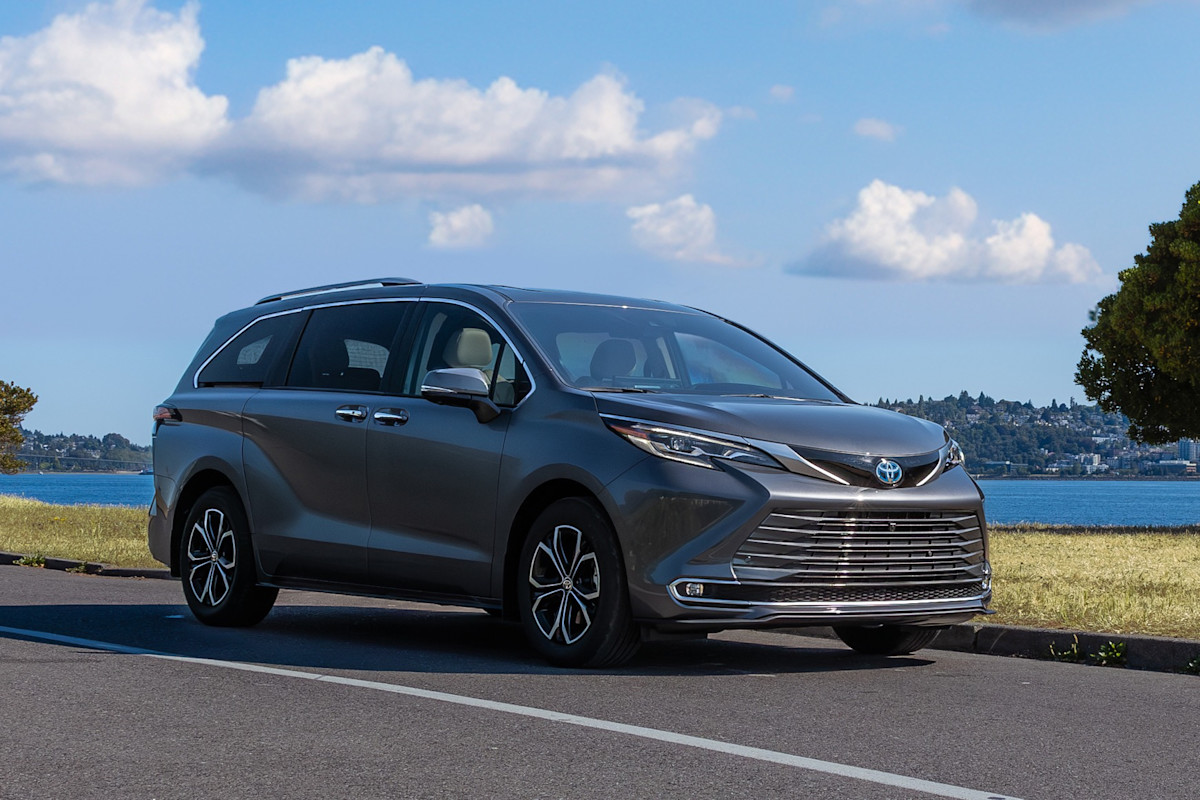
Decades ago, some minivans were referred to as Dustbusters because they resembled the popular cordless hand vacuum. Arguably, today’s Dustbusters have more style than a typical minivan—after all, there’s only so much you can do with a box-on-wheels design formula that exists to maximize interior passenger and cargo room. Toyota has tried, although the 2025 Toyota Sienna’s trapezoidal grille, which appears as though it’s ready to Hoover up the road, doesn’t help to dispel the hand-vac metaphor. There are also upswept body lines, hidden sliding door tracks and swollen rear fenders that wrap into a rear end that mimics the cinched-in-the-middle look in the front. Narrow taillights feature sharp corner spears that stab down to define the edges of the Sienna, drawing a family resemblance to the Camry sedan. This year’s Platinum trim level gets new flower-petal wheel designs to replace the previous split-five-spoke design.
But the Sienna still looks… like a minivan. Of course, if you want seating for up to eight in a more fashionable SUV-shaped package your Toyota dealership will point you in the direction of the Toyota Grand Highlander, but for outright practicality the brick-like shape of a minivan is hard to beat.
Our test vehicle was the top-of-the-line Toyota Sienna Platinum model, dipped in the new-for-2025 Magnetic Gray paint color. It caps a lineup that also includes the LE, XLE, XSE, Limited, and Woodland Edition. Prices range from $40,980 to $57,940, including the $1,495 destination charge. Toyota loaded up our test vehicle with an extended connected services subscription, all-weather floor mats, a digital rearview mirror, and a few other accessories. Those upgrades brought the manufacturer’s suggested retail price (MSRP) to $58,634, including the destination charge.
Toyota says it has updated the Sienna’s interior for 2025. The Platinum trim level includes a “new woodgrain finish for an upscale look.” A 17-year-old passenger, who rarely comments on such things, got into the Sienna, pointed at this material, and deemed it ‘chopped.’ That, in teen slang, means it did not look good. She also didn’t like how it faded to black at the forward end of the center console.
We, the adult professionals, thought the Sienna’s interior looked better than before.

Performance
The only powertrain available for the 2025 Toyota Sienna is a hybrid system that features a 2.5-liter four-cylinder engine and a continuously variable transmission (CVT). Front-wheel drive (FWD) comes standard; the available all-wheel-drive (AWD) system features an additional (rear-mounted) electric motor that drives the rear wheels when necessary. Although Toyota offers plug-in hybrid versions of the Prius and RAV4, there’s no equivalent powertrain for the Sienna.
The net horsepower rating is 245, which isn’t a lot considering the Sienna seats up to eight people and tows up to 3,500 pounds. However, the torque from the electric assist motor(s) is immediately available, saving this minivan from feeling slow. So, while we expected the Sienna to feel sluggish, it didn’t. Not with four people aboard, anyway. In the city, you don’t notice the powertrain much at all, and when cruising on the highway, it’s decidedly quiet. Accelerate hard, though, to enter the freeway, pass slower traffic, or climb a mountain grade, and the moaning CVT sounds like it is in pain.
Of course, the point of the Sienna’s hybrid powertrain is to maximize fuel economy. The official EPA rating for our FWD test model was 36 mpg in combined driving. On the evaluation loop, the Sienna averaged 26.3 mpg with two people and nothing else aboard for the drive.
That poor result was not because we were having too much fun driving the Sienna. Although it has predictable and secure handling with little body roll, you won’t derive much enjoyment from driving this vehicle. Crisp, precise, and communicative are not the adjectives to use for the steering. The handling gets squishy in curves and corners, and after a hard-braking event during a mountain descent, the brakes were momentarily cooked.
You can get a Sienna XSE for a racier look and a sport-tuned suspension, which might add a hint of fun to the drive, but dial down your expectations. With standard suspension, the Sienna gives a smooth, absorbent ride with excellent impact isolation. If there’s an automotive equivalent to a marshmallow on wheels, this is it. Additionally, our test vehicle proved impressively quiet on the highway. When the CVT wasn’t droning, that is.

Form & function
Minivans are all about form and function, and the Toyota Sienna offers a couple of unusual seating and cargo-carrying solutions. But let’s start with an assessment of the front chairs, which are power adjustable, heated and ventilated, and wrapped in perforated leather. After a couple of hours of driving, the cushions felt hard, and we needed a stop to get out and stretch. That bodes poorly for road-trip comfort.
The Platinum’s second-row, long-slide, reclining captain’s chairs with ottoman-style leg rests were a hit with teenagers. They thought the refrigerated compartment on the back of the center console was cool, too. As you’d hope of a minivan, the third-row seat is accommodating of adults. Also, thanks to the sliding side doors and second-row seats, loading and unloading people is easy, even in cramped parking situations. All but LE models have a hands-free power liftgate, too.
Storage space is generous, particularly the wide tray located under the center console. However, a family that brings 32-ounce water bottles everywhere had trouble finding secure places to stash them. Also, the black plastic lining the dashboard tray in front of the passenger isn’t very good at holding things in place when taking right-hand corners.
Behind the third-row seat, the Sienna holds 33.5 cubic feet of cargo, stacked vertically in the floor well. That storage well accommodates the third-row seats, which you can collapse and stow using one hand. Once they’re securely stashed, the Sienna provides 75.2 cubic feet of cargo space behind the second-row seats. For comparison, that’s as much as some midsize SUVs provide with only a driver and front passenger aboard.
Maximum cargo capacity measures 101 cubic feet. That’s less than every minivan rival, and by a significant margin. But there’s a good explanation for it. With the Chrysler Pacifica, you can drop the second-row seats into floor storage wells. With the Honda Odyssey and Kia Carnival, you can unfasten, lift, and remove the second-row seats. With the Sienna, you tip the bottom cushion up, slide the second-row seats forward, and that’s it. Toyota’s consumer research must show that most minivan owners never maximize the space by removing the seats, which, if you’ve ever undertaken the task, is a genuine hassle. But if you want maximum load space, even on rare occasions such as a house move or a massive clear-out, the Sienna might not be the minivan for you.

Technology
While entry-level models have smaller displays, Toyota equips the higher-spec Sienna models with a 12.3-inch digital instrumentation panel and a 12.3-inch touchscreen display for the Toyota Audio Multimedia (TAM) infotainment system. In addition, our Platinum test vehicle featured a four-zone automatic climate control system with ice-cold air conditioning, a 10-inch head-up display (HUD), and a camera-based digital rearview mirror. An Entertainment Package is available, installing an 11.6-inch display, an HDMI input, a remote, and two wireless headphones.
The TAM system provides access to five different connected services plans with varying complimentary subscription periods. Wi-Fi Connect is the shortest, with a 30-day/3 GB trial on all trim levels. Service Connect and Safety Connect are the longest, free to use for up to 10 years. Drive Connect and Remote Connect come with one-year trial periods on selected trim levels. Our test vehicle had an optional extension of the Remote Connect and Drive Connect subscriptions.
With its connected services active, the TAM system is remarkably capable. We’re particularly satisfied with the digital assistant that’s a part of the Drive Connect plan. Say “Hey, Toyota” to wake the assistant, and then you can issue conversational commands and questions. The technology quickly and accurately responded to nearly all of our evaluation commands. If you request a specific musical artist or genre while listening to the SiriusXM satellite radio, the system will direct you to log in to your Apple or Amazon Music account, which are native to the TAM system. Of course, if you let your Drive Connect subscription lapse, those features are unavailable. But you can always pair your phone to the Bluetooth and run the wireless Apple CarPlay or Android Auto as a replacement for the native, cloud-based navigation system and digital voice assistant.
In the Sienna Platinum, this infotainment goodness pairs with a 12-speaker JBL premium audio system. With the sound settings in the default position, this setup produces excessive bass and sounds muddy when streaming music from a paired device or listening to SiriusXM. Toyota says it includes Clari-Fi technology to add clarity to compressed digital music files.
Everyone appreciated the four-zone climate control system, which is standard for all but the entry-level Sienna LE model (which has three-zone climate). The digital rearview camera, meanwhile, offers zoom-in/zoom-out capability, which is perfect for when the cargo area is packed full or you’re carrying a full load of passengers. The see-through surround-view camera is also helpful, as is the HUD. However, it would be nice if the HUD communicated blind-spot warnings.

Safety
Surprisingly, the 2025 Sienna does not have the latest version of Toyota Safety Sense (TSS). Many of the automaker’s other models use TSS 3.0, but the Sienna features TSS 2.0. The lower number means it has an older technology set, but we preferred it that way. Toyotas with TSS 3.0 have tech that tries, often clumsily, to save drivers from themselves. For example, Predictive Driving Assist actively brakes and steers in everyday driving, while the adaptive cruise control reduces speed in curves, usually by too much. We are not fans.
The Sienna’s TSS 2.0 collection of advanced driving assistance systems (ADAS) dispenses with those precautions, giving the driver what they’ve requested and leaving it up to them to adjust settings for different situations. Honestly, it was refreshing to use the Sienna’s TSS 2.0. Highlights of TSS 2.0 include forward collision warning with automatic emergency braking, pedestrian detection, lane departure warning, lane-keeping assist, lane-centering assist, and adaptive cruise control. In addition, it equips the minivan with automatic high-beam headlights, and all Siennas also have blind-spot monitoring and rear cross-traffic alert.
Generally speaking, these technologies work as intended. The lane-centering assist (called Lane Tracing Assist by Toyota) can waver a little in some driving situations, but overall it performs well. Also, when you signal and change lanes to pass slower vehicles, the Sienna responds quickly and starts accelerating back up to the set speed without waiting for the van to move entirely into the passing lane.
During two sudden traffic braking events, a common fixture of Los Angeles freeways, the Sienna required human intervention to avoid a collision. During the first of those situations, we had the tech set to the closest following distance. During the second, having learned a lesson the first time, we had already switched to the middle following distance, which didn’t help. So, remain vigilant when using the adaptive cruise control in urban areas.
For the 2025 model year, the Sienna adds new rear-seat reminder technology. After a driver has exited and locked the doors, it can detect movement within the cabin and issue warnings in an escalated manner, culminating in an alert to the owner’s smartphone via the Toyota app and, ultimately, a phone call. (You need to set that up for it to work.) The new tech also works if the Sienna remains unlocked, but in a slightly different way.
Since minivans are frequently purchased to shuttle families, the new rear-seat reminder system is a thoughtful addition. But crash-test safety is also of paramount importance. The National Highway Traffic Safety Administration (NHTSA) gives the Sienna a five-star overall rating, but while the frontal crash-test result was four stars, it only scored three stars for its protection of the driver in a frontal impact. That’s the worst result of any minivan. Unexpectedly, no minivans earn a Top Safety Pick rating from the Insurance Institute for Highway Safety (IIHS).

Cost-effectiveness
By the numbers, the Toyota Sienna has the lowest base price and the highest EPA fuel economy estimates of any hybrid-powered minivan. Add the ToyotaCare complimentary scheduled maintenance for two years or 25,000 miles, and the generous free trial subscriptions to the TAM system’s connected services, and it seems like a relative bargain. Plus, it offers an optional AWD system, which is unavailable on hybrid-powered alternatives.
In our experience, there are two potential flaws in that thinking. First, in our testing, the Sienna came nowhere near its official fuel economy rating. Second, the Toyota’s maximum cargo volume measurement is much lower than its competitors.
Still, depending on how you drive and your cargo-hauling needs, those might be non-issues. And if that’s the case, the Sienna seems to offer nearly unbeatable value and is rivaled only by the Kia Carnival Hybrid. The Carnival offers a turbocharged hybrid powertrain with a traditional automatic transmission, and is more satisfying to drive. It doesn’t offer AWD, but it does give you the option of a traditional V6 engine instead of a hybrid drivetrain, unlike the Sienna.
Ultimately, your pick among the four available minivans—Chrysler Pacifica, Honda Odyssey, Kia Carnival, and Toyota Sienna—depends on what you want the vehicle to do for you. Each one has its unique features, strengths, and weaknesses, so evaluate them carefully before choosing. After all, buying a minivan is a bit like buying an appliance. Such as a Dustbuster.


What owners say
Great handling car with an amazing amount of flexible storage. The XSE trim provides extra features for our sporting needs including the hidden tow and Hybrid makes this fuel efficient. No range anxiety when there is >800km on a full tank.
June 14, 2025We looked at some platinum and XLE models. While platinum has built-in fridge and built in vacuum but it's also more pricey. While XLE doesn't have ottoman and second row entertainment unit. This model fits perfectly for my family's needs
November 11, 2025Trims & specs
Base MSRP $50,500 | Seating 7 |
Engine 2.5L 245 hp I4 Hybrid | Cargo Capacity 33.5 cu ft |
Combined MPG 36 | Drivetrain FWD |
Base MSRP $56,445 | Seating 7 |
Engine 2.5L 245 hp I4 Hybrid | Cargo Capacity 33.5 cu ft |
Combined MPG 36 | Drivetrain FWD |
Base MSRP $46,295 | Seating 7 |
Engine 2.5L 245 hp I4 Hybrid | Cargo Capacity 33.5 cu ft |
Combined MPG 35 | Drivetrain AWD |
Base MSRP $46,940 | Seating 7 |
Engine 2.5L 245 hp I4 Hybrid | Cargo Capacity 33.5 cu ft |
Combined MPG 36 | Drivetrain FWD |
Base MSRP $47,830 | Seating 7 |
Engine 2.5L 245 hp I4 Hybrid | Cargo Capacity 33.5 cu ft |
Combined MPG 35 | Drivetrain AWD |
Base MSRP $57,205 | Seating 7 |
Engine 2.5L 245 hp I4 Hybrid | Cargo Capacity 33.5 cu ft |
Combined MPG 35 | Drivetrain AWD |
Base MSRP $39,485 | Seating 8 |
Engine 2.5L 245 hp I4 Hybrid | Cargo Capacity 33.5 cu ft |
Combined MPG 36 | Drivetrain FWD |
Base MSRP $44,295 | Seating 8 |
Engine 2.5L 245 hp I4 Hybrid | Cargo Capacity 33.5 cu ft |
Combined MPG 36 | Drivetrain FWD |
Base MSRP $44,295 | Seating 7 |
Engine 2.5L 245 hp I4 Hybrid | Cargo Capacity 33.5 cu ft |
Combined MPG 36 | Drivetrain FWD |
Base MSRP $50,725 | Seating 7 |
Engine 2.5L 245 hp I4 Hybrid | Cargo Capacity 33.5 cu ft |
Combined MPG 35 | Drivetrain AWD |
Base MSRP $41,485 | Seating 8 |
Engine 2.5L 245 hp I4 Hybrid | Cargo Capacity 33.5 cu ft |
Combined MPG 35 | Drivetrain AWD |
Base MSRP $52,500 | Seating 7 |
Engine 2.5L 245 hp I4 Hybrid | Cargo Capacity 33.5 cu ft |
Combined MPG 35 | Drivetrain AWD |


Pricing trends
MSRP range
$39,485 - $57,205
Current avg. market price
$44,912
Trending down by 2.5% this month
May 2026 - November 2026