2025 Honda Odyssey Reviews, Pricing & Specs


Pros & cons
What we like
Enjoyable to drive
Comfortable seats
Plenty of cargo space
What to consider
Hybrid powertrain unavailable
Outdated technology
Poor value for money
The CarGurus verdict
Minivans like the 2025 Honda Odyssey are perfect for family life, but this one is falling behind its rivals.
Honda hasn’t redesigned the Odyssey since 2018, but this minivan does get a few updates that will appeal to the Odyssey faithful. They include subtle styling changes, a new 7-inch digital driver display, an updated 9-inch touchscreen infotainment system, modernized USB-C charging ports, and a smartphone charging pad. A new Amazon Fire TV rear-seat entertainment system also arrives for 2025. While appreciated, these improvements don’t rescue the Odyssey from its increasingly uncompetitive position.
Verdict: The 2025 Odyssey doesn’t offer a hybrid powertrain or an all-wheel-drive (AWD) option. The updated tech merely meets minimum standards and expectations. And in a new crash-test evaluation, Honda’s minivan earns a rare low rating. Certainly, the Odyssey remains comfortable, exceptionally practical, and enjoyable to drive. But it needs a redesign, and soon.
out of 10 expert review
Look & feel
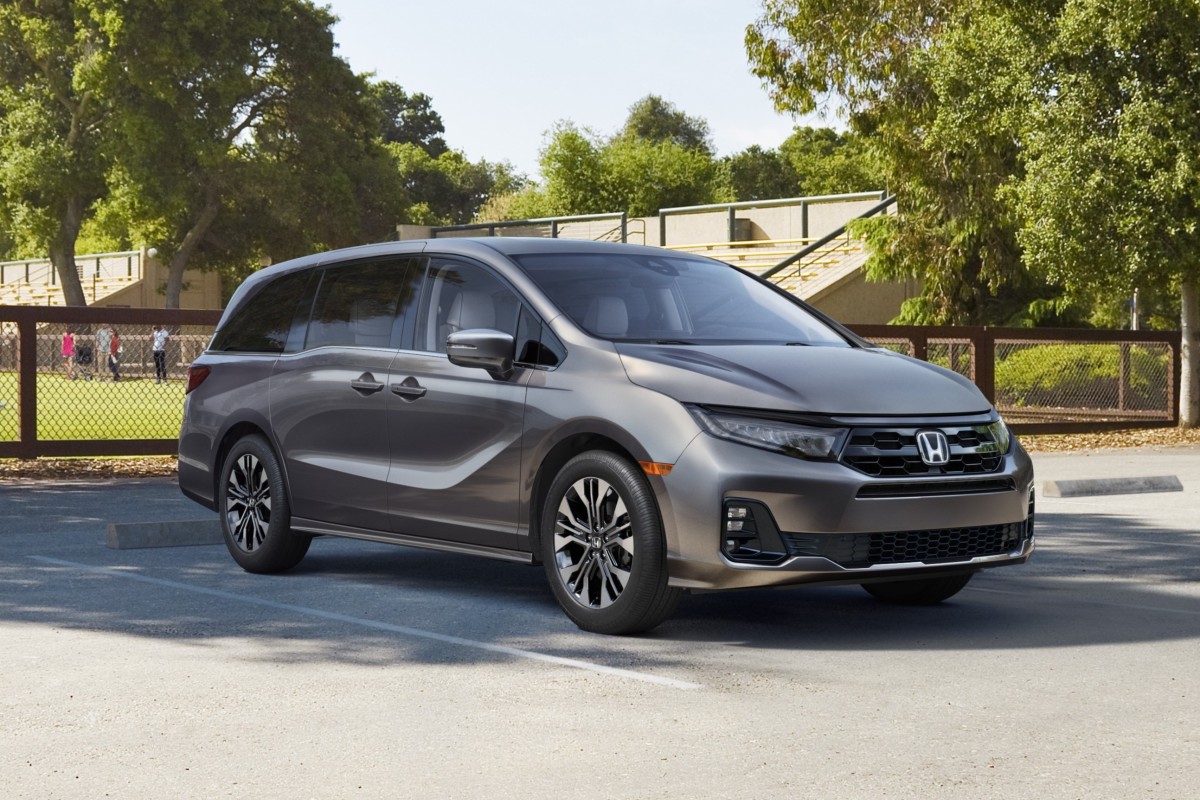
Nobody buys a minivan for its styling. That’s particularly true of the 2025 Honda Odyssey, to which you can draw a straight thematic design line from the fourth-generation 2011 Odyssey. In other words, it has a been-there, done-that aesthetic that’s as tired as a typical Dad joke.
That’s true of the interior, too, where buttons, knobs, and physical switchgear are the rule. We are not complaining about that, though. In this respect, Honda’s old-school approach is a blessing, and the controls feature bright white markings on matte black backgrounds to make them easy to find and use.
For 2025, the Odyssey comes in EX-L, Sport-L, Touring, and Elite trim levels. With the departure of the base EX trim, the most affordable version of the Odyssey jumps higher in price, to $42,220 from $38,240 for last year’s EX model. The loaded-up Honda Odyssey Elite tops out at $51,180, not including the destination charge of $1,450.
Our test vehicle arrived in Elite trim and a new-for-2025 paint color called Smoke Blue Pearl. Inside, it had classy two-tone black and light gray leather seats with the typical high-quality materials we expect in a Honda. It looked good, as minivans go. But again, nobody buys one of these things for the styling.

Performance
Driving enjoyment isn’t high on a minivan buyer’s list, either, but here, the Honda Odyssey proves rewarding, at least as minivans go.
Under its stubby hood, you’ll find a tried-and-true 3.5-liter V6 engine making 280 horsepower and 262 pound-feet of torque. A 10-speed automatic transmission delivers that motive force to the Odyssey’s front wheels. You cannot get AWD or a hybrid powertrain in this Honda, features available in other minivans.
According to the EPA, the 2025 Odyssey should get 22 mpg in combined driving. Our test vehicle returned 21.4 mpg on the evaluation loop and averaged 24 mpg during a week of travel that included an eight-hour round-trip drive from the far northwestern reaches of the Los Angeles suburbs to downtown San Diego.
Comparing the Honda’s fuel economy ratings to hybrid rivals, a Chrysler Pacifica Hybrid has a plug-in powertrain EPA-rated at 32 miles of electric-only driving before its V6 engine turns on. Then, it averages 30 mpg. The hybrid-only Toyota Sienna returns 35-36 mpg, while the Kia Carnival returns 33 mpg with its optional hybrid powertrain. In addition, Chrysler and Toyota offer AWD, although you can’t get it with the Pacifica’s plug-in hybrid powertrain.
People who like to drive might find the Honda’s fuel-economy tradeoff worthwhile. The V6 provides rousing performance, and Honda expertly tunes the ride and handling to give the Odyssey an utterly natural driving experience. It has a connected but compliant ride, responsive steering and braking, and nimble handling, no matter the situation.
Testing day was foggy and damp, requiring extra caution when driving in the mountains. However, past experiences with the Odyssey on the twists and turns of Mulholland Highway reveal a minivan with genuine athleticism. Historically, hot weather and mountain driving have produced some brake rumble, vibration, and fade with the Odyssey. This time, chilly temperatures and a nearly new test vehicle produced no similar behavior.
On a weekend road trip to San Diego, the Odyssey proved a comfortable and reasonably quiet space for the slog down the notoriously clogged 101, 405, and 5 freeways. The 10-speed automatic kicks down quickly for passing power, and the V6 has no trouble merging the van into fast-flowing traffic. When it’s flowing, of course.
In downtown San Diego, clear sightlines made it easier to navigate the unfamiliar parts of the city. However, Honda still needs to offer a surround-view camera system on this vehicle.

Form & function
The point of a minivan is to carry as many people and haul as many things as possible in the smallest and most fuel-efficient package allowable. The 2025 Odyssey definitely checks those boxes.
The Odyssey can carry eight people, and it provides up to 140.7 cubic feet of cargo in a garageable vehicle that gets 22 mpg. For comparison, a Chevy Suburban offers eight-passenger seating, 144.5 cubic feet of maximum cargo space, and, with its optional turbocharged diesel engine, returns 23 mpg in combined driving. But you’ll spend a minimum of about $20,000 more than the Odyssey to get one.
With Elite trim, the driver and front passenger also enjoy comfortable power-adjustable seats wrapped in soft, perforated leather. Inboard armrests, heating, and ventilation add to the Honda’s seating satisfaction, as does a heated steering wheel. However, to enjoy a tall seating position, drivers with longer legs might feel a little cramped because there isn’t enough seat track travel.
In the second row, the Odyssey has what Honda calls Magic Slide seats. They offer three-passenger capacity thanks to a center jump seat that you can remove to create two individual chairs with a pass-through to the third row. Or, you can fold the center seat back down to create a console equipped with cupholders and a tray.
The Magic Slide seats do not offer heating or ventilation, but you can slide them together to place them closer to the middle of the van, slide just one of them into the center of the van, and slide them forward for easier reach from the front seats. They’re soft yet supportive, and second-row passengers enjoy plenty of legroom. The side window shades do not cover all of the glass, so you’ll need supplementary cover for infants and young children who still ride in car seats.
To maximize cargo space, you must remove the Magic Slide second-row seats and find a place to store them. They are heavy and awkward to maneuver, but if you rarely require the added space, the trade-off to enjoy their configurability is likely worthwhile.
The Kia Carnival’s seats work similarly. In the Chrysler Pacifica (not the Hybrid), the second-row Stow ‘N Go seats fold into the floor, but they’re not very comfortable to sit in and lack the configurability of the Honda. In a Toyota Sienna, the second-row seats slide forward and collapse flat against the front seatbacks, preserving their comfort while ensuring easy and quick access to maximum cargo volume when necessary.
Like other minivans, the Honda Odyssey’s third-row seat is roomy enough for two adults or three children. The Odyssey Touring and Elite include third-row side window shades, too. Each part of the 60/40-split folding seat easily drops into the storage well behind the third row, as long as you don’t have a bunch of stuff stored there. You can also position the seat as an outward-facing place to sit.
Speaking of storage, the Odyssey offers plenty of space for stashing this and that throughout the cabin and cargo area. Parents can also easily monitor their children using the overhead conversation mirror and the available Cabin Talk intercom feature and Cabin Watch camera system.

Technology
Honda gives the 2025 Odyssey a light technology update. A new 7-inch digital driver display pairs with an analog speedometer, and the minivan adds a 9-inch touchscreen infotainment system with a faster processor for quicker response to inputs. In addition, wireless Apple CarPlay, wireless Android Auto, and wireless smartphone charging are now standard, and Honda sprinkles USB-C charging ports throughout the cabin.
Wisely, Honda retains a volume knob and radio tuning buttons. However, while the infotainment system is an improvement, it remains substandard. It still has dated graphics, the native voice recognition technology isn’t sophisticated enough to provide an intuitive user experience, and the Elite’s audio system is unimpressive. In addition, phones can easily move on the center console charger pad, canceling the charge.
We had no trouble pairing an iPhone 16 to the infotainment system, running Apple CarPlay, streaming music, and using Siri to find various destinations on our weekend road trip. The minivan’s native voice recognition isn’t as helpful. It’s not conversational, so you must adhere to suggested command structures to find success when programming a destination. Also, when asking for directions to the nearest hospital, a chiropractor’s office was the first result on the list.
Honda introduced a new rear-seat entertainment system in the 2025 Odyssey as well. The roof-mounted, single-screen setup looks anachronistic, but it features Amazon Fire TV technology to stream content from Disney+, Netflix, Peacock, Amazon Prime Video, and more. If you can get it to work.
We tasked two teenagers with making the system work. They gave up after a few minutes, returning to their individual devices and Air Pods. So, your middle-aged author gave it a whirl but quickly hit a dead-end. According to the instructions on the infotainment system display, the rear entertainment system “does not include any built-in apps or features,” so you must connect a personal device via the HDMI port. We lacked the right cable to do so.
In a world where you can pair a smartphone to specific rather than all Bluetooth devices in a home or use a laptop to get internet access through a wirelessly paired phone’s hotspot and conduct business from anywhere in the world as long as there is a cell signal, the Odyssey’s rear seat entertainment system is frustrating.

Safety
Every 2025 Odyssey has Honda Sensing, a collection of driving-assistance systems. Standard safety features include adaptive cruise control, forward collision warning, automatic emergency braking, lane-departure warning, lane-keep assist, lane-centering assist, blind-spot monitoring, and rear cross-traffic alert. The Touring and Elite add front and rear parking sensors.
Generally, the Honda Sensing features operate smoothly and unobtrusively. However, we prefer a steering wheel vibration for lane-departure warnings instead of the Honda’s subtle steering wheel wobble. Also, when using the adaptive cruise control in moderate to heavy traffic, the Odyssey can brake too hard in response to other vehicles entering the gap ahead. When slower vehicles depart the lane, the Odyssey demonstrates a delayed reaction time to the new situation.
In safety testing performed by the National Highway Traffic Safety Administration (NHTSA), the 2025 Odyssey earns impressive ratings. It also performs well in tests conducted by the Insurance Institute for Highway Safety (IIHS), with one exception. In a new evaluation for which Honda didn’t engineer the current-generation Odyssey, the van earns a “Poor” rating, performing worse than all of its rivals.

Cost-effectiveness
Honda’s strategy with the Odyssey is, well, odd. At the same time consumers are increasingly voicing concerns about new vehicle affordability, Honda has dropped the lower-priced versions of its minivan, making it more expensive than its competitors. In addition, a fuel-efficient hybrid option is unavailable, so ownership costs will likely be higher than rival minivans. Honda doesn’t offer the extra traction of an AWD system, either.
Meanwhile, over at Toyota, the Sienna is available at a lower price, with a standard hybrid powertrain returning 36 mpg. You can get AWD on a Sienna, and Toyota provides two years or 25,000 miles of complimentary scheduled maintenance. The Sienna’s second-row seats don’t require removal to use the maximum cargo capacity, either.
The Kia Carnival is another appealing alternative, with SUV-adjacent styling, an available hybrid powertrain, and a generous warranty. The Kia’s onboard tech and driving-assistance systems are undeniably impressive, and in top-spec trim, it comes with heated, ventilated, and power-adjustable second-row lounge chairs.
Additionally, Volkswagen has finally launched the long-anticipated ID. Buzz, an electric reincarnation of the beloved Microbus. The Buzz is pricey, but the added cost in exchange for the daily drive down memory lane might be worth it to people seeking a different kind of family hauler.
Essentially, Honda needs to redesign the Odyssey. It’s a great traditional minivan. But it’s not a great modern minivan.

What owners say
Trims & specs
Base MSRP N/A | Seating N/A |
Engine N/A | Cargo Capacity N/A |
Combined MPG N/A | Drivetrain N/A |
Base MSRP $42,220 | Seating 8 |
Engine 3.5L 280 hp V6 | Cargo Capacity 32.8 cu ft |
Combined MPG 23 | Drivetrain FWD |
Base MSRP $51,180 | Seating 8 |
Engine 3.5L 280 hp V6 | Cargo Capacity 32.8 cu ft |
Combined MPG 23 | Drivetrain FWD |
Base MSRP $43,370 | Seating 8 |
Engine 3.5L 280 hp V6 | Cargo Capacity 32.8 cu ft |
Combined MPG 23 | Drivetrain FWD |
Base MSRP $46,910 | Seating 8 |
Engine 3.5L 280 hp V6 | Cargo Capacity 32.8 cu ft |
Combined MPG 23 | Drivetrain FWD |


Pricing trends
MSRP range
$42,220 - $51,180
Current avg. market price
$34,459
Trending down by 2.7% this month
May 2026 - November 2026