2021 Honda CR-V Hybrid Reviews, Pricing & Specs




Pros & cons
What we like
Great ride quality
Comfortable
Quiet cabin
What to consider
Fuel economy is underwhelming
Outdated technology
Uninspired styling
Expert review
The 2021 Honda CR-V Hybrid is everything most people claim to want in a new vehicle, but it falls short in several critical areas.
Emotion drives your choice in a new car, truck, or SUV. You say you want reliability, safety, practicality, and efficiency. Then you buy the vehicle you think is the best looking, or comes in the right color combination, or gives you the biggest thrill, or makes a statement about your success. After all, you want your new set of wheels to look good on you, in addition to all that other boring stuff. The 2021 Honda CR-V Hybrid compact SUV is all about the boring stuff. And it doesn't look half bad, either.
out of 10 expert review
Look & feel
Honda added its two-motor hybrid powertrain to the CR-V for the 2020 model year. At the same time, all CR-Vs got a freshening, including updated styling, improved interior storage, standard Honda Sensing safety technology, and available wireless smartphone charging. A handful of new paint colors also debuted last year.
For the 2021 model year, nothing changes. But that doesn't mean improvements aren't necessary, as we shall see.
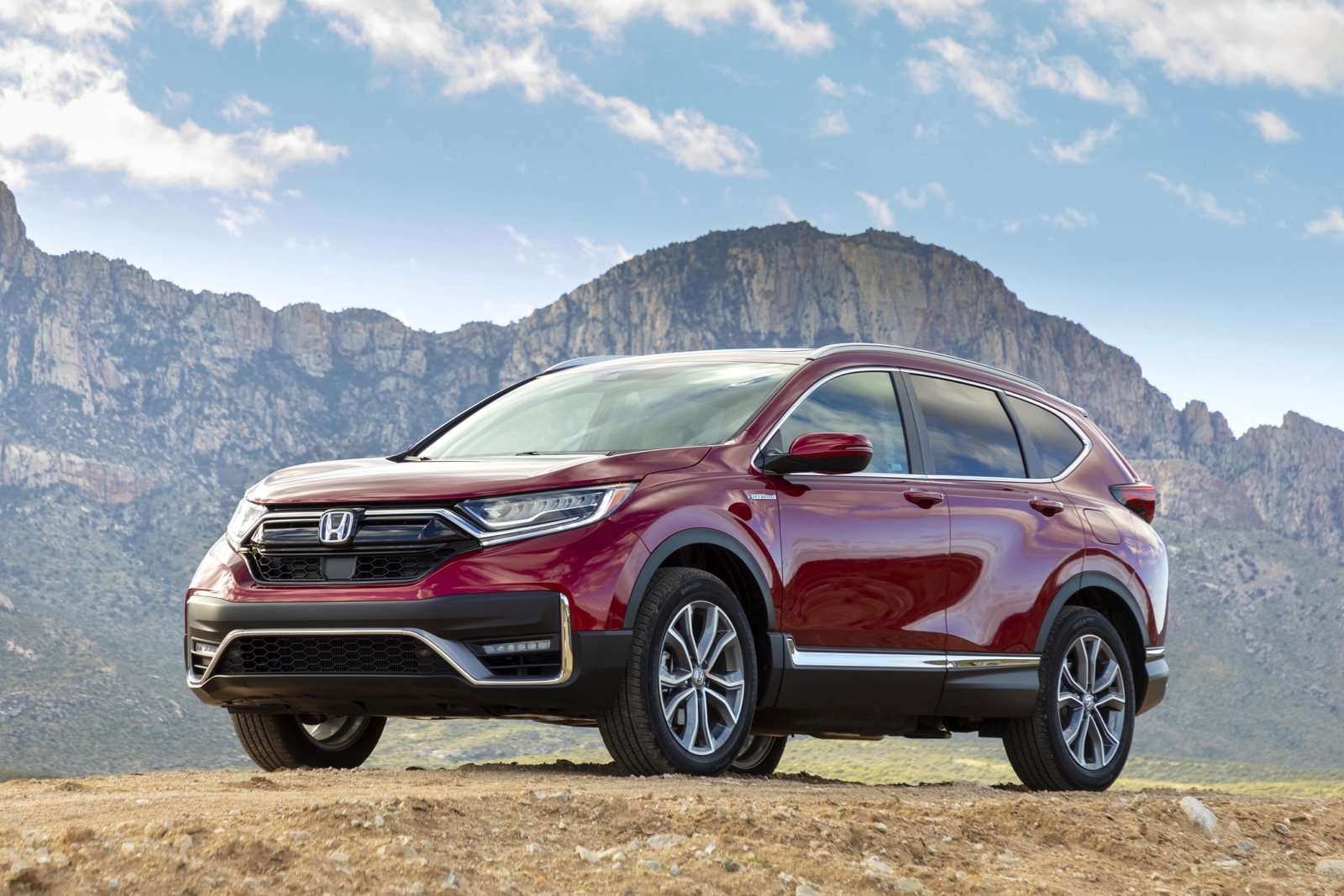
The 2021 Honda CR-V Hybrid looks much like the standard gas-only variants. You get "Hybrid" badges, of course, and blue Honda logos. The LED fog lights have a more sophisticated design, and the rear bumper is different. Otherwise, nothing calls out the fact that you're driving the fuel-sipping version of the CR-V, which is also more powerful and arguably more enjoyable to drive than the gasoline version.
Inside, the CR-V Hybrid has different trim and comes with unique instrumentation that shows battery-charge status, power regeneration, and power distribution. The paddles on the CR-V Hybrid's steering wheel also manage the regenerative braking system, not the transmission.
Honda offers the CR-V Hybrid in EX, EX-L, and Touring trim levels, and they all have standard all-wheel drive (AWD). Pricing ranges between $30,560 and $36,350—a $1,200 premium over equivalent gas-only models with AWD.
Upgrading from EX trim to the EX-L adds leather upholstery, a better sound system, a heated steering wheel, a power liftgate, and more. Touring trim equips the SUV with larger 19-inch wheels, navigation, a premium sound system, parking sensors, wireless smartphone charging, and a hands-free power liftgate, among other features.
Our test vehicle arrived in Touring trim and wore extra-cost Platinum White Pearl paint, which has a tinge of blue sparkle. Ivory leather decorated the cabin, presenting a rich two-tone contrast against the black upper panels and carpets. All CR-V Hybrids suffer the indignity of fake wood that looks nothing like the real thing.
No further upgrades were on the test vehicle, which cost $37,920 MSRP, including the mandatory $1,175 destination charge.
Performance
Honda's two-motor hybrid technology pairs a 2.0-liter gasoline four-cylinder engine with an electric assist motor and a generator/starter motor in place of a conventional transmission. Total system output measures 212 horsepower, and the electric assist motor generates 232 pound-feet of immediate torque.
Three driving modes are available—EV Drive, Hybrid Drive, and Engine Drive—and the CR-V automatically selects the most appropriate one based on the situation. Additionally, there are three driver-selected modes—Econ, Sport, and EV. Power only flows to the rear wheels when necessary for added traction.
Compared to the gas-only CR-V, the added weight of the battery pack and electric motors amounts to 194 pounds, carried low in the vehicle for a reduced center of gravity. The CR-V Hybrid also has slightly better weight distribution and retains the standard CR-V AWD model's 8.2 inches of ground clearance.
Aside from some occasional steady-state droning under acceleration, the CR-V Hybrid is good to drive. It's quick off the line, has plenty of power for its mission, rides nicely, and handles predictably. As is true of any Honda, the engineers have honed the driving character to deliver on expectations while adding the surprise and delight of genuinely enjoyable dynamics.
On the testing route, the CR-V Hybrid returned 33.7 mpg. That's not anywhere near the EPA rating of 38 mpg in combined driving and doesn't come close to matching the 39.7 mpg we obtained from a RAV4 Hybrid earlier this year.
Perhaps more city driving would have increased our result, but the RAV4 Hybrid didn't require any special driving situations to prove itself efficient. Your results, as they say, may vary.
Form & function
If the CR-V Hybrid falls short in terms of expected and real-world-competitive fuel economy, it capably carries people and cargo.
Up front, supportive front seats supply hours of comfort at a time. The driver's seat provides 12-way power adjustment, allowing you to dial in excellent leg support combined with a proper position behind the steering wheel. Heated front seats are also standard, and the available leather feels soft and high in quality.
The front passenger's seat does not supply height adjustment, which is the only comfort-related complaint. The cushions are fine, but it would be nice to raise the chair a little higher off of the floor.
The rear seat room is downright remarkable. Adults enjoy cross-your-legs levels of space, similar to Honda's accommodating Accord sedan. Honda angles the bottom cushion for good leg support and the backrest for maximum comfort. There are air conditioning vents and 2.5-amp quick-charge USB ports, and a flat floor makes the CR-V more accommodating for three rear passengers.
Interior storage space is impressive, even though the Touring trim's wireless smartphone charger uses up plenty of real estate on the center console.
Honda configures cargo space for maximum utility. Behind the rear seat, the CR-V Hybrid holds 33.2 cubic feet of volume, down from the standard CR-V Touring's 37.6 cubic feet due to the battery pack. Nevertheless, even with the cargo compartment cover in use, you can line four full-sized suitcases up beneath it.
Maximum cargo space measures 68.7 cubic feet—a whopping 7.1 cubic feet less than a standard gasoline CR-V Touring. And, since inquiring minds want to know, a Toyota RAV4 Hybrid offers more space by volume, regardless of how you position the seats.
Technology
The last time Honda redesigned the CR-V was for the 2017 model year. Its infotainment system doesn't look outdated, but it performs that way.
The surface is large and flush, with a power/volume knob. The touchscreen underneath it measures seven inches across, making it one of the smaller displays in the segment. The lack of a tuning knob negatively impacts the user experience, though it's easy enough to cycle through radio station pre-sets using the controls on the steering wheel.
Push the engine start button, and it takes a long time for the infotainment system to fire up. The voice-recognition technology cannot interpret or respond to naturally-spoken commands, so you'll want to use the wired Apple CarPlay or Android Auto feature for that kind of interaction. The navigation map display is cluttered, too, and the HondaLink connected services plans for this SUV are barely worth mentioning.
Honda offers dual 2.5-amp quick-charging ports for the rear seat, but you get 1.5-amp and 1-amp USB ports in the front. Wireless smartphone charging is standard with Touring trim but appears to be a space-robbing afterthought on the center console.
If there is a silver lining here, the Touring's nine-speaker premium audio sounds good. The infotainment system also supports text messaging, offers SiriusXM satellite radio, and features integrated Pandora internet radio.
Safety
Honda equips every 2021 CR-V with Honda Sensing. This collection of advanced driving-assistance systems includes the usual suspects.
Standard features include adaptive cruise control with full-stop capability in traffic. Forward-collision warning and automatic emergency braking guard help prevent a collision or reduce the CR-V's speed before impact. Lane-departure warning, lane-keeping assist, and Honda's Road Departure Mitigation (designed to prevent drivers from veering off the road) are also standard. Additionally, the CR-V Hybrid includes blind-spot monitoring with rear cross-traffic alert.
These systems work with smoothness, accuracy, and consistency. However, the CR-V's technology is not quite as broad or sophisticated as what you might find in other compact crossovers with which it competes. Also, the CR-V doesn't offer automatic collision notification, SOS emergency calling, or safe teen driver settings of any kind.
Should you get into a collision, know that the CR-V Hybrid is a safe SUV. It earns a five-star overall rating from the National Highway Traffic Safety Administration (NHTSA) and gets a Top Safety Pick rating from the Insurance Institute for Highway Safety (IIHS).
Cost-effectiveness
At $1,200 over an equivalent gasoline CR-V, buying a CR-V Hybrid for the long-haul makes sense, especially if gas prices are high. Surprisingly, as this review is written and in a Southern California zip code, the lease rates for the CR-V Hybrid are more favorable than for equivalent gas-only models with AWD. So, you can choose the hybrid version and save a little money in two ways.
Aside from generally cheap lease deals on all CR-V models, there isn't much in the way of value to compel a purchase. Competitors may offer better warranty coverage, complimentary scheduled maintenance, superior fuel economy, more technology, substantial connected services plans, and more.
The implied promise in buying a Honda CR-V is that it will be reliable, safe, practical, and efficient. You may also like the way it looks, the way it drives, how comfortable it is, and how functional the cargo area is. But this well-rounded goodness, and Honda's effortless ability to sell CR-Vs in large quantities, means the company need not entice people with value-added benefits outside of appealing lease payments.

What owners say
"Owners of the 2021 Honda CR-V Hybrid generally enjoy its smooth ride, quiet cabin, and impressive fuel economy. Many appreciate the abundance of features, especially in higher trims. However, some drivers expressed concerns about the unique gear button system and the lack of a traditional spare tire."
Quiet, roomy, versatile, and great for the gas mileage!
May 2, 2024We love our new 2021 Honda CR-V Hybrid Touring. It looks good, rides good and the cabin is very quiet. Roomy and tons of features.
July 14, 2021I love the safety features on the CRV and also everything else about it. I would definitely recommend it ti anyone.
February 3, 2024What owners say
Quiet, roomy, versatile, and great for the gas mileage!
May 2, 2024We love our new 2021 Honda CR-V Hybrid Touring. It looks good, rides good and the cabin is very quiet. Roomy and tons of features.
July 14, 2021I love the safety features on the CRV and also everything else about it. I would definitely recommend it ti anyone.
February 3, 2024Wonderful vehicle. At 60,000 miles, no issues. We keep up on all service suggestions. I will need new tires soon. Only issue... The lock will engage/activate/click every time we slow down and then accelerate. Otherwise, its exactly what we wanted.
September 26, 2023Great gas mileage nice reliable vehicle…no gear shifter. Just buttons
July 8, 2023Excellent , Maintained superb No problems ever Neat and shining Fantastic gas mileage
April 23, 2022This vehicle has more than what Im looking for, the EX trim offers a lot more standard features compared to other competitors. The cabin is very quiet and the ride is very smooth definitely recommend this SUV to everyone
May 6, 2021In the 4 days that I have had this car, I have driven it on mountain roads, highways, city streets, hilly neighborhoods in all gears, including reverse. I chose this car due to its updated electronics such as lane keep assist, adaptive cruise control, and low speed electric drive. Contrary to some other reviews, I found the information display responsive enough. Other thoughts: 1) To switch blower mode from dash to floor modes requires the information display touchscreen which can be distracting, 2) The large EV lithium battery takes up part of the former spare tire area, leaving no room for a real spare tire or doughnut tire...instead, you get an electric sealant/air inflator kit, 3) there are several plastic storage compartments in the doors and panels but only the center console has a cover to hide its contents, 4) Drive, Reverse, Park are large push buttons on the center console which I quickly adapted to. I think this AWD car is a good value for the features it offers.
August 14, 2023Love the hybrid model! The car runs smoothly. The manual is difficult to follow.
December 29, 2023Trims & specs
Base MSRP $36,350 | Seating 5 |
Engine 2.0L 212 hp I4 Hybrid | Cargo Capacity 33.2 cu ft |
Combined MPG 38 | Drivetrain AWD |
Base MSRP $30,560 | Seating 5 |
Engine 2.0L 212 hp I4 Hybrid | Cargo Capacity 33.2 cu ft |
Combined MPG 38 | Drivetrain AWD |
Base MSRP $33,150 | Seating 5 |
Engine 2.0L 212 hp I4 Hybrid | Cargo Capacity 33.2 cu ft |
Combined MPG 38 | Drivetrain AWD |


Pricing trends
MSRP range
$30,560 - $36,350
Current avg. market price
$25,880
Trending down by 0.5% this month
May 2026 - October 2026


