
If you live in a city, traffic is a fact of life. Whether you’re in Los Angeles, California, Boston, Massachusetts, the greater Chicago area, New York or Atlanta, you’re going to be one of tens of thousands of Americans trying to get to the same place—and it’s particularly bad during rush-hour traffic.
But there are a number of strategies drivers can take when dealing with heavy traffic congestion. These tips can make traffic safer and more bearable. Some of this is the kind of advice you’ll still find in your most basic driver’s ed manual or when studying for a driving test, but there are also technological advances from the last ten years that can make dense traffic much less of a burden. We won’t argue that you’ll enjoy it, but you can at least arrive at your destination less exhausted than you might have before.
Tips for Heavy-Traffic Driving Plus the Best Cars for Traffic in 2024
- Keep a Safe—and Smart—Following Distance
- Avoid Distractions
- Keep Your Eyes Up, Even at Traffic Lights
- Know What Your Brakes are Doing
- Use Your Mirrors
- Use Your Signals
- Embrace Driver Assistance Technologies
- The Best Cars for Driving in Traffic
- Ford F-150 Lightning
- Kia Niro EV
- Mitsubishi Outlander
- Hyundai Ioniq 6
- Subaru Forester

1. Keep a Safe—and Smart—Following Distance
The key to a safe journey in traffic is allowing yourself the time to react if something bad happens in front of you.
The people who like to dispense the most advice on following distance typically work for or at your car insurance company, because they have little interest in actually paying claims after an accident; they’d much rather collect their premium and have you avoid a crash.
Travelers Insurance, for example, recommends the “three-second rule” for following distance: as you’re cruising along at highway speed, you’re supposed to choose a marker beside the road. As the car in front of you passes it, you’re supposed to count “one one thousand, two one thousand, three one thousand.” If your front bumper takes three full seconds to pass that roadside marker after the rear bumper of the car in front of you has passed it, then you’ve succeeding in following the rule.
To give you an idea of how much space you’re supposed to be leaving, three seconds at 60 miles per hour is 12 car lengths, or about 200 feet. When traffic is moving, however, the flow of traffic tends to creep up to 70, 75 miles per hour, which should increase your following distance another one or two car lengths. Going at a constant speed of 75 miles per hour means you need 14 car lengths between you and the car ahead; that’s about 225 feet, or almost exactly two-thirds of a football field. So, if you were standing in the end zone, the car in front of you should be at your opponent’s 30 yard line.
Depending on where you live, if you leave that much space between you and the car in front of you, it will invariably be filled with two, three, five or more drivers thinking that space looks like a perfect spot merge into, making forward progress more of a theory than an actual practice.
In heavy traffic at slower speeds, leaving that space is even more challenging and sometimes less practical, even if the three-second rule means you can leave less space. At 20 miles per hour, that rule dictates that you should leave roughly four car lengths.
If you’re a beginner in highway or city traffic, learning how much space you need to keep between you and the car in front is going to take some time. Unfortunately, they teach very little of this in your typical driving school, but you some brands like Ford and Kia do offer their own, more comprehensive, driving lessons for teens.

2. Avoid Distrations
You have more distractions than ever in a modern vehicle. Not only do you have things like cell phones along for the ride, the days of being able to tune the radio to a station you like, fast forward to a specific song on a cassette or adjust the heat without taking your eyes off the road are gone forever.
With all these distractions, it’s important to not pay attention to them while hurtling down the at highway speeds. Along with Apple CarPlay and Android Auto that help to minimize distraction, a bunch of third party apps help to eliminate texts, calls and video calls altogether while the car is in motion. Apps like On My Way, Safe 2 Save, and TrueMotion are good technologies for beginner drivers and those of us with experience alike.
With traffic congestion at an all time high, the likelihood of a crash is off the charts. Somebody 20 cars in front of you gets aggressive on the brake pedal and all of those cars in a conga line have to stop more and more quickly. If you’re the last car in that line and you haven’t been looking far ahead, you’re going to either plow into the traffic in front of you, or the car behind you is going to rear-end you.

3. Keep Your Eyes Up, Even at Traffic Lights
Looking as far down the road as possible is key to avoiding a crash. Brake lights an eighth of a mile in front of you should indicate that you should be slowing down long before the car in front of you attempts a panic stop.
How far you can look down the road is heavily dependent on weather and road conditions. On a clear day you can see a lot further. When it’s raining, foggy or snowing, your sight distance can be reduced to the end of your hood. It’s why there are so many videos on YouTube of multiple vehicle crashes in the fog and snow. If you can’t see an eighth of a mile in front of you, by the time you see that multi-car pileup in front of you, it’s going to be too late. Better to drive slowly, occupy the right lane and be ready to stop or take evasive action.
Anticipating what’s happening in front of you is also helpful in city traffic. The worst thing for all concerned is for drivers to wade into an intersection on a green traffic light only to have progress come to a halt with you in the middle of the intersection. Predict how the traffic is moving and, if it looks like you can’t fully get through the intersection before the light turns red, stop before the intersection—even if the light is still green. You’re better off being the first car at a red light than the last car through a green one, especially if the latter means you’re stuck in the intersection and blocking the way of angry drivers.

4. Know What Your Brakes are Doing
We’ve had antilock brakes systems (ABS) for more than a quarter century now and amazingly, most drivers still don’t know what they’re supposed to do. They’re not there to reduce your stopping distance and they’re not there to prevent the horrendous screech of rubber on asphalt. Anti-lock brakes exist so that you can maintain steering control when you’re applying full brake pressure. If there’s one thing you should take away from this article, that’s it.
People who have taken MSF motorcycle rider safety courses will be familiar with the “traction pie,” a graphic representation of the available traction your tires can provide. If you devote 100% of that pie chart to anything, be it acceleration, braking, or cornering, you have nothing in reserve for anything else. So if you’ve devoted 100% of your tires’ traction capacity to braking, you have none in reserve to turn.
That’s the idea behind ABS: it allows you to apply full braking pressure while still offering a percentage in reserve to point your vehicle in a direction other than that of the car stopped in front of you. When ABS engages, you’ll feel the brake pedal pulse, and the wheels won’t lock up. This is by design, but it means that if you don’t steer away from your path—which ABS is allowing you to do—your car may still go straight into the car stopped in front of you.
Braking distances don’t change with ABS. It still takes the same distance to come to a full stop and that distance gets longer if the road is wet, icy or covered in snow. But in any condition, you’ll retain the ability to steer around the obstacle in front of you.
The challenge in these situations is that you have very little time to decide where you’re going to go, and if you haven’t allowed ample distance, that time gets even shorter. In the passing lane, your exit path is usually into the median, but if you’re in the middle lane, you need to quickly check your mirrors to see if there’s a safe place on either side to escape to. It makes paying attention and leaving a safe stopping distance even more important.

5. Use Your Mirrors
Your mirrors are a vital tool to understanding when it’s safe to merge into the lanes to the right and left of you. In heavy traffic, new technologies like blind-spot monitoring and lane-departure warnings help you to get a better sense of what’s in your lane and the lanes around you. Visual and audible cues can help you learn when it’s safe to merge into another lane.
What’s just as important, though, is understanding how to adjust your mirrors so you can see what’s going on around you in congested traffic. In 1995, the Society of American Engineers (SAE) published a paper on the geometry behind adjusting your mirrors for an optimal view. According to Car and Driver, “The paper advocates adjusting the mirrors so far outward that the viewing angle of the side mirrors just overlaps that of the cabin’s rearview mirror. This can be disorienting for drivers used to seeing the flanks of their own car in the side mirrors. But when correctly positioned, the mirrors negate a car’s blind spots. This obviates the need to glance over your shoulder to safely change lanes as well as the need for an expensive blind-spot warning system.”
So what does that mean? It means that you should adjust your mirrors so that the view out of the rearview mirror slightly overlaps that of the side mirrors, and that a sliver of the corner of your vehicle is going to be visible in the side mirrors. Most people tend to adjust their mirrors so that there’s no part of their own vehicle in the glass, but that creates a huge blind spot that can hide a motorcycle or even a car.

6. Use Your Signals
This is going to be a hard pill for some drivers to swallow (CarGurus is based in Massachusetts, after all), but you’re supposed to use your turn indicators when driving. They’re helpful for the other traffic around you to figure out what it is that you’re doing.
And you’re not just supposed to use your signals when you’re turning into a side street. Using them when merging onto a congested expressway, or changing lanes is when they’re most useful. Almost all modern vehicles have a turn indicator with two positions: one with a detent that keeps the directional on until the turn is completed, and a second without a detent that allows the signal to flash for a few seconds and then turn itself off, a particularly useful function when changing lanes.

7. Embrace Driver Assistance Technologies
The greatest boon to drivers who have to face regular heavy traffic in the last few years has been the introduction of adaptive cruise control and other related technologies. Adaptive cruise control allows you to set a distance between you and the car in front of you, and then follow at that distance up to a speed that you’ve set.
Early versions of this technology shut off under 10 miles per hour or so, but the more recent versions will follow at that preset distance all the way down to a full stop. Some adaptive cruise control systems will automatically start you moving again once traffic starts to move again, while others require the driver to touch the accelerator or press a button to move again.
Technologies like Super Cruise and BlueCruise from GM and Ford, respectively, take it a step further. These advanced driver assistance systems (ADAS) allow you to set a speed on the highway while the vehicle follows the lane markers, not only following at a safe distance and maintaining a speed, but keeping your vehicle in its lane without input from you, even passing slower cars when there’s room to safely do so.
It's not “autonomous driving” since the system will disable itself around toll plazas, construction zones and the like, but the cognitive load it takes off the driver on long, traffic-laden drives is truly appreciated.
The Best Cars for Traffic in 2024
We’ve driven a lot of vehicles in traffic this year. Whether it’s commuting to CarGurus HQ in Cambridge, MA, battling the increasingly congested I-495 in the MetroWest area, or even watching the clock tick toward two hours (or four on summer holiday weekends) on a 90-mile trip north to Portland, Maine, we’ve had a lot of chances to find some of the better vehicles for negotiating heavy traffic:

Ford F-150 Lightning
Despite its ponderous size, the F-150 Lightning we drove over the last year has been one of our favorite traffic fighters. The height is nice for seeing further down the road, but it’s really the technology that we came to love.
BlueCruise seems to get better every time we use it. The earliest version of Ford’s semi-autonomous driving technology tended to wander in the lane a bit, but it seems to learn more quickly now. We drove from the Wells exit of the Maine Turnpike all the way to the toll gantry in Hampton, New Hampshire before the system briefly required human intervention. From there, we only had to intervene three more times all the way to the Massachusetts Turnpike, were we required to take over, either to take an off-ramp or to drive through a construction zone.
BlueCruise is available on several select Ford vehicles including the Mustang Mach-E, the F-150 and F-150 Lightning and the Expedition.

Kia Niro EV
At the opposite end of the price spectrum is the Kia Niro EV. Part the Niro EV’s appeal is it’s size. Being so small means the Niro offers much greater maneuverability than something like the F-150.
While it doesn’t have autonomous driving technology to match the Lightning’s BlueCruise, it does offer over 20 standard collision-avoidance and driver-assist features, including lane-keeping assist and lane-following assist, auto emergency braking, blind-spot collision avoidance assist, and rear cross-traffic collision assist. Aside from the last one, all of the other technologies are a significant aid to Americans driving in traffic.

Mitsubishi Outlander
This one was a surprise, given how awful earlier generations of the Outlander were. But the current generation of the Outlander is based on the Nissan Rogue/X-Trail, underpinned by a shared platform that arrived to Mitsubishi’s engineering teams as part of the Renault-Nissan-Mitsubishi alliance.
Even in the base ES trim level, the Outlander is equipped with a blind-spot warning system with lane-change assist, but you should step up to at least the SE trim level, as it includes that plus adaptive cruise control with traffic jam assist, lane-keeping assist and lane-departure prevention.
That’s similar whether you purchase the Outlander with a regular internal combustion engine or the Outlander PHEV, which comes with a plug-in hybrid drivetrain.

Hyundai Ioniq 6
The Hyundai Ioniq 6 really feels like the best interpretation of an electric vehicle available right now. The lowest SE trim level is equipped with 18-inch wheels sporting tires that have a little extra sidewall, making it more comfortable in highway traffic. And in rear-wheel drive (RWD) form, it can deliver up to 361 miles on a charge. However, if you upgrade to a higher SEL or Limited trim with 20-inch wheels, that range figure drops by 60 miles.
Unfortunately, if you want the full panoply of highway driving assistance technology, you do need to step up to the SEL. Highway Driving Assist 2 is standard on the SEL and the Limited.
Hyundai also provides a nice lane-changing feature that most manufacturers don’t: When you activate the turn signal, the instrument panel displays a view of what’s in the lane next to you. It’s a little disorienting at first, but once you get used to it, it really helps eliminate any blind spots to the rear. Given these helpful technologies, if you’re going to drive regularly in heavy traffic, aim for the SEL or Limited trims. If range is your top priority, however, we recommend the SE trim level.
Subaru Forester
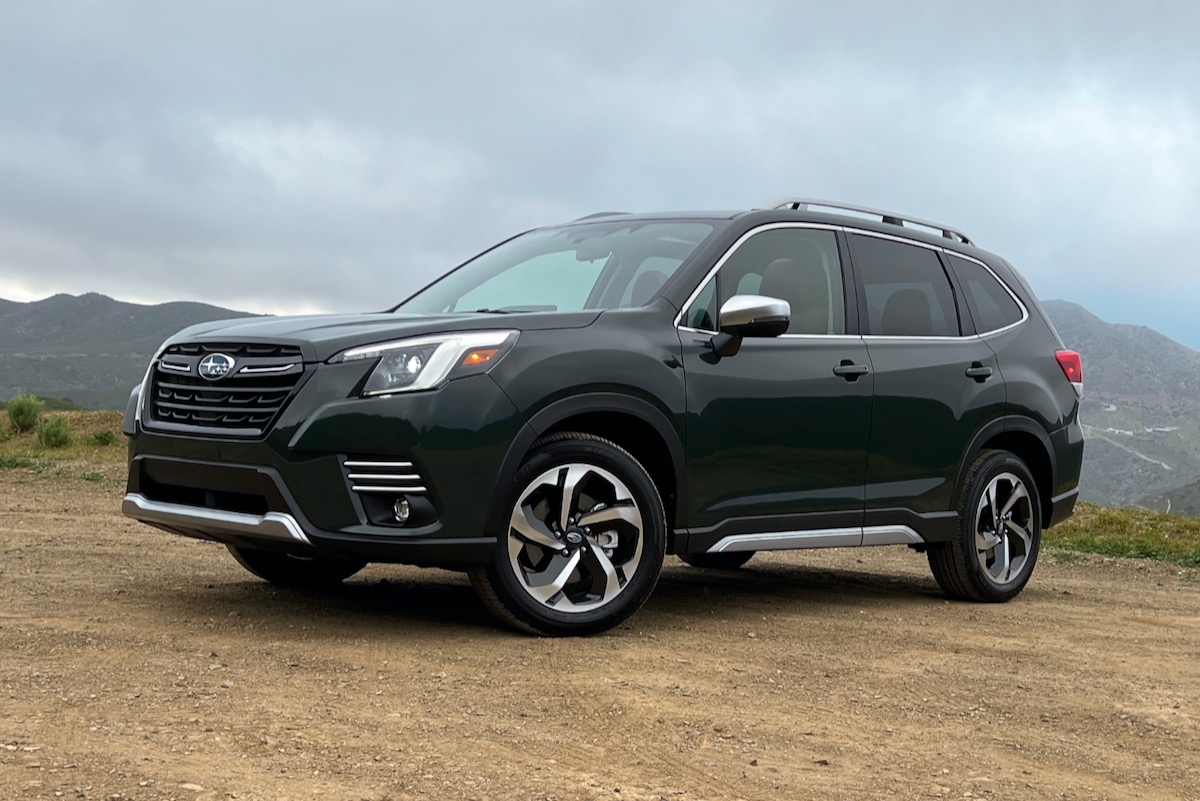
Even at the Subaru Forester’s base trim level, you’ll find all of the driver assist technology that comes in more expensive trim levels. The brand’s EyeSight suite of driver assist technologies provides lane-keeping assist, lane-departure warning, adaptive cruise control, and automatic emergency braking. These are all things that should help you avoid a crash in highway traffic.
The Subaru Forester’s main advantage, though is old-school: It has excellent visibility. Just being able to see well is a huge safety advantage in traffic. We’re in an unprecedented era of obstructed view driving thanks to huge pillars that hide airbags and provide roof strength, five headrests for passenger safety and just general bad design choices that leave huge blind-spots.
The Forester has plenty of airbags, great roof strength, and headrests for every passenger, but the car’s two-box design has a huge glass greenhouse that provides good views of traffic all around so that you’re less reliant on cameras and mirrors to see where you’re going.