What does it actually mean for a car to be "safe" in 2026? It's not just seatbelts and airbags anymore—today's vehicles are loaded with technology designed to prevent crashes before they happen. This week on The Driveway Podcast, the crew decodes everything from crash test organizations to autonomous driving systems, and reveals the safest cars they've tested this year.
Car Safety Decoded, and Our Safest Cars in 2026 | The Driveway Podcast #41
The Driveway Podcast
Episode 41
Published: February 18, 2026
- This Week in Auto News
- What Makes a Car Safe?
- NHTSA vs. IIHS: Understanding Crash Test Ratings
- Active vs. Passive Safety Systems
- Must-Have Safety Features
- Autonomous Driving: The Levels and Key Players
- The Safest Cars of 2026
- Speed Round: One Safety Feature You Can't Live Without
- How to Listen
- The Hosts
This Week in Auto News
New Cars Incoming
The Driveway crew has a packed travel schedule. Natalie visited Quebec to ice-drive a camouflaged 2027 Volkswagen Atlas prototype—complete with an NDA and a no-phones-inside-the-car policy. Dave traveled to San Diego for the all-new Mazda CX-5, which features a much-needed infotainment overhaul. Elliot and Matt have been bouncing around California to test the 2026 Toyota bZ Woodland and 2026 Toyota C-HR, two new electric vehicles, followed by their Subaru counterparts (the Trailseeker and the Uncharted) the following week. Keep an eye out for those reviews and videos.
Toyota Reveals New Three-Row SUV
Toyota revealed a brand-new three-row SUV: the fully electric 2027 Toyota Highlander. Read the full story here.
What Makes a Car Safe?
Matt breaks down how CarGurus evaluates safety in its Test Drive Reviews. The team scores vehicles against other cars in their segment, focusing primarily on crash test ratings and the availability of advanced driver assistance systems (ADAS).
The key factor? Whether safety tech is standard or optional. Automakers like Toyota earn high marks by including their full Toyota Safety Sense suite—automatic emergency braking, lane keeping assist, rear cross-traffic alert, blind spot warning—on every trim level, from base to top-of-the-line. Luxury automakers that charge extra for features like blind spot monitoring on certain trims get penalized in comparison to competitors that include them standard.
It's not just about what tech is included, either. The team also evaluates how well the systems work and whether they're so annoying that drivers want to turn them off. As Matt pointed out, many ADAS features are adjustable—you can dial back the sensitivity of pre-collision braking or rear automatic braking in your car's settings. If a system is going off seven times a week (looking at you, Elliot's Honda Accord), it might be worth spending a few minutes in the driveway adjusting the thresholds.

NHTSA vs. IIHS: Understanding Crash Test Ratings
Dave walks through the two major safety organizations that car shoppers should know:
NHTSA (National Highway Traffic Safety Administration)
A federal government agency under the Department of Transportation. NHTSA puts vehicles through three main crash tests and assigns a one-to-five star rating, with five being the best. The catch? NHTSA's criteria haven't changed significantly in years, so nearly every vehicle tested earns four or five stars these days—making the ratings less useful for distinguishing between vehicles.
IIHS (Insurance Institute for Highway Safety)
An independent organization funded largely by insurance companies. IIHS conducts more crash tests than NHTSA and also evaluates ADAS systems, headlight performance, seatbelt reminder systems, and even the ease of use for child car seat (LATCH) installations. Ratings range from Good (best) to Acceptable, Marginal, and Poor. Vehicles that score well earn a Top Safety Pick or Top Safety Pick+ award.
Why IIHS gets the edge: Unlike NHTSA, IIHS intentionally raises the bar. When most vehicles start scoring well in a particular test, IIHS makes the test harder—giving automakers a few years' heads-up before implementing new criteria. IIHS also requires that safety features be available on all trims of a vehicle to count toward its rating. So if an automaker offers amazing adaptive headlights only on the top trim, it won't help their IIHS score.
Dave's recommendation: Use both, but lean toward IIHS for the most current, comprehensive picture of a vehicle's safety. Their Top Safety Pick+ designation is arguably the most meaningful safety award a car can earn.
Active vs. Passive Safety Systems
Natalie explains the difference between the two types of safety systems in modern vehicles:
Passive Safety Systems are your worst-case-scenario protections—they activate during or after a crash to limit damage. Think airbags, seatbelt pretensioners, crumple zones, reinforced safety cages, and head restraints. These are the features we tend to take for granted because they've been around for decades.
Active Safety Systems are interventional—they work to prevent a crash from happening in the first place. These include automatic emergency braking (AEB), electronic stability control, blind spot monitoring, lane departure warning and keeping assist, adaptive cruise control, and traction control. These are the technologies that rely on sensors and computers to detect dangers and either alert the driver or take corrective action.
The simple way to think about it: active safety prevents the incident, passive safety reduces the severity if one occurs. Though there are exceptions—some active systems kick in after a crash, like automatically unlocking doors for emergency responders.
Must-Have Safety Features
The team shares which ADAS features they find most useful in everyday driving:
Dave is a fan of pre-collision braking. Set it to the right sensitivity level so it doesn't go off prematurely, and it could save you in that split second when you look down to change a radio station. He also calls out blind spot monitoring as essential, especially with modern vehicles having increasingly large blind spots.
Elliot highlights the front camera that activates when pulling into a parking spot—a surprise-and-delight feature that's usually only on higher trims. He also notes that Hyundai and Kia's blind spot camera system, which displays a live feed in the instrument cluster when you activate a turn signal, is a feature you get dependent on quickly. Ford has adopted a similar system, and Chevy offers it too, though it displays on the infotainment screen (covering the map—not ideal).
Natalie is a fan of rear cross-traffic alert, especially for city driving where you're constantly backing out of driveways and parking lots. It detects cross traffic without having to crane your neck.
Matt singles out adaptive cruise control for long highway drives—essential for road trips but, admittedly, less used around Boston.
The crew also discusses the importance of cameras in general, with the consensus being that more camera views are almost always helpful—as long as they don't stay on too long (a Kia/Hyundai gripe) or cover up the navigation map.
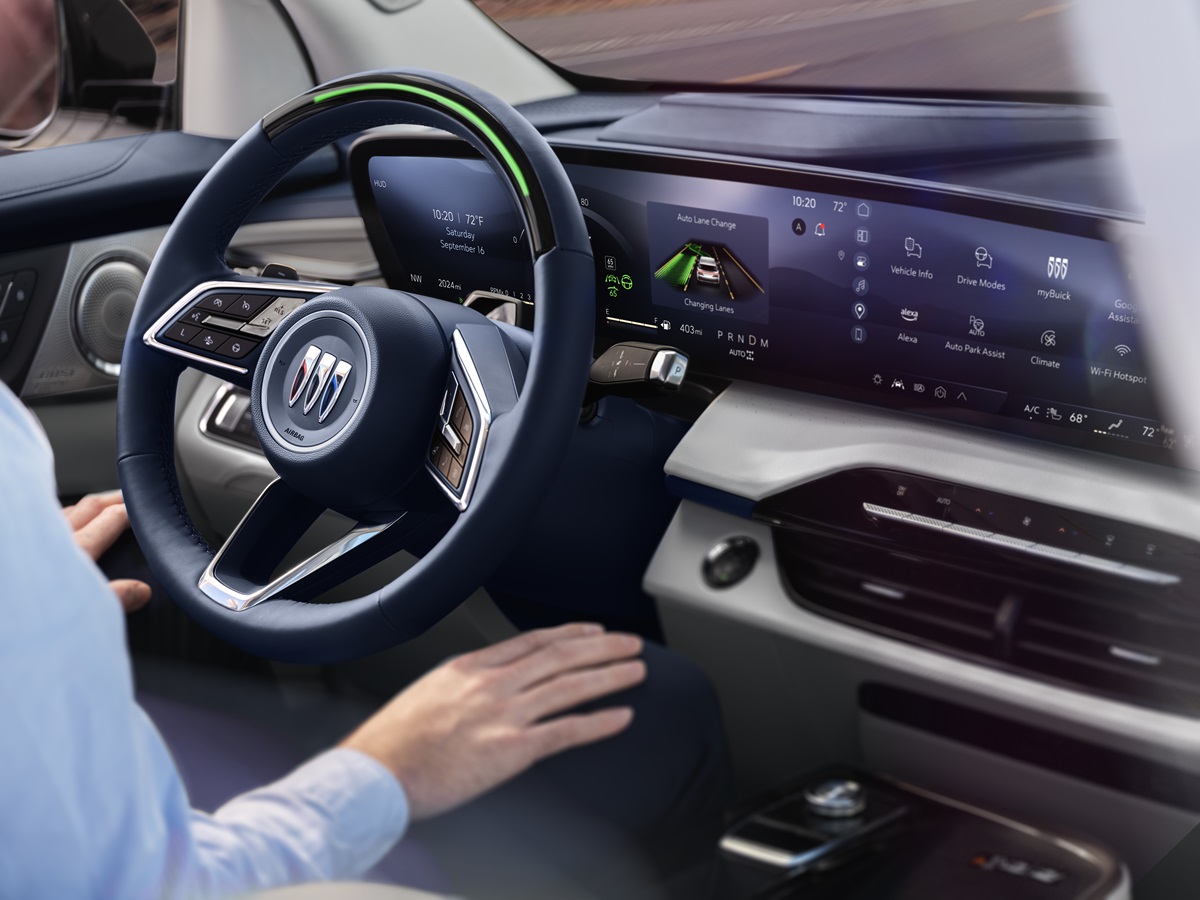
Autonomous Driving: The Levels and Key Players
Dave breaks down the current state of hands-free driving systems and the levels of autonomous driving:
The Big Three Systems (for now):
-
GM Super Cruise works on approximately 400,000 miles of pre-mapped US highways. Dave's personal favorite for its clear communication with the driver. The steering wheel has built-in lights: blue when the system is engaged, green when it's available, and red for warnings. Super Cruise provides more warning before disengaging and does so less frequently than competitors. GM has expanded availability across its lineup—it was even offered on the Bolt EUV for around $27–30K.
-
Ford Blue Cruise covers about 130,000 miles of pre-mapped zones. Rated higher overall by Consumer Reports, though Dave has experienced sudden, unexpected disengagements while driving. Available on more Ford and Lincoln models.
-
Tesla Autopilot works anywhere, using cameras only (no radar or lidar). This is both its strength and its controversy—other automakers argue that cameras alone don't provide enough redundancy for a system controlling an entire vehicle. Dave editorializes that while drivers may feel safe in their own Tesla, the unregulated nature of where the system can be used raises concerns for cyclists, pedestrians, and other drivers sharing the road.
Emerging Player: Rivian is developing a more advanced hands-free system and has notably said it will assume liability for crashes that occur while its system is properly engaged—a first in the industry with no legal precedent in US law.
The Levels of Autonomous Driving:
- Level 0: No automation. The driver does everything.
- Level 1: Driver assistance. The system helps with either speed or steering (e.g., adaptive cruise control).
- Level 2: Partial automation. The system controls both speed and steering, but the driver must stay engaged (e.g., Tesla Autopilot, Super Cruise, Blue Cruise).
- Level 3: Conditional automation. The driver can take their eyes off the road but must be ready to intervene (e.g., Mercedes-Benz Drive Pilot).
- Level 4: High automation. The vehicle drives itself in specific areas or conditions (e.g., Waymo).
- Level 5: Full automation. The vehicle drives itself anywhere, anytime. This doesn't exist yet.
The Safest Cars of 2026
Based on CarGurus' Test Drive Review safety scores from the past year, here are the standouts:
Safest Car/Hybrid: 2025 Hyundai Sonata – 10/10
Hyundai packs a comprehensive suite of safety tech as standard equipment. The Sonata earned a Top Safety Pick+ from IIHS this year after improving its performance in the updated moderate overlap frontal impact test—a detail thoroughly explained in CarGurus reviewer Chris Wardlaw's write-up. The Toyota Prius also scored a 10/10, with Toyota being a pioneer in making safety tech standard across the lineup.
Safest Crossover: 2025 Mazda CX-70 – 10/10
The CX-70 earned top marks for crash test performance and a comprehensive ADAS suite. In fact, every Mazda except the Miata earned a Top Safety Pick+ from IIHS. The caveat? The CX-70's infotainment system can be frustrating to use—and as the team pointed out, the safest car in the world isn't so safe if your eyes are off the road trying to find a radio station. The CX-90 also holds Top Safety Pick+ status from IIHS, despite the added complexity of a third row.
Safest Truck: 2025 Ford F-150 – 9/10
The F-150 and Toyota Tundra both scored 9/10 in safety, but the F-150 gets the edge thanks to Ford's Blue Cruise hands-free driving system—something Toyota doesn't currently match. Worth noting: most heavy-duty trucks (F-250, F-350, and larger) aren't crash tested at all, which is increasingly relevant as more buyers move from half-ton to three-quarter-ton trucks.
A word on the arms race: The team acknowledges the self-perpetuating cycle of vehicle size—everyone buys bigger vehicles to feel safe around other big vehicles, and the cycle continues. Heavier trucks and EVs raise the stakes for everyone on the road, making defensive driving the single most important safety measure any driver can practice.
Speed Round: One Safety Feature You Can't Live Without
If each host could only have one safety feature from everything discussed on this episode:
- Matt: Adaptive cruise control is essential for those six-hour highway drives to adventure destinations.
- Natalie: Rear cross-traffic alert is a lifesaver for city driving and parking lots. Plus, it works instantly without having to physically turn and look.
- Dave: Pre-collision braking because every millisecond counts, and the system might beat your own reaction time. Just make sure it's tuned to the right setting.
- Elliot: Blind spot monitoring because the sheer frequency of use makes it invaluable. And the feature he wishes everyone else had? Automatic high beams—a feature many drivers don't even know exists on their car. Check your settings.
Next Week: The crew builds their dream value garage. It's going to get a little crazy.
How to Listen
Have a question for the team? Reach out through the podcast's social channels or leave a comment on YouTube.