2026 Toyota bZ Woodland Reviews, Pricing & Specs



Pros & cons
What we like
Great ride quality
Standard all-wheel drive
Easy-to-use technology
What to consider
Polarizing design
EV range is less than 300 miles
Tall drivers may have visibility issues
Expert review
The 2026 Toyota bZ Woodland joins Toyota’s growing EV lineup with some mild off-road chops, moderate range, and a very comfortable ride.
While the original Toyota bZ is the basis for this new rugged EV, the bZ Woodland is about 6 inches longer, has standard all-wheel drive, gets more ground clearance, and expands cargo capacity. This means it also has less electric range.
Through a partnership with Subaru, the bZ Woodland shares the same underpinnings as the Subaru Trailseeker. So, you’ll see a blend of Toyota features, such as the infotainment system, and Subaru features, such as X-Mode, on both vehicles. If you are looking for an alternative “off-road” EV, the only other real option will be the Hyundai Ioniq 5 XRT.
Verdict: The 2026 Toyota bZ Woodland comes in a well-equipped base model as well as an up-level Premium trim. It is ideal for someone who has an active lifestyle and needs to get to a trailhead or campsite with all their gear in the back. However, it also makes a nice commuter car with a quiet cabin, smooth ride, and plenty of tech.
out of 10 expert review
Look & feel
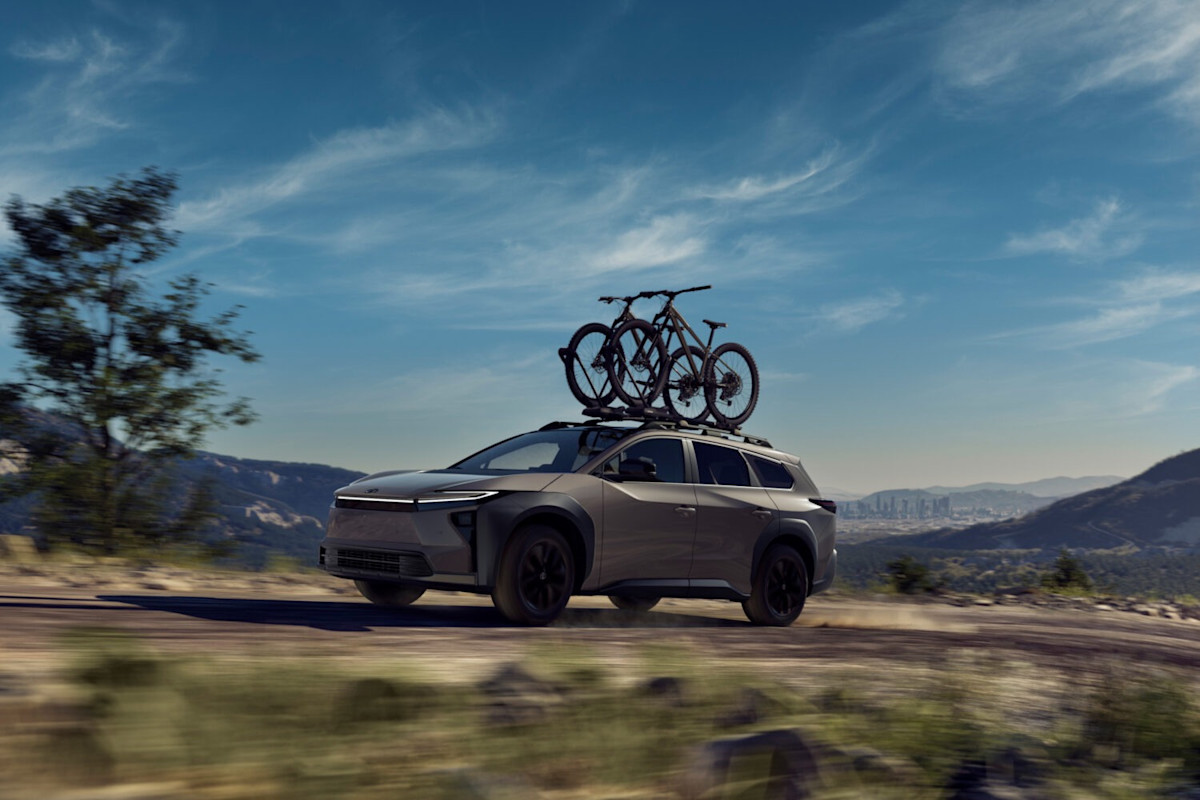
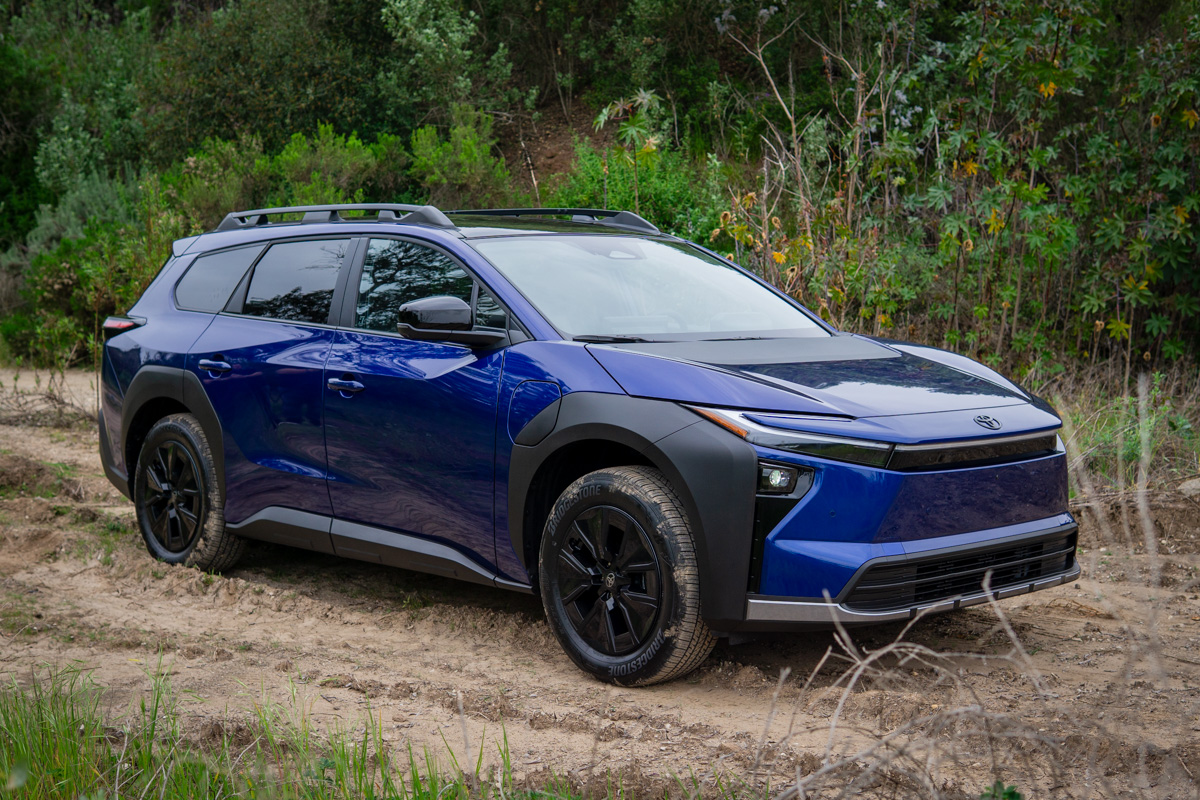
Beauty is always going to be in the eye of the beholder, but the design of the new bZ Woodland is a tad polarizing with the large black plastic cladding over the wheel arches. At least it’s intended to be functional, designed to protect the vehicle from rocks and trail rash when going off pavement. In terms of feeding an active lifestyle, the bZ Woodland also gets standard roof rails for luggage accessories or bike racks, and the standard 18-inch wheels with black covers are handsome and help take some of the heat off the black cladding. If you truly plan to take the bZ Woodland off-road we recommend the bronzy Stepping Stone exterior paint, which not only downplays the cladding but also hides the dirt quite well.
The bZ Woodland shares the same 112.2-inch wheelbase as the bZ, but its length stretches to 190.2 inches, giving it longer lines and a more wagon-like appearance as well as more cargo space. Additionally, ground clearance increases to 8.4 inches, and with optional all-terrain tires, the bZ Woodland is ready for the trail.
While the exterior of the bZ Woodland is equal parts wagon and crossover, the interior is airy and tech forward. The simple horizontal dash design is punctuated by a large 14-inch infotainment screen. A lot of the climate and audio functions are housed within the screen, which could be a non-starter for some, but you do at least have two large dials for temperature as well as a volume dial.
Interior materials are generally above average, and the leatherette seating surfaces are soft and well-designed. They are also well-padded and comfy for longer drives. The only material choice we question is on the center console: It’s a dull plastic that looks like it could scratch easily and collect dust. That same material is repeated on the door panels near the handles. The Premium trim adds a glass roof, and we appreciate that it has a one-touch power-operated screen that blocks the sun on a hot, bright day.
Performance
The 2026 Toyota bZ Woodland comes standard with dual motors and all-wheel drive (AWD), and the total system output is 375 horsepower, with 167 kW and 198 pound-feet evenly distributed to the front and rear. Toyota estimates the zero-to-60-mph time to be 4.4 seconds.
As an AWD-only model, the electric range depends not on the trim but on the tires. It will get up to 281 miles of range with the standard all-season tires. But if you opt for the all-terrain tires, range will drop to 260 miles, so you’ll really want to think long and hard about how you’ll truly be using the bZ Woodland before selecting your tire choice. On the upside, the bZ Woodland comes standard with a North American Charging Standard port (NACS) as well as a Combined Charging Standard (CCS) adapter. This means you have a lot of charging options.
We took a few long on-pavement loops in the bZ Woodland during the preview, and our general sense is that the performance is everything you could want from an electric vehicle. It’s smooth, quiet and fast. With the instantaneous torque, you get that belly-flip acceleration from a stop and when passing, and with its size, it feels nimble. We tested both the all-season and all-terrain tires on road and didn’t notice any appreciable increase in road noise between the two – except when we came off the dirt and hit the pavement in the all-terrains. Then we could hear the mud flapping off the wheels in the initial acceleration.
And yes, we did go off road. We had the opportunity to take a muddy trail up the side of a mountain after the area had received 3 inches of rain. A day prior, the trail was impassable when an off-road truck got stuck in the mud, needing to wait a day to get tugged out. So, while we weren’t traversing the Moab trail, we weren’t on a neatly graveled path either.
Unfortunately, after the rain, we couldn’t make it all the way to the top of the mountain, so we didn’t get to do some of the articulation exercises Toyota set up for us. However, avoiding gaping crevices and not slipping off the side of the mountain gave us a good real-world feel of what the bZ Woodland can do. And X-Mode with Grip Control played a key role in that. It’s kind of like a low-speed cruise control that sets a consistent speed and modulates power delivery, so the driver can watch the road while the car slowly makes its way through slippery surfaces.
Overall, the bZ Woodland has a well-balanced feel to it. It handles pavement without a lot of droning tire noise, smoothing out the worst of the bumps for a comfortable ride. Then it can tackle mild off-road situations with equal ease, gripping slick surfaces without much difficulty.
Form & function
One of the things we appreciated the most about the 2026 bZ Woodland was all the space to store your stuff. Up front, you have an under-console opening that will fit a small bag or fragile groceries like eggs. Plus, the cover on the armrest has buttons on the left and right so that it will open toward the passenger or driver, depending on who needs to access it. You’ll also find pockets on the back of the driver and front passenger seat for additional storage as well as large bottle holders in the doors and a rear pull-down armrest with additional cup holders.
A power liftgate is standard, and those who are short or have a low ceiling in their garage will appreciate that it is height adjustable. Simply lower the liftgate to your desired height, then press and hold the power button until you hear the long beep. Next time you open it, the liftgate will automatically return to that height.
With its longer length and slightly taller height, the bZ Woodland has a max cargo capacity of 74.9 cubic feet, which is nearly 8 cubic feet more than you’ll see in the regular bZ. Leaning into the idea that owners will have an active lifestyle, the bZ Woodland comes standard with all-weather, easily cleanable floor and cargo mats. It’s also worth noting that the headliner is black, which means if you’re putting bikes in the cargo area, wheels won’t leave tread marks on the ceiling.
One possible pain point will be the tiny gauge cluster popping up on the dash behind the wheel. For most people, this position is fine, however, we talked to some of the 6-foot-tall-plus testers, and they mentioned that with the steering wheel in a comfortable position, the top of the wheel did bisect the cluster. So, taller drivers will want to look at this specifically. Another pain point might be in the category of rear legroom. Even with its stretched length, it doesn’t gain any extra legroom over the regular bZ, which means the Hyundai Ioniq 5 XRT has a lot more space in the back seat. And if you want to compare it to a more conventional gas vehicle, the new 2026 Toyota RAV4 also has more rear legroom.
Technology
From a tech perspective, the 2026 Toyota bZ Woodland is well-stocked in its base form. It has a standard 14-inch infotainment screen with navigation and available connected services. It supports wireless Apple CarPlay and Android Auto, feeding directions into the gauge cluster to help drivers keep their eyes on the road. It also has two Qi-capable wireless phone chargers up front, a total of four USB-C charge ports, heated front and rear seats, heated steering wheel, dual automatic climate controls, smart-key access on all doors and the liftgate, eight-way power adjustable front seats, and the ability to use your phone as a key. All standard.
Frankly, upgrading to the Premium trim only gets you a few more tech features. This includes a rear camera mirror, driver’s seat memory settings, a nine-speaker JBL premium audio system, ventilated front seats, auto-tilt side mirrors, and a panoramic fixed-glass roof with a power sunshade.
While some people might not like the screen controls for climate and audio, they weren’t buried in the screen and were easy to access. Overall, we like the usability of the infotainment system and the native voice commands that let you say things like: “Hey, Toyota, I’m cold.” And the vehicle will do things like increase your temperature and turn on your heated seats. Additionally, if you’re bored, be sure to ask Toyota to tell you a joke.
If you are interested in Toyota’s connected features (like cloud navigation, remote start, and the “Hey, Toyota” voice assistant), they are subscription-based. The good news: You get a three-year free trial for Drive Connect and Remote Connect and a five-year free trial for Safety Connect and Service Connect. The bad news: Once you’re addicted to the services, it’ll cost you between $15 and $50 a month, depending on what you decide to keep.
Safety
Toyota has long been known for prioritizing safety features, and whether you opt for the base or Premium trim, we feel like an old Prego commercial when we say: It’s in there. There is a very long list of standard safety features in addition to the eight airbags and three-point seatbelts for all seating positions. Plus, if you have kids in car seats, it’s worth noting the bZ Woodland’s LATCH system includes lower anchors on outboard rear seats and tether anchors on all rear seats.
Safety features on both trims include 360-degree camera views, dynamic guidelines on the back-up camera, blind spot monitoring, rear cross-traffic alert, safe exit alert, front and rear parking assist with automatic braking, a pre-collision system with pedestrian detection, lane trace assist, adaptive cruise control, lane departure alert with steer assist, automatic high beams, and road sign assist. The only safety-esque feature that’s an option is the rear camera mirror, which comes standard on the Premium trim.
At the time of this writing, neither the Insurance Institute for Highway Safety (IIHS) nor the National Highway Traffic Safety Administration (NHTSA) have crash tested the 2026 Toyota bZ Woodland. However, the IIHS did give the closely related 2025 bZ4X a 2025 Top Safety Pick+ award with Good ratings in all crashworthiness tests, and the NHTSA gave the 2025 bZ4X an overall five-star safety rating.
Cost-effectiveness
Looking at the 2026 Toyota bZ Woodland versus the regular bZ, you might gasp at the $10,000 price difference between the base models. But we don’t think that’s a valid comparison because of all the standard up-level features—not to mention inherent off-roadiness and standard all-wheel drive (AWD)—you get on the bZ Woodland. The shocker, and perhaps the value, of the base bZ Woodland is that it costs the same ($46,750) as the AWD bZ Limited. And the estimated range is actually 3 miles less on the Limited. In our book, why wouldn’t you upgrade to the bZ Woodland, which also has more horsepower?
However, if you’re looking for something with more off-road EV chops, perhaps the more valid comparison will be to the Hyundai Ioniq 5 XRT, which starts at $47,875. It has a lot of the same features you’ll find on the base bZ Woodland but has a smaller infotainment screen, no heated rear seats, one wireless phone charger, less ground clearance and less max cargo capacity. And it doesn’t offer things like driver’s seat memory settings, ventilated front seats, or glass roof, all of which are on the Premium bZ Woodland ($48,850). In the plus column for the Ioniq 5 XRT, however, is the fact that a lot of the connected services that are subscription-based options on the Toyota come standard on the Hyundai.
While the bZ Woodland only gets between 260 and 281 miles of range, depending on tires, you have to keep in mind it’s standard with AWD, 375 horsepower, and a lot of premium features. So, while people who prioritize range over capability might not find the value here, if you’re looking for a mild off-roader with reasonable range to get you to that bike trail, we think the bZ has a lot of value, especially when you compare apples to apples.

What owners say
Trims & specs
Base MSRP $47,480 | Seating 5 |
Engine N/A | Cargo Capacity 33.3 cu ft |
Combined MPG N/A | Drivetrain N/A |
Base MSRP $45,380 | Seating 5 |
Engine N/A | Cargo Capacity 33.8 cu ft |
Combined MPG N/A | Drivetrain N/A |