Hot on the heels of launching the Tesla Model S sedan, Tesla released the Model X SUV for the 2016 model year, making it the first all-electric SUV widely available in the U.S. It took a long time for another automaker to bring out a remotely competitive vehicle, and a decade after the Model X arrived there are still only a handful of electric SUVs that offer the option of up to seven seats. Getting the Model X to market quickly was made possible by the fact that it shares its powertrain and many other parts with the Model S sedan. In fact, the low, curvy roofline gives it a similar overall shape to the Model S, putting it closer to SUV coupes such as the BMW X6 in looks than conventional three-row SUVs such as the Volvo XC90.
Tesla Model X Buying Guide: Cost, Reliability, and the Best Years to Buy
Search for Tesla Model X
See all


As with the closely related Model S, the Model X hasn’t changed much in the decade or so that it’s been on sale. Tesla doesn’t adhere to a typical model year schedule, preferring to roll out updates as they occur, and most of these have been incremental rather than fundamental. You’ll often see design changes as well as over-the-air software updates in the same model year, so if there’s a feature you’re looking for, such as Full Self-Driving (FSD), you’ll want to check that it's on a specific vehicle. You’ll also want to verify the iteration of software and hardware the vehicle has. A multitude of different battery packs have been used over time, with variations in chemistry, size, and range, but all are lithium-ion based.
While Tesla does offer another SUV in its lineup, the entry-level Model Y, the Model X is the clear winner if you need a family vehicle, because it’s a much larger car with a longer wheelbase and extra cargo space. It also gives you the option of five, six, or seven seats, as well as extra premium features. While it has a higher curb weight than the Model Y (which is based on the Model 3), the Model X has a larger battery and, like for like, a longer electric range.
In January 2026, Elon Musk confirmed that production of the Model X (and the Model S) will end in spring 2026, but the Model X has a place in automotive history as one of the most advanced cars of its era. Even at the end of its lifecycle, it remained competitive in terms of tech and range with newer electric cars such as the Cadillac Lyriq and the Porsche Cayenne Electric.
If you’re buying a used Model X, it’s worth bearing in mind that, like most Teslas, it has had some build quality issues, but it still has great potential as a used electric vehicle, especially if someone else has taken care of all the recalls and kept up with Tesla’s over-the-air updates. A lot of the earlier bugs have been worked out of later models and there are big savings to be had on what these high-end cars cost new.
Our buying guide looks at how the Tesla Model X has evolved over time, which models are available, and which are the best and worst versions to buy.
Tesla Model X Buying Guide: Cost, Reliability, and the Best Years to Buy
- Frequently Asked Questions
- Tesla Model X Pros and Cons
- Tesla Model X Generations
- Tesla Model X First Generation (2016–2026)
Frequently Asked Questions
Which Tesla Model X years are the best?
The 2023 to 2025 Tesla Model X gets the highest predictive reliability scores on Consumer Reports, and 2024 has the highest owner satisfaction score of any Model X. Data from NHTSA.gov shows later models also get fewer consumer complaints and recalls than the earlier model years. If you’re looking for an older, cheaper Model X, then 2019 examples are a sweet spot, since they have relatively few recalls and consumer complaints.
What are the worst Tesla Model X years?
Early Tesla Model X SUVs were plagued with suspension and build quality issues, and the Falcon Wing doors were particularly problematic. According to NHTSA.gov, the 2016 to 2018 model years received lots of complaints and had more investigations than later models, while Consumer Reports gives those early years low predictive reliability. Tesla’s new car warranty coverage is an industry-standard four-year/50,000-mile bumper-to-bumper warranty, while the Model X has a separate eight-year/150,000-mile warranty for the battery and drive unit.
Is a used Tesla Model X a good deal?
A Tesla Model X can be a good deal, especially because you can find used models that cost about a third of the original MSRP. The base price in 2019 was around $72,000, and you’ll likely find a car from that model year today for around $28,000. There are even better deals to be had with top-tier models, since the original MSRP was around $139,000 and you can find a used one for around $30,000. Of course, newer used Tesla Model X SUVs will cost more, but even for a 2023 model you can expect to pay around $30,000 less than the original MSRP.
Tesla Model X Pros and Cons
Pros:
- Impressive battery range
- Lots of advanced tech
- Fast acceleration
Cons:
- Lacks Apple CarPlay and Android Auto
- Cramped third row
- Falcon Wing doors tricky in tight spaces
Tesla Model X Generations
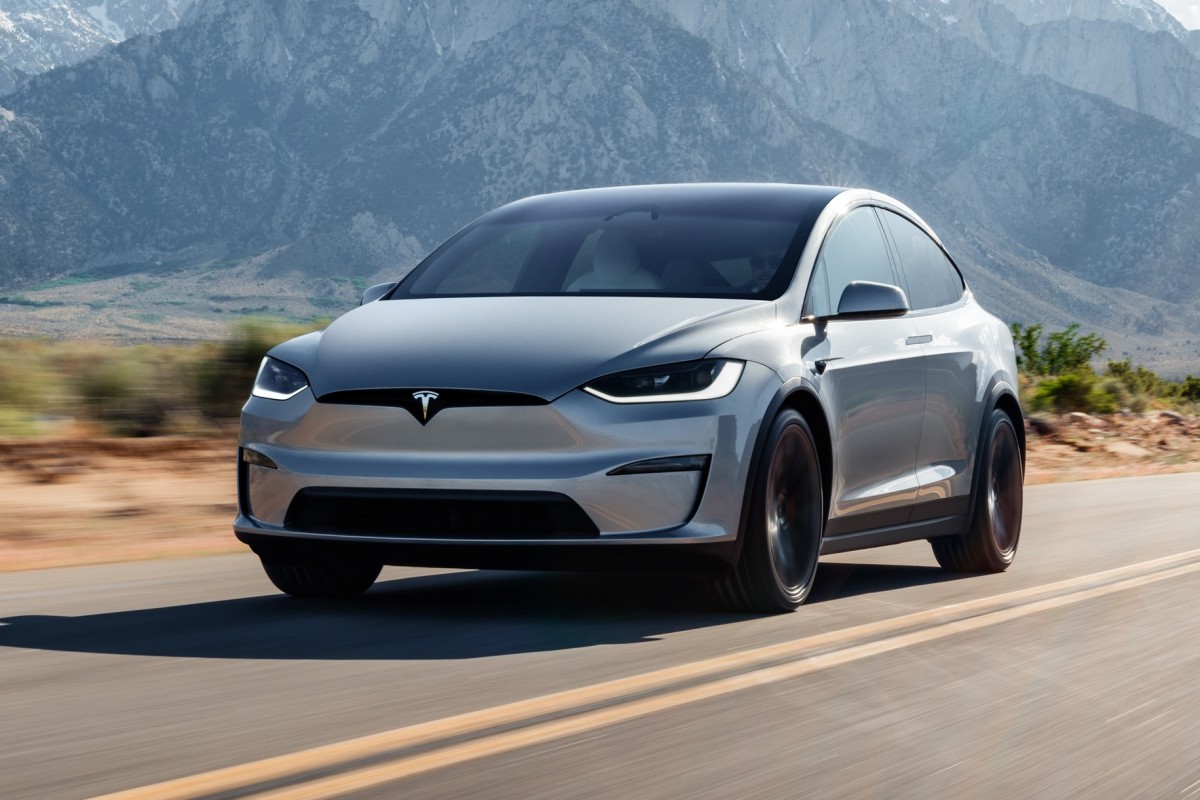
Tesla Model X First Generation (2016–2026)
The Tesla Model X is based on the same platform as the Tesla Model S, sharing about 30% of its content with the full-size sedan. The Model X is classified as a midsize crossover, and it has two- and three-row options, seating up to seven passengers. Its claim to fame: The double-hinged Falcon Wing rear doors that open up instead of out.
At launch, the Model X had three battery pack options: 75 kWh, 90 kWh, and 100 kWh. Power and range increase with the size of the battery pack, with the top P100D models delivering 532 horsepower and 289 miles of estimated range. Dual-motor all-wheel drive (AWD) is standard for all models. Later in 2016, Tesla produced a more affordable 60D model that only had a 200-mile range.
Standard features for the Tesla Model X at launch included a 17-inch infotainment touchscreen, a panoramic glass roof, a frunk (front trunk) for extra storage, navigation with real-time traffic updates, free charging using Tesla’s Supercharger network, LED headlights, keyless entry, power Falcon doors, and a power liftgate. The standard seating configuration was two rows with five seats, with two three-row layouts available as options—a six-seater with second-row captain’s chairs, or a conventional 2/3/2 layout. Options included seat heaters throughout the cabin, a heated steering wheel, cooled front seats, and leather upholstery. Ludicrous Mode was available for the 90D models and standard on the P100D models, propelling the Model X from 0-60 mph in 3.3 seconds and 2.9 seconds respectively. The semi-autonomous Enhanced Autopilot system, which included adaptive cruise control, was also available.
The base 60D model was dropped in 2017, and a new 100 kWh battery with boosted range and standard adaptive air suspension was added at this time. In 2018, Tesla dropped the 90D model and added a split-folding second-row seat on seven-passenger models, while maximum range jumped to 295 miles. In 2019, Tesla started simplifying the model structure, and the numerical designations were replaced by Standard Range, Long Range, and Performance model designations, with the maximum range rising to 325 miles.
There were some tech changes for the 2020 model year, including the addition of features such as Smart Summon, and adaptive air suspension was standardized. Maximum range increased to 371 miles toward the end of 2020.
As with the Tesla Model S, the Model X got a major overhaul in 2021. You wouldn’t know it from the outside, since a new front bumper was the only notable exterior change, but the interior was redesigned and the entire powertrain was updated.
The Model X Plaid model was also introduced, with a tri-motor setup for even faster acceleration and better efficiency. The Model X also got new electrical architecture, an improved infotainment system with faster processing speeds, and updated Autopilot hardware. The new interior brought a more modern, premium look, with a landscape-format center screen, better materials, a revised center console, a yoke steering wheel, and the addition of a rear-seat entertainment screen. There were just two primary trims in this model year: Long Range and Plaid. By this time, Model X owners now had to pay for Tesla Supercharger use.
Long Range models have two AC electric motors and a 100 kWh battery pack, making 670 hp for a top speed of 155 mph. The Plaid models feature three AC electric motors and a 100 kWh battery pack delivering 1,020 hp. Official range estimates for this year were 360 miles and 340 miles respectively, but they were reduced in 2022 to 348 miles and 333 miles due to updated testing standards.
Standard specs included all-wheel drive, front and rear heated seats, a heated steering wheel, heated washer nozzles, LED fog lights, 20-inch alloy wheels, adaptive suspension, a location-aware garage door opener, automatic front doors, vegan leatherette seating surfaces, 12-way power adjustable front seats, dual-zone automatic climate control, a power liftgate, a premium 17-speaker audio system, navigation, Wi-Fi connectivity, and Bluetooth phone pairing. What you didn’t get, not even as an option, were Apple CarPlay or Android Auto. Available features included 22-inch alloy wheels and the Full Self-Driving Capability (FSD) package with the likes of Smart Summon and Autopark.
The Model X continued without major changes until 2023, and the Long Range trim was replaced by Standard trim in that model year. At this time, Tesla started the rollout of Hardware 4 (HW4) for advanced Autopilot and FSD systems. By 2024, a circular steering wheel became standard, and the steering yoke became an option. There were some more significant changes in mid-2025, including a new front bumper camera, dynamic ambient lighting inside the cabin, new wheel designs, improved interior quietness, and more third-row space.
Run-out versions of the Tesla Model X were priced from about $100,000 to $115,000 when new, but as a used car it’s available for a fraction of that. You can find early versions with less than 100,000 miles on the odometer for little more than $20,000, and $22,000 is enough for one that’s covered less than 80,000 miles.
Post-2021 examples with sensible mileage start at about $40,000, and at the time of writing, it was possible to pick up one of these updated models with less than 30,000 miles on the clock for about $45,000 at dealerships.
Related Topics

by Jill Ciminillo
Jill Ciminillo is a Chicago-based automotive writer, influencer, TikTok Creator, YouTube personality, and podcast host, with her articles appearing on websites such as U.S. News & World Report, Capital One Auto Navigator, Consumer Guide Automotive, A Girl's Guide to Cars, and Drive Chicago. Additionally, she co-hosts a weekly Car Stuff radio show via Talk Zone. Previously, Jill has been the automotive editor for the Chicago Sun-Times News Group as well as Sinclair Broadcast Group. She is also a past president for the Midwest Automotive Media Association and has the distinction of being the first female president for that organization. Jill is also currently a juror for the North American Car, Utility and Truck of the Year (NACTOY) and Women's Worldwide Car of the Year (WWCOTY).
The content above is for informational purposes only and should be independently verified. Please see our Terms of Use for more details.


