The Kia Sorento was introduced to the U.S. Market in 2003, joining the smaller Sportage as the second crossover SUV from the Korean automaker. Along with the Sportage, it's the longest-running model in Kia's lineup. Over its lifetime, the Sorento has seen Kia's early struggles and its impressive rise in the 2010s. In some ways, you can get a good overview of Kia's U.S. history by following the Sorento alone.
First-generation Sorentos weren't much to write home about, with weak and inefficient engines, and interior materials outclassed by rivals of the time. They were affordable, though, and came with a long list of features, plus a very generous warranty, making them accessible to a broad range of buyers.
Things started turning around for the Sorento and Kia with the second generation in 2011. With help from newly acquired Audi designer Peter Schreyer, it adopted more purposeful styling and introduced a design language that endured for over a decade. As with most Kias, the current Sorento is built on a platform shared with parent company Hyundai, which rescued Kia from financial challenges in 1998. In this case, it's the Hyundai Santa Fe that's the closest relative.
Nowadays, Kia is highly regarded in some of the most popular vehicle classes, garnering numerous awards and accolades that would have been unimaginable 15 years ago. The Sorento, along with other Kias, has evolved from a vehicle some would have dreaded to a class-leading or at least an aspirational car. It's now worthy of consideration against compact SUV stalwarts such as the Honda CR-V, the Toyota RAV4, and the Mazda CX-50.
Kia Sorento Buying Guide: Cost, Reliability, and the Best Years to Buy
Frequently Asked Questions
Which Kia Sorento years are the best?
The Sorento has consistently improved since its debut, and as a result, the latest fourth-generation model ranks as the best. As with most generations, the first few years seem to have the most mechanical problems, but the most serious were resolved by the 2023 model year. All of its recalls are noted on the NHTSA website, and if they've been addressed by Kia service, we'd have no qualms about going with earlier models.
The latest Sorentos are more spacious than their forebears, and offer a comprehensive suite of safety features, making them stand out as smarter choices for family-oriented shoppers.
Which Kia Sorento years are the worst?
The first-generation Sorentos were hampered by poor handling and comfort, as well as weak engines and disappointing fuel economy. These models were also plagued by recalls for possible fires that lingered and reappeared over the decades. The second generation had even more fire-related recalls, along with some issues with the vehicle rolling away in park, and substandard welds in the driver's seat and rear subframe.
Is a used Kia Sorento a good deal?
The Kia Sorento is indeed a good used car deal, but maybe not for the best reason. It tends to depreciate faster than the average SUV in its class, losing between 50 and 55 percent of its purchase price in the first five years. That's great news if you're buying, but not so much if you're selling. Our advice is to find one that's only a few years old in order to avoid the biggest drop in value, use it for all it's worth, and then expect little when turning it in.
Kia's 10-year/100,000-mile warranty is one of the best in the industry, and can certainly entice some shoppers, but it's important to note that this coverage only applies to the first owner. Once sold, it reverts to an industry-standard five-year/60,000 plan.
Kia Sorento Pros and Cons
Pros:
- Lots of features for the money
- Generous warranty for the first owner
- Newer models offer plenty of space and style
Cons:
- Concerning recall issues on early models
- Early V6 engines were inefficient
- Older four-cylinder models are weak and thirsty
Kia Sorento Generations
Fourth Generation (2021 - present)
The new Kia Sorento once again proved the agility of the manufacturer's production, because it was another fully redesigned model. Styling took a completely different direction to fall in line with the brand's new look, featuring a more aggressive and sporty nose and deeper contours carved out of the body. It also grew another two inches in length, putting it more in line with midsize SUVs. As a result, it became a three-row SUV, and space increased enough to comfortably accommodate adults. Not surprisingly, its starting MSRP also increased.
A new 191-horsepower 2.5-liter four-cylinder engine and an eight-speed transmission were standard on the Kia Sorento LX and the S trim, while a 281-horsepower turbocharged upgrade came with the Kia Sorento EX and SX trims. The V6 was dropped, and in its place was the Sorento Hybrid, powered by a 1.6-liter four-cylinder engine paired with an electric motor and a six-speed transmission. The combined power output was 227 horsepower, but it was only available in S and EX trims.
The hybrid was the obvious mileage leader of the group, with an EPA-estimated 39/35 mpg city/highway. The new base four-cylinder powertrain jumped to 24/29 mpg city/highway, and the turbo option was almost as efficient at 22/29 mpg city/highway.
Wood-grained trim and quilted leather upholstery lent it a more luxurious personality, giving it an even stronger footing against rivals, and standard features with the base LX trim included a smart key with push-button start and smart cruise control. S added Syntex seat trim with heated front seats and an available panoramic sunroof package. With the third row of seats now being standard, second-row captain's chairs are available, starting with the EX trim. Helping matters was a more complete suite of standard safety features that included collision warning, lane-keep assist, and rear cross-traffic collision-avoidance assist. On higher trims, a blind-spot monitor, rear parking sensors, adaptive cruise control, rear automatic braking, and a surround-view monitor were available.
Also available was a blind-spot view camera that projected a video feed of the blind spot into the instrument panel when a turn signal was activated. In principle, it makes sense, but in practice, the system was more distracting than helpful, especially at night.
Big changes continued into 2022, with the addition of a plug-in hybrid model. A 67-kW electric motor fed by a 13.8-kWh battery pack allowed for up to 32 miles of electric-only range, and when the battery was depleted, the hybrid engine was still capable of 34 mpg. Power was more than adequate, at 261 horsepower. Elsewhere in the lineup, a rugged Sorento X-Line appearance package debuted, and a few features were moved from the options list to standard. It also denoted models with all-wheel drive, and the X-Line EX AWD, the X-Line SX AWD, and the X-Line SX Prestige AWD all have more off-road chops than anything without the moniker. As a minimum, they add 20-inch X-Line alloy wheels with a gloss black finish, 8.2 inches of ground clearance, multiple drive modes including a snow mode, and a panoramic sunroof with a power sunshade.
The 2023 Sorento added the blind-spot monitor and rear automatic braking to the base LX model, as well as a few minor feature shuffles between trim levels. Yet another styling update happened in 2024, but it wasn't as significant as the one in 2021. The biggest design change was in the headlights and grille, giving the SUV an even sharper and more angular look. The X-Line trim range was joined by the X-Pro SX Prestige AWD, which brought greater off-road skills thanks to all-terrain tires. On the tech front, a new digital instrument display and infotainment touchscreen were added, and driver assist and other features were retuned for better performance. With all of these changes in just three years, it's no surprise the Sorento returned in 2025 and 2026 in the same form.
At the time of writing, fourth-generation Sorentos had a manufacturer's suggested retail price (MSRP) starting at around $32,000 and cresting above $47,000. On the used car market, these Sorentos lose between $1,000 and $2,000 in their first year of ownership. After three years, that difference grows to between $10,000 and $12,000, making them an excellent purchase that will hold more of its relative value. As with most vehicles, higher-priced trim levels tend to depreciate more than entry-level models.
The fourth-generation Sorento received four out of five stars in most NHTSA tests and achieved five stars in side crashes. The 2024 model year improved its overall score to five stars for the non-hybrid models, and in 2025, they followed suit. The IIHS also awarded "Good" scores in all tests and named the Sorento a Top Safety Pick. The 2025 model received a second-worst "Marginal" score in a new frontal moderate overap test, but that improved the next year. For 2026, the IIHS awarded the Sorento a Top Safety Pick+ award, the agency's highest honor.
Third Generation (2016 - 2020)
The 2016 Kia Sorento grew in size and stature, measuring 7.6 inches longer than the first generation and 4.1 inches longer than the second generation. The new styling was more rounded, and it began to look more like a midsize SUV. The new entry-level L trim and returning LX trim came with a 185-horsepower 2.4-liter four-cylinder engine. In the middle was a 240-horsepower turbocharged 2.0-liter four-cylinder for the EX and SX trims, and at the top, the 290-horsepower 3.3-liter V6 returned. A six-speed automatic transmission sent power to the front wheels (FWD), and all-wheel drive was optional.
The base four-cylinder engine was estimated to return up to 20/27 mpg city/highway, while the turbo version beat it by one mpg. The V6, however, dropped slightly to 18/25 mpg city/highway. We recommend the turbocharged engine, as even leisurely drivers will feel the base unit is too weak for the larger Sorento. For those who need the third row, the V6 engine is the best choice to haul the added mass.
Inside, the Sorento greatly improved the quality of its materials, and passenger space increased. The third row was more accommodating than before, but those seats were still best left to kids. This generation also saw the growth of advanced safety features, with standard rear parking sensors and available forward collision and lane-departure warnings.
The safety theme continued into 2017 with the addition of automatic emergency braking and adaptive headlights. Technology also improved, thanks to Apple CarPlay and Android Auto smartphone integration, along with a couple of new safety features (adaptive headlights and automatic emergency braking). Also, the EX 2.0T got standard shift paddles, but the SX Limited trim was no longer offered with the 2.0T engine.
These changes were enough to carry the Sorento into 2019, with no notable changes in between. That year brought a new eight-speed transmission for the V6 engine, increasing fuel economy by one mpg. The third row seats were also added to the standard features list, along with some minor styling tweaks, and the turbocharged four-cylinder was discontinued. In 2020, the exterior lights and bumpers received a light design refresh, and the EX and SX Limited trims were dropped.
The NHTSA awarded the third-generation Sorento five stars for all crash tests and four stars for rollover protection, and these scores held for the entire production run. Similarly, the IIHS gave it "Good" scores in all crash tests and named it a Top Safety Pick. For the 2019 model year, it was upgraded to Top Safety Pick+ status, which was the Institute's new highest honor that debuted in 2013. The following year, it dropped back to a Top Safety Pick.
Second Generation (2011 - 2015)
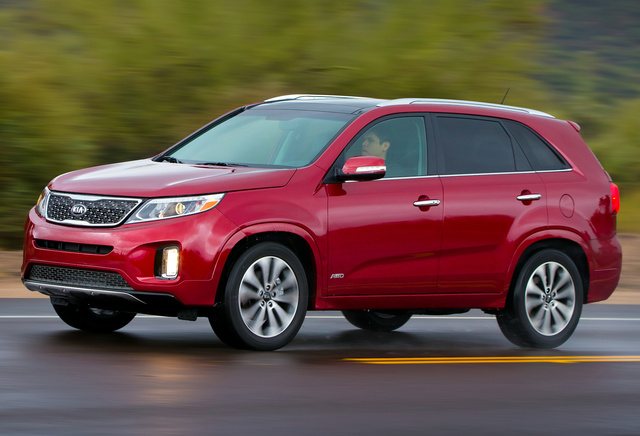
The Sorento received its first full redesign for the 2011 model year, in the midst of Kia's major turnaround. The new look ushered in the manufacturer's distinctive double-tab grille and angular body panels, helping it stand out from more generic SUVs. There were even significant changes underneath, with a switch to unibody construction that improved comfort and handling.
The base engine was a 175-horsepower four-cylinder that resulted in some of the slowest acceleration times in its class. A 3.5-liter V6 with 276 horsepower was available as an option and ended up being one of the quicker choices in the class, but was only offered with the EX trim. Front-wheel drive was standard, and all-wheel drive (AWD) was optional. The base trim came with a six-speed manual transmission, while all others upgraded to an automatic.
The four-cylinder engine was estimated at 21/28 mpg city/highway, while the V6 was rated at 20/25 mpg city/highway. All-wheel drive reduced those figures by only one or two mpg overall. It lost some of the fully-fledged four-wheel drive prowess, but a locking center differential helped to improve traction. Other changes included a new sporty SX trim and an available third row of seats, though space was only suitable for smaller passengers.
In 2012, an optional 191-horsepower four-cylinder engine gave buyers a mid-range choice with a 21/30 mpg city/highway estimate. Other additions included available driver's seat ventilation and voice-activated controls. The following year, only a few minor features were made available on more trims, and leather upholstery was made standard on the EX trim.
The Sorento received a minor interior and exterior styling refresh in 2014, along with a more powerful 290-horsepower 3.3-liter V6 engine. On the low end, the base four-cylinder was sent out to pasture, and on the high end, a new SX-L trim was added. All models benefited from a revised suspension system that further improved handling and ride quality. Advanced safety features also began appearing this year, with the introduction of an available blind-spot monitor.
The 2014 refresh seemed a bit premature, considering the Sorento had recently undergone a redesign. In hindsight, Kia was already preparing for yet another generation, as the 2015 model was unchanged.
Initial crash tests conducted by NHTSA resulted in a four-out-of-five star rating across the board, though it's important to note that the Agency revised many of its evaluations around this time. These standards were adjusted to reflect the improvements made to survivability, making favorable scores more difficult to achieve. In 2012, the side crash score was upgraded to five stars, and in 2014, all crash tests rose to five stars, but rollover tests still received four stars.
The IIHS was more favorable in its ratings, awarding the Sorento the top "Good" score in all categories, and naming it a Top Safety Pick, the Institute's highest honor at the time. In 2014, a new small overlap frontal crash test was added to the program, and the Sorento received a "Poor" rating, losing its Top Safety Pick status.
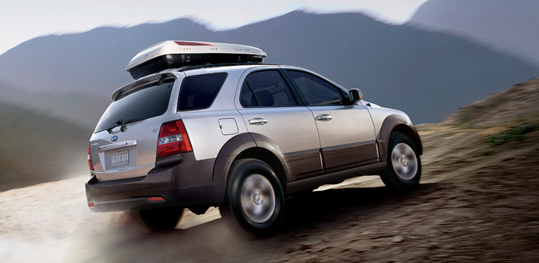
First Generation (2003 - 2010)
Unlike many contemporaries, the first Sorentos were built on a truck-like body-on-frame platform, rather than a unibody. It also offered a four-wheel drive option (not all-wheel drive) with low-range gearing that gave it uniquely strong off-road and towing abilities. Unfortunately, it also resulted in a harsh ride and subpar on-road handling.
Under the hood was a 3.5-liter V6 engine that produced 192 horsepower and 217 pound-feet of torque. Two Kia Sorento trim levels were available: the LX and EX. Both came standard with rear-wheel drive and a four-speed automatic transmission, and, with a hefty 4,200-pound curb weight, that engine was underpowered, and the Sorento was sluggish.
The base LX trim came with steel wheels and plastic covers, air conditioning, cruise control, and power accessories (windows, mirrors, and locks). The EX steps up to larger alloy wheels, keyless remote entry, a power-adjustable driver's seat, an improved audio system, and a sunroof. The optional EX Luxury package dressed up the interior with leather seat upholstery, automatic climate control, and a premium audio system. A navigation system was an option with either trim level.
At the time, the EPA estimated the rear-wheel drive Sorento would return 14 mpg city and 18 mpg highway, while the four-wheel drive models dropped to 13/17 mpg city/highway. As a comparison, the Honda CR-V of the time was rated between six and eight mpg higher. Cargo capacity was more competitive, measuring 31 cubic-feet to the CR-V's 33.5 cu-ft capacity.
In 2004, the Sorento leaned into the sporty side of things, adding an LX Sport package that introduced a five-speed manual transmission, side steps, alloy wheels, and roof rails. Some new interior colors and trim materials also debuted. The following year, that Sport package added a premium audio system and dark headlight trim. In 2005, the four-speed automatic transmission was replaced with a five-speed unit, improving fuel economy by one mpg across the board. The 2006 model year brought even fewer changes, making alloy wheels standard for the LX.
The Sorento received a refresh in 2007 with the introduction of a new 3.8-liter V6 that made 262 horsepower. Despite the extra power, this new engine was also more efficient, estimated as high as 15/21 mpg city/highway. It also benefited from slightly restyled front and rear fascia, along with a new instrument panel. The more potent engine not only improved acceleration but also towing capacity, which increased to 5,000 lbs.
For 2008, the LX trim switched to a smaller 3.3-liter V6 that produced 242 horsepower, but the EX kept its 3.8-liter engine. It wasn't a big difference from the larger engine, either in how it drove or in fuel economy, which was estimated at 16/22 mpg at its best. The Sorento returned unchanged in 2009 and took a break in 2010.
For the first three years of the Sorento's production, it received four stars from the National Highway Traffic Safety Administration (NHTSA) for frontal crash protection and five stars in side crash tests. In rollover tests, it received a concerning three stars. The 2007 refresh improved scores to five stars in crash tests and four stars for rollover protection.
The Insurance Institute for Highway Safety (IIHS) gave the Sorento its second-best score of "Acceptable" in frontal crash tests and its lowest score of "Poor" in side crashes and for head restraints and seats. The 2007 refresh improved the result, with the top score of "Good" for frontal crashes and head restraints/seats, but side protection remained "Poor."
Related Topics