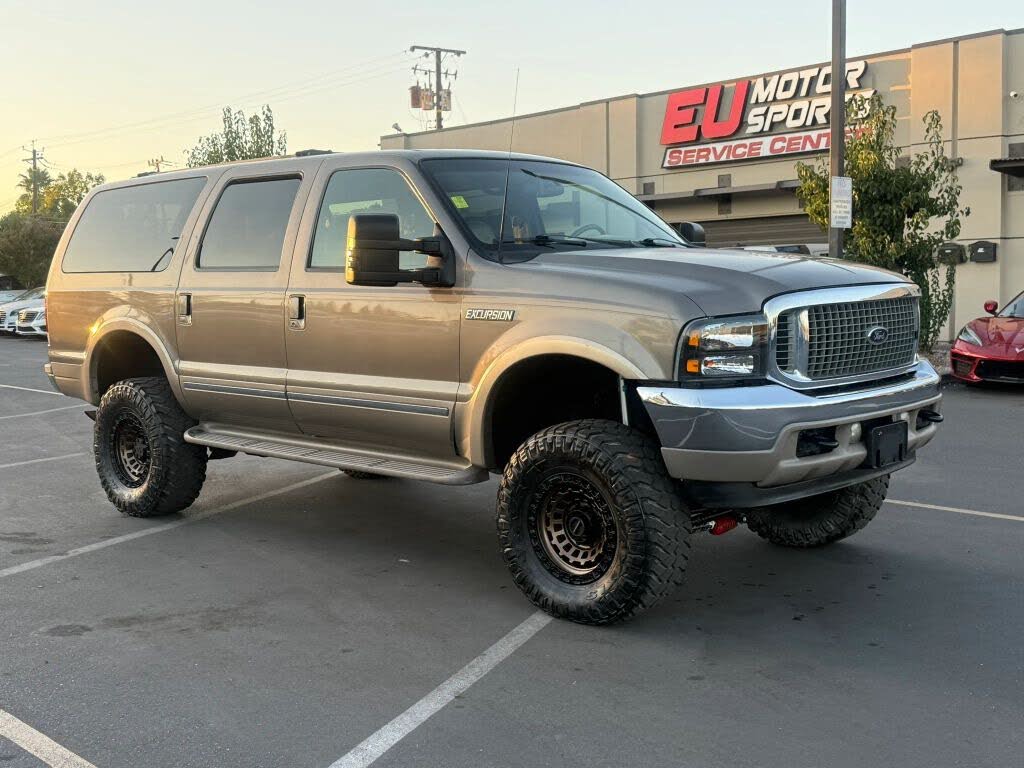
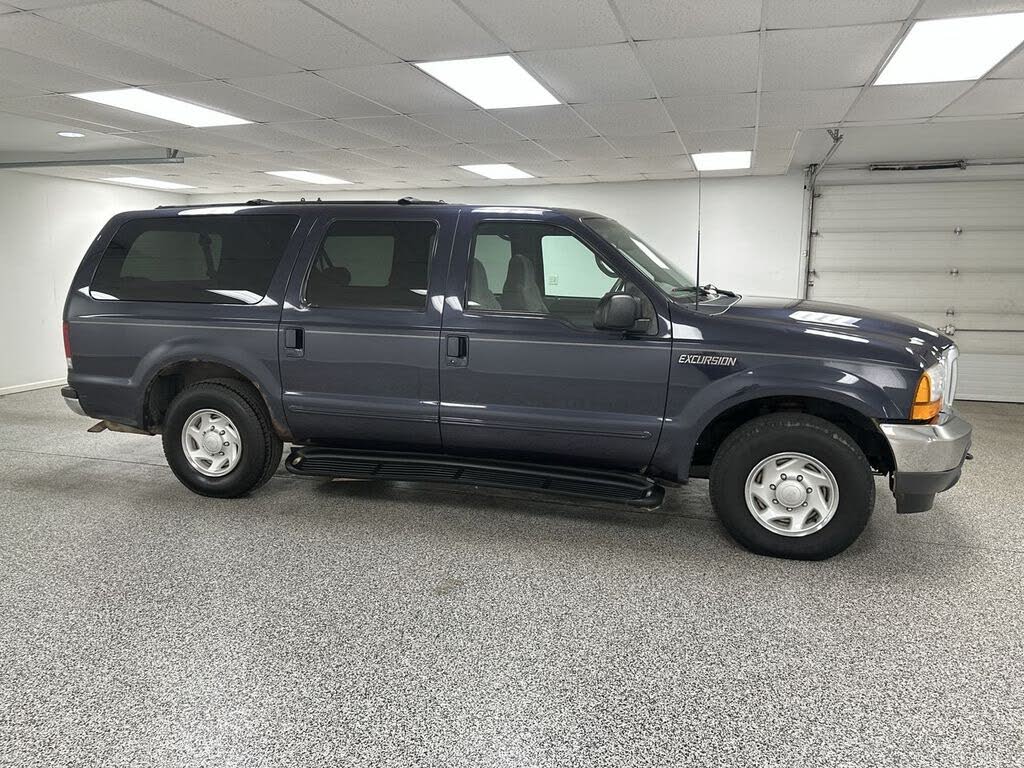
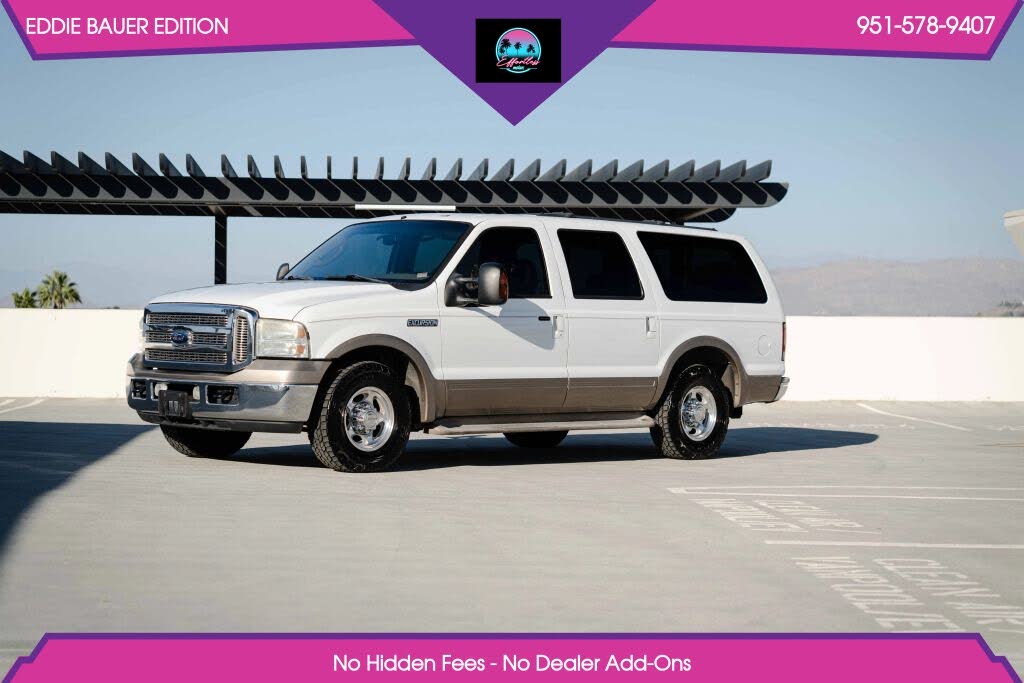
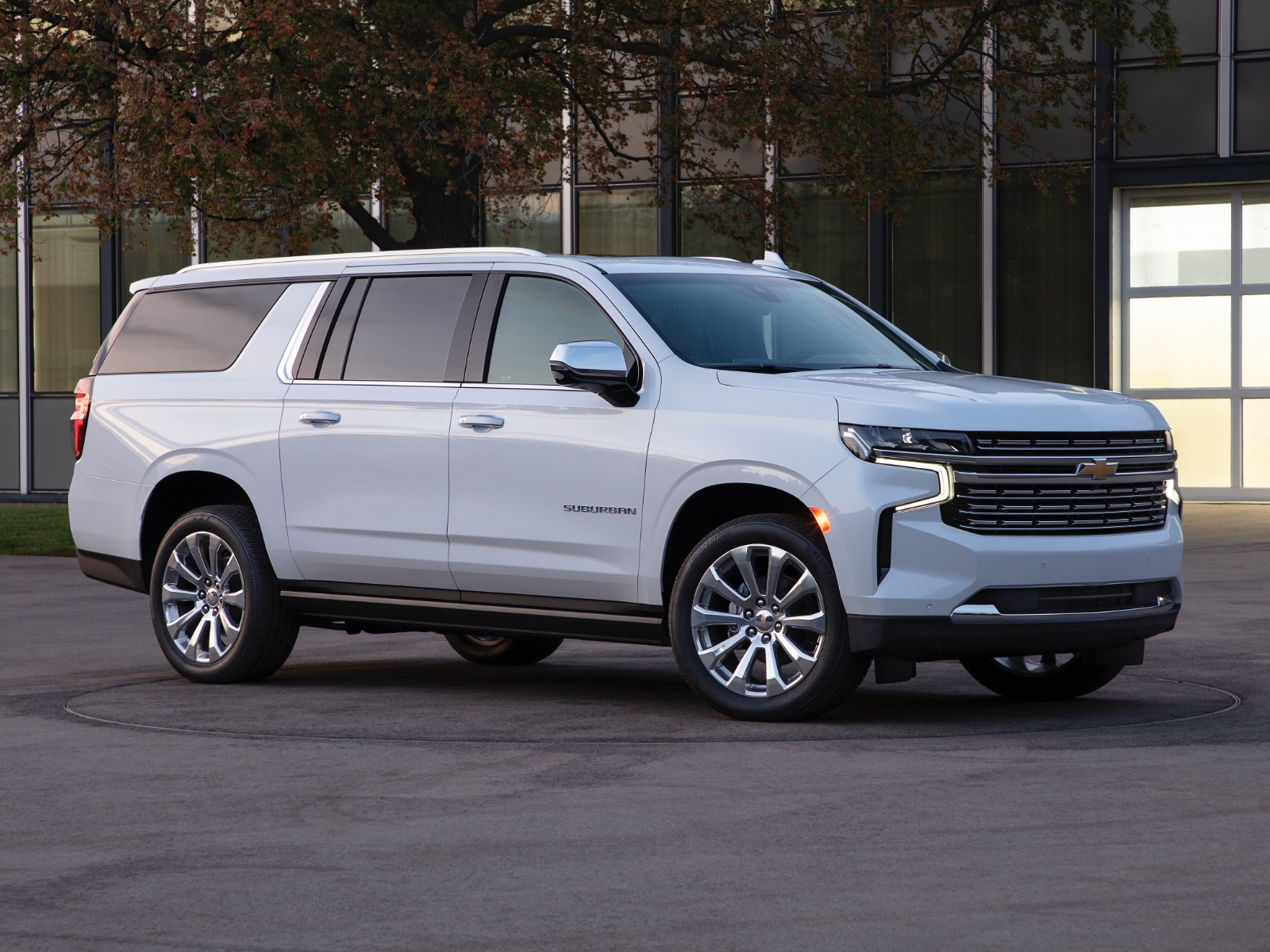
If you belong to the camp that believes bigger is better, the Ford Excursion may your ideal sport utility vehicle. Whereas the older Ford Bronco and the large Ford Expedition were based on the full-size F-150 pickup truck, the massive Excursion used the chassis and running gear of the heavy duty Ford F-250 Super Duty truck. The Excursion full-size SUV was designed to compete with the Chevrolet Suburban 2500 (which was also sold wearing a GMC badge), a heavier duty version of the regular Suburban that General Motors sold from 1992 through 2013.
The Ford Excursion was powered by both gasoline and diesel engines, used heavy duty transmissions, transfer cases, and axles, and had a whopping full frame underneath that was derived from Ford’s three-quarter-ton pickup. While those attributes made the Excursion an excellent choice for towing and hauling duties, they also meant it was difficult to park in cities and garages alike. The Excursion was also so heavy that it wasn’t required to carry EPA fuel economy ratings, though suffice it to say its mpg was, and remains, terrible.
Since it’s based on the Ford Super Duty pickup truck, the Excursion drives like one. If poor fuel economy isn’t a deal breaker and a buyer has the room to park the beast in their driveway, a used Ford Excursion could be an excellent choice for those who want to pack their entire families into an SUV with a trailer or camper in tow. That said, most would be better served by something a little bit smaller, less thirsty, and more comfortable on city streets and parking lots—of which the automotive industry offers an abundance of choice.
Ford Excursion Buying Guide: Cost, Reliability, and the Best Years to Buy
Frequently Asked Questions
Which Ford Excursion years are the best?
The final 2005 Ford Excursion model year has the fewest complaints, according to CarComplaints.com. But that doesn’t mean that only 2005 Ford Excursions are reliable. In fact, some savvy buyers seek out older Excursion models from 2000-2003 with Ford’s ultra reliable 7.3-liter Power Stroke V8 diesel engine.
While models powered by the older 7.3-liter Power Stroke diesel engine have less horsepower and torque than later 2004 and 2005 Ford Excursion models with the newer 6.0-liter Power Stroke diesel V8, the older and larger engine has proven more reliable. That said, if you’re looking for an Excursion with a gas engine, newer is better.
What are the worst Ford Excursion years?
Gas Ford Excursions powered by both the 5.4-liter V8 and 6.8-liter V10 engines are known to be reliable, regardless of the year they were built. The original 2000 model year has the most complaints online, but the underlying issues that plagued the first Excursion were never adequately addressed from the factory.
The biggest issue with Excursion’s 5.4-liter and 6.8-liter gasoline engines relates to spark plugs that can blow out of the holes threaded into the engine’s heads. Ford issued a technical service bulletin (TSB) that addressed the spark plug ejection issue, and the fix prescribed by the TSB required significant mechanical expertise. At this point, most Ford Excursions with affected engines have been repaired, but it’s always wise to check the service history.
Also, 2004 and 2005 Ford Excursion models powered by the 6.0-liter Power Stroke turbodiesel engine were plagued with problems. Issues like stretched head bolts, blown head gaskets, high-pressure oil pump failure, leaky oil coolers, and faulty emissions equipment are not easy to fix. If you’re not a mechanic and don’t want to deal with such issues, Excursion models with the 6.0-liter Power Stroke diesel engine should be avoided.
Is a used Ford Excursion a good deal?
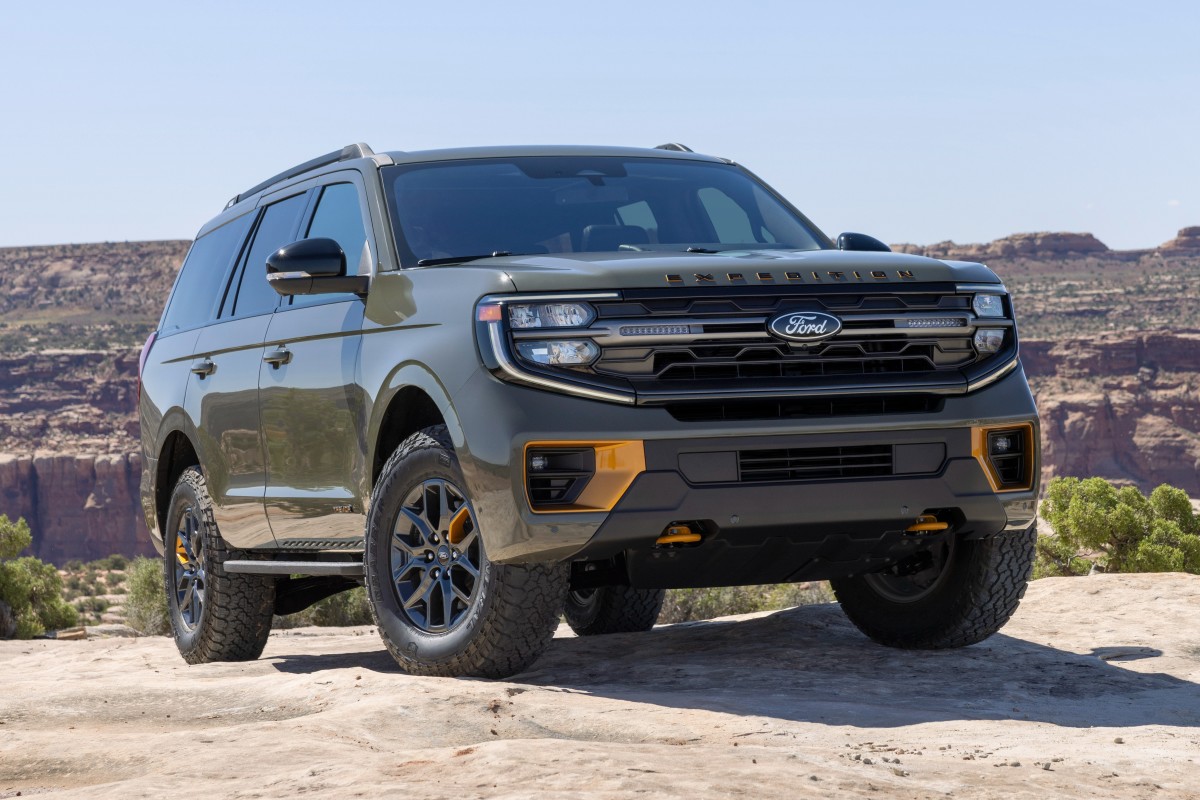
No, a used Ford Excursion isn’t really a good deal, with a possible exception for potential buyers who truly need eight- or nine-passenger seating, heavy duty four-wheel drive, massive towing capacity, and have wallets deep enough for the hefty fuel bills. Ford’s slightly smaller Expedition also offers three rows of seats and lots of storage space, particularly its extended-wheelbase EL and Expedition Max versions. Because Ford only sold the Excursion for six model years, there aren’t nearly as many of them on the road as there are heavy-duty Chevrolet and GMC Suburban SUVs, and desirable Excursions powered by well-cared-for 7.3-liter Power Stroke diesel engines often carry exorbitant price tags.
If an SUV based on a Ford Super Duty truck platform is overkill for you, the Ford Expedition has been offered in long-wheelbase form since 2007. The Ford Expedition Max and the earlier Expedition EL are still based on the Ford F-Series trucks, but they’re more refined than the heavier-duty Excursion ever was, featuring independent rear suspension and updated V8 engines, and can still carry three rows of passengers and tow big trailers. It’s also wise to consider competitors from General Motors, including the Chevrolet Suburban, the GMC Yukon XL, and the Cadillac Escalade.
Ford Excursion Pros and Cons
Pros
- Multiple powertrains
- Extremely roomy interior
- Impressive towing capability
Cons
- Poor fuel economy
- Poor ride quality
- Multiple unreliable engines
Ford Excursion Generations
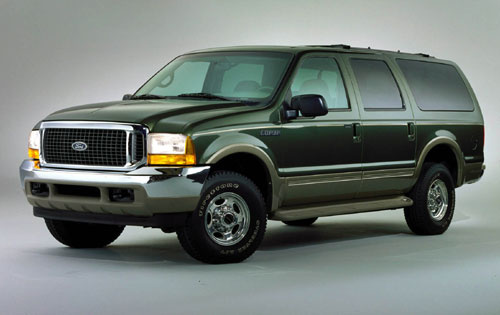
First Generation (2000-2005)
The 2000 Ford Excursion debuted with two trim levels. In base XLT trim, it came standard with remote keyless entry, an AM/FM/cassette/CD stereo, power windows and door locks, and an overhead console. The Ford Excursion XLT had cloth seats arranged in a 40/20/40 split-bench up front, and second- and third-row bench seats, which meant it could seat up to nine passengers—although it only had five cupholders. The 2000 Ford Excursion Limited came with leather seats—buckets up front and a bench or captain’s chairs for the second row—woodgrain interior trim, rear-seat audio controls, and, though it actually held fewer people, as many as 10 cupholders. Regardless of the trim level, the third-row seat was removable.
The 2001 Ford Excursion returned in XLT and Limited trim levels. The XLT got some upgrades for 2002, including chrome steel wheels and new body cladding. The Excursion Limited now offered a rear-seat entertainment system complete with a VCR that sent its video cassette-sourced images to a 6.4-inch overhead screen. For 2003, the Excursion XLT received optional power-adjustable pedals and a power front passenger seat. The 2003 Excursion Limited added memory controls to the power seats, and the VCR-based entertainment system was upgraded to use DVDs.
More substantial upgrades came to the Ford Excursion for the 2003 model year. A revised front suspension setup improved the ride and handling, and XLT Premium and Eddie Bauer trim levels were added to the menu. The Eddie Bauer edition had an outdoorsy feel, while the Limited remained the top trim level. An XLS trim level was added for 2004, and the XLT model became the mid-level option. The 2005 Ford Excursion would be the final model year for the behemoth SUV.
When it first hit the market, the 2000 Ford Excursion offered three engine options, all mated to a four-speed automatic transmission. Excursion models with rear-wheel drive came standard with a 5.4-liter Triton V8 engine that produced 255 horsepower and 350 pound-feet of torque. An optional 6.8-liter Triton V10 engine pushed those numbers to 310 hp and 425 lb-ft. From 2000 through 2003, a durable 7.3-liter Power Stroke diesel engine with 250 hp and, more importantly, 525 lb-ft of torque, was also available.
Halfway through the 2003 model year, Ford introduced its 6.0-liter Power Stroke diesel V8 and hooked it to an all-new five-speed automatic transmission. The 6.0 Power Stroke offered 325 horsepower and 550 pound-feet of torque, making it the most powerful engine ever offered in the Excursion, though its more emissions-friendly design was troublesome from the start.
The 6.0 Power Stroke diesel was replaced in the Ford Super Duty truck line with a 6.4-liter unit for the 2008 model year. Though the 6.4-liter Power Stroke diesel also had its fair share of reliability problems, by then, the Ford Excursion no longer existed.
Towing specs for the Ford Excursion range from a low of 6,100 pounds to a high of 11,000 pounds, according to the engine, whether it has a RWD or a 4WD drivetrain, and the rear axle ratio. The maximum towing figures require either a diesel engine or the big V10 with the proper axle ratio. All the Excursion’s powertrain components were shared with other Ford trucks sold in North America from the era.
Related Topics