2020 Hyundai Elantra Reviews, Pricing & Specs




Pros & cons
What we like
Spacious
Excellent value for money
What to consider
Fairly pedestrian performance
Poor fuel economy
The CarGurus verdict
In its final year before a complete redesign, the 2020 Hyundai Elantra is a more compelling choice than ever.
Hyundai isn’t pulling any punches when it comes to the compact car segment, where value is of utmost importance. And though a completely redesigned 2021 Elantra is coming soon, the automaker bestows several value-enhancing improvements upon the outgoing 2020 Hyundai Elantra compact sedan. They include free scheduled maintenance, improved fuel economy ratings, and new standard safety features.
out of 10 expert review
Look & feel
Last redesigned for the 2017 model year, and then boldly restyled for 2019, the 2020 Hyundai Elantra is visually unchanged this model year. Last year’s restyle swapped the Elantra’s Genesis Jr. design cues for a geometric-influenced appearance clearly intended to set the stage for the dramatically angular styling of the all-new 2021 Elantra.
Six versions of the car are available: base SE, SEL, Value Edition, Eco, Limited, and Sport. Prices run from $19,300 to $24,150, and our Elantra Limited test vehicle included the Ultimate Package and a set of floor mats to bring the window sticker to a total of $27,630 including the $975 destination charge. In addition to the sedan, Hyundai also offers an Elantra GT hatchback for the 2020 model year.
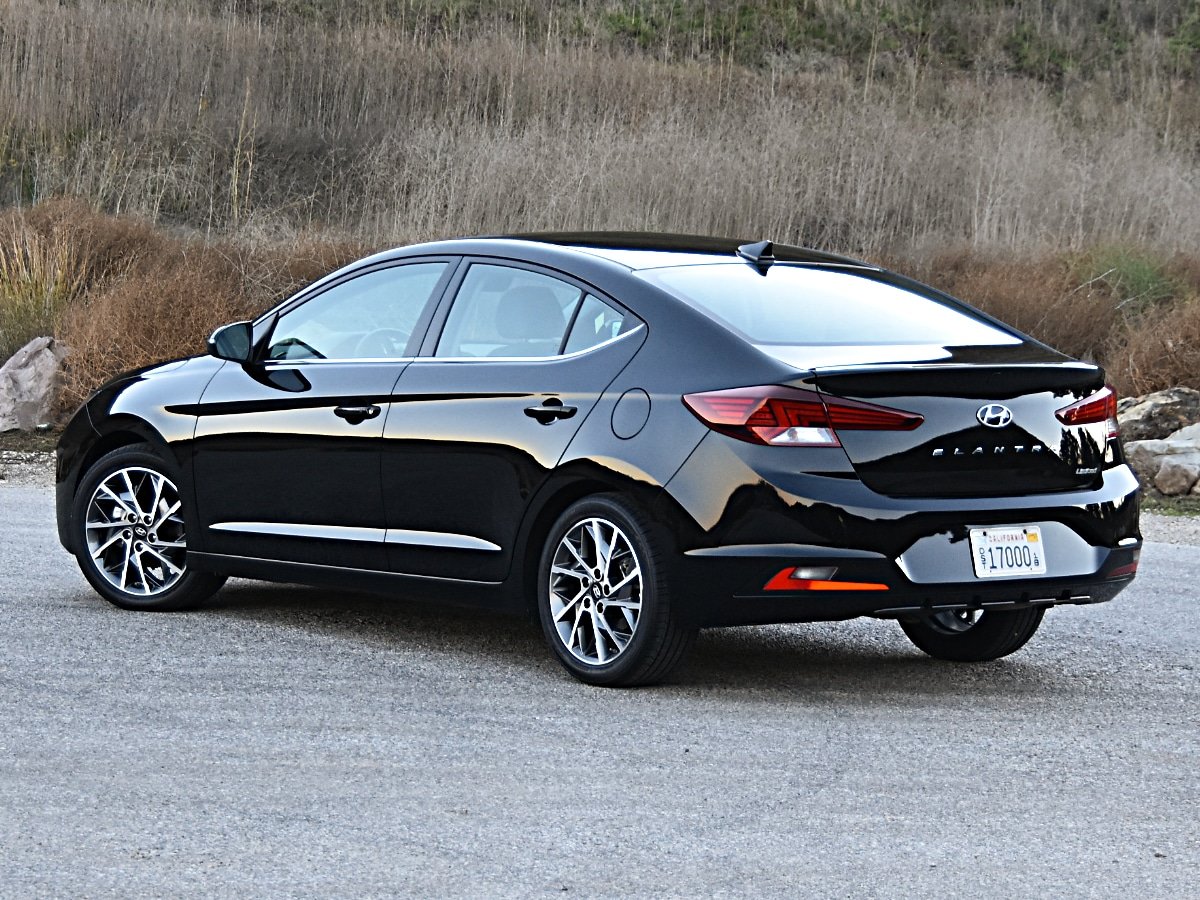
A black paint job brought the Elantra’s angular headlight, fog light, and wheel designs into stark relief while adding strong contrast to this trim level’s chrome grille, beltline, and logo detailing. Visually, the end result is a stylish small car, if not appealing to everyone.
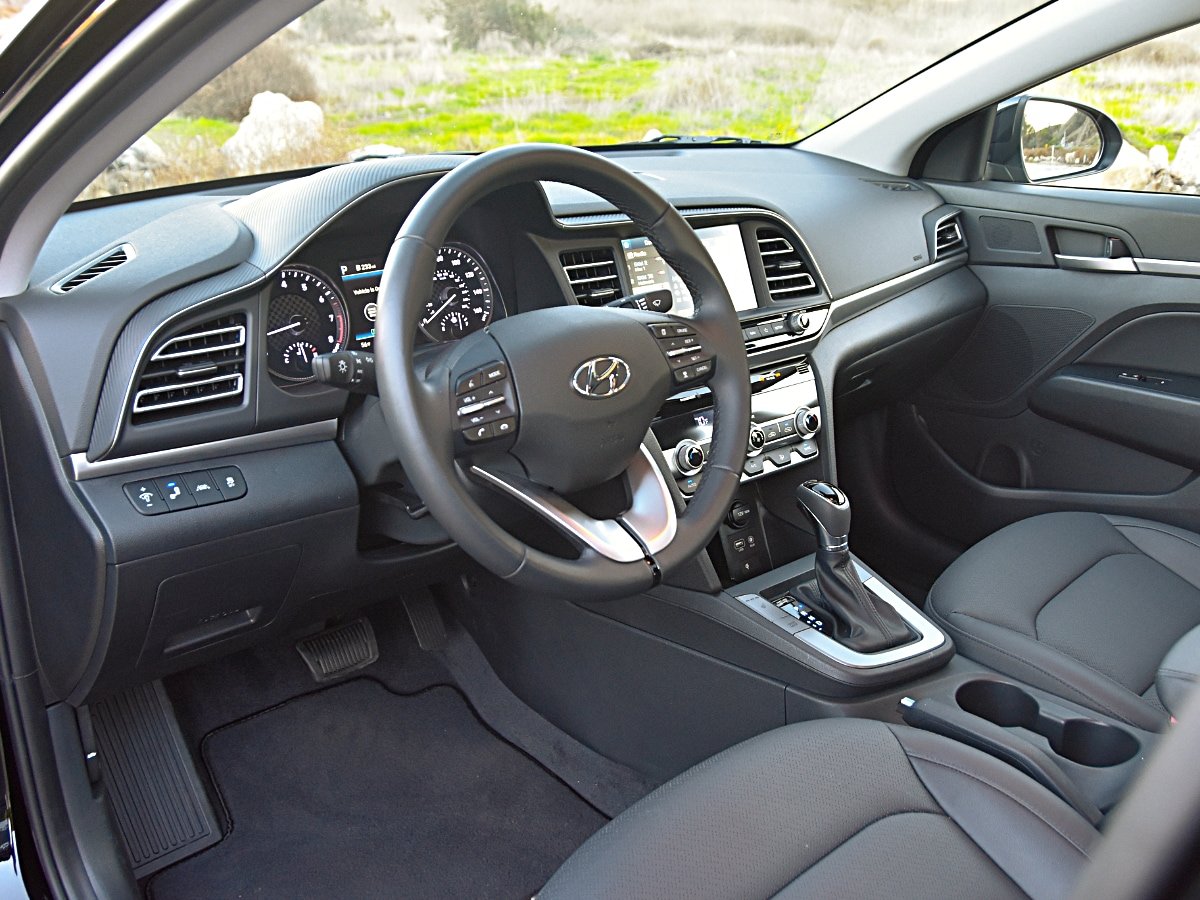
When Hyundai restyled the Elantra’s exterior, it also updated the interior to add a more upscale look. Silver trim on the air vents, climate control panel, engine start button, steering wheel, and other areas dress the Elantra Limited up, but enough hard and glossy plastic remains to remind you that this is, after all, a mainstream compact car.
Performance
The base engine is a 147-horsepower, 2.0-liter four-cylinder engine paired with a brand new continuously variable transmission (CVT). The CVT replaces last year’s six-speed automatic and Hyundai has done away with the formerly available six-speed manual gearbox. Making the CVT standard with SE trim is one reason why the car is $1,100 more than it was last year. All Elantra models are front-wheel drive.
Two specialty models are also available. The Elantra Eco has a turbocharged 1.4-liter four-cylinder engine good for 128 horsepower, but it delivers 24 extra lb-ft of torque compared to the standard engine (156 vs. 132), and it peaks between 1,400 rpm and 3,700 rpm. The Elantra Eco uses a seven-speed dual-clutch automatic transmission (DCT) and has a new-for-2020 automatic engine start/stop system. It gets 36 mpg in combined driving instead of 34 mpg for most Elantras with the standard powertrain.
You can also get the Elantra Sport trim. This sport-tuned version of the car has a 1.6-liter turbo four-cylinder making 201 horsepower and 195 lb-ft of torque, and also swaps out the standard beam-axle rear suspension for an independent design. Plenty of fun to drive, the Elantra Sport sadly loses its manual gearbox for 2020, putting its seven-speed DCT on the standard equipment list.
Getting back to our Elantra Limited test car, with its 2.0-liter four-cylinder and new CVT, most people will be happy with this combination. Hyundai calls the CVT an “Intelligent Variable Transmission,” and it is an excellent example of the breed. Rarely will you notice that it isn’t a traditional automatic, thanks to simulated gear shifts as the Elantra accelerates.
Hyundai points out that the new CVT employs a chain belt rather than the common push belt, as well as a wide-ratio pulley system providing a broader range of operation for greater efficiency on the highway and improved low-end responsiveness in the city. Based on EPA fuel economy ratings, the new CVT improves gas mileage by 2 mpg in combined driving.
Unfortunately, our real-world experience with the 2020 Elantra did not validate the efficiency claims. This test car averaged 29.3 mpg on the testing loop, coming up well short of the 34 mpg we expected. Worse, a 2019 Elantra Limited with the old six-speed automatic delivered an average of 29.5 mpg on the same loop. Of course, your results may vary
As far as ride and handling are concerned, the downside to the 2020 Elantra is its simple torsion beam axle rear suspension design. Basically, if one rear wheel hits a bump or hole on the road surface, the other side of the axle must also work to absorb the impact. This detracts from both the ride and the handling.
Some cars with beam-axle suspension designs mask this trait with a degree of success, such as the Mazda3. Others, like the Elantra, do not, and it gives the car an unsettled feeling. Based on driving experience in the Elantra Sport, that model’s independent rear suspension provides a superior ride even though that car is tuned firmly.
In general, the Elantra Sport is also more enjoyable to drive. A standard Elantra is agreeable enough, but uninspiring. Ultimately, this car is an appliance for commuting, bought for reasons other than the joy possible in the journey rather than simply the destination.

Form & function
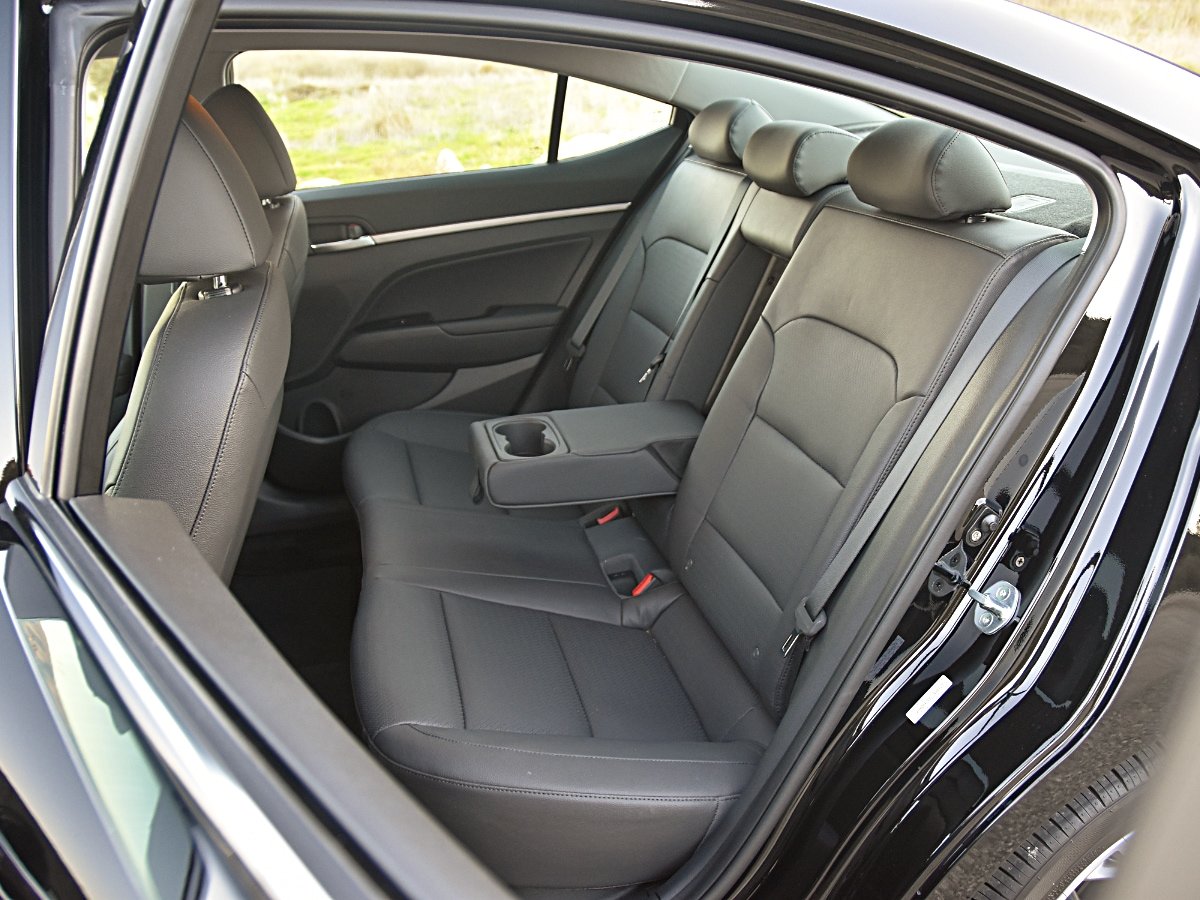
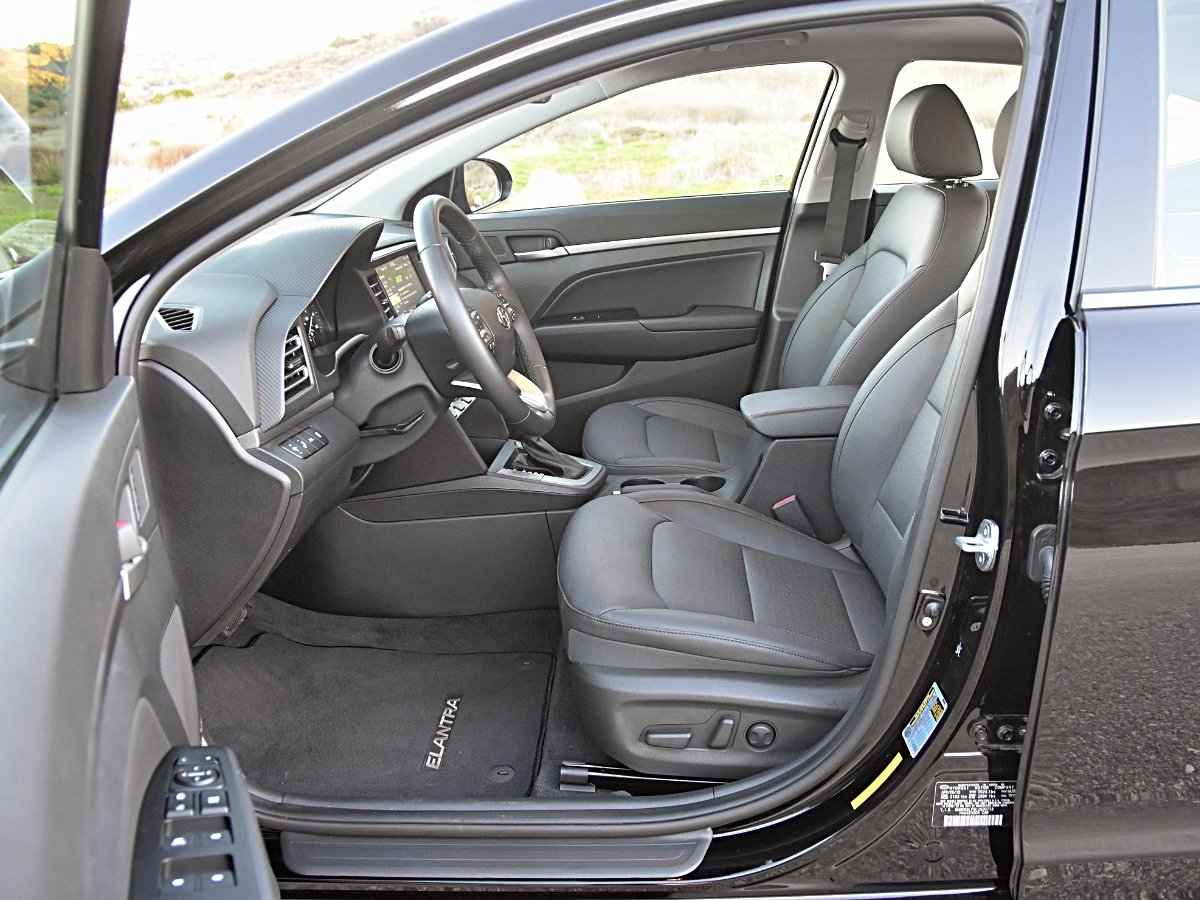
Counted among the roomier compact cars available, the Elantra offers comfortable accommodations for four adults, with a fifth person squeezed in for (very) short trips.
Our Limited test car came with power driver’s seat adjustment, leather upholstery, and a sliding center console armrest that improves comfort. Also, miracle of miracles, the automaker equips every Elantra with a front passenger's seat-height adjuster.
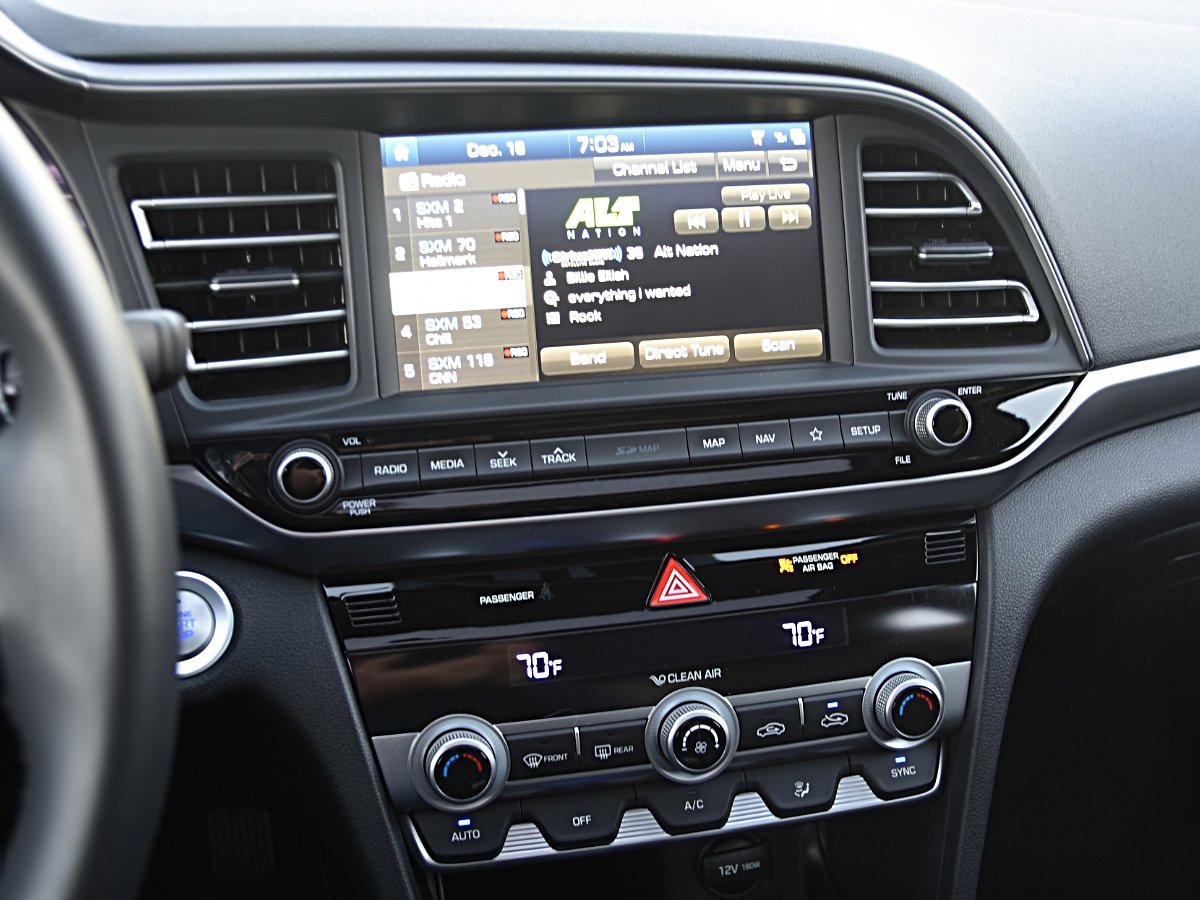
Every 2020 Elantra also includes a dual-zone automatic climate control system with a Clean Air ionizer and an automatic defogging system. If you live where it's cold, know that all but the SE and SEL have heated front seats. If you live where it's hot, know that air conditioning vents are not available for rear passengers.
Interior storage is perfectly proportioned for a compact car, and the trunk supplies 14.4 cubic feet of space, which is nearly as much as some midsize sedans provide. Another thoughtful touch is the interior grab handle inside the trunk lid, which makes it easy to swing shut.
Technology
Standard equipment for the 2020 Elantra includes a touchscreen infotainment system with Bluetooth and a USB port. With base SE trim, the screen size measures 5 inches diagonally. Upgrade to the Elantra SEL, and a larger 7-inch display is standard, along with Apple CarPlay, Android Auto, and SiriusXM satellite radio. Get the Value Edition, and you’ll enjoy a complimentary subscription to Blue Link Connected Car and Remote plans for the first three years of ownership.
Limited trim ups the ante with wireless smartphone charging and a premium Infinity sound system with Clari-Fi digital music restoration technology. This trim level’s Ultimate Package increases the touchscreen size to 8 inches and adds navigation, Blue Link Guidance service, and SiriusXM data services. The Sport trim is offered with all of the Limited model’s upgrades, but they’re packaged differently. You’ll want that version’s Premium Package in order to get the top level of tech.
Nestled between the stylish new air vents, the touchscreen display sits high on the dashboard and is canted a bit toward the driver. Beneath it, a row of shortcut buttons makes it easy to find the menu or function you seek, and it is flanked by volume and tuning knobs. The execution here is excellent, making the infotainment system exceptionally easy to use, and the voice recognition system is agreeable enough when using fairly natural commands.
The Infinity sound system impresses for the compact car segment, too, producing a depth of sound uncommon in the class.
Safety
Another change for the 2020 Elantra is that Smart Sense is now standard on all trim levels.
What is Hyundai Smart Sense? It’s the company’s collection of advanced driving assistance systems (ADAS), and in the Elantra the list includes forward-collision warning, automatic emergency braking, lane departure warning, lane-keeping assist, and a driver attention monitor.
Starting with SEL trim, the Elantra is equipped with blind-spot warning and rear cross-traffic alert, and both the Limited and Sport install full LED headlights with automatic high-beam operation. Add the Ultimate Package to the Elantra Limited, and you’ll get adaptive cruise control, a pedestrian detection system, and Safe Exit Assist, which warns occupants not to open a side door when traffic is approaching the car from the rear.
Our test car had the whole safety enchilada, and the ADAS works with accuracy if not class-leading refinement. Automakers are really improving on this front, especially with regard to smoothness, so the redesigned 2021 Elantra had better offer next-generation Smart Sense technology.
When equipped with full LED headlights, the 2020 Elantra earns a Top Safety Pick from the Insurance Institute for Highway Safety (IIHS). In testing conducted by the National Highway Traffic Safety Administration (NHTSA), the car gets an overall rating of four stars. Also, the NHTSA notes a concern about rear-door intrusion on the rear-seat passenger during the side-impact test.
Cost-effectiveness
The 2020 Hyundai Elantra is an absolute bargain of a car. Roomy, safe, equipped with thoughtful details, and even stylish, it competes well on those merits alone. But when you add the unbeatable value inherent in any Hyundai, well, it’s almost irrational to choose any other compact car.
Here’s the deal. The Elantra includes a five-year/60,000-mile bumper-to-bumper warranty and a five-year/unlimited mileage roadside assistance plan. Additionally, the powertrain warranty amounts to 10 years or 100,000 miles. And to make sure you get yourself on the right path as far as maintenance is concerned, scheduled service is free for the first three years or 36,000 miles.
There is more to the value equation. For example, versions with Blue Link provide three free years of service. Buy a new Elantra, and if you decide you don’t like it you can exercise the Three Day Worry-Free Exchange offer that Hyundai includes with every one of its vehicles. Plus, the Elantra is known for its low cost of ownership, which, given all of the freebies listed here, should come as no surprise.
It all adds up to an extremely cost-effective choice in a compact car. But value is not the only reason to choose a 2020 Hyundai Elantra. Rather, it is one of many.
What owners say
"Overall, drivers of the 2020 Hyundai Elantra appreciate its great value, gas mileage, and smooth ride. Many love the safety features and updated technology. However, some are disappointed by the lack of advanced features like keyless entry and the performance of cruise control. A few also noted concerns about the price being on the higher side for what is offered."
The only thing I can think of it is missing rear air conditioning.
September 22, 2020Love the car! Looks slick, drives smooth and has a lot of features for car under 20,000.
August 29, 2020I love my car, great value, its missing nothing and I would compare it to a Honda Accord.
June 14, 2020What owners say
The only thing I can think of it is missing rear air conditioning.
September 22, 2020Love the car! Looks slick, drives smooth and has a lot of features for car under 20,000.
August 29, 2020I love my car, great value, its missing nothing and I would compare it to a Honda Accord.
June 14, 2020I loved the color, the steadiness, and how comfortable the car is.
June 6, 2022Great car with amazing gas mileage and has all the modern modest gadgets. Only real issue I have with it is the brakes. Maybe it is just my car but this car is a Front wheel drive so the breaking feels more aggressive then it actually is because the force and counter force from the breaks are being applied to the same wheels. Others that awesome car and I would highly recommend for everyone day use.
June 7, 2023Elantra is a great car! I had an 07 with 145,000 miles and spent less on repairs for the Elantra than any car I have owned. Just bought 2020 Elantra and love it! I am sure it will be as good,
February 7, 2021Ive had four Elantras. Im disappointed in my current 2020 SEL. If I use the accelerator pedal and drive 55mph the tachometer reads 1500 rpm and gas mileage is great. The minute I turn on cruise control the rpm jumps to 2100 and the mpg drops by about 5mpg. All my others got the best mileage using cruise control. I took the car to a dealer twice and once the service manage observed this. He said the car is functioning as designed. I dont think so. Im looking at Honda because I use cruise control a lot. Otherwise, the car is a good buy.
June 16, 2020It has all safety things you want and need. Ones that honda and Toyota are now just getting Hyundai had them for a couple years at least. Great gas mileage and great warranty. And nice looking car
December 3, 2020Good value. Car handles well and is fun to drive. The negatives: Very basic features. No Sirius XM capabilities, no keyless entry, no push button start. only one USB port, no auto lock/open when touching door handle. The kind of car you would get if you rented the 2nd most economical at Hertz. Basic, but a good value.
January 2, 2021Great gas mileage and ride. Lots of extra safety features
June 18, 2020Trims & specs
Base MSRP $20,950 | Seating 5 |
Engine 2.0L 147 hp I4 | Cargo Capacity 14.4 cu ft |
Combined MPG 35 | Drivetrain FWD |
Base MSRP N/A | Seating N/A |
Engine N/A | Cargo Capacity N/A |
Combined MPG N/A | Drivetrain N/A |
Base MSRP $19,300 | Seating 5 |
Engine 2.0L 147 hp I4 | Cargo Capacity 14.4 cu ft |
Combined MPG 36 | Drivetrain FWD |
Base MSRP $20,050 | Seating 5 |
Engine 2.0L 147 hp I4 | Cargo Capacity 14.4 cu ft |
Combined MPG 35 | Drivetrain FWD |
Base MSRP $24,150 | Seating 5 |
Engine 1.6L 201 hp I4 | Cargo Capacity 14.4 cu ft |
Combined MPG 29 | Drivetrain FWD |
Base MSRP $23,150 | Seating 5 |
Engine 2.0L 147 hp I4 | Cargo Capacity 14.4 cu ft |
Combined MPG 35 | Drivetrain FWD |
Base MSRP $21,600 | Seating 5 |
Engine 1.4L 128 hp I4 | Cargo Capacity 14.4 cu ft |
Combined MPG 37 | Drivetrain FWD |
Base MSRP N/A | Seating N/A |
Engine N/A | Cargo Capacity N/A |
Combined MPG N/A | Drivetrain N/A |
Base MSRP N/A | Seating N/A |
Engine N/A | Cargo Capacity N/A |
Combined MPG N/A | Drivetrain N/A |
Base MSRP N/A | Seating N/A |
Engine N/A | Cargo Capacity N/A |
Combined MPG N/A | Drivetrain N/A |
Base MSRP N/A | Seating N/A |
Engine N/A | Cargo Capacity N/A |
Combined MPG N/A | Drivetrain N/A |


Pricing trends
MSRP range
$19,300 - $24,150
Current avg. market price
$13,294
Trending down by 2.1% this month
May 2026 - November 2026


