Toyota RAV4 Hybrid vs Volkswagen Taos
Overview | |
Years produced2016-2025 | Years produced2022-Present |
MSRP$31,225 | MSRP$24,155 |
Listings9176 | Listings9462 |
Ratings & Reviews | |
User Reviews | User Reviews |
Expert reviews6.3 out of 10 | Expert reviews6.3 out of 10 |
Pros
Cons
| Pros
Cons
|
Reviews SummaryThe 2023 Toyota RAV4 Hybrid is a solid choice in its rather limited class, with an easily attained 40 mpg, pleasant driving characteristics, and high levels of comfort. A new infotainment system helps its standing, as does a new off-road capable Woodland Edition. | |
Reviews SummaryOffering available all-wheel drive, a higher driving position, a roomy interior for four people, and plenty of utility, entry-level SUVs pay dividends in exchange for their higher price tags. Volkswagen introduced its new, most affordable crossover in 2022, and the 2023 Taos adds more standard safety features and equipment. Otherwise, aside from a lack of engine power and drivetrain refinement, it remains an appealing choice in the small SUV segment. | |
No video found | |
Popular Features & Specs | |
Engine2.5L 219 hp I4 Hybrid | Engine1.5L 158 hp I4 |
Drive TrainAWD | Drive TrainFWD |
Seating Capacity5 | Seating Capacity5 |
EV Battery Capacity1.6 kWh | EV Battery Capacity |
MPG City41 | MPG City28 |
MPG Highway38 | MPG Highway36 |
Engine | |
Engine Name2.5L 219 hp I4 Hybrid | Engine Name1.5L 158 hp I4 |
DrivetrainAWD | DrivetrainFWD |
Fuel Economy | |
EV Battery Capacity1.6 kWh | EV Battery Capacity |
MPG City41 | MPG City28 |
MPG Highway38 | MPG Highway36 |
Interior | |
Seating Capacity5 | Seating Capacity5 |
Safety | |
Front Crash Overall4 | Front Crash Overall4 |
Side Crash Overall5 | Side Crash Overall5 |
Dimensions & Capacity | |
Cargo Space37.6 cu ft | Cargo Space27.9 cu ft |
Curb Weight3690 lbs | Curb Weight3175 lbs |
Height67.0 in | Height64.4 in |
Length180.9 in | Length175.8 in |
Width73.0 in | Width72.5 in |
Wheelbase105.9 in | Wheelbase105.9 in |
Maximum Payload1210 lbs | Maximum Payload937 lbs |
Number of doors4 | Number of doors4 |
Maximum Towing Capacity1750 lbs | Maximum Towing Capacity |
Overview | ||
Years produced | 2016-2025 | 2022-Present |
MSRP | $31,225 | $24,155 |
Listings | ||
Ratings & Reviews | ||
User reviews | ||
Expert reviews | 6.3 out of 10Read full review | 6.3 out of 10Read full review |
Pros & cons | Pros
Cons
| Pros
Cons
|
Summary | The 2023 Toyota RAV4 Hybrid is a solid choice in its rather limited class, with an easily attained 40 mpg, pleasant driving characteristics, and high levels of comfort. A new infotainment system helps its standing, as does a new off-road capable Woodland Edition. | Offering available all-wheel drive, a higher driving position, a roomy interior for four people, and plenty of utility, entry-level SUVs pay dividends in exchange for their higher price tags. Volkswagen introduced its new, most affordable crossover in 2022, and the 2023 Taos adds more standard safety features and equipment. Otherwise, aside from a lack of engine power and drivetrain refinement, it remains an appealing choice in the small SUV segment. |
Video | No video found | |
Popular Features & Specs | ||
Engine | 2.5L 219 hp I4 Hybrid | 1.5L 158 hp I4 |
Drive Train | AWD | FWD |
Seating Capacity | 5 | 5 |
EV Battery Capacity | 1.6 kWh | |
MPG City | 41 | 28 |
MPG Highway | 38 | 36 |
Engine | ||
Engine Name | 2.5L 219 hp I4 Hybrid | 1.5L 158 hp I4 |
Drivetrain | AWD | FWD |
Fuel Economy | ||
EV Battery Capacity | 1.6 kWh | |
MPG City | 41 | 28 |
MPG Highway | 38 | 36 |
Interior | ||
Seating Capacity | 5 | 5 |
Safety | ||
Front Crash Overall | 4 | 4 |
Side Crash Overall | 5 | 5 |
Dimensions & Capacity | ||
Cargo Space | 37.6 cu ft | 27.9 cu ft |
Curb Weight | 3690 lbs | 3175 lbs |
Height | 67.0 in | 64.4 in |
Length | 180.9 in | 175.8 in |
Width | 73.0 in | 72.5 in |
Wheelbase | 105.9 in | 105.9 in |
Maximum Payload | 1210 lbs | 937 lbs |
Number of doors | 4 | 4 |
Maximum Towing Capacity | 1750 lbs | |
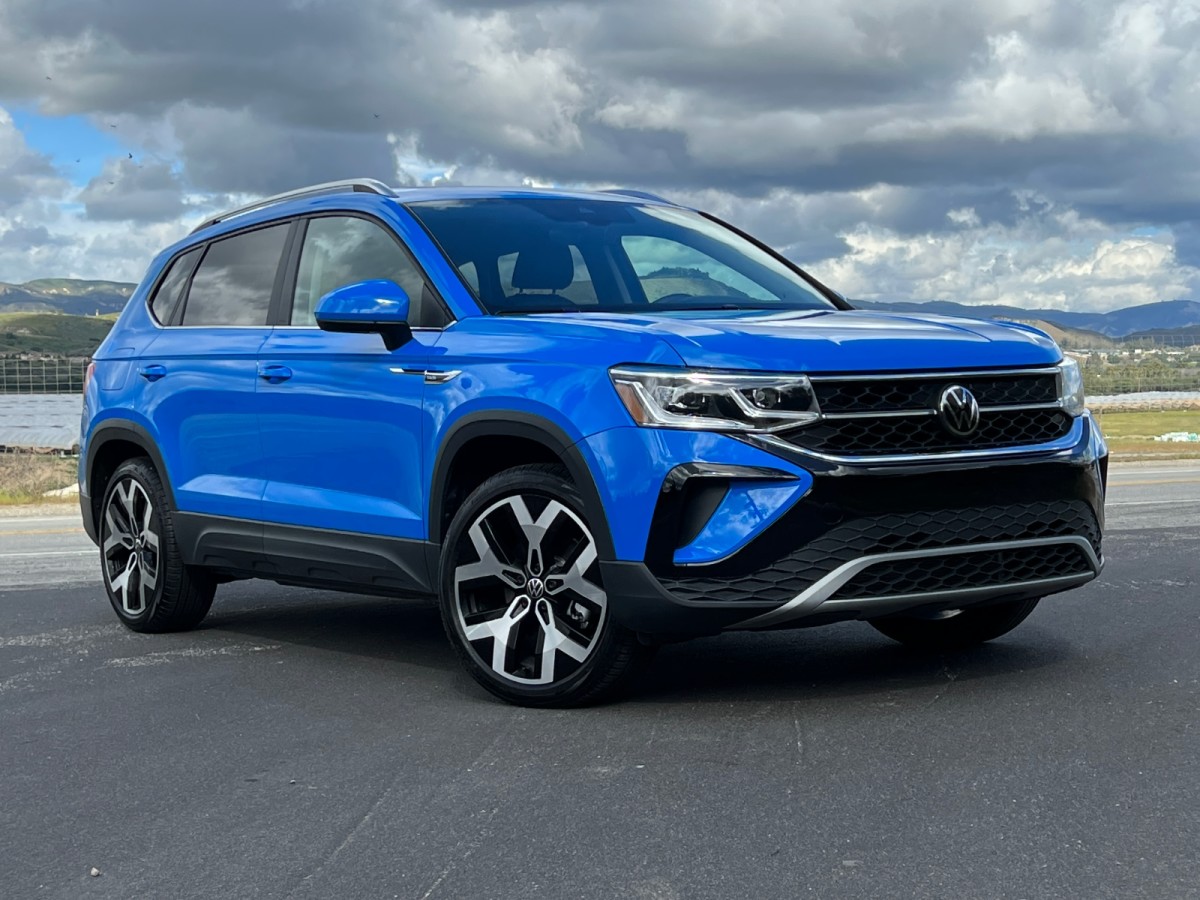
Though the Volkswagen Taos nameplate was exclusive to North America, Volkswagen sold this SUV all around the world. Designed for appeal, engineered for affordability, and sized to succeed almost anywhere while maximizing passenger comfort and practical utility, the Taos and its derivatives were quite popular. In the U.S., the Taos was Volkswagen’s third-best selling model in its inaugural year of 2022, even beating the Jetta by 20,843 units according to Automotive News. That year, Jetta sales shrank 38.3%, a shocking decline for the once-thriving model. Despite a base price starting about $3,500 higher than the Jetta, the Taos undoubtedly siphoned some sales from the sedan.
For 2023, VW Taos prices ranged from $24,155 to $34,535, not including a destination charge of $1,235. The SUV came in S, SE, and SEL trim levels, with a choice between front-wheel drive (FWD) and 4Motion all-wheel drive (AWD). Our test vehicle arrived in SEL trim, which included 4Motion. Dipped in Cornflower Blue paint, it had no options and carried a manufacturer’s suggested retail price (MSRP) of $35,830, including the destination charge.
That was pricey for the small SUV segment, but the Taos SEL was a stylish, sporty, and appealing vehicle. Bold 19-inch alloy wheels with a machined surface, the bright blue paint, creased and carved flanks, and proper proportions gave the top-trim version an upscale look that eased some of the sticker shock.
The premium look and feel continued inside, where the test car’s light gray seat and dashboard accents, gloss black trim, metallic detailing, and leather seats made the Taos SEL resemble a cut-rate Audi. According to Volkswagen, the Taos was nearly as roomy inside as the larger Tiguan model, making it one of the biggest small crossover SUVs available.
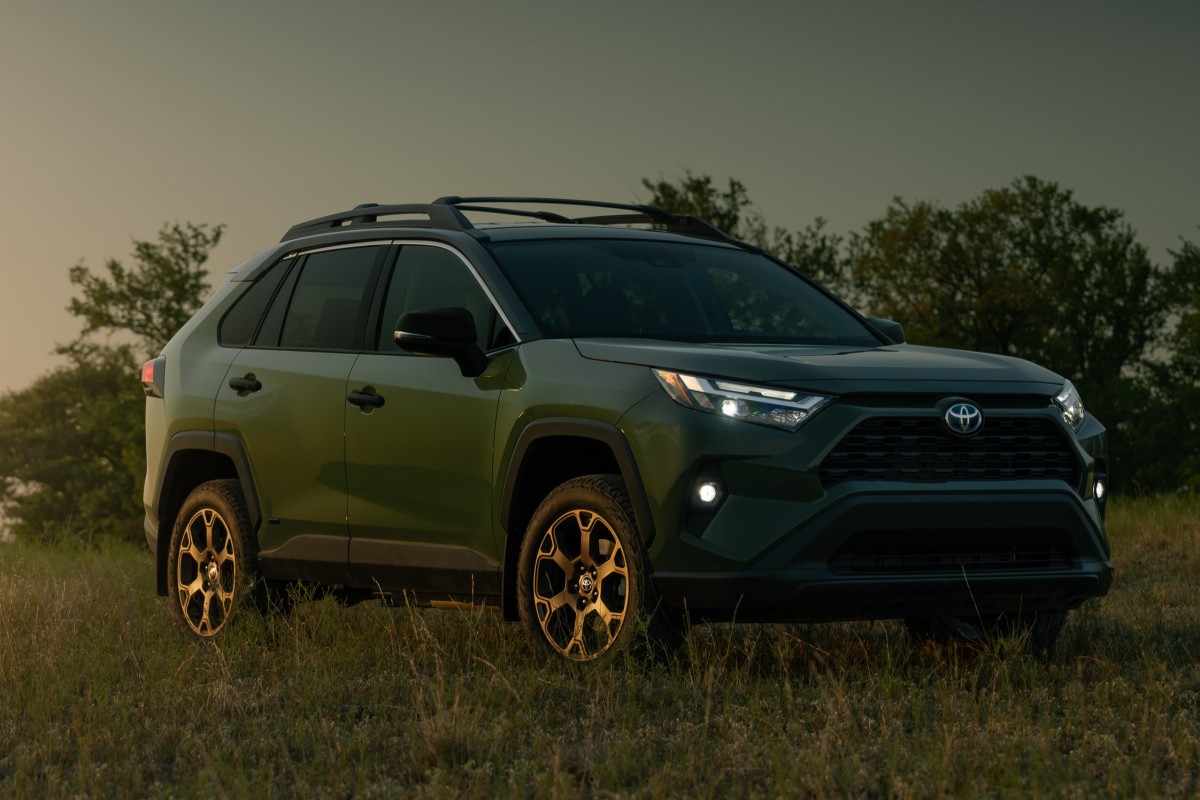
When the Toyota RAV4 was redesigned in 2019, it shed its softer and more typical crossover styling in favor of a more substantial and blocky appearance. The trapezoidal grille was adapted from Toyota's truck line to add some heft, with beveled and angled bodywork surrounding it to frame the headlights. This design was a bigger deal immediately after the restyling, but in the years since, other carmakers adopted a similar approach, seen in models like the Honda CR-V and Mazda CX-50.
The angular theme carried over to the interior, featuring a multi-tiered dashboard with beveled cutouts to add visual interest to an otherwise plain surface. The basic layout was common for vehicles at the time, with an infotainment touchscreen mounted atop the dash and a good amount of physical buttons and knobs for primary feature control.
Materials quality was about average for the class and price. There were plenty of hard plastics, but most surfaces people were prone to come into contact with were lightly padded. Both the base model and the new Woodland trim curiously left out the leather-wrapped steering wheel and opted for a very downmarket urethane wheel and center armrest. It felt rubbery and cheap in hand, which was a problem since that’s what the driver was always touching. Thankfully, most other trim levels came with a leather covering. Build quality was strong, with no detectable creaks or squeaks when driving over rough pavement.


In terms of performance, every 2023 Taos had a turbocharged 1.5-liter four-cylinder engine making 158 horsepower and 184 pound-feet of torque. With FWD, the engine paired with an eight-speed automatic transmission. With AWD, which was optional with S and SE trim and standard on the Taos SEL, a seven-speed dual-clutch automatic was standard.
Depending on the model, a Taos could have up to five driving modes and four additional settings for the 4Motion AWD system. Additionally, a Sport transmission mode was available. It was a bit much, so the test centered around the Normal and Sport modes with 4Motion in its Onroad setting.
Driving the Taos SEL smoothly was a challenge because powertrain response was hard to predict. Sometimes, there was a surge of torque that wasn’t expected. Other times, an unexpected delay in response could cause a momentary panic when turning left across oncoming traffic. Frequently, the dual-clutch transmission exhibited its characteristic halting behavior. A typical consumer might not put up with this, but acclimating the driving style to the quirks allowed for finding peace with this SUV in urban and suburban areas.
Tested in Southern California, the Taos traversed the Santa Monica Mountains on Mulholland Highway. Switching to Sport mode and setting the transmission in Sport mode eliminated some inconsistency in powertrain response but consumed more fuel. Still, over the entire route, the test vehicle averaged 26.8 mpg, just short of the official EPA rating of 28 mpg in combined driving.
Doubling up on Sport modes didn’t solve the engine’s lack of power. At the Taos SEL’s sticker price, one could get a turbocharged Mazda CX-30 generating 250 hp and 320 lb-ft or the thrilling Hyundai Kona N boasting 276 hp and 289 lb-ft. In comparison, the Taos’s 158 hp and 184 lb-ft seemed almost an embarrassment. Volkswagen Group knew how to make powerful, efficient, and refined turbocharged four-cylinder drivetrains. It was a shame the Taos didn’t benefit from this mastery.
With the 4Motion AWD, VW swapped the standard torsion-beam rear suspension for an independent multi-link setup. However, since the Taos offered no more than 6.6 inches of ground clearance, depending on the configuration, it wasn’t meant for far-off-road adventures. The Ford Bronco Sport, Jeep Compass Trailhawk, or Subaru Crosstrek were better options in that regard.
During the test run down Mulholland, the Taos SEL demonstrated a distinctly Germanic driving character. Sitting closer to the road than some rivals, and equipped with grippy P225/45R19 Pirelli Scorpion all-season tires, the Taos SEL felt firm, sure-footed, and stable. Additionally, due to excellent visibility, it was easy to place on a road.
Steering effort was light, but the wheel felt good in hand and the response was sharp and accurate. This little SUV was nimble, tossable, and easy to trust. Despite lacking power, its inherent athleticism made for a rousing good time, especially while traveling downhill.
Volkswagen equipped the Taos with four-wheel-disc brakes, but brake pedal feel and response were occasionally hard to predict, making it challenging to know what to expect when pressing down. Sometimes, the response was touchy and too aggressive. Other times, nothing much happened. This flaw called attention to itself often enough to deserve mention.
At highway speeds, the Taos suffered from wind noise and plenty of road noise. But that was common for the small SUV segment.
The RAV4 Hybrid was powered by a 2.5-liter four-cylinder engine paired with an electric motor/generator. They mated to a continuously variable transmission (CVT) that drove the front wheels. A second electric motor between the rear axles provided AWD. Combined, they produced 219 horsepower and accelerated the RAV4 to 60 mph in a respectable 7.5 seconds. Most drivers never needed to floor the pedal unless trying to merge with highway traffic on a steep uphill ramp.
Compared to other RAV4 models, the Hybrid powertrain was about half a second quicker than the standard RAV4, while the plug-in hybrid RAV4 Prime reached 60 mph in an impressive 5.5 seconds. Within the compact hybrid SUV class, the Kia Sportage hybrid was a fraction of a second quicker, and the Honda CR-V Hybrid clocked in at around 8 seconds, placing them on an even playing field acceleration-wise.
The brakes operated much like any other vehicle, hybrid or otherwise. The initial pedal stroke typically engaged regenerative braking, using the RAV4's braking momentum to charge the hybrid battery. Under more aggressive stops or when coming to a full stop, the physical brakes were actuated, but transitions weren't felt.
The suspension ably smoothed ride quality over moderate bumps and potholes while also delivering confident cornering. It wasn’t sporty and didn’t need to be. Instead, it did the fundamentals well and should appeal to most drivers. The RAV4 Hybrid's driving dynamics evoked no complaints but also didn’t impress. Competitors were somewhat similar in this manner: fairly calm and effortless to drive.
When shopping for a 2023 Taos, it became apparent that the S trim had cloth seats, SE trim had CloudTex artificial leather upholstery, and SEL trim had real leather.
Both the SE and SEL featured cold-weather equipment, including heated side mirrors, heated washer nozzles, and heated front seats. The SEL test vehicle also had rain-sensing wipers, dual-zone automatic climate control, ventilated front seats, and a heated steering wheel.
An eight-way power driver’s seat was standard in SE and SEL trims. It was exceptionally comfortable, and the Taos felt bigger inside than most competitors, akin to selling one class up in size. However, it needed a sliding and height-adjustable center armrest for maximum comfort.
Small SUVs were notorious for their cramped back seats, but that wasn't the case in the VW Taos. Passengers found plenty of room for their legs and feet, softly padded front seatbacks, air conditioning vents, and, in the SEL, a panoramic sunroof that extended over their heads. The door panels were constructed of hard plastic, and the seat cushion felt a bit low, but otherwise, the Taos offered impressive rear-seat room and comfort.
Storage space was plentiful for all occupants, though most locations weren’t lined, causing noise and vibration from items placed there. In the cargo area, deep wells existed on either side of the main load floor. Cargo space was generous, too, offering 27.9 cubic feet behind the back seat and 65.9 cubic feet with the rear seat folded down. With 4Motion, the figures were slightly smaller, at 24.9 and 60.2 cubic feet, respectively.
The RAV4 Hybrid’s front seats offered plenty of space for larger passengers, and the rear seats easily accommodated average-sized adults. On paper, there was slightly more rear headroom than the Honda CR-V or Kia Sportage, but a bit less legroom. In practice, the differences were insignificant, though placing a rear-facing infant seat might require scooting the front seat up to make room. The rear seat cushions were also set a bit low, which could leave taller passengers wishing for more thigh support on long road trips.
Behind the rear seats, the RAV4 Hybrid provided up to 37.5 cubic feet of cargo space — only a tenth of a cubic foot smaller than the non-hybrid RAV4. Despite the hybrid battery pack, cargo space wasn’t sacrificed. By comparison, the Honda CR-V could hold 39.5 cubic feet, and the Kia Sportage measured 39.3 cubic feet, offering no significant advantage among these hybrids. The rear seatbacks folded flat with the cargo floor, but shorter owners found the reach to be rather long.
One area where the RAV4 excelled was in interior storage for personal items. The front passenger had a wide shelf in the dashboard, and there was a phone tray in front of the center console. An optional wireless charging pad should be available for that spot, but as of the time of writing, it wasn’t listed in Toyota's online configurator, likely due to the ongoing chip shortage. Additionally, there were very large cupholders capable of holding massive Super Big Gulp cups and a large center armrest bin. Door pockets were about average in size.
Volkswagen equipped every 2023 Taos with standard digital instrumentation. The screen measured eight inches on S and SE trims, while the SEL got a 10.25-inch display with more features, viewing options, and the ability to display the navigation map over the entire panel.
Infotainment systems ranged from basic to fully featured. The Taos S had a standard 6.5-inch touchscreen, Bluetooth, and Car-Net connected services. Subscription plans included Remote Access (via smartphone, with a last parked location function); Safe & Secure (SOS emergency calling, automatic crash notification); and Hotspot (Wi-Fi). Additionally, Family Guardian provided teen-driver-related safety features.
With SE and SEL trims, the infotainment system added an 8-inch touchscreen, Bluetooth support for multiple devices, wireless Apple CarPlay and Android Auto, SiriusXM 360L satellite radio service, and an additional USB port. Wireless smartphone charging was standard.
A native navigation system was standard in the SEL. By signing up for Wi-Fi service, extra payments provided connected services like over-the-air navigation data updates, natural voice-recognition technology, and access to premium streaming media services like Tidal. The SEL also featured an eight-speaker Beats Audio premium sound system.
Despite the premium infotainment setup, the user experience was hit-or-miss. Volkswagen concealed some virtual controls until they approached the screen, causing occasional confusion. Radio tuning required ensuring the system was on the correct function, and accessing advanced driver assistance systems settings required navigating graphical sheets with hidden icons. Users often resorted to staring blankly at the interface. Also, mapping usage was limited between the digital instrumentation and center touchscreens, and the voice-recognition technology underperformed unless paired with additional paid services. The best results came when running Apple CarPlay or Android Auto.
For 2023, the RAV4 received a new infotainment system that significantly improved over previous iterations. The touchscreen graphics were modern and sharp, and the menus were logically arranged. The screen placement atop the dashboard reduced distractions. Most trims came with an 8.0-inch display, while higher trims upgraded to a 10.5-inch touchscreen. The base display’s on-screen buttons were small, requiring more precise effort to use accurately.
Wireless Apple CarPlay and Android Auto were standard on all RAV4 models, and a wireless charging pad was an option. Without the charger, drivers still dealt with cables for charging. The system offered over-the-air software updates to keep features current, while connectivity included a Wi-Fi hotspot, along with remote vehicle monitoring and control. The top RAV4 Hybrid trim upgraded to a fully digital instrument panel. Most RAV4 models came with a six-speaker audio system that delivered decent clarity and power for a base system. The Limited trim featured a more powerful 11-speaker JBL setup.
For the 2023 model year, Volkswagen improved the Taos's standard safety features. The Taos S included standard Front Assist (forward collision warning with pedestrian detection and automatic emergency braking), a blind-spot monitoring system, and rear cross-traffic alert.
The Taos SE added VW’s IQ.Drive collection of ADAS as standard equipment (it was optional with S trim). IQ.Drive equipped the SUV with Lane Assist (lane-departure warning, lane-keeping assist); Travel Assist (adaptive cruise control with stop-and-go and lane-centering assist); Emergency Assist (automatic stopping when a driver became unresponsive); and an active version of blind-spot monitoring that attempted to prevent unsafe lane changes.
Additionally, the Taos featured a standard post-collision automatic braking system (all trims), automatic high-beam headlights (SE and SEL; optional on S), parking sensors with automatic braking (SEL), and a road-sign recognition system (SEL).
Travel Assist received high marks during the evaluation: driving north on Pacific Coast Highway from Malibu to Oxnard, the technology navigated curves and construction zones with ease. On the freeway, the system maintained proper distance to traffic ahead without excessive or inconsistent braking and quickly accelerated back to cruising speed when slower vehicles exited. Overall, Travel Assist proved smooth, accurate, and refined.
Lane Assist was user-friendly and not intrusive, with only one false warning about a perceived lane marker crack.
Both the National Highway Traffic Safety Administration (NHTSA) and the Insurance Institute for Highway Safety (IIHS) ratings were decent but imperfect.
The National Highway Traffic Safety Administration (NHTSA) awarded the RAV4 Hybrid five out of five stars for overall and side crash protection and four stars in frontal and rollover crash tests. The Insurance Institute for Highway Safety (IIHS) gave the RAV4 its highest score of "Good" in all tests except for its new moderate overlap frontal and side-impact tests, where it scored a second-best "Acceptable" safety rating. The IIHS also named the RAV4 a Top Safety Pick, the Institute's second-highest honor.
All 2023 RAV4 Hybrid models came standard with Toyota's Safety Sense 2.5 suite of safety features. This suite included forward collision warning with pedestrian detection and automatic emergency braking, adaptive cruise control, lane-keep assist, automatic high beams, and a traffic sign reader. The XLE trim added a blind-spot monitor with rear cross-traffic alerts. The top Limited trim added front and rear parking proximity sensors with automatic braking when backing up. A surround-view camera system and a digital rearview mirror were optional, allowing a clear view behind the vehicle, even if the cargo area was fully loaded.
During our time with the RAV4, the systems performed well and without false alarms. The adaptive cruise control was noted for smooth throttle and brake inputs, as well as gentle stops.
CarGurus highlights
According to CarGurus experts, the overall rating for the 2023 Volkswagen Taos was 6.3 out of 10, while the 2023 Toyota RAV4 Hybrid scored 6.3 out of 10. Given these ratings, both cars provided solid options within their segments, but the Toyota RAV4 Hybrid, with its superior fuel efficiency, better safety ratings, and more spacious interior, edged out the competition. Therefore, for those looking for a balanced package of performance, safety, and utility, the Toyota RAV4 Hybrid came out as the more recommended choice.
Choose the 2023 Toyota RAV4 Hybrid if:
- You're looking for superior fuel efficiency coupled with decent power and acceleration for daily driving needs.
- You value strong safety ratings and robust safety feature suites like Toyota's Safety Sense 2.5.
- You prefer a more spacious and utility-focused vehicle with generous cargo and in-cabin storage options.




Choose the 2023 Volkswagen Taos if:
- You want a stylish and sporty small SUV with premium interior touches.
- You need an SUV with ample rear seat and cargo space that feels like it belongs in a larger class.
- You prefer a vehicle with strong ADAS (IQ.Drive) and excellent navigation aids like Travel Assist.





CarGurus highlights
According to CarGurus experts, the overall rating for the 2023 Volkswagen Taos was 6.3 out of 10, while the 2023 Toyota RAV4 Hybrid scored 6.3 out of 10. Given these ratings, both cars provided solid options within their segments, but the Toyota RAV4 Hybrid, with its superior fuel efficiency, better safety ratings, and more spacious interior, edged out the competition. Therefore, for those looking for a balanced package of performance, safety, and utility, the Toyota RAV4 Hybrid came out as the more recommended choice.
Choose the 2023 Toyota RAV4 Hybrid if:
Shop Now- You're looking for superior fuel efficiency coupled with decent power and acceleration for daily driving needs.
- You value strong safety ratings and robust safety feature suites like Toyota's Safety Sense 2.5.
- You prefer a more spacious and utility-focused vehicle with generous cargo and in-cabin storage options.





Choose the 2023 Volkswagen Taos if:
Shop Now- You want a stylish and sporty small SUV with premium interior touches.
- You need an SUV with ample rear seat and cargo space that feels like it belongs in a larger class.
- You prefer a vehicle with strong ADAS (IQ.Drive) and excellent navigation aids like Travel Assist.








By: CarGurus + AI
At CarGurus, our team of experienced automotive writers remain at the heart of our content operation, conducting hands-on car tests and writing insightful guides that are backed by years of industry experience. To complement this, we are harnessing AI to make our content offering more diverse and more helpful to shoppers than ever. To achieve this, our AI systems are based exclusively on CarGurus content, ratings and data, so that what we produce is both unique to CarGurus, and uniquely helpful to car shoppers.