Hyundai Tucson vs Volkswagen Atlas Cross Sport
Overview | |
MSRP$27,500 | MSRP$36,985 |
Listings204 | Listings244 |
Ratings & Reviews | |
User Reviews | User Reviews |
Expert reviews8.5 out of 10 | Expert reviews7.0 out of 10 |
Pros
Cons
| Pros
Cons
|
Reviews SummaryWith the growth and evolution of the compact SUV market, shoppers have seemingly endless options. And the growth of this segment has allowed for different models to grow in their own unique ways. The Mazda CX-5 is upscale and athletic, while the Ford Bronco Sport is a surprisingly capable off-roader. So what if you aren’t seeking a well-honed niche vehicle? What if you are looking for a small SUV that’s and overall great vehicle? The 2024 Hyundai Tucson answers that question as a well-rounded compact SUV that doesn’t excel in any one particular area, but instead covers a lot of what modern consumers demand out of their vehicle. This format is one that has been embraced by perennial segment standouts like the Toyota RAV4 and Honda CR-V. Verdict: The Tucson is a well-rounded small SUV and a good value. It does not shine in any particular area, instead blending good performance with a comfortable and spacious cabin, impressive tech and safety features, and an attractive price tag. | |
Reviews SummaryVolkswagen's efforts to grow its appeal in the United States have developed over a long process of trial and error, but VW showed it finally understood American tastes when it launched the Atlas three-row crossover SUV. And because not everyone needs three rows, VW followed up the standard Atlas with the two-row Cross Sport for the 2020 model year. Both versions get a significant refresh for 2024. The 2024 Volkswagen Atlas Cross Sport gets most of the same updates as its three-row sibling, including different styling, more standard features, and the discontinuation of its six-cylinder engine option in favor of a more powerful turbocharged four-cylinder engine. These changes are aimed at making the Cross Sport more competitive against other midsize crossovers like the Chevrolet Blazer and Honda Pilot, the aged Ford Edge and Nissan Murano, and the more truck-like Jeep Grand Cherokee. The 2024 Atlas Cross Sport lineup includes SE, SE with Technology, SEL, SEL R-Line, and SEL Premium R-Line trim levels. We drove the range-topping SEL Premium R-Line for this review. | |
No video found | |
Popular Features & Specs | |
Engine2.5L 187 hp I4 | Engine2.0L 269 hp I4 |
Drive TrainFWD | Drive TrainFWD |
Seating Capacity5 | Seating Capacity5 |
Horsepower187 hp @ 6100 rpm | Horsepower |
MPG City25 | MPG City20 |
MPG Highway32 | MPG Highway27 |
Engine | |
Engine Name2.5L 187 hp I4 | Engine Name2.0L 269 hp I4 |
Torque178 lb-ft @ 4000 rpm | Torque |
Horsepower187 hp @ 6100 rpm | Horsepower |
DrivetrainFWD | DrivetrainFWD |
Fuel Economy | |
MPG City25 | MPG City20 |
MPG Highway32 | MPG Highway27 |
Interior | |
Seating Capacity5 | Seating Capacity5 |
Safety | |
Front Crash Overall5 | Front Crash Overall4 |
Side Crash Overall5 | Side Crash Overall5 |
Dimensions & Capacity | |
Cargo Space38.7 cu ft | Cargo Space40.3 cu ft |
Curb Weight3346 lbs | Curb Weight4173 lbs |
Height65.6 in | Height68.1 in |
Length182.3 in | Length195.6 in |
Width73.4 in | Width88.5 in |
Wheelbase108.5 in | Wheelbase117.3 in |
Maximum Payload1283 lbs | Maximum Payload1091 lbs |
Number of doors4 | Number of doors4 |
Maximum Towing Capacity2000 lbs | Maximum Towing Capacity2000 lbs |
Standard Towing Capacity2000 lbs | Standard Towing Capacity |
Overview | ||
MSRP | $27,500 | $36,985 |
Listings | ||
Ratings & Reviews | ||
User reviews | ||
Expert reviews | 8.5 out of 10Read full review | 7.0 out of 10Read full review |
Pros & cons | Pros
Cons
| Pros
Cons
|
Summary | With the growth and evolution of the compact SUV market, shoppers have seemingly endless options. And the growth of this segment has allowed for different models to grow in their own unique ways. The Mazda CX-5 is upscale and athletic, while the Ford Bronco Sport is a surprisingly capable off-roader. So what if you aren’t seeking a well-honed niche vehicle? What if you are looking for a small SUV that’s and overall great vehicle? The 2024 Hyundai Tucson answers that question as a well-rounded compact SUV that doesn’t excel in any one particular area, but instead covers a lot of what modern consumers demand out of their vehicle. This format is one that has been embraced by perennial segment standouts like the Toyota RAV4 and Honda CR-V. Verdict: The Tucson is a well-rounded small SUV and a good value. It does not shine in any particular area, instead blending good performance with a comfortable and spacious cabin, impressive tech and safety features, and an attractive price tag. | Volkswagen's efforts to grow its appeal in the United States have developed over a long process of trial and error, but VW showed it finally understood American tastes when it launched the Atlas three-row crossover SUV. And because not everyone needs three rows, VW followed up the standard Atlas with the two-row Cross Sport for the 2020 model year. Both versions get a significant refresh for 2024. The 2024 Volkswagen Atlas Cross Sport gets most of the same updates as its three-row sibling, including different styling, more standard features, and the discontinuation of its six-cylinder engine option in favor of a more powerful turbocharged four-cylinder engine. These changes are aimed at making the Cross Sport more competitive against other midsize crossovers like the Chevrolet Blazer and Honda Pilot, the aged Ford Edge and Nissan Murano, and the more truck-like Jeep Grand Cherokee. The 2024 Atlas Cross Sport lineup includes SE, SE with Technology, SEL, SEL R-Line, and SEL Premium R-Line trim levels. We drove the range-topping SEL Premium R-Line for this review. |
Video | No video found | |
Popular Features & Specs | ||
Engine | 2.5L 187 hp I4 | 2.0L 269 hp I4 |
Drive Train | FWD | FWD |
Seating Capacity | 5 | 5 |
Horsepower | 187 hp @ 6100 rpm | |
MPG City | 25 | 20 |
MPG Highway | 32 | 27 |
Engine | ||
Engine Name | 2.5L 187 hp I4 | 2.0L 269 hp I4 |
Torque | 178 lb-ft @ 4000 rpm | |
Horsepower | 187 hp @ 6100 rpm | |
Drivetrain | FWD | FWD |
Fuel Economy | ||
MPG City | 25 | 20 |
MPG Highway | 32 | 27 |
Interior | ||
Seating Capacity | 5 | 5 |
Safety | ||
Front Crash Overall | 5 | 4 |
Side Crash Overall | 5 | 5 |
Dimensions & Capacity | ||
Cargo Space | 38.7 cu ft | 40.3 cu ft |
Curb Weight | 3346 lbs | 4173 lbs |
Height | 65.6 in | 68.1 in |
Length | 182.3 in | 195.6 in |
Width | 73.4 in | 88.5 in |
Wheelbase | 108.5 in | 117.3 in |
Maximum Payload | 1283 lbs | 1091 lbs |
Number of doors | 4 | 4 |
Maximum Towing Capacity | 2000 lbs | 2000 lbs |
Standard Towing Capacity | 2000 lbs | |
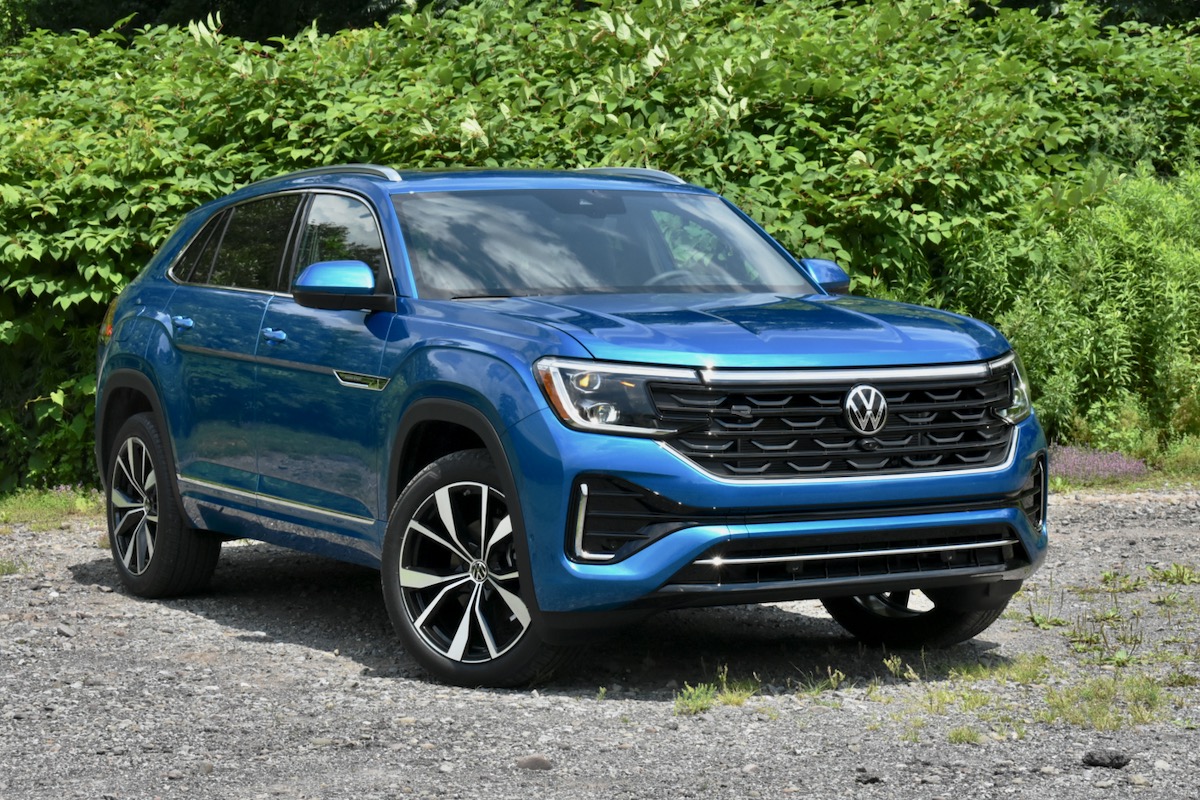
The 2024 Volkswagen Atlas Cross Sport received the same styling updates as its three-row sibling, the Atlas. These updates primarily included new lighting elements in both the front and rear areas. Notably, the Volkswagen logos on the grille and tailgate now light up in white and red, respectively. This feature made its debut on the all-electric Volkswagen ID.4.
Other distinctive lighting elements adorn the Cross Sport's exterior. At the front, a light bar connects the daytime running lights, complementing the new standard LED headlights. This design aims to give both the Atlas and Cross Sport a more Americanized look, fitting since both models are built in Chattanooga, Tennessee. These vehicles were also designed specifically for the U.S. market.
Reshaped taillights blend into a rear light bar, housing the second illuminating VW logo at the rear. While the front end of the Cross Sport closely resembles the standard Atlas, the rear features a lower roofline. This design element gives the Cross Sport a silhouette more akin to the "crossover coupes" seen in German luxury brands. The Cross Sport is also 5.2 inches shorter than the standard Atlas and sits a bit lower.
For 2024, all Cross Sport trims received new wheel designs. The base SE trim boasts 18-inch alloy wheels, while the SE with Technology and SEL models sport 20-inch wheels. For those seeking a more customized look, an optional black wheel package was available. The sporty SEL R-Line comes with a unique 20-inch wheel design, extended side skirts, and different front and rear bumpers. The top-tier SEL Premium R-Line features all these elements, along with 21-inch wheels. However, the Cross Sport doesn't offer the more rugged Peak Edition package that was added to the three-row Atlas lineup for 2024.
The interior of the Cross Sport also mirrors the standard Atlas. A central touchscreen now stands upright instead of melting into the dashboard, and the center console is raised, creating a small storage nook below. This design was facilitated by a new electronic shifter, unencumbered by mechanical connections to the transmission.
Interior amenities included standard leatherette upholstery, while SEL and higher models offered leather seats. The highest trim level, SEL Premium R-Line, featured quilted leather upholstery with a diamond pattern. The test model also sported blue seat inserts. However, despite efforts to enhance the simulated wood and carbon-fiber-facsimile trim, they remained different types of plastic.
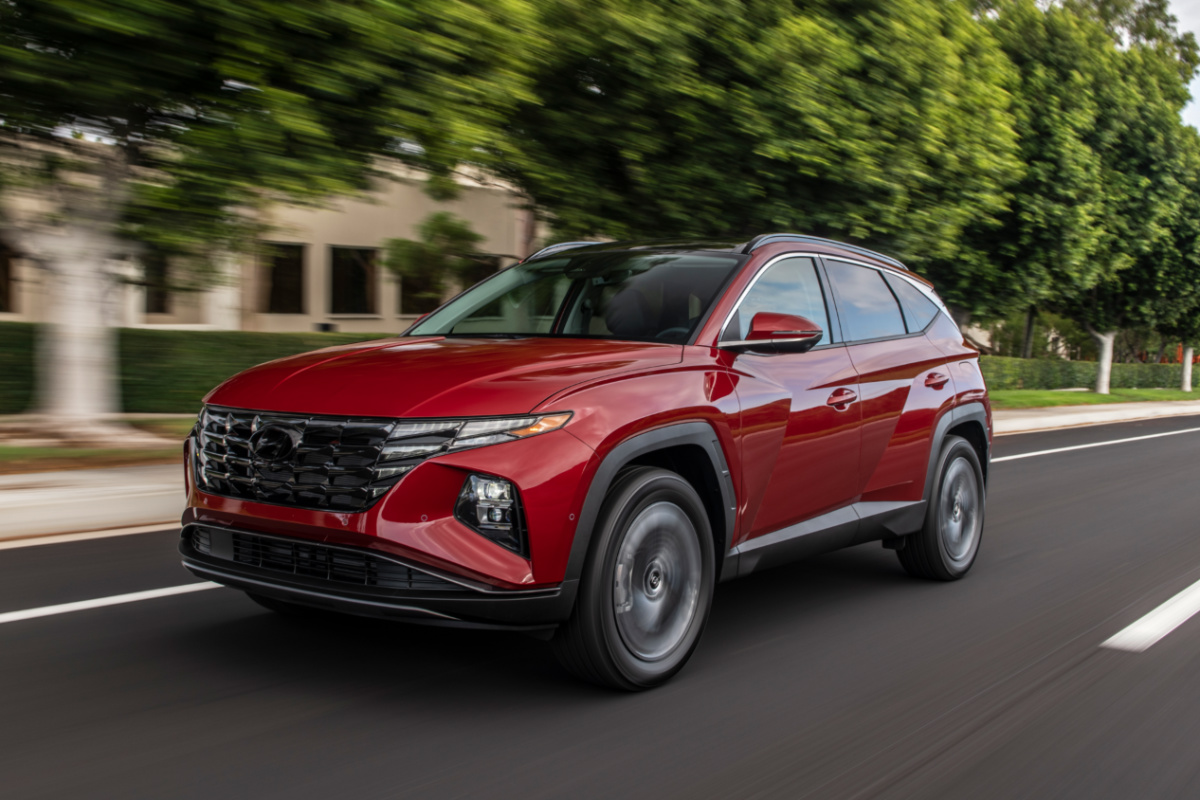
On the other side, the 2024 Hyundai Tucson carried over much of its design from its 2022 fourth-generation debut. The Tucson showcased a bold, aggressive look with taut angles and unique design choices, such as its headlights blending into the grille. Even in white—a challenging color for vehicle photography—the Tucson maintained a sharp and contemporary appearance.
Hyundai managed to create an athletic presence through contrasting angles and cohesive design elements. Unlike some luxury brands that merely scale their designs up or down across different models, Hyundai gave every vehicle a unique style. The Tucson was available in SE, SEL, XRT, and Limited trims. The SE came with 17-inch alloy wheels and roof rails, while the SEL’s convenience package added 19-inch alloys. The rugged XRT trim featured unique black 19-inch alloy wheels, side steps, dark exterior trim, and functional roof racks. The Limited trim came with a dark chrome grille and upgraded headlights.
The Tucson's interior continued the excellent design execution seen outside. The cabin was modern and refined, packed with technology that felt approachable. One downside was the absence of a volume dial in some models, replaced by touch-capacitive buttons and a toggle on the steering wheel. However, the overall user experience was well-thought-out, with conveniently located controls.
The base SE trim of the Tucson included features like two USB ports, remote keyless entry, a manually adjustable driver’s seat, HD radio, power windows, and an 8-inch touchscreen infotainment system with wireless Apple CarPlay and Android Auto. The SEL trim added amenities like push-button start, a power-adjustable driver’s seat, dual-zone automatic climate control, wireless device charging, and additional USB ports. The XRT trim incorporated synthetic leather upholstery and a leather-wrapped steering wheel as standard equipment.
Our test model was the Limited trim, packed with features like ventilated front seats, heated rear seats, a heated steering wheel, genuine leather upholstery, a panoramic sunroof, an upgraded Bose premium stereo system, and memory settings for the driver’s seat.


For 2024, the Volkswagen Atlas Cross Sport exclusively featured a 2.0-liter turbocharged four-cylinder engine, paired with an eight-speed automatic transmission. This engine configuration marked the end of an era for VW, bidding farewell to the 3.6-liter VR6 engine previously available in earlier models. The new turbo-four engine was rated at 269 horsepower and 273 pound-feet of torque, delivering performance on regular fuel. While it had slightly less horsepower than the VR6, it offered more torque and reached peak performance at 1,550 rpm, compared to the VR6’s 3,600 rpm.
Volkswagen claimed improved performance with this new engine, predicting the 2024 Cross Sport would be quicker from zero to 60 mph than the previous model with the VR6. Though the engine was powerful—an upgrade from the former standard 2.0-liter turbo-four producing 235 hp and 258 lb-ft of torque—it wasn't exactly quiet. The noise-to-power ratio was concerning, and the engine worked hard to achieve its performance metrics. Despite its "Sport" moniker, the Cross Sport was one of the least engaging vehicles to drive in its class. It didn't qualify as a laid-back cruiser either, as ride quality was subpar, possibly due to the test car’s 21-inch wheels. The maximum towing capacity remained 5,000 pounds, except for the base SE model, rated at 2,000 pounds.
Conversely, the 2024 Hyundai Tucson was equipped with a 2.5-liter four-cylinder engine, generating 187 horsepower and 178 pound-feet of torque, paired with an eight-speed automatic transmission. This powertrain route power to either the front wheels or an optional all-wheel-drive system.
While this engine configuration was sufficient for city driving, achieving highway speeds and performing passing maneuvers required pushing the throttle almost to the floor. Despite this effort, acceleration remained underwhelming, and the engine became noticeably noisy. For those seeking more power, Hyundai offered a 226-hp Tucson Hybrid or a 261-hp Tucson Plug-In Hybrid. However, these hybrid versions featured a button-style shifter design, exclusive to the Limited trim in conventionally powered models. Though intuitive enough, this shifter took time to get accustomed to, especially for those swapping vehicles frequently within the family.
Despite the standard engine's limitations, the Tucson excelled in handling and ride quality. It adeptly balanced ride comfort and cornering prowess, soaking up road bumps efficiently—perfect for long journeys or daily commuting. While not as athletic as Mazda's CX-5 or CX-50, the Tucson’s driving experience was well-rounded.
The 2024 Volkswagen Atlas Cross Sport gained additional standard equipment for 2024. The base SE trim now featured heated side mirrors, two-zone automatic climate control, and a heated steering wheel. The front seats were both ventilated and heated. The SE with Technology trim added a standard power liftgate and tow hitch. The SEL trim now had heated second-row seats and leather upholstery as standard, moving these features lower on the trim-level hierarchy than in previous models.
In terms of interior space, front headroom in the Cross Sport was comparable to most rivals. However, the stylish roofline compromised rear-seat headroom, making the rear area feel more cramped. Legroom in the rear was competitive, and front-row legroom was ample. Despite the sleek design, cargo space was relatively unaffected. The Cross Sport offered 40.3 cubic feet of cargo space with the 60/40 split-folding rear bench seat in place, compared to 30.5 cubic feet in the Tucson. Folding the rear seats expanded storage to 77.6 cubic feet, which was substantial for its class.
Meanwhile, the 2024 Hyundai Tucson provided 38.7 cubic feet of cargo space with the rear seats up and up to 74.8 cubic feet when folded down. While these numbers were impressive for a compact SUV, the Tucson trailed slightly behind the Cross Sport in terms of cargo volume. The base Tucson SE trim included features like a manual liftgate, whereas higher trims (SEL and above) came with a hands-free power liftgate, enhancing convenience when loading or unloading items.
The Tucson's cabin could comfortably seat up to five passengers, offering generous headroom and legroom across both rows. The front seats were particularly spacious, making long trips more enjoyable for four adults. Functional touches like deep cup holders, a center tray between the shifter area and the center stack, and a standard wireless device charging pad added to the Tucson's appeal.
The 2024 Volkswagen Atlas Cross Sport saw enhanced tech features for 2024. The base model now included a 12-inch touchscreen, a 10.25-inch digital instrument cluster, wireless Apple CarPlay and Android Auto, and wireless phone charging. While the infotainment system featured intuitive layouts and well-designed graphics, the haptic touchpads for volume control proved to be cumbersome compared to conventional buttons. The new standard features also included four USB-C ports, with up to six available in higher trims. Additionally, a USB-C dash cam port was added on SE with Technology and above models. The SEL trim now included a standard head-up display, and the optional premium audio system was upgraded to a Harman Kardon setup. The SEL Premium R-Line model featured a 12-speaker Harman Kardon audio system as standard equipment.
In comparison, the 2024 Hyundai Tucson boasted one of the best standard infotainment systems on the market. The 8-inch touchscreen with wireless Apple CarPlay and Android Auto offered a straightforward operation. Higher trims like the SEL Convenience Package, XRT, and Limited included a fully digital instrument panel and a larger 10.25-inch touchscreen. However, these trims lacked wireless connectivity for Android Auto and Apple CarPlay, relying instead on an annoying haptic one-press-up/one-press-down volume toggle. On the plus side, the touchscreen and haptic buttons were glove-friendly, a significant benefit in cold climates. Additionally, the Tucson’s remote start system had evolved to a more user-friendly setup, making it easier to get on the move quickly.
The 2024 Volkswagen Atlas Cross Sport earned a five-star overall safety rating from the National Highway Traffic Safety Administration (NHTSA), scoring five stars in side-impact crash tests and four stars in frontal and rollover tests. The Insurance Institute for Highway Safety (IIHS) hadn’t released ratings for the 2024 Cross Sport at the time of publication, but the 2023 model received top "Good" scores in most crash tests. The Cross Sport came standard with VW's IQ.Drive package, featuring forward collision warning, automatic emergency braking, blind-spot monitoring, rear cross-traffic alert, lane-keeping assist, adaptive cruise control, and Travel Assist. Higher trims added predictive adaptive cruise control, park assist, and a surround-view camera system.
The 2024 Hyundai Tucson offered a comprehensive suite of standard driver assistance features. These included automatic emergency braking, forward collision warning, pedestrian and cyclist detection, adaptive cruise control, lane-departure warning, lane-keeping assist, automatic high beams, driver attention monitoring, blind-spot monitoring, and rear cross-traffic alert. The Limited trim further included front and rear parking sensors, a 360-degree parking camera system, Hyundai’s Smart Park feature, and a blind-spot camera system. The IIHS gave the 2024 Tucson a "Good" overall score in most crash tests, with the standard headlights earning an "Acceptable" rating and crash-prevention technology receiving a "Superior" score. The 2024 Tucson, a carryover from the 2023 model, was an IIHS Top Safety Pick+ and earned five stars in frontal crash tests and four stars in rollover tests from the NHTSA.
CarGurus highlights
According to CarGurus experts, the overall rating for the 2024 Volkswagen Atlas Cross Sport is 7.0 out of 10, while the 2024 Hyundai Tucson scores 8.5 out of 10. In this side-by-side comparison, it's clear that the Hyundai Tucson emerges as the better choice. Offering a more intuitive and user-friendly infotainment system, excellent ride comfort, and superior safety features, the Tucson outshines the Atlas Cross Sport. Therefore, based on these ratings and a closer look at each vehicle’s strengths and weaknesses, the 2024 Hyundai Tucson is the recommended choice.
Choose the 2024 Hyundai Tucson if:
- You want a compact SUV with excellent handling and ride quality.
- You prefer an intuitive standard infotainment system with wireless Apple CarPlay and Android Auto.
- You prioritize advanced safety features and a high safety rating.


Choose the 2024 Volkswagen Atlas Cross Sport if:
- You prefer a midsize crossover with more powerful engine options.
- You value cargo space and towing capability.
- You seek a modern infotainment system with a standard 12-inch touchscreen.


CarGurus highlights
According to CarGurus experts, the overall rating for the 2024 Volkswagen Atlas Cross Sport is 7.0 out of 10, while the 2024 Hyundai Tucson scores 8.5 out of 10. In this side-by-side comparison, it's clear that the Hyundai Tucson emerges as the better choice. Offering a more intuitive and user-friendly infotainment system, excellent ride comfort, and superior safety features, the Tucson outshines the Atlas Cross Sport. Therefore, based on these ratings and a closer look at each vehicle’s strengths and weaknesses, the 2024 Hyundai Tucson is the recommended choice.
Choose the 2024 Hyundai Tucson if:
Shop Now- You want a compact SUV with excellent handling and ride quality.
- You prefer an intuitive standard infotainment system with wireless Apple CarPlay and Android Auto.
- You prioritize advanced safety features and a high safety rating.
Choose the 2024 Volkswagen Atlas Cross Sport if:
Shop Now- You prefer a midsize crossover with more powerful engine options.
- You value cargo space and towing capability.
- You seek a modern infotainment system with a standard 12-inch touchscreen.

By: CarGurus + AI
At CarGurus, our team of experienced automotive writers remain at the heart of our content operation, conducting hands-on car tests and writing insightful guides that are backed by years of industry experience. To complement this, we are harnessing AI to make our content offering more diverse and more helpful to shoppers than ever. To achieve this, our AI systems are based exclusively on CarGurus content, ratings and data, so that what we produce is both unique to CarGurus, and uniquely helpful to car shoppers.

