2024 Hyundai Tucson Reviews, Pricing & Specs



Pros & cons
What we like
Energetic turbocharged powertrain
Good passenger and cargo space
Refined cabin styling
What to consider
Infotainment system can be frustrating
Learning curve on shifter controls in Limited models
Disappointing powertrain
The CarGurus verdict
The 2024 Hyundai Tucson packs tons of safety features and (occasionally) less-than-intuitive tech in an athletic, contemporary package.
With the growth and evolution of the compact SUV market, shoppers have seemingly endless options. And the growth of this segment has allowed for different models to grow in their own unique ways. The Mazda CX-5 is upscale and athletic, while the Ford Bronco Sport is a surprisingly capable off-roader. So what if you aren’t seeking a well-honed niche vehicle? What if you are looking for a small SUV that’s and overall great vehicle? The 2024 Hyundai Tucson answers that question as a well-rounded compact SUV that doesn’t excel in any one particular area, but instead covers a lot of what modern consumers demand out of their vehicle. This format is one that has been embraced by perennial segment standouts like the Toyota RAV4 and Honda CR-V.
Verdict: The Tucson is a well-rounded small SUV and a good value. It does not shine in any particular area, instead blending good performance with a comfortable and spacious cabin, impressive tech and safety features, and an attractive price tag.
out of 10 expert review
Look & feel
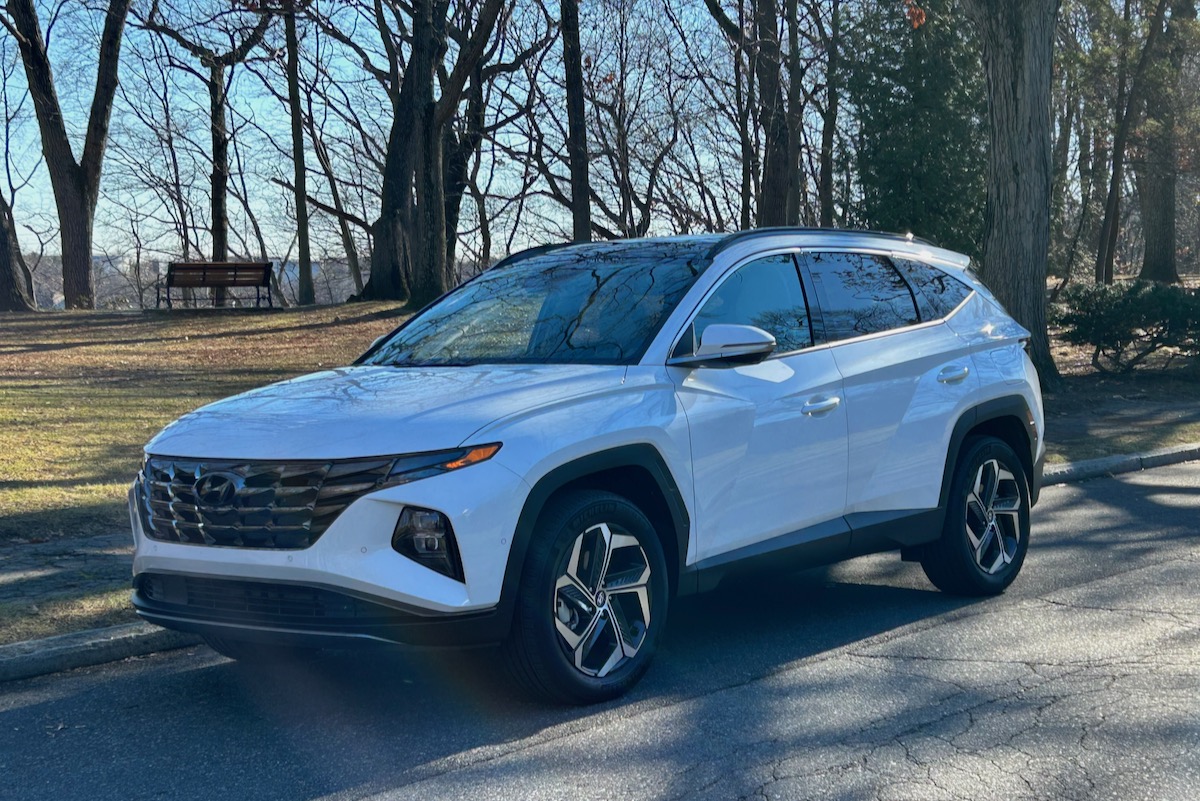
The current-generation Hyundai Tucson was introduced for the 2022 model year, marking the fourth generation of this compact SUV. It’s largely a carryover from 2022 to 2023 to today. The Tucson has fantastic styling, with taut angles and very unique choices, such as the headlights that blend into the grille. Any one of these details on their own would be an aggressive choice, but it’s all woven together into a handsome, contemporary package. Even in white—our test vehicle color—this crossover looks sharp, which is impressive because white is typically not an ideal color for vehicle photography.
The contrasting angles make for an athletic presence and that headlight integration shares a design trend that Hyundai has been executing very well right now. Some automakers—typically luxury brands—make all of their vehicles look the same and simply scale up and down in size. Hyundai vehicles all have their own unique style. Trim levels for the Tucson include SE, SEL, XRT, and Limited. The SE comes with 17-inch alloy wheels and roof rails. Moving up to the SEL’s available convenience package adds 19-inch alloy wheels. The XRT trim has unique black 19-inch alloy wheels, side steps, dark exterior trim, and functional roof racks. The Limited features a dark chrome grille and upgraded headlights.
That terrific design execution continues in the modern, refined cabin. You can tell there is a lot of technology here, but it’s packaged in a way that makes it feel approachable. There are some details we don’t like, such as our test model's missing volume dial. Instead, it had touch-capacitive buttons and a toggle on the steering wheel, but a volume dial always make a vehicle easier to live with. The location of some controls closer to the shifter and cupholders was a nice touch. You’ll have to learn which buttons are down in the center and away from the touchscreen and climate controls, though.
Standard features on the base SE trim include two USB ports, remote keyless entry, a manually adjustable driver’s seat, HD radio, power windows, and an 8-inch touchscreen infotainment system with wireless Apple CarPlay and wireless Android Auto.
Moving up to the Tucson SEL adds push-button start, a power-adjustable driver’s seat, dual-zone automatic climate control, wireless device charging, and two more USB ports. An SEL Convenience package is available. It adds synthetic leather upholstery, a leather-wrapped steering wheel, a fully digital instrument panel, and a larger touchscreen with navigation. In addition to its unique exterior styling touches, the XRT trim adds features from the SEL Convenience Package—like the synthetic leather upholstery—as standard equipment.
We drove the Limited trim, which came extremely well-equipped. It included ventilated front seats, heated rear seats, a heated steering wheel, genuine leather upholstery, a panoramic sunroof, an upgraded Bose premium stereo system, and memory settings for the driver’s seat.

Performance
The 2024 Hyundai Tucson comes equipped with a 2.5-liter four-cylinder engine. It develops 187 horsepower and 178 pound-feet of torque. Power is routed through an eight-speed automatic transmission to the front wheels or available all-wheel drive (AWD).
This is the only non-hybrid powertrain offered in the Tucson, which is disappointing. It’s fine for around-town driving, but getting up to highway speeds and making a passing maneuver requires putting the throttle nearly to the floor. It still doesn’t feel like it’s getting you there much faster, either, and it makes a great deal of engine noise while it’s working to do so. If you prefer more motivation, check out the 226-hp Tucson Hybrid or the 261-hp Tucson Plug-In Hybrid.
The downside of those more powerful and efficient versions is that they come standard with a proprietary button-style shifter design, which comes on only the Limited trim for the conventionally powered Tucson (all other trims get a more traditional shifter). This will take a moment to learn, and even longer to sink in and become second nature, which could be an issue if you lend your vehicle to a family member. Hyundai‘s shifter design isn’t the best but it’s intuitive enough and seamlessly integrated into the center console, which has its benefits in packaging the area for other features.
Where the Tucson shines (from a driving dynamics perspective) is its handling and ride quality. It strikes a deft combination of ride comfort and cornering prowess. The Tucson soaks up bumps in the road, which will make it great for long trips or the daily commute. Take it quickly through a turn, and you’ll enjoy the well-weighted and precise steering. It’s not as athletic as a Mazda CX-5 or CX-50, but those vehicles are the athletic exceptions. Instead, like with many elements of the Tucson, the driving experience is well-rounded.

Form & function
The Tucson provides up to 74.8 cubic feet of cargo space with the rear seats folded. With the rear seats in use, it provides up to 38.7 cubic feet of cargo space. Those are terrific numbers among the compact SUV segment, and the Tucson is only outclassed by the Honda CR-V (76.5 cubic feet) in this regard. The Tucson SE comes with a manual liftgate. All other trims (SEL and above) come with a hands-free power liftgate.
You may have seen one of these smart liftgates where the owner needs to wave a foot under the rear bumper to operate it. The whole point of the hands-free liftgate is to make it more convenient when your arms are full due to groceries or holding your child, so balancing on one foot in some form of “Parking-Lot Waltz,” doesn’t seem like the most practical method of operation. Instead, you just need to approach the rear of the Tucson with the key fob on your person. Once the vehicle is locked and 15 seconds have passed, you just have to stand within three feet of the rear bumper for more than three seconds. It’s a very intuitive system that makes an eponymous big box out of a big box store much easier to load.
The Tucson has room for up to five passengers, and both rows provide adult-friendly seating. There’s plenty of headroom and legroom, even in the rear area, but the front seats are that bit more spacious. This vehicle can handle four adults for a longer trip, which is more than some other small SUVs can claim.
There are plenty of deep cup holders throughout the cabin. The center tray between the shifter area and the center stack has room for items, and it’s also home to the standard wireless device charging pad.

Technology
The standard infotainment system includes an 8-inch touchscreen with wireless Apple CarPlay and wireless Android Auto. It’s one of the best infotainment systems on the market, and operation is impressively straightforward. There are home buttons on the side of the screen for functions like Radio, Media, and Setup. And while it has thumb rollers instead of conventional volume and tuning dials, it’s helpful enough and doesn’t pull your eyes away from the road when operating.
The SEL Convenience Package, XRT, and Limited trims all come with a fully digital instrument panel, as well as a larger 10.25-inch touchscreen. It still has an intuitive layout, but there are some downsides. For one, you lose the wireless connectivity for Android Auto and Apple CarPlay. Not a deal-breaker, but it’s interesting that a feature one might consider an upgrade is found on only the entry-level infotainment system. Next, instead of the thumb rollers, you get an annoying haptic one-press-up/one-press-down volume toggle. On the plus side, the touchscreen and haptic buttons (think “microwave button pad”) all work while wearing gloves. We found that in extreme cold, it took a while for the heating system to kick in, so the gloves were necessary some mornings. Not having to remove them to use the interface was helpful.
We also love how Hyundai has evolved its remote start system. For years, you press the key fob to start the vehicle remotely, and then when you hop in, you press the start button. In the Tucson, once its remotely started and you get into the car, the vehicle detects the key. Just put it in Drive and go.

Safety
A number of driver assistance features come standard on the Hyundai Tucson, including automatic emergency braking, forward collision warning, pedestrian and cyclist detection, adaptive cruise control, lane-departure warning, lane-keeping assist, automatic high beams, driver attention monitoring, blind-spot monitoring, and rear cross-traffic alert.
Stepping up to the range-topping Limited trim adds front and rear parking sensors, a 360-degree parking camera system, and Hyundai’s Smart Park remote-parking feature. With Smart Park, you can back up or pull forward the vehicle into a tight parking spot while standing outside the vehicle. It has a very straightforward operation via two buttons on the key fob. The Limited also adds a helpful blind-spot camera system. When you activate the turn signal in a particular direction, this feature presents a real-time video feed of the blind spot that corresponds to that direction. The blind-spot monitor will warn you that something is there, but the blind-spot camera system adds another layer of context to survey the lane yourself before moving over.
The Insurance Institute for Highway Safety (IIHS) gives the 2024 Tucson a best overall score of “Good” in most phases of crash testing. The standard headlights get a less superlative score of “Acceptable.” The crash-prevention technology earns a best possible score of “Superior.” The 2024 Tucson is largely a carryover from the 2023 model, which is an IIHS Top Safety Pick+. The National Highway Traffic Safety Administration (NHTSA) has not fully evaluated the 2024 Tucson, but so far it earned five stars in a frontal crash test and four stars in a rollover test.

Cost-effectiveness
The most fuel-efficient version of the 2024 Hyundai Tucson is the front-wheel-drive (FWD) model. It returns EPA fuel-economy estimates of 25 mpg city, 32 mpg highway, and 28 mpg combined. The AWD model returns 23 mpg city, 29 mpg highway, and 25 mpg combined. Within the compact SUV segment, the Nissan Rogue, Toyota RAV4, and CR-V are more efficient.
Base MSRP for the 2024 Hyundai Tucson is $27,250 for the SE trim. The SEL starts at $29,400 and the SEL Convenience Package adds $2,500 to that price. The quasi-rugged Tucson XRT trim starts at $34,075 and the range-topping Limited trim that we drove starts at $36,510. AWD adds $1,500 to the price. The Tucson is backed by Hyundai’s impressive 10-year/100,000-mile powertrain warranty.
So it’s not the fastest small SUV or the most efficient, but oftentimes things like acceleration and MPG come at the expense of other attributes. When we say that the 2024 Hyundai Tucson is a well-rounded SUV, we mean that one attribute does not excel to the detriment of other attributes. The handling blends comfort and precision, the cabin provides plenty of space for people and their gear, and the technology is helpful without being intrusive. Combine all of this with a base price that undercuts the Toyota RAV4, Honda CR-V, and Mazda CX-5, and you have the makings of a small SUV that’s a tremendous value for consumers.

What owners say
"Overall, owners of the 2024 Hyundai Tucson appreciate its great features, sleek design, and value for money. Many enjoy the spacious interior and modern technology. However, some drivers noted minor complaints about missing compartments and poor visor lighting."
Love the features of the car. Lots of new tech and a comparable upgrade from my previous vehicle.
March 22, 2026This car seems to be perfect for me. All wheel drive, all the features i want. Roomy enough for my tall hubby and my grand kids. Love it!
January 18, 2026I love the features of this car. It has everything I want and more. I love the sleek design. It’s a great price for its value. I’ve had no issues so far. The only complaint I have is the visor lighting is very poor, but that’s a very minor complaint.
March 31, 2025What owners say
Love the features of the car. Lots of new tech and a comparable upgrade from my previous vehicle.
March 22, 2026This car seems to be perfect for me. All wheel drive, all the features i want. Roomy enough for my tall hubby and my grand kids. Love it!
January 18, 2026I love the features of this car. It has everything I want and more. I love the sleek design. It’s a great price for its value. I’ve had no issues so far. The only complaint I have is the visor lighting is very poor, but that’s a very minor complaint.
March 31, 2025Wish it had programmed seat memory, and seat would slide back when exiting and reset when entering like my rogue did. Am still learning all the features, but enjoy it so far
October 4, 2023The car has great features, I wish it had more compartments. It needs somewhere to put your sunglasses. I also drove the Santa fe. It was really nice but also so much more now with the upgraded body.
October 26, 2024Trims & specs
Base MSRP $35,825 | Seating 5 |
Engine 2.5L 187 hp I4 | Cargo Capacity 38.7 cu ft |
Combined MPG 26 | Drivetrain AWD |
Base MSRP $31,150 | Seating 5 |
Engine 2.5L 187 hp I4 | Cargo Capacity 38.7 cu ft |
Combined MPG 26 | Drivetrain AWD |
Base MSRP $34,235 | Seating 5 |
Engine 2.5L 187 hp I4 | Cargo Capacity 38.7 cu ft |
Combined MPG 28 | Drivetrain FWD |
Base MSRP $29,650 | Seating 5 |
Engine 2.5L 187 hp I4 | Cargo Capacity 38.7 cu ft |
Combined MPG 28 | Drivetrain FWD |
Base MSRP N/A | Seating 5 |
Engine N/A | Cargo Capacity 38.7 cu ft |
Combined MPG N/A | Drivetrain N/A |
Base MSRP $38,260 | Seating 5 |
Engine 2.5L 187 hp I4 | Cargo Capacity 38.7 cu ft |
Combined MPG 26 | Drivetrain AWD |
Base MSRP N/A | Seating N/A |
Engine N/A | Cargo Capacity N/A |
Combined MPG N/A | Drivetrain N/A |
Base MSRP $36,760 | Seating 5 |
Engine 2.5L 187 hp I4 | Cargo Capacity 38.7 cu ft |
Combined MPG 28 | Drivetrain FWD |
Base MSRP $31,150 | Seating 5 |
Engine 2.5L 187 hp I4 | Cargo Capacity 38.7 cu ft |
Combined MPG 26 | Drivetrain AWD |
Base MSRP $29,650 | Seating 5 |
Engine 2.5L 187 hp I4 | Cargo Capacity 38.7 cu ft |
Combined MPG 28 | Drivetrain FWD |
Base MSRP $29,000 | Seating 5 |
Engine 2.5L 187 hp I4 | Cargo Capacity 38.7 cu ft |
Combined MPG 26 | Drivetrain AWD |
Base MSRP $27,500 | Seating 5 |
Engine 2.5L 187 hp I4 | Cargo Capacity 38.7 cu ft |
Combined MPG 28 | Drivetrain FWD |


Pricing trends
MSRP range
$27,500 - $38,260
Current avg. market price
$23,397
Trending down by 0.6% this month
May 2026 - November 2026