Hyundai Tucson vs Kia EV9
Overview | |
MSRP$27,500 | MSRP$54,900 |
Listings201 | Listings100 |
Ratings & Reviews | |
User Reviews | User Reviews |
Expert reviews8.5 out of 10 | Expert reviews8.5 out of 10 |
Pros
Cons
| Pros
Cons
|
Reviews SummaryWith the growth and evolution of the compact SUV market, shoppers have seemingly endless options. And the growth of this segment has allowed for different models to grow in their own unique ways. The Mazda CX-5 is upscale and athletic, while the Ford Bronco Sport is a surprisingly capable off-roader. So what if you aren’t seeking a well-honed niche vehicle? What if you are looking for a small SUV that’s and overall great vehicle? The 2024 Hyundai Tucson answers that question as a well-rounded compact SUV that doesn’t excel in any one particular area, but instead covers a lot of what modern consumers demand out of their vehicle. This format is one that has been embraced by perennial segment standouts like the Toyota RAV4 and Honda CR-V. Verdict: The Tucson is a well-rounded small SUV and a good value. It does not shine in any particular area, instead blending good performance with a comfortable and spacious cabin, impressive tech and safety features, and an attractive price tag. | |
Reviews SummaryWith the Kia EV9, the Korean automaker innovates in more ways than one. It’s not only a new vehicle, or even only a new electric vehicle (EV). It also introduces a new business model that allows owners to continue to customize their vehicle long after they’ve left the dealership. And yet, while it breaks new ground, the EV9 manages to provide a refreshingly familiar driving experience. Verdict: It looks like Kia’s got a winner on its hands. Well-appointed, comfortably sized, and offered at a price point fit to embarrass its luxury-brand rivals, the EV9 is a compelling package. Add to that its intuitive driving feel and its potential for later-term customization, and this just may be the ambassador vehicle it takes to bring the EV-wary over to the green side. | |
Popular Features & Specs | |
Engine2.5L 187 hp I4 | Engine215 hp Electric |
Drive TrainFWD | Drive TrainRWD |
Seating Capacity5 | Seating Capacity7 |
Horsepower187 hp @ 6100 rpm | Horsepower |
EV Battery Capacity | EV Battery Capacity76.1 kWh |
MPG City25 | MPG City99 |
MPG Highway32 | MPG Highway77 |
Battery Charge Time (120V) | Battery Charge Time (120V)64 hours |
Engine | |
Engine Name2.5L 187 hp I4 | Engine Name215 hp Electric |
Torque178 lb-ft @ 4000 rpm | Torque |
Horsepower187 hp @ 6100 rpm | Horsepower |
Battery Charge Time (120V) | Battery Charge Time (120V)64 hours |
DrivetrainFWD | DrivetrainRWD |
Fuel Economy | |
EV Battery Capacity | EV Battery Capacity76.1 kWh |
MPG City25 | MPG City99 |
MPG Highway32 | MPG Highway77 |
Interior | |
Seating Capacity5 | Seating Capacity7 |
Key Features | |
Navigation System | Navigation SystemStandard |
Safety | |
Front Crash Overall5 | Front Crash Overall4 |
Side Crash Overall5 | Side Crash Overall5 |
Dimensions & Capacity | |
Cargo Space38.7 cu ft | Cargo Space20.2 cu ft |
Curb Weight3346 lbs | Curb Weight5093 lbs |
Height65.6 in | Height68.9 in |
Length182.3 in | Length197.2 in |
Width73.4 in | Width77.9 in |
Wheelbase108.5 in | Wheelbase122.0 in |
Maximum Payload1283 lbs | Maximum Payload1322 lbs |
Number of doors4 | Number of doors4 |
Maximum Towing Capacity2000 lbs | Maximum Towing Capacity2000 lbs |
Standard Towing Capacity2000 lbs | Standard Towing Capacity |
Overview | ||
MSRP | $27,500 | $54,900 |
Listings | ||
Ratings & Reviews | ||
User reviews | ||
Expert reviews | 8.5 out of 10Read full review | 8.5 out of 10Read full review |
Pros & cons | Pros
Cons
| Pros
Cons
|
Summary | With the growth and evolution of the compact SUV market, shoppers have seemingly endless options. And the growth of this segment has allowed for different models to grow in their own unique ways. The Mazda CX-5 is upscale and athletic, while the Ford Bronco Sport is a surprisingly capable off-roader. So what if you aren’t seeking a well-honed niche vehicle? What if you are looking for a small SUV that’s and overall great vehicle? The 2024 Hyundai Tucson answers that question as a well-rounded compact SUV that doesn’t excel in any one particular area, but instead covers a lot of what modern consumers demand out of their vehicle. This format is one that has been embraced by perennial segment standouts like the Toyota RAV4 and Honda CR-V. Verdict: The Tucson is a well-rounded small SUV and a good value. It does not shine in any particular area, instead blending good performance with a comfortable and spacious cabin, impressive tech and safety features, and an attractive price tag. | With the Kia EV9, the Korean automaker innovates in more ways than one. It’s not only a new vehicle, or even only a new electric vehicle (EV). It also introduces a new business model that allows owners to continue to customize their vehicle long after they’ve left the dealership. And yet, while it breaks new ground, the EV9 manages to provide a refreshingly familiar driving experience. Verdict: It looks like Kia’s got a winner on its hands. Well-appointed, comfortably sized, and offered at a price point fit to embarrass its luxury-brand rivals, the EV9 is a compelling package. Add to that its intuitive driving feel and its potential for later-term customization, and this just may be the ambassador vehicle it takes to bring the EV-wary over to the green side. |
Video | ||
Popular Features & Specs | ||
Engine | 2.5L 187 hp I4 | 215 hp Electric |
Drive Train | FWD | RWD |
Seating Capacity | 5 | 7 |
Horsepower | 187 hp @ 6100 rpm | |
EV Battery Capacity | 76.1 kWh | |
MPG City | 25 | 99 |
MPG Highway | 32 | 77 |
Battery Charge Time (120V) | 64 hours | |
Engine | ||
Engine Name | 2.5L 187 hp I4 | 215 hp Electric |
Torque | 178 lb-ft @ 4000 rpm | |
Horsepower | 187 hp @ 6100 rpm | |
Battery Charge Time (120V) | 64 hours | |
Drivetrain | FWD | RWD |
Fuel Economy | ||
EV Battery Capacity | 76.1 kWh | |
MPG City | 25 | 99 |
MPG Highway | 32 | 77 |
Interior | ||
Seating Capacity | 5 | 7 |
Key Features | ||
Navigation System | Standard | |
Safety | ||
Front Crash Overall | 5 | 4 |
Side Crash Overall | 5 | 5 |
Dimensions & Capacity | ||
Cargo Space | 38.7 cu ft | 20.2 cu ft |
Curb Weight | 3346 lbs | 5093 lbs |
Height | 65.6 in | 68.9 in |
Length | 182.3 in | 197.2 in |
Width | 73.4 in | 77.9 in |
Wheelbase | 108.5 in | 122.0 in |
Maximum Payload | 1283 lbs | 1322 lbs |
Number of doors | 4 | 4 |
Maximum Towing Capacity | 2000 lbs | 2000 lbs |
Standard Towing Capacity | 2000 lbs | |
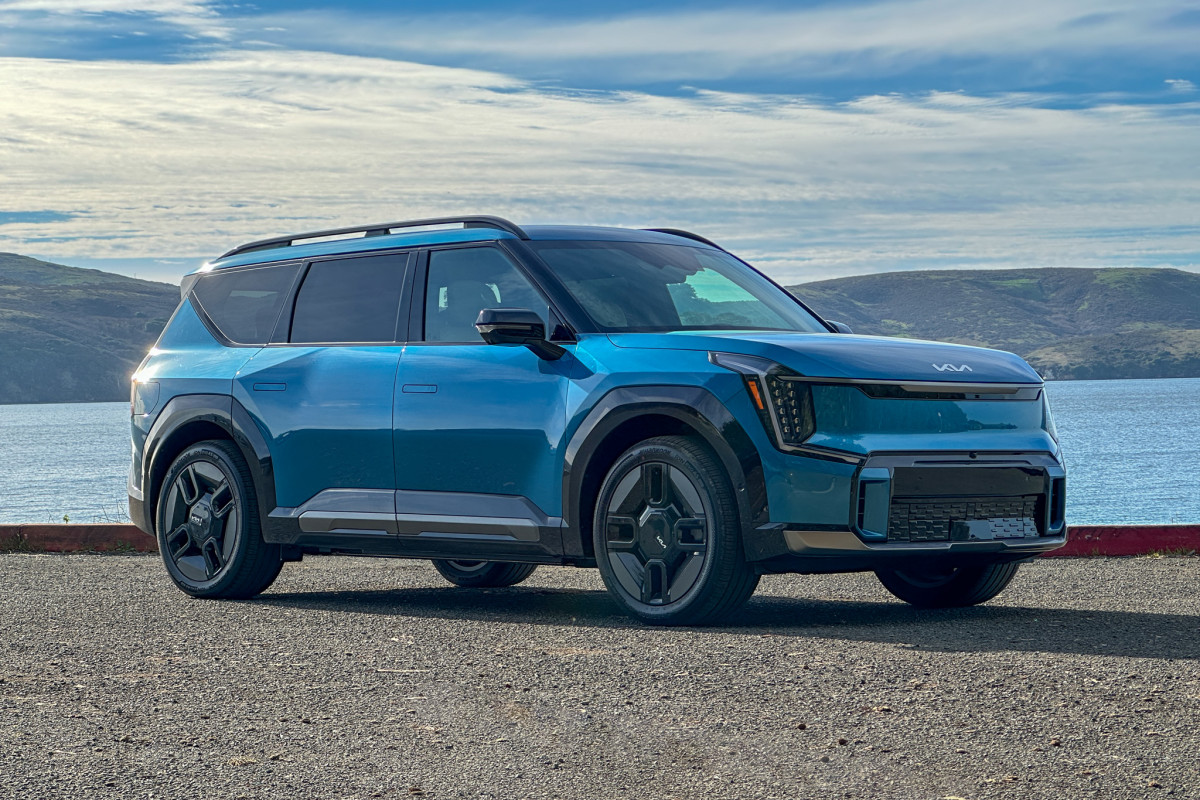
The 2024 Kia EV9 marked a bold departure for Kia's electric vehicle lineup. Sporting a distinctly Kia exterior with a more angular and futuristic design, the EV9’s aesthetics captured attention. The octagonal wheel arches and a sharply angled rear window emphasized its modern look. Its most distinguishing feature was the innovative lighting signature–the “Star Map” daytime running lights and the unique LED headlight clusters composed of dashes or dots, varying by trim. The upper trims, Land and GT-Line, included a Digital Pattern Lighting Grille that added additional points of light when the vehicle was turned on. The wheels also followed the blocky theme, with 19-inch wheels that conveyed a sense of motion and aerodynamics. Inside, the EV9 boasted an airy and fresh interior, enhanced by light gray tones and dual sunroofs. Standard eight-way power-adjustable front seats with two-way lumbar support, and further adjustments in higher trims, made the SynTex seating surfaces comfortable and durable.
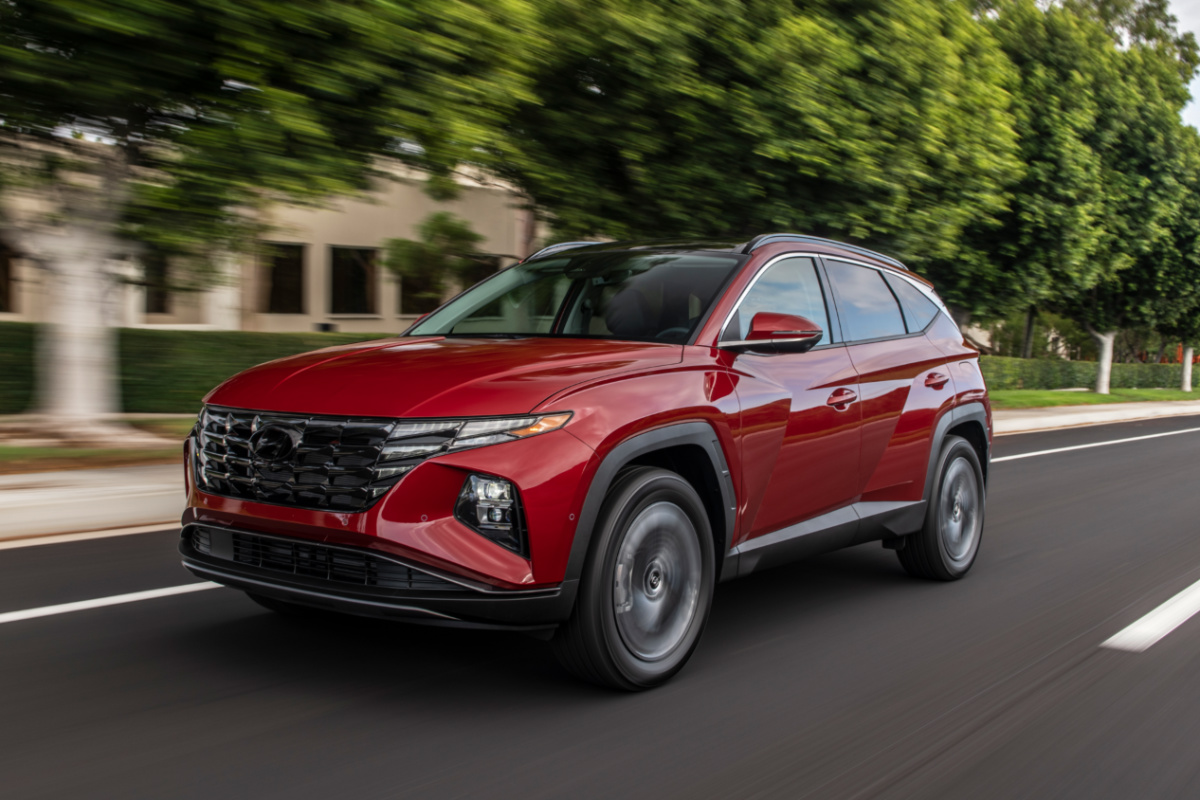
In contrast, the 2024 Hyundai Tucson continued the design language introduced in its fourth generation. The Tucson's exterior featured taut angles and distinctive headlight integration into the grille, creating a contemporary and aggressive look. Even in the test model’s white color, the Tucson exuded sharpness. The contrast between angles resulted in an athletic presence, a testament to Hyundai’s unique style. The Tucson's trims ranged from SE with 17-inch alloy wheels to the Limited trim with dark chrome grilles and upgraded headlights. Inside, the Tucson did not disappoint with its modern and refined cabin. Tech was prominently featured but remained approachable, though the touch-capacitive buttons for volume control on some trims were less favored. The standard features included a manually adjustable driver’s seat and an 8-inch touchscreen infotainment system, with higher trims adding digital instrument panels and larger touchscreens.


The 2024 Kia EV9 offered various powertrain options, starting with the Light trim's single motor rear-wheel-drive that produced 215 hp and 258 lb-ft of torque, giving it an EPA-estimated range of 230 miles. The Light Long Range model, with a 99.8-kWh battery, delivered a slightly reduced 201 hp but extended the range to 304 miles. Higher trims featured dual-motor all-wheel-drive configurations, with the Wind and Land trims delivering 379 hp and 443 lb-ft of torque for 280 miles of range. The sportier GT-Line increased torque to 516 lb-ft but reduced the range to 270 miles. Driving the GT-Line through Northern California highlighted its smooth and refined power delivery, demonstrating solid handling with minimal body roll. Regenerative braking was adjustable and could mimic the feel of a gas-powered vehicle, thanks to paddle-mounted controls for regeneration levels.
The 2024 Hyundai Tucson came with a 2.5-liter four-cylinder engine producing 187 hp and 178 lb-ft of torque, paired with an eight-speed automatic transmission. It provided adequate power for city driving but struggled with highway acceleration and passing, revealing its limitations through increased engine noise and effort. The Tucson shone in its handling and ride quality, balancing comfort with cornering prowess. While not as athletic as rivals like the Mazda CX-5, it offered well-weighted and precise steering. The Hybrids offered better performance with 226 hp for the Tucson Hybrid and 261 hp for the Plug-In Hybrid, although they required adapting to a different shifting mechanism. The non-hybrid models maintained conventional shifters, which might be more user-friendly for some.
The 2024 Kia EV9’s key differentiator was its third-row seating, providing ample headroom of 39.5 inches, surpassing rivals like the BMW X7 and the Rivian R1S. Third-row legroom was also commendable, ranging from 30.8 to 32.0 inches depending on the middle row’s arrangement. Cargo capacity was notable with 20.2 cubic feet behind the third row, expandable to 43.5 cubic feet with it folded, and a total of 81.7 cubic feet with only the front seats in use. The floating center console offered adequate storage up front, supplemented by additional compartments in the back for higher trims.
The 2024 Hyundai Tucson provided a maximum of 74.8 cubic feet of cargo space with the rear seats folded and 38.7 cubic feet with them in use. These impressive figures positioned the Tucson well within the compact SUV segment, second only to the Honda CR-V. It featured a hands-free power liftgate on SEL trims and above, operated simply by standing near the rear bumper with the key fob. Seating accommodated five passengers comfortably, with generous headroom and legroom for both rows. The vehicle was equipped with deep cup holders throughout and a center tray for additional storage, enhancing practicality for daily use.
The Kia EV9 featured an advanced curved display integrating three screens: a 12.3-inch driver information display, a 5-inch Climate Display, and a 12.3-inch infotainment touchscreen. Wireless Apple CarPlay and Android Auto, as well as a wireless charging pad, were standard. Audio systems varied, with Light and Wind trims having an eight-speaker setup, while Land and GT-Line trims boasted a 14-speaker Meridian Premium Audio system. Over-the-air (OTA) updates allowed for post-purchase upgrades via the Kia Connect store, enhancing the vehicle’s capabilities over time.
The Hyundai Tucson’s standard 8-inch touchscreen with wireless Apple CarPlay and Android Auto was user-friendly, featuring home buttons for key functions. Upgrades included a fully digital instrument panel and a 10.25-inch touchscreen on higher trims, though these lost wireless connectivity for Apple CarPlay and Android Auto and replaced thumb rollers with a less preferred haptic system. The touchscreen and haptic buttons worked well with gloves, a thoughtful feature for cold climates. Hyundai’s evolved remote start system allowed drivers to enter and drive without pressing the start button, enhancing convenience.
The Kia EV9 came with a robust suite of standard advanced driver-assistance systems (ADAS), including adaptive cruise control with machine learning and stop-and-go capabilities, blind-spot collision avoidance, and forward collision avoidance. Higher trims received additional features like a Blind-spot View Monitor and parking collision avoidance assist. While it hadn’t been rated by IIHS or NHTSA at the time of writing, it received the highest rating from Euro NCAP.
The Hyundai Tucson included a comprehensive set of standard driver assistance features, such as automatic emergency braking, forward collision warning, pedestrian and cyclist detection, and lane-keeping assist. The Limited trim added front and rear parking sensors, a 360-degree camera system, and Smart Park for remote-parking capabilities. The Tucson earned a "Good" rating in most phases of IIHS crash testing and "Superior" for its crash-prevention technology. It had also received a five-star frontal crash rating and a four-star rollover rating from NHTSA.
CarGurus highlights
According to CarGurus experts, the overall rating for the 2024 Kia EV9 is 8.5 out of 10, while the 2024 Hyundai Tucson scores 8.5 out of 10. Ultimately, choosing between these two vehicles depends on your specific needs. For those looking for an electric vehicle with innovative features and spacious seating, the Kia EV9 stands out. However, if a traditional, well-rounded compact SUV with excellent safety features and user-friendly technology is what you seek, the Hyundai Tucson is a strong contender. Given their equal ratings, it’s best to test drive both and see which one suits your lifestyle better.
Choose the 2024 Hyundai Tucson if:
- You prefer the convenience of a hands-free power liftgate and straightforward storage solutions.
- Comprehensive standard safety features and practical daily usability are your priorities.
- An intuitive infotainment system with a user-friendly layout is important to you.


Choose the 2024 Kia EV9 if:
- You need an electric vehicle with third-row seating and ample headroom.
- Advanced over-the-air updates and post-purchase upgrades are appealing to you.
- You desire a vehicle with adjustable regenerative braking and a futuristic design.


CarGurus highlights
According to CarGurus experts, the overall rating for the 2024 Kia EV9 is 8.5 out of 10, while the 2024 Hyundai Tucson scores 8.5 out of 10. Ultimately, choosing between these two vehicles depends on your specific needs. For those looking for an electric vehicle with innovative features and spacious seating, the Kia EV9 stands out. However, if a traditional, well-rounded compact SUV with excellent safety features and user-friendly technology is what you seek, the Hyundai Tucson is a strong contender. Given their equal ratings, it’s best to test drive both and see which one suits your lifestyle better.
Choose the 2024 Hyundai Tucson if:
Shop Now- You prefer the convenience of a hands-free power liftgate and straightforward storage solutions.
- Comprehensive standard safety features and practical daily usability are your priorities.
- An intuitive infotainment system with a user-friendly layout is important to you.
Choose the 2024 Kia EV9 if:
Shop Now- You need an electric vehicle with third-row seating and ample headroom.
- Advanced over-the-air updates and post-purchase upgrades are appealing to you.
- You desire a vehicle with adjustable regenerative braking and a futuristic design.

By: CarGurus + AI
At CarGurus, our team of experienced automotive writers remain at the heart of our content operation, conducting hands-on car tests and writing insightful guides that are backed by years of industry experience. To complement this, we are harnessing AI to make our content offering more diverse and more helpful to shoppers than ever. To achieve this, our AI systems are based exclusively on CarGurus content, ratings and data, so that what we produce is both unique to CarGurus, and uniquely helpful to car shoppers.

