2024 Toyota 4Runner vs 2024 Kia EV9
Overview | |
MSRP$54,900 | MSRP$40,705 |
Listings855 | Listings1025 |
Ratings & Reviews | |
User Reviews | User Reviews |
Expert reviews8.5 out of 10 | Expert reviews4.5 out of 10 |
Pros
Cons
| Pros
Cons
|
2024 Kia EV9 Reviews SummaryWith the Kia EV9, the Korean automaker innovates in more ways than one. It’s not only a new vehicle, or even only a new electric vehicle (EV). It also introduces a new business model that allows owners to continue to customize their vehicle long after they’ve left the dealership. And yet, while it breaks new ground, the EV9 manages to provide a refreshingly familiar driving experience. Verdict: It looks like Kia’s got a winner on its hands. Well-appointed, comfortably sized, and offered at a price point fit to embarrass its luxury-brand rivals, the EV9 is a compelling package. Add to that its intuitive driving feel and its potential for later-term customization, and this just may be the ambassador vehicle it takes to bring the EV-wary over to the green side. | |
2024 Toyota 4Runner Reviews SummaryVerdict: The Toyota 4Runner remains an accomplished off-road-capable vehicle with a strong reputation for reliability and durability. A new 4Runner is expected, and the current model's aging platform is in desperate need of a full redesign. It trails newer rivals when it comes to technology, safety features, fuel efficiency, and power. The 2024 Toyota 4Runner would be easier to recommend it if the price were significantly reduced. | |
Popular Features & Specs | |
Engine215 hp Electric | Engine4.0L 270 hp V6 |
DrivetrainRWD | Drivetrain4X2 |
Seating Capacity7 | Seating Capacity7 |
Horsepower | Horsepower270 hp @ 5600 rpm |
EV Battery Capacity76.1 kWh | EV Battery Capacity |
Fuel Economy (City)99 MPG/MPGe | Fuel Economy (City)16 MPG/MPGe |
Fuel Economy (Highway)77 MPG/MPGe | Fuel Economy (Highway)19 MPG/MPGe |
Battery Charge Time (120V)64 hours | Battery Charge Time (120V) |
Engine | |
Engine Name215 hp Electric | Engine Name4.0L 270 hp V6 |
Torque | Torque278 lb-ft @ 4400 rpm |
Horsepower | Horsepower270 hp @ 5600 rpm |
Battery Charge Time (120V)64 hours | Battery Charge Time (120V) |
DrivetrainRWD | Drivetrain4X2 |
Fuel Economy | |
EV Battery Capacity76.1 kWh | EV Battery Capacity |
Fuel Economy (City)99 MPG/MPGe | Fuel Economy (City)16 MPG/MPGe |
Fuel Economy (Highway)77 MPG/MPGe | Fuel Economy (Highway)19 MPG/MPGe |
Interior | |
Seating Capacity7 | Seating Capacity7 |
Key Features | |
Navigation SystemStandard | Navigation System |
Safety | |
Front Crash Overall4 | Front Crash Overall4 |
Side Crash Overall5 | Side Crash Overall5 |
Dimensions & Capacity | |
Cargo Space20.2 cu ft | Cargo Space47.2 cu ft |
Curb Weight5093 lbs | Curb Weight4400 lbs |
Height68.9 in | Height71.5 in |
Length197.2 in | Length190.2 in |
Width77.9 in | Width75.8 in |
Wheelbase122.0 in | Wheelbase109.8 in |
Maximum Payload1322 lbs | Maximum Payload1700 lbs |
Number of doors4 | Number of doors4 |
Maximum Towing Capacity2000 lbs | Maximum Towing Capacity5000 lbs |
Standard Towing Capacity | Standard Towing Capacity5000 lbs |
Overview | ||
MSRP | $54,900 | $40,705 |
Listings | ||
Ratings & Reviews | ||
User reviews | ||
Expert reviews | 8.5 out of 10Read full review | 4.5 out of 10Read full review |
Pros & cons | Pros
Cons
| Pros
Cons
|
Summary | With the Kia EV9, the Korean automaker innovates in more ways than one. It’s not only a new vehicle, or even only a new electric vehicle (EV). It also introduces a new business model that allows owners to continue to customize their vehicle long after they’ve left the dealership. And yet, while it breaks new ground, the EV9 manages to provide a refreshingly familiar driving experience. Verdict: It looks like Kia’s got a winner on its hands. Well-appointed, comfortably sized, and offered at a price point fit to embarrass its luxury-brand rivals, the EV9 is a compelling package. Add to that its intuitive driving feel and its potential for later-term customization, and this just may be the ambassador vehicle it takes to bring the EV-wary over to the green side. | Verdict: The Toyota 4Runner remains an accomplished off-road-capable vehicle with a strong reputation for reliability and durability. A new 4Runner is expected, and the current model's aging platform is in desperate need of a full redesign. It trails newer rivals when it comes to technology, safety features, fuel efficiency, and power. The 2024 Toyota 4Runner would be easier to recommend it if the price were significantly reduced. |
Video | ||
Popular Features & Specs | ||
Engine | 215 hp Electric | 4.0L 270 hp V6 |
Drivetrain | RWD | 4X2 |
Seating Capacity | 7 | 7 |
Horsepower | 270 hp @ 5600 rpm | |
EV Battery Capacity | 76.1 kWh | |
Fuel Economy (City) | 99 MPG/MPGe | 16 MPG/MPGe |
Fuel Economy (Highway) | 77 MPG/MPGe | 19 MPG/MPGe |
Battery Charge Time (120V) | 64 hours | |
Engine | ||
Engine Name | 215 hp Electric | 4.0L 270 hp V6 |
Torque | 278 lb-ft @ 4400 rpm | |
Horsepower | 270 hp @ 5600 rpm | |
Battery Charge Time (120V) | 64 hours | |
Drivetrain | RWD | 4X2 |
Fuel Economy | ||
EV Battery Capacity | 76.1 kWh | |
Fuel Economy (City) | 99 MPG/MPGe | 16 MPG/MPGe |
Fuel Economy (Highway) | 77 MPG/MPGe | 19 MPG/MPGe |
Interior | ||
Seating Capacity | 7 | 7 |
Key Features | ||
Navigation System | Standard | |
Safety | ||
Front Crash Overall | 4 | 4 |
Side Crash Overall | 5 | 5 |
Dimensions & Capacity | ||
Cargo Space | 20.2 cu ft | 47.2 cu ft |
Curb Weight | 5093 lbs | 4400 lbs |
Height | 68.9 in | 71.5 in |
Length | 197.2 in | 190.2 in |
Width | 77.9 in | 75.8 in |
Wheelbase | 122.0 in | 109.8 in |
Maximum Payload | 1322 lbs | 1700 lbs |
Number of doors | 4 | 4 |
Maximum Towing Capacity | 2000 lbs | 5000 lbs |
Standard Towing Capacity | 5000 lbs | |
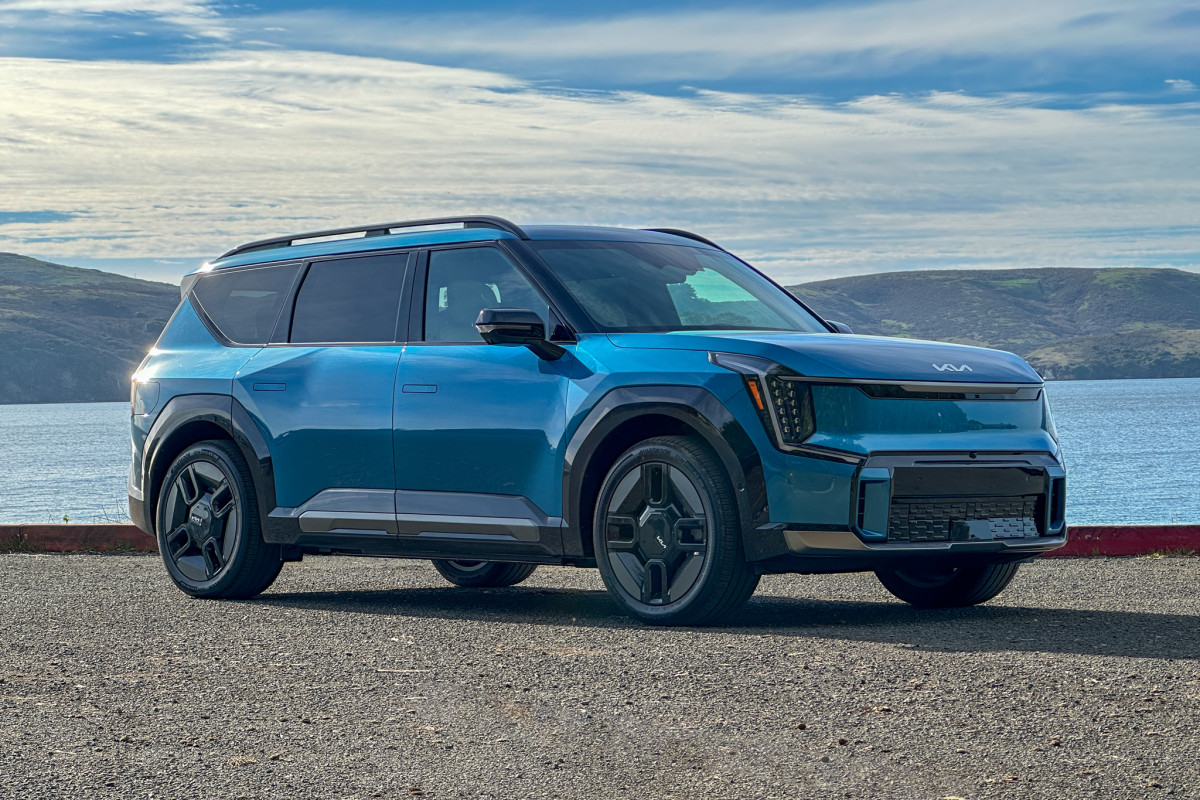
From a first glance, the 2024 Kia EV9 exemplified a new era for Kia's electric vehicles with a robust, innovative design. It reflected a distinct aesthetic that leaned towards a technological and boxy style, reminiscent of digital clock numbers. The body lines traced the octagonal wheel arches, while the rear window angled sharply upwards, almost meeting the roof spoiler. The EV9 showcased multiple lighting signatures highlighted by the standard “Star Map” daytime running lights and the distinctive "Digital Tiger Face." LED headlights came in clusters of dashes or dots, based on the trim. The higher Land and GT-Line trims even featured a Digital Pattern Lighting Grille with a constellation of lights visible when the vehicle was on. Owners could purchase additional lighting patterns, although the Digital Grille wasn't available with the extra-cost matte exterior colors.
The wheel designs supplemented this geometric, blocky motif. The base 19-inch wheels maintained a sense of motion and aerodynamics. In contrast, the Land's 20-inch wheels featured interlocking triangles, and the GT-Line's 21-inch wheels boasted square shapes.
Inside, the EV9's airy and fresh ambiance was accentuated by a light gray two-tone interior and dual sunroofs. With eight-way power-adjustable front seats across all trims, and more customization options in higher trims, comfort was a big focus. The SynTex seating surfaces were both comfortable and durable, as evidenced by the fabric lining the chairbacks, door cards, and center console.
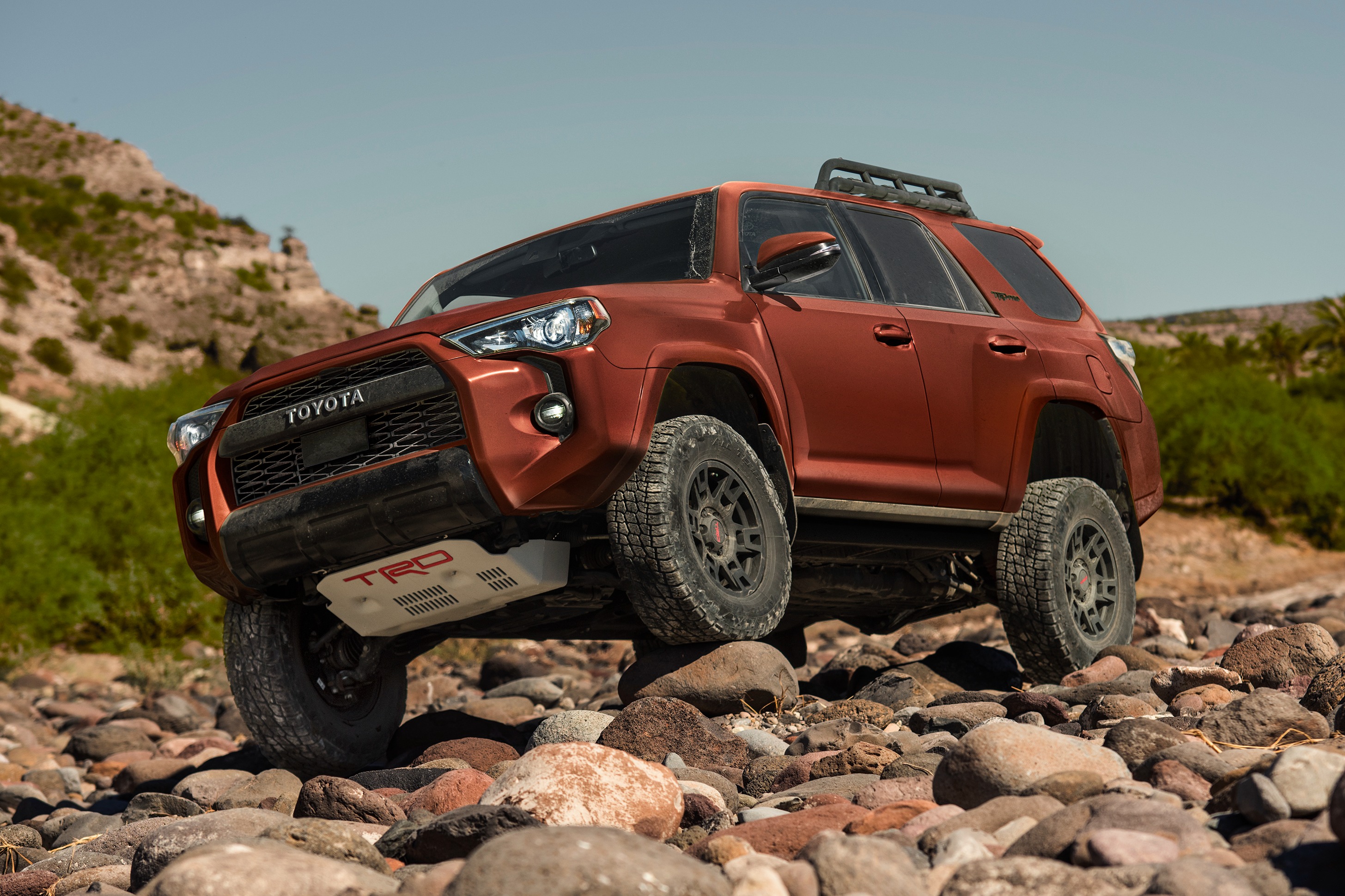
Meanwhile, the 2024 Toyota 4Runner stood as a nostalgic throwback. Retaining its form from the 2010 redesign with minor refreshes, it was an icon of old-school ruggedness rather than modern savviness. The vehicle's boxy shape was bolstered by flared fenders, imparting a feeling of stability crucial for off-road expeditions. The large and chunky grille and liftgate, combined with the TRD Pro’s underbody skid plates and all-terrain tires, highlighted its ruggedness. The aggressive styling was further amplified by the beefy tubular roof rack.
However, stepping inside the 4Runner felt like time travel to an older era, with a predominantly analog instrument panel, an eight-inch infotainment touchscreen, traditional gear selector, and last-gen technology features. The sturdy handles, analog dials, and the commanding view from the driver’s seat provided practical benefits for off-road driving, compensating somewhat for its outdated vibe. The interior materials, though not luxurious, were rugged and straightforward, making them suitable for off-road adventures.


The 2024 Kia EV9 Light trim was fueled by a single motor, providing rear-wheel drive (RWD) with 215 horsepower and 258 lb-ft of torque, boasting an EPA-estimated electric range of 230 miles. The Light Long Range model offered the best range with a 99.8-kWh battery, albeit at a lower horsepower of 201, but could travel up to 304 miles.
The higher trims came exclusively with all-wheel drive (AWD) and dual electric motors. Wind and Land trims delivered 379 hp and 443 lb-ft of torque, translating to a range of 280 miles. The GT-Line favored performance with 516 lb-ft of torque, although it reduced the range to 270 miles.
Driving the GT-Line around Napa Valley demonstrated smooth power delivery and acceleration. The EV9 avoided the aggressive jolts typical of electric vehicles, preferring a more refined increase to cruising speed. Handling was commendable with minimal body roll and good stability. Regenerative braking was adjustable, with i-Pedal mode delivering a single-pedal driving experience. Fast charging capabilities were a notable mention, with a high-speed DC fast charger taking the vehicle from 10 to 80 percent in just 25 minutes.
In contrast, the 2024 Toyota 4Runner was powered by a 4.0-liter V6 engine yielding 270 horsepower and 278 lb-ft of torque, paired with a five-speed automatic transmission. Unlike the Bronco's ten-speed and Wrangler's eight-speed transmissions, the 4Runner’s drivetrain felt somewhat dated.
Off-road, the 4Runner's powertrain performed adequately, but on-road, it felt sluggish. The rear-end squat during acceleration and the noticeable noise from the engine and exhaust could be off-putting. The TRD Pro’s sport exhaust exacerbated this by adding a loud, almost jarring sound.
At times, braking caused significant nosedive due to the soft suspension, reflecting its off-road focus. Body roll during cornering was substantial, making gentle handling essential. However, the 4Runner’s large tire sidewalls and soft suspension ignored rougher road conditions effectively, although passengers prone to motion sickness might find it less than pleasant.
The Kia EV9's standout feature was its third row, unusual for electric vehicles but remarkably spacious. It offered 39.5 inches of headroom, surpassing other models like the Kia Telluride, BMW X7, and Rivian R1S. Third-row legroom ranged from 30.8 to 32.0 inches, catering to a maximum of seven passengers compared to the Telluride's eight. The EV9 offered second-row captain’s chairs on higher trims, providing added comfort and support.
Cargo space was ample, with 20.2 cubic feet behind the third row, 43.5 cubic feet with it folded, and 81.7 cubic feet with only the front seats upright. The flat load floor eased luggage handling, though front storage was moderate due to the floating center console design.
The 4Runner, by contrast, appeared dated but functional. The control layout was user-friendly, with large climate control dials and straightforward driveline levers suitable for off-road adventuring. Storage spaces were plentiful, with visible benefits for road trips, though hard plastics dominated the interior.
In terms of cargo capacity, the 4Runner could manage 47.2 cubic feet behind the rear seats, expanding to 89.7 cubic feet with the seats stowed. The sliding deck option reduced capacity but added functionality. Despite lacking remote seat releases and a powered liftgate, the 4Runner featured a versatile sliding glass rear window and a generous 5,000-pound towing capacity, offering practical benefits for outdoor enthusiasts.
The Kia EV9 featured a comprehensive tech suite with three screens integrated into a single curved display. It had a 12.3-inch driver information display, a 5-inch climate display, and another 12.3-inch infotainment display. Wireless Apple CarPlay and Android Auto were standard, along with a wireless charging pad. Lower trims had an eight-speaker system, while higher trims had a 14-speaker Meridian Premium Audio system. The head-up display was exclusive to the GT-Line trim.
Significantly, the EV9’s connectedness allowed OTA updates, enabling owners to purchase additional features and services from the Kia Connect store, enhancing the vehicle's customization and future-proofing capabilities.
The Toyota 4Runner's infotainment system offered Apple CarPlay and Android Auto but fell short with an eight-inch touchscreen, lacking in off-road specific apps and gauges. The TRD Pro’s 15-speaker JBL premium audio system provided excellent sound quality, though it was often overshadowed by engine and road noise.
Advanced terrain controls were placed in the headliner console with pictograms instead of text labels, making the 4Runner's off-road capabilities less intuitive without a manual.
The Kia EV9 boasted an extensive suite of advanced driver-assistance systems (ADAS), much of which were also optional on the Telluride. It featured standard adaptive cruise control with machine learning, blind-spot collision avoidance, and forward collision avoidance. Higher trims included Blind-spot View Monitors and reverse parking collision avoidance.
Although it hadn't yet been tested by NHTSA or IIHS, the EV9 received the highest rating from Euro NCAP.
The Toyota 4Runner had mixed safety ratings. NHTSA gave it four out of five stars overall, with three stars in rollover evaluations. IIHS provided its best ratings for moderate frontal overlap and side protection tests but noted poor results in newer small overlap frontal tests.
Standard across most trims were adaptive cruise control, forward collision warning, automatic emergency braking, lane departure warning, and blind-spot monitoring. Higher trims featured a surround-view camera system, though oversensitive alerts could be a minor nuisance while driving.
CarGurus highlights
According to CarGurus experts, the overall rating for the 2024 Kia EV9 is 8.5 out of 10, while the 2024 Toyota 4Runner scores 4.5 out of 10. Based on these ratings, the Kia EV9 is the clear winner. With its innovative design, advanced technology, versatile space, and strong safety features, the EV9 is better positioned to meet the needs of modern SUV buyers. While the 4Runner maintains its rugged charm and off-road prowess, it simply can't compete with the EV9's comprehensive and future-oriented offerings.
Choose the 2024 Toyota 4Runner if:
- You need a rugged, off-road-capable SUV with traditional underpinnings and a sturdy build.
- Flexible cargo capacity and an optional sliding deck for practical off-road and camping use are essential.
- A simpler, more analog interior with straightforward controls and excellent outward visibility appeal to your needs.


Choose the 2024 Kia EV9 if:
- You prefer a modern, tech-savvy vehicle with a futuristic design and advanced lighting features.
- A third-row seat with significant headroom and versatile cargo space is a priority.
- You want an extensive suite of driver-assistance systems and the ability to upgrade features via OTA updates.


CarGurus highlights
According to CarGurus experts, the overall rating for the 2024 Kia EV9 is 8.5 out of 10, while the 2024 Toyota 4Runner scores 4.5 out of 10. Based on these ratings, the Kia EV9 is the clear winner. With its innovative design, advanced technology, versatile space, and strong safety features, the EV9 is better positioned to meet the needs of modern SUV buyers. While the 4Runner maintains its rugged charm and off-road prowess, it simply can't compete with the EV9's comprehensive and future-oriented offerings.
Choose the 2024 Toyota 4Runner if:
Shop Now- You need a rugged, off-road-capable SUV with traditional underpinnings and a sturdy build.
- Flexible cargo capacity and an optional sliding deck for practical off-road and camping use are essential.
- A simpler, more analog interior with straightforward controls and excellent outward visibility appeal to your needs.
Choose the 2024 Kia EV9 if:
Shop Now- You prefer a modern, tech-savvy vehicle with a futuristic design and advanced lighting features.
- A third-row seat with significant headroom and versatile cargo space is a priority.
- You want an extensive suite of driver-assistance systems and the ability to upgrade features via OTA updates.

By: CarGurus + AI
At CarGurus, our team of experienced automotive writers remain at the heart of our content operation, conducting hands-on car tests and writing insightful guides that are backed by years of industry experience. To complement this, we are harnessing AI to make our content offering more diverse and more helpful to shoppers than ever. To achieve this, our AI systems are based exclusively on CarGurus content, ratings and data, so that what we produce is both unique to CarGurus, and uniquely helpful to car shoppers.

