Chevrolet Trax vs Chevrolet Bolt
Overview | |
MSRP$21,700 | MSRP$27,600 |
Listings730 | Listings6 |
Ratings & Reviews | |
User Reviews | User Reviews |
Expert reviews7.7 out of 10 | Expert reviews6.3 out of 10 |
Pros
Cons
| Pros
Cons
|
Reviews SummaryThe Trax is the cheapest new car Chevy sells in the United States. It takes the place of compact sedans and hatchbacks in the Bowtie brand’s lineup, while competing with entry-level crossover SUVs such as the Hyundai Venue and the Nissan Kicks. The current Trax was introduced for the 2024 model year, and for 2026 the only changes are two new exterior color options. White Sands is available with Activ and RS models, while Apex Red is available with RS, LS, and LT models. Verdict: Blending elements of compact cars and crossover SUVs, the Trax hits a sweet spot of utility and affordability. It’s also pleasant to drive and offers impressive infotainment tech, but a lack of solid safety ratings and the unavailability of all-wheel drive are the tradeoffs. | |
Reviews SummaryWith more range, more power, and improved technology, the Chevrolet Bolt EV returns after a three-year hiatus. It also claims the title of the most affordable EV in the U.S., but is due to remain in production only until mid-2027. Verdict: The 2027 Chevrolet Bolt EV is an excellent choice for shoppers seeking an electric vehicle that won't break the bank. It may not be all that fancy or refined, but it gets the basics right when it comes to range and capabilities. | |
No video found | No video found |
Popular Features & Specs | |
Seating Capacity5 | Seating Capacity5 |
EV Battery Capacity | EV Battery Capacity65 kWh |
Battery Charge Time (120V) | Battery Charge Time (120V)64 hours |
Battery Charge Time (240V) | Battery Charge Time (240V)9.8 hours |
Engine | |
Engine Name1.2L 137 hp I3 Flex Fuel Vehicle | Engine Name210 hp Electric |
Torque162 lb-ft @ 2500 rpm | Torque |
Horsepower137 hp @ 5000 rpm | Horsepower |
Battery Charge Time (120V) | Battery Charge Time (120V)64 hours |
Battery Charge Time (240V) | Battery Charge Time (240V)9.8 hours |
DrivetrainFWD | DrivetrainFWD |
Fuel Economy | |
EV Battery Capacity | EV Battery Capacity65 kWh |
Interior | |
Seating Capacity5 | Seating Capacity5 |
Key Features | |
Navigation System | Navigation SystemStandard |
Safety | |
Front Crash Overall4 | Front Crash Overall |
Dimensions & Capacity | |
Cargo Space25.6 cu ft | Cargo Space16.2 cu ft |
Curb Weight2983 lbs | Curb Weight3776 lbs |
Height61.4 in | Height63.9 in |
Length178.6 in | Length169.6 in |
Width71.8 in | Width80.1 in |
Wheelbase106.3 in | Wheelbase105.3 in |
Maximum Payload1162 lbs | Maximum Payload873 lbs |
Number of doors4 | Number of doors4 |
Overview | ||
MSRP | $21,700 | $27,600 |
Listings | ||
Ratings & Reviews | ||
User reviews | ||
Expert reviews | 7.7 out of 10Read full review | 6.3 out of 10Read full review |
Pros & cons | Pros
Cons
| Pros
Cons
|
Summary | The Trax is the cheapest new car Chevy sells in the United States. It takes the place of compact sedans and hatchbacks in the Bowtie brand’s lineup, while competing with entry-level crossover SUVs such as the Hyundai Venue and the Nissan Kicks. The current Trax was introduced for the 2024 model year, and for 2026 the only changes are two new exterior color options. White Sands is available with Activ and RS models, while Apex Red is available with RS, LS, and LT models. Verdict: Blending elements of compact cars and crossover SUVs, the Trax hits a sweet spot of utility and affordability. It’s also pleasant to drive and offers impressive infotainment tech, but a lack of solid safety ratings and the unavailability of all-wheel drive are the tradeoffs. | With more range, more power, and improved technology, the Chevrolet Bolt EV returns after a three-year hiatus. It also claims the title of the most affordable EV in the U.S., but is due to remain in production only until mid-2027. Verdict: The 2027 Chevrolet Bolt EV is an excellent choice for shoppers seeking an electric vehicle that won't break the bank. It may not be all that fancy or refined, but it gets the basics right when it comes to range and capabilities. |
Video | No video found | No video found |
Popular Features & Specs | ||
Seating Capacity | 5 | 5 |
EV Battery Capacity | 65 kWh | |
Battery Charge Time (120V) | 64 hours | |
Battery Charge Time (240V) | 9.8 hours | |
Engine | ||
Engine Name | 1.2L 137 hp I3 Flex Fuel Vehicle | 210 hp Electric |
Torque | 162 lb-ft @ 2500 rpm | |
Horsepower | 137 hp @ 5000 rpm | |
Battery Charge Time (120V) | 64 hours | |
Battery Charge Time (240V) | 9.8 hours | |
Drivetrain | FWD | FWD |
Fuel Economy | ||
EV Battery Capacity | 65 kWh | |
Interior | ||
Seating Capacity | 5 | 5 |
Key Features | ||
Navigation System | Standard | |
Safety | ||
Front Crash Overall | 4 | |
Dimensions & Capacity | ||
Cargo Space | 25.6 cu ft | 16.2 cu ft |
Curb Weight | 2983 lbs | 3776 lbs |
Height | 61.4 in | 63.9 in |
Length | 178.6 in | 169.6 in |
Width | 71.8 in | 80.1 in |
Wheelbase | 106.3 in | 105.3 in |
Maximum Payload | 1162 lbs | 873 lbs |
Number of doors | 4 | 4 |
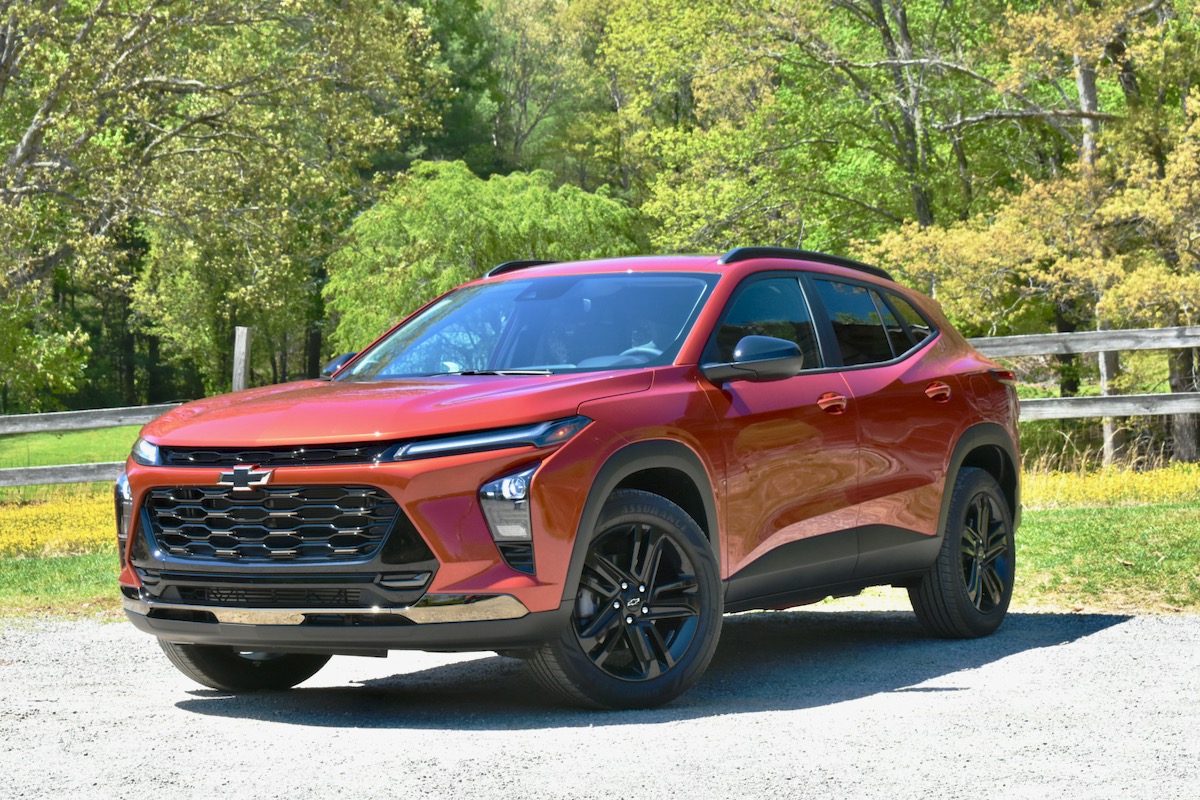
The 2026 Chevrolet Trax emerged as a more appealing option for those who missed the affordable cars like the Cruze or Sonic, which Chevy had previously removed from its lineup. This second-generation Trax adopted a more car-like design, sharing its proportions with the Buick Envista, while maintaining enough SUV styling elements to satisfy marketing demands. The vehicle's design was characterized by Blazer-like headlights, a wide grille, and a tall front end, giving it a distinct personality. The sides featured chunky wheel arches and a pronounced rib in the doors, while the laid-back windshield and upward arc of the rear side windows contributed to a sleeker appearance. Despite its small size, the Trax exuded SUV toughness with its wide stance and imposing grille.
Inside, the Trax was marked by its entry-level feel, with rubbery surfaces, but it compensated with design details that were a cut above. The interior featured large, round air vents and contrasting trim, which helped distract from the economical materials. The instrument cluster and touchscreen layout had a Corvette-like resemblance, and the predominantly black interior was broken up by gray door panels and dashboard trim, along with blue accents in the LT test car. Cloth upholstery was standard on the LS and 1RS trims, while higher trims offered suede-like Evotex or a combination of both.
The 2027 Chevrolet Bolt retained a familiar look, with only slight styling changes. Its front end resembled a conventional gas-powered car more than an EV, with a thin slot behind the Chevy Bowtie logo and an integrated grille insert in the bumper. The 2027 model continued from where the 2023 version left off, straddling the line between a large hatchback and a subcompact SUV. The Bolt's tall and narrow design prioritized utility and interior space over a sporty stance. The RS model added gloss black exterior trim for a touch of flair.
Inside, the Bolt underwent a more dramatic makeover while maintaining its basic structure. A larger digital instrument panel and infotainment touchscreen occupied the dashboard, and the push-button gear selector was moved to the steering column, freeing up storage space in the center console. The cabin featured hard plastic surfaces, reinforcing the Bolt's budget feel, but the elbow touch points had thin padding. The base LT trim came with cloth upholstery, while the RS trim upgraded to Evotex synthetic leather with red stitching. The rear seating area had an abundance of hard plastics and lacked padding for the door armrests.
The 2026 Chevrolet Trax was powered by a 1.2-liter turbocharged three-cylinder engine, producing 137 horsepower and 162 pound-feet of torque. It featured a six-speed automatic transmission and front-wheel drive, with no all-wheel drive option available. Despite having one less cylinder than the norm, the Trax's engine delivered 16 more horsepower and 49 more pound-feet of torque than the naturally-aspirated 1.6-liter four-cylinder engine in the Hyundai Venue. The Trax accelerated confidently and maintained its performance at higher speeds, with no discernible turbo lag. The conventional geared automatic transmission contributed to its drivability, offering less delay between engine revving and power application compared to a CVT.
The Trax felt poised on twisty roads, with a stable and car-like demeanor, although it exhibited significant body roll and limited grip. The electric power steering was responsive, allowing drivers to take advantage of the Trax's small size. The suspension effectively absorbed bumps, providing a comfortable ride, while active noise cancellation helped close the refinement gap with the Buick Envista. Some tire noise and engine drone were still evident.
The 2027 Chevrolet Bolt featured a new 65-kilowatt-hour lithium-iron phosphate battery pack, reducing costs and requiring fewer rare earth minerals. A new motor from Chevy's Equinox EV delivered 210 horsepower and 169 pound-feet of torque to the front wheels. The Bolt's acceleration was estimated to be similar to the previous Bolt EV, typically reaching 0-60 mph in the low seven-second range. While this might seem slow by EV standards, it was quick compared to gas-powered subcompact SUVs, with immediate pedal response.
The Bolt offered one-pedal driving with medium or high levels of brake regeneration, although it could be jumpy at low speeds. The ride was firm but not overly stiff, and road noise was more noticeable due to the absence of an internal combustion engine. The Bolt's low center of gravity, thanks to the heavy battery in the floor, contributed to its agility on curvy roads. On a full charge, the 2027 Bolt was estimated to achieve up to 262 miles of range, a 15-mile improvement over its predecessor. It featured a Tesla-derived NACS charge port, with adapters for CCS and J1772 connectors, and charging speed increased to 150 kW, allowing for a 10% to 80% recharge in 25 minutes.
The 2026 Chevrolet Trax offered competitive interior space compared to other small crossovers, with headroom similar to the Hyundai Kona and Subaru Crosstrek. While the Subaru provided an extra inch of front legroom, the Trax offered rear-seat passengers an additional 2.2 inches of legroom. The Trax's second-row legroom advantage was about four inches compared to the Hyundai Venue and Nissan Kicks. With 25.6 cubic feet of cargo space behind the rear seats, the Trax was comparable to a Honda Civic hatchback. It offered 54.1 cubic feet of cargo space with the back seats folded, although the Hyundai Kona provided more cargo space with the rear seats folded, and the Nissan Kicks offered more space whether the seats were up or down.
The Trax's tall seating position facilitated easy ingress and egress, providing shorter drivers with a decent view of the road. Forward visibility was impressive, although the rear window view was less clear, compensated by large exterior mirrors. The front seats were positioned far inboard, limiting covered center console storage but allowing for large door pockets. Two large cup holders next to the shifter accommodated American-sized beverages, although the wireless device charger struggled to hold phones in place.
The 2027 Chevrolet Bolt featured a more upright driving position, providing ample space for larger occupants. Taller drivers might have wished for more telescoping extension from the steering wheel, as they needed to scoot the seat forward to comfortably reach it. The rear seats were also upright, offering plenty of headroom and adequate thigh support. The floor was flat, reducing the penalty for center-seat passengers.
The Bolt could hold up to 16.2 cubic feet of cargo behind the rear seats, which was small for the class but still provided ample capacity for most users. A large bin underneath the floor and the ability to slide the floor into it offered additional luggage space. The release latches for the rear seatbacks were easily accessible from the cargo area, and the seats folded flat with the cargo floor in its upper position. While there was no frunk, the Bolt offered ample storage for personal items up front, with a large bin featuring movable/removable dividers, a big floor tray, and a deep center armrest bin. A rubberized wireless phone charger, additional dashboard pockets, and moderate door pockets provided ample storage options.
The 2026 Chevrolet Trax came standard with an 8-inch touchscreen, wireless Apple CarPlay/Android Auto connectivity, and a four-speaker audio system on the LS base model. Higher trim levels featured an 11-inch touchscreen, an all-digital 8-inch instrument cluster, and a six-speaker sound system. Two USB ports (one USB-A and one USB-C) for connectivity were standard, with additional charge-only USB-A and USB-C ports for rear-seat passengers on all but the LS trim level.
The LT test car featured an easily-readable digital cluster with a large centered speed readout and other information displayed in concentric circles. The big touchscreen had a sensible layout, with a stack of icons to the left of large display tiles. An analog volume knob was included, although it was somewhat hard to reach. The touchscreen was angled toward the driver, making it harder for the front passenger to use, and the climate controls and volume knob were also difficult to reach for the passenger.
The 2027 Chevrolet Bolt EV models came with an 11-inch digital instrument panel and an 11.3-inch center touchscreen, shared with the Chevy Colorado midsize truck. The infotainment system ran on a Google-based operating system, meaning Apple CarPlay and standalone Android Auto were not supported. Users had to pair their phones via Bluetooth to listen to personal music libraries, but browsing control was sufficient. The optional Technology package added a surround-view camera system, a digital rear-view mirror, additional safety features, and a wireless charging pad.
The infotainment system was user-friendly, with logical menus, sharp graphics, and quick responses to inputs. Separate physical climate controls reduced distraction, and the navigation system could help drivers find charging stations en route. The Bolt was capable of vehicle-to-load charging, allowing it to serve as a backup power source for a home during power outages, although additional equipment and installation were required.
The 2026 Chevrolet Trax came with standard driver-assist features, including automatic emergency braking, front pedestrian braking, lane keep assist, lane departure warning, forward collision warning, automatic high beams, and a following distance indicator. Adaptive cruise control, blind spot monitoring, rear cross traffic alert, and rear park assist were available on higher trim levels and as options for some lower trims. Chevy's Teen Driver monitoring system activated all available safety features and allowed parents to monitor their teens' driving behavior. However, full safety ratings were not yet available, and the Trax received a "Poor" rating in the IIHS's updated moderate overlap front crash test, although it achieved a "Good" rating in the small overlap front test.
The 2027 Chevrolet Bolt's crash test results were not yet published by the NHTSA or IIHS, but it was expected to achieve high scores based on its platform. Standard advanced safety features included forward collision warning with automatic emergency braking, adaptive cruise control, lane-keep assist, blind-spot monitors with active steering assist, and a safety alert seat. The optional Technology package added a surround-view camera system, a digital rear-view mirror, automatic wipers, rear-pedestrian alert, and traffic-sign recognition. GM's Super Cruise hands-free automated highway driving system was available for an additional cost, making the Bolt one of the few budget EVs to offer such an advanced system.
CarGurus highlights
According to CarGurus experts, the overall rating for the 2026 Chevrolet Trax is 7.7 out of 10, while the 2027 Chevrolet Bolt scores 6.3 out of 10. Based on these ratings, the 2026 Chevrolet Trax is the recommended choice, offering a more balanced package of affordability, practicality, and technology.
Choose the 2026 Chevrolet Trax if:
- You prioritize a more affordable entry-level vehicle with SUV styling elements.
- You need competitive interior space and cargo capacity for a small crossover.
- You value a straightforward infotainment system with wireless Apple CarPlay/Android Auto connectivity.


Choose the 2027 Chevrolet Bolt if:
- You want an electric vehicle with a respectable range and quick charging capabilities.
- You appreciate advanced safety features and the option for hands-free highway driving.
- You seek a user-friendly infotainment system with logical menus and sharp graphics.


CarGurus highlights
According to CarGurus experts, the overall rating for the 2026 Chevrolet Trax is 7.7 out of 10, while the 2027 Chevrolet Bolt scores 6.3 out of 10. Based on these ratings, the 2026 Chevrolet Trax is the recommended choice, offering a more balanced package of affordability, practicality, and technology.
Choose the 2026 Chevrolet Trax if:
Shop Now- You prioritize a more affordable entry-level vehicle with SUV styling elements.
- You need competitive interior space and cargo capacity for a small crossover.
- You value a straightforward infotainment system with wireless Apple CarPlay/Android Auto connectivity.
Choose the 2027 Chevrolet Bolt if:
Shop Now- You want an electric vehicle with a respectable range and quick charging capabilities.
- You appreciate advanced safety features and the option for hands-free highway driving.
- You seek a user-friendly infotainment system with logical menus and sharp graphics.

By: CarGurus + AI
At CarGurus, our team of experienced automotive writers remain at the heart of our content operation, conducting hands-on car tests and writing insightful guides that are backed by years of industry experience. To complement this, we are harnessing AI to make our content offering more diverse and more helpful to shoppers than ever. To achieve this, our AI systems are based exclusively on CarGurus content, ratings and data, so that what we produce is both unique to CarGurus, and uniquely helpful to car shoppers.

