2024 Toyota 4Runner vs 2024 Mazda CX-90
Overview | |
MSRP$37,845 | MSRP$40,705 |
Listings2022 | Listings1088 |
Ratings & Reviews | |
User Reviews | User Reviews |
Expert reviews8.0 out of 10 | Expert reviews4.5 out of 10 |
Pros
Cons
| Pros
Cons
|
2024 Mazda CX-90 Reviews SummaryThe 2024 Mazda CX-90 is the family-hauling crossover we finally want to drive. This all-new Mazda delivers a turbocharged straight-six engine (or a PHEV, if you prefer), rear-wheel-drive architecture, brilliant handling, and a 20% discount from the surprisingly similar BMW X5. We sampled the new 2024 Mazda CX-90 Turbo S and the CX-90 PHEV on Northern California’s twisty roads, and we came away impressed by the big and powerful SUV’s handling and composure. | |
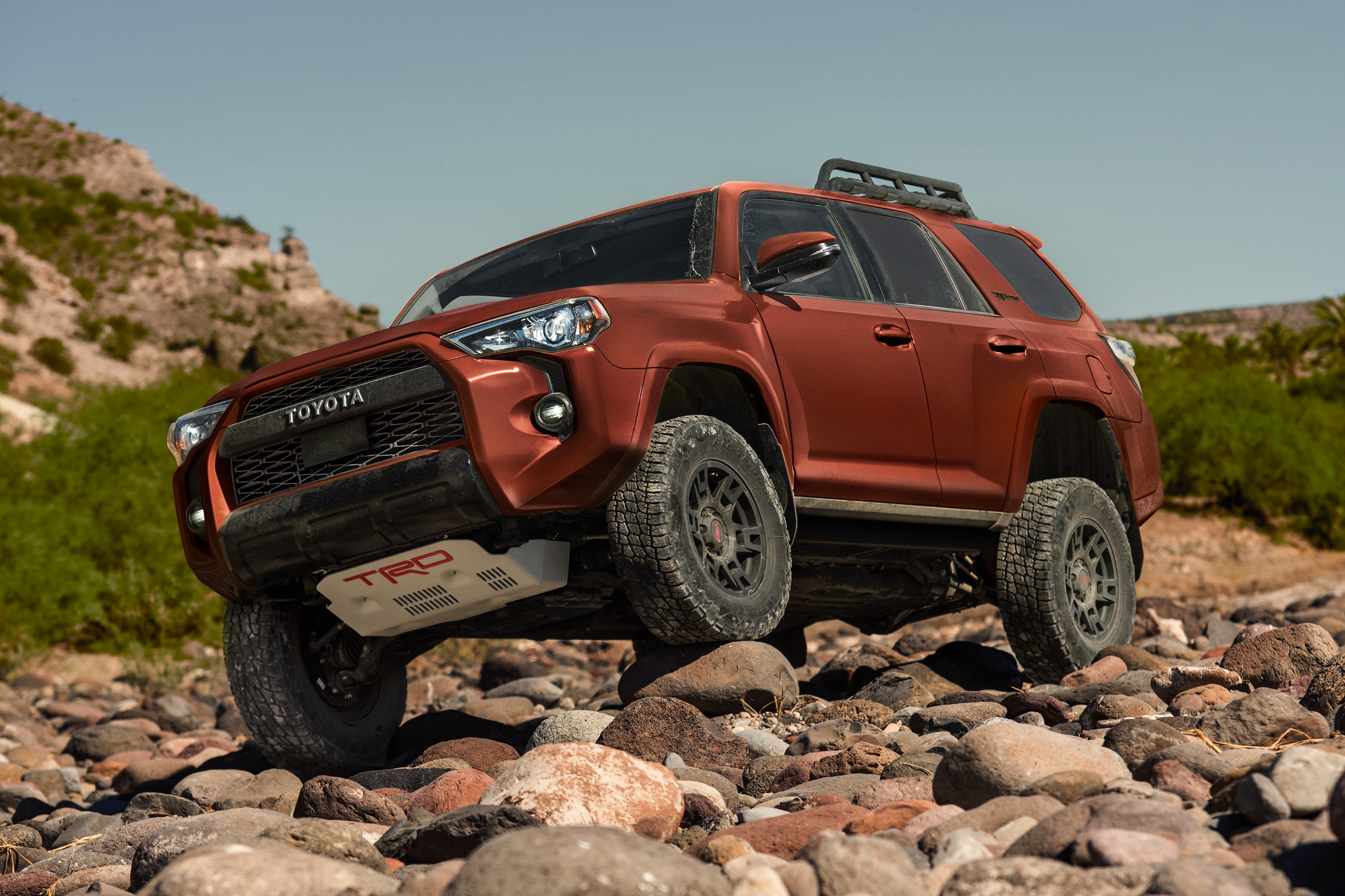
2024 Toyota 4Runner Reviews SummaryVerdict: The Toyota 4Runner remains an accomplished off-road-capable vehicle with a strong reputation for reliability and durability. A new 4Runner is expected, and the current model's aging platform is in desperate need of a full redesign. It trails newer rivals when it comes to technology, safety features, fuel efficiency, and power. The 2024 Toyota 4Runner would be easier to recommend it if the price were significantly reduced. | |
Popular Features & Specs | |
Engine3.3L 280 hp I6 | Engine4.0L 270 hp V6 |
DrivetrainAWD | Drivetrain4X2 |
Seating Capacity8 | Seating Capacity7 |
Horsepower280 hp @ 5000 rpm | Horsepower270 hp @ 5600 rpm |
EV Battery Capacity0.33 kWh | EV Battery Capacity |
MPG City24 | MPG City16 |
MPG Highway28 | MPG Highway19 |
Engine | |
Engine Name3.3L 280 hp I6 | Engine Name4.0L 270 hp V6 |
Torque332 lb-ft @ 2000 rpm | Torque278 lb-ft @ 4400 rpm |
Horsepower280 hp @ 5000 rpm | Horsepower270 hp @ 5600 rpm |
DrivetrainAWD | Drivetrain4X2 |
Fuel Economy | |
EV Battery Capacity0.33 kWh | EV Battery Capacity |
MPG City24 | MPG City16 |
MPG Highway28 | MPG Highway19 |
Interior | |
Seating Capacity8 | Seating Capacity7 |
Safety | |
Front Crash Overall4 | Front Crash Overall4 |
Side Crash Overall5 | Side Crash Overall5 |
Dimensions & Capacity | |
Cargo Space14.9 cu ft | Cargo Space47.2 cu ft |
Curb Weight4709 lbs | Curb Weight4400 lbs |
Height68.2 in | Height71.5 in |
Length200.8 in | Length190.2 in |
Width84.9 in | Width75.8 in |
Wheelbase122.8 in | Wheelbase109.8 in |
Maximum Payload1709 lbs | Maximum Payload1700 lbs |
Number of doors4 | Number of doors4 |
Maximum Towing Capacity3500 lbs | Maximum Towing Capacity5000 lbs |
Standard Towing Capacity3500 lbs | Standard Towing Capacity5000 lbs |
Overview | ||
MSRP | $37,845 | $40,705 |
Listings | ||
Ratings & Reviews | ||
User reviews | ||
Expert reviews | 8.0 out of 10Read full review | 4.5 out of 10Read full review |
Pros & cons | Pros
Cons
| Pros
Cons
|
Summary | The 2024 Mazda CX-90 is the family-hauling crossover we finally want to drive. This all-new Mazda delivers a turbocharged straight-six engine (or a PHEV, if you prefer), rear-wheel-drive architecture, brilliant handling, and a 20% discount from the surprisingly similar BMW X5. We sampled the new 2024 Mazda CX-90 Turbo S and the CX-90 PHEV on Northern California’s twisty roads, and we came away impressed by the big and powerful SUV’s handling and composure. | Verdict: The Toyota 4Runner remains an accomplished off-road-capable vehicle with a strong reputation for reliability and durability. A new 4Runner is expected, and the current model's aging platform is in desperate need of a full redesign. It trails newer rivals when it comes to technology, safety features, fuel efficiency, and power. The 2024 Toyota 4Runner would be easier to recommend it if the price were significantly reduced. |
Video | ||
Popular Features & Specs | ||
Engine | 3.3L 280 hp I6 | 4.0L 270 hp V6 |
Drivetrain | AWD | 4X2 |
Seating Capacity | 8 | 7 |
Horsepower | 280 hp @ 5000 rpm | 270 hp @ 5600 rpm |
EV Battery Capacity | 0.33 kWh | |
MPG City | 24 | 16 |
MPG Highway | 28 | 19 |
Engine | ||
Engine Name | 3.3L 280 hp I6 | 4.0L 270 hp V6 |
Torque | 332 lb-ft @ 2000 rpm | 278 lb-ft @ 4400 rpm |
Horsepower | 280 hp @ 5000 rpm | 270 hp @ 5600 rpm |
Drivetrain | AWD | 4X2 |
Fuel Economy | ||
EV Battery Capacity | 0.33 kWh | |
MPG City | 24 | 16 |
MPG Highway | 28 | 19 |
Interior | ||
Seating Capacity | 8 | 7 |
Safety | ||
Front Crash Overall | 4 | 4 |
Side Crash Overall | 5 | 5 |
Dimensions & Capacity | ||
Cargo Space | 14.9 cu ft | 47.2 cu ft |
Curb Weight | 4709 lbs | 4400 lbs |
Height | 68.2 in | 71.5 in |
Length | 200.8 in | 190.2 in |
Width | 84.9 in | 75.8 in |
Wheelbase | 122.8 in | 109.8 in |
Maximum Payload | 1709 lbs | 1700 lbs |
Number of doors | 4 | 4 |
Maximum Towing Capacity | 3500 lbs | 5000 lbs |
Standard Towing Capacity | 3500 lbs | 5000 lbs |
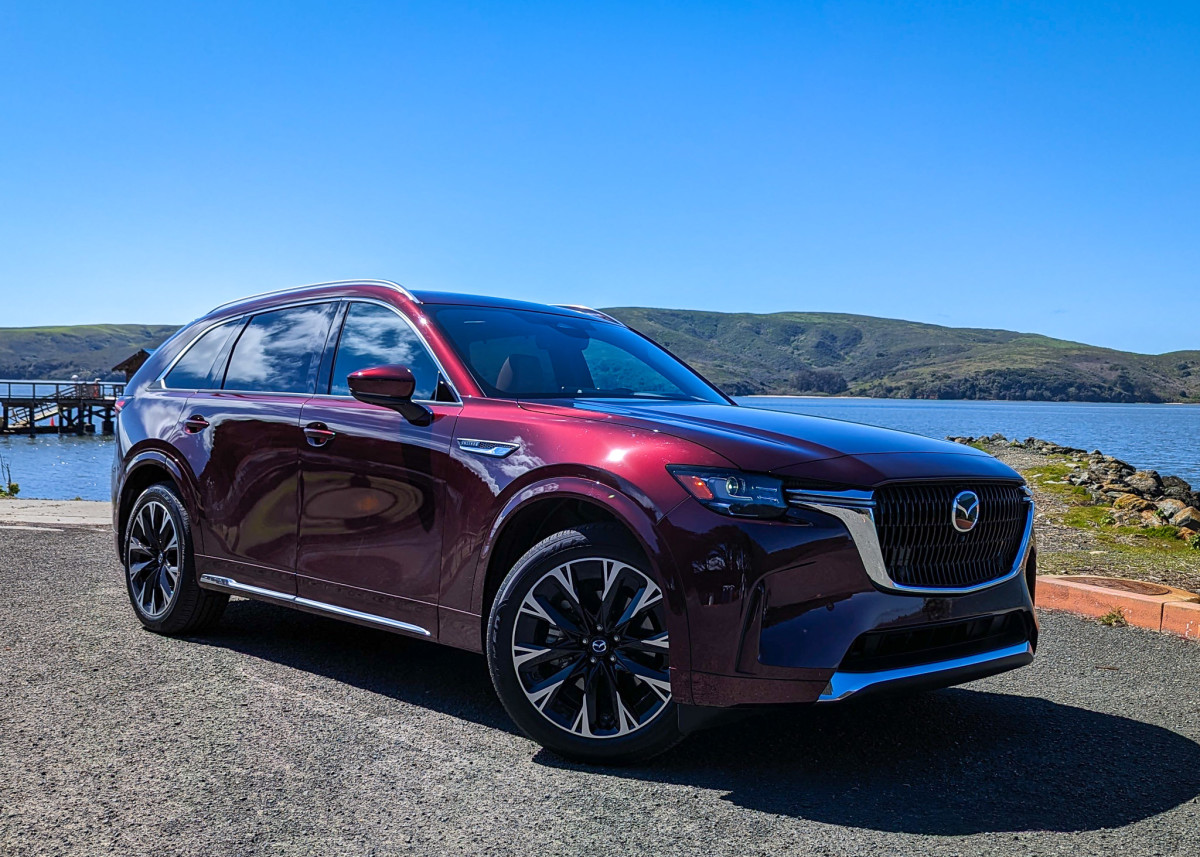
If you were in the market for a luxury vehicle back in 2024, the Mazda CX-90 made a compelling argument that extended beyond traditional names like BMW or Mercedes-Benz. The Japanese auto manufacturer, known for quality and design, had outdone itself with the all-new Mazda CX-90, offering a near-luxury experience without luxury-level pricing. This SUV, stretching over 200 inches, took the design language of smaller Mazdas and magnified it, creating a car that was both imposing and elegant.
The exterior showcased a big grille, a wide-set front end, and large wheels ranging from 19 to 21 inches, which demanded attention. Chrome trim added a touch of class, making it look elegant despite its size. Once you stepped inside, you were greeted with an interior that could rival luxury brands. Top models came with brown suede upholstery, wood inlays, and matte black plastic bits, creating a sophisticated atmosphere devoid of tackiness.
The CX-90 was available in 11 trim levels spread across three powertrains. This included the CX-90 Turbo, the plug-in hybrid (PHEV) model, and the high-performance CX-90 Turbo S. Price and features varied, but even the base models benefitted from Mazda’s stylish design and comfortable layout.
In contrast, the 2024 Toyota 4Runner was a throwback to a bygone era. Last redesigned in 2010, its rugged, boxy design persisted into the new decade, adding to its classic yet outdated feel. Its flared fenders and beefy stance gave it an impression of stability and strength, ideal for off-roading. Notable features included chunky beveled shapes in the grille and liftgate, underbody skid plates, and all-terrain tires, especially in the TRD Pro model, which exuded a serious attitude geared towards tackling tough terrains.
However, the 4Runner’s interior did show its age, with old-school styling and last-generation technology. The dashboard featured analog dials and a smaller eight-inch infotainment touchscreen, both harkening back to older designs. Hard plastic was common, though cushioned panels provided some comfort. The upholstery tried to approximate leather but resembled vinyl. The design might spark nostalgia for some, but most modern consumers likely saw it as dated.


The 2024 Mazda CX-90 introduced two new powertrains. First, it had a plug-in hybrid (PHEV) option, a first for Mazda SUVs. Alongside this, there were two iterations of a new turbocharged inline six-cylinder engine. The base version of this turbo I6 delivered 280 horsepower and 332 pound-feet of torque, but the upgraded version in the CX-90 Turbo S produced a robust 340 horsepower and 369 lb-ft of torque when using premium fuel.
All trims came with all-wheel drive (AWD) and an eight-speed automatic transmission. Three driving modes—Normal, Sport, and Off-Road—allowed for customization of driving experience. The upgraded I6 engine was particularly noteworthy for its incredible exhaust note, which was unusual for a Mazda.
The CX-90 PHEV combined a 2.5-liter four-cylinder engine with a 17.8-kWh battery and a 68-kW electric motor, yielding a total output of 323 horsepower and 369 lb-ft of torque. It offered an all-electric driving range of 26 miles and an EPA-estimated 56 MPGe in combined driving.
Overall, both powertrains provided impressive handling and cornering, thanks to the double-wishbone front suspension and transverse engine layout that enhanced agility and performance in tight corners. Mazda’s reputation for creating driver-focused vehicles shone through with the CX-90.
Every 2024 Toyota 4Runner was powered by a 4.0-liter V6 engine generating 270 horsepower and 278 lb-ft of torque. While competitive in raw numbers, it was let down by a five-speed automatic transmission, which felt outdated compared to the ten-speed transmission in the Ford Bronco and the eight-speed in the Jeep Wrangler. The TRD Pro came standard with 4WD and a two-speed transfer case, while other trims were RWD with optional 4WD.
The 4Runner’s performance was more suited to off-road adventures than highway driving. On pavement, it felt sluggish, requiring heavy footwork on the gas pedal to merge onto highways. The soft suspension was great for off-road articulation but resulted in significant body roll and nose dive during cornering and braking.
This robust setup, however, came into its own off-road. The 4Runner could tackle rugged terrains with aplomb, thanks to its sturdy build and off-road-centric features. But for everyday driving, the performance left much to be desired, with excessive engine noise and a less refined driving experience.
The Mazda CX-90 offered versatility in its seating and cargo configurations. Lower trims could seat up to eight passengers with a three-seat second and third row, while mid-level trims replaced the second-row bench with captain’s chairs, reducing capacity to seven. The Turbo S variant adjusted configurations further; its base trim seated seven, while the Premium and Premium Plus trims offered a six-seat configuration with a two-seat third row.
Cargo space slightly varied depending on the seating config. Models with the two-seater third row offered a maximum of 75.2 cubic feet, 15.9 cubic feet behind the third row, and 40.1 cubic feet behind the second row. Models with three-across seating in the back provided up to 74.2 cubic feet when all rows were folded, 14.9 cubic feet behind the third row, and 40.0 cubic feet behind the second row. While a significant improvement over the CX-9, the CX-90 still lagged behind competitors like the Honda Pilot and Toyota Highlander in overall capacity.
Interior storage was thoughtful and ample. The center console, door pockets, and cupholders were spacious, and higher trims offered additional storage options like a center console for the middle-row captain's chairs.
The Toyota 4Runner’s interior design was functional but aged. The cabin space was ample, especially for front passengers, though taller drivers might find the steering wheel’s range limited. The second row was roomy in terms of leg space but somewhat constrained in headroom for taller individuals due to its elevated bench design, which offered a stadium-like view. A third row was available on select trims for extra seating.
Storage options were practical, with various nooks for snacks and drinks, including a large armrest bin, medium-sized cupholders, and deep door pockets. Cargo space was impressive, with 47.2 cubic feet available behind the rear seats and a maximum of 89.7 cubic feet when seats were stowed, although seat stowage required manual effort.
A unique feature was the almost flat load floor, making it possible to sleep in the cargo area, and a sliding glass rear window for easier access to gear. The 4Runner also sported a 5,000-pound towing capacity, further enhancing its utility.
Mazda’s tech approach focused on minimizing distractions. The Mazda Connect infotainment system used physical controls like buttons and a rotary knob, foregoing touchscreens to keep drivers’ eyes on the road. While well-intentioned, this system often caused more frustration than ease, particularly when navigating maps or selecting radio stations.
Conversely, personalization software in the CX-90 used facial recognition to adjust settings like seats, mirrors, and the HUD to individual profiles, offering some consolation. Standard features included Android Auto and Apple CarPlay, with higher trims allowing touchscreen interaction for these popular platforms.
In the 2024 Toyota 4Runner, the infotainment system was basic but functional, featuring standard Apple CarPlay and Android Auto. The small eight-inch touchscreen, however, posed usability issues while driving, and the system lacked off-road-specific apps found in competitors.
The TRD Pro model included a 15-speaker JBL premium audio system, but appreciating it fully was difficult due to road and engine noise. Off-road terrain controls were located in the headliner console but required some study through the owner’s manual due to pictogram labels instead of descriptions.
Mazda’s i-Activsense suite of ADAS came standard on the CX-90, offering features like blind-spot monitoring, adaptive cruise control, automatic emergency braking, smart brake support, rear cross-traffic alert, and a safe-exit warning. Our top-spec test car also had advanced systems like lane-centering and adaptive cruise control, which worked well with only minor issues.
Though untested by the IIHS and NHTSA at the time, the CX-90 was expected to perform well, given the stellar safety ratings of its predecessor, the CX-9.
The NHTSA gave the 2024 4Runner four stars overall, with five stars for side impacts but only three stars for rollover evaluations. The IIHS offered mixed ratings, with high scores for older tests but marginal and poor results in newer small overlap frontal tests.
Standard safety features were comprehensive, including adaptive cruise control, forward collision warning, automatic emergency braking, lane-departure warning, and blind-spot monitoring. However, the 4Runner’s safety systems were often hypersensitive, which might prove annoying during daily driving.
CarGurus highlights
According to CarGurus experts, the overall rating for the 2024 Mazda CX-90 is 8.0 out of 10, while the 2024 Toyota 4Runner scores 4.5 out of 10. Given these ratings, we recommend the 2024 Mazda CX-90. It achieves a superior blend of luxury, performance, and practicality, offering more compelling features and a refined driving experience. While the 2024 Toyota 4Runner excels in rugged off-road performance, its dated design, less refined technology, and lower safety ratings make the Mazda CX-90 the overall better choice for most consumers.
Choose the 2024 Toyota 4Runner if:
- Rugged off-road capability and classic SUV design are important.
- You need a vehicle with generous cargo capacity and practical storage options.
- Strong towing capabilities and robust build quality are top priorities.


Choose the 2024 Mazda CX-90 if:
- You value luxurious design and finish at a more affordable price.
- You prefer a balanced combination of performance in both turbocharged and PHEV options.
- Advanced and standard safety features are a priority for you.


CarGurus highlights
According to CarGurus experts, the overall rating for the 2024 Mazda CX-90 is 8.0 out of 10, while the 2024 Toyota 4Runner scores 4.5 out of 10. Given these ratings, we recommend the 2024 Mazda CX-90. It achieves a superior blend of luxury, performance, and practicality, offering more compelling features and a refined driving experience. While the 2024 Toyota 4Runner excels in rugged off-road performance, its dated design, less refined technology, and lower safety ratings make the Mazda CX-90 the overall better choice for most consumers.
Choose the 2024 Toyota 4Runner if:
Shop Now- Rugged off-road capability and classic SUV design are important.
- You need a vehicle with generous cargo capacity and practical storage options.
- Strong towing capabilities and robust build quality are top priorities.
Choose the 2024 Mazda CX-90 if:
Shop Now- You value luxurious design and finish at a more affordable price.
- You prefer a balanced combination of performance in both turbocharged and PHEV options.
- Advanced and standard safety features are a priority for you.

By: CarGurus + AI
At CarGurus, our team of experienced automotive writers remain at the heart of our content operation, conducting hands-on car tests and writing insightful guides that are backed by years of industry experience. To complement this, we are harnessing AI to make our content offering more diverse and more helpful to shoppers than ever. To achieve this, our AI systems are based exclusively on CarGurus content, ratings and data, so that what we produce is both unique to CarGurus, and uniquely helpful to car shoppers.

