2024 Kia Sorento vs 2024 Lexus TX
Overview | |
MSRP$53,700 | MSRP$31,990 |
Listings45 | Listings258 |
Ratings & Reviews | |
User Reviews | User Reviews |
Expert reviews7.2 out of 10 | Expert reviews8.7 out of 10 |
Pros
Cons
| Pros
Cons
|
2024 Lexus TX Reviews SummaryVerdict: Lexus has sold three-row SUVs in the past. But they were either originally engineered for serious off-roading (GX), too expensive (LX), or too cramped for third-row passengers (RX L). The 2024 Lexus TX is none of these things, making it perfect for the typical three-row luxury SUV buyer who spends almost all their time on paved roads. Overall, based on our week testing a TX 350 Luxury model, this new Lexus SUV gets most things right. | |
2024 Kia Sorento Reviews SummaryOn the small end of the midsize SUV spectrum, the Sorento is a classic in-betweener. It’s big enough to get a standard third row and has more room than compact crossovers like the Toyota RAV4, but it’s smaller and cheaper than most three-row midsizes, including Kia’s Telluride and the Ford Explorer. Gas-powered 2024 Sorentos get a visual glow-up as well as major infotainment and safety system updates, and a new X-Pro trim. Hybrid and PHEV Sorentos, which we review separately, won’t get these changes until 2025. Verdict: The 2024 Kia Sorento’s new looks make it seem bigger and fancier, and the X-Pro adds capability. There are more safety features and the Sorento’s tech is even easier to use. Demerits remain, namely the diminutive third row and pricey top trims, but the 2024 Sorento has lots to offer family buyers. | |
No video found | |
Popular Features & Specs | |
Engine2.4L 275 hp I4 | Engine2.5L 191 hp I4 |
DrivetrainFWD | DrivetrainFWD |
Seating Capacity7 | Seating Capacity7 |
Horsepower275 hp @ 6000 rpm | Horsepower191 hp @ 6100 rpm |
MPG City21 | MPG City23 |
MPG Highway27 | MPG Highway31 |
Engine | |
Engine Name2.4L 275 hp I4 | Engine Name2.5L 191 hp I4 |
Torque317 lb-ft @ 1700 rpm | Torque181 lb-ft @ 4000 rpm |
Horsepower275 hp @ 6000 rpm | Horsepower191 hp @ 6100 rpm |
DrivetrainFWD | DrivetrainFWD |
Fuel Economy | |
MPG City21 | MPG City23 |
MPG Highway27 | MPG Highway31 |
Interior | |
Seating Capacity7 | Seating Capacity7 |
Key Features | |
Navigation SystemStandard | Navigation SystemStandard |
Safety | |
Front Crash Overall | Front Crash Overall4 |
Side Crash Overall | Side Crash Overall5 |
Dimensions & Capacity | |
Cargo Space20.2 cu ft | Cargo Space12.6 cu ft |
Curb Weight4420 lbs | Curb Weight3814 lbs |
Height70.1 in | Height66.7 in |
Length203.1 in | Length189.6 in |
Width78.3 in | Width74.8 in |
Wheelbase116.1 in | Wheelbase110.8 in |
Maximum Payload1590 lbs | Maximum Payload1587 lbs |
Number of doors4 | Number of doors4 |
Maximum Towing Capacity5000 lbs | Maximum Towing Capacity2000 lbs |
Overview | ||
MSRP | $53,700 | $31,990 |
Listings | ||
Ratings & Reviews | ||
User reviews | ||
Expert reviews | 7.2 out of 10Read full review | 8.7 out of 10Read full review |
Pros & cons | Pros
Cons
| Pros
Cons
|
Summary | Verdict: Lexus has sold three-row SUVs in the past. But they were either originally engineered for serious off-roading (GX), too expensive (LX), or too cramped for third-row passengers (RX L). The 2024 Lexus TX is none of these things, making it perfect for the typical three-row luxury SUV buyer who spends almost all their time on paved roads. Overall, based on our week testing a TX 350 Luxury model, this new Lexus SUV gets most things right. | On the small end of the midsize SUV spectrum, the Sorento is a classic in-betweener. It’s big enough to get a standard third row and has more room than compact crossovers like the Toyota RAV4, but it’s smaller and cheaper than most three-row midsizes, including Kia’s Telluride and the Ford Explorer. Gas-powered 2024 Sorentos get a visual glow-up as well as major infotainment and safety system updates, and a new X-Pro trim. Hybrid and PHEV Sorentos, which we review separately, won’t get these changes until 2025. Verdict: The 2024 Kia Sorento’s new looks make it seem bigger and fancier, and the X-Pro adds capability. There are more safety features and the Sorento’s tech is even easier to use. Demerits remain, namely the diminutive third row and pricey top trims, but the 2024 Sorento has lots to offer family buyers. |
Video | No video found | |
Popular Features & Specs | ||
Engine | 2.4L 275 hp I4 | 2.5L 191 hp I4 |
Drivetrain | FWD | FWD |
Seating Capacity | 7 | 7 |
Horsepower | 275 hp @ 6000 rpm | 191 hp @ 6100 rpm |
MPG City | 21 | 23 |
MPG Highway | 27 | 31 |
Engine | ||
Engine Name | 2.4L 275 hp I4 | 2.5L 191 hp I4 |
Torque | 317 lb-ft @ 1700 rpm | 181 lb-ft @ 4000 rpm |
Horsepower | 275 hp @ 6000 rpm | 191 hp @ 6100 rpm |
Drivetrain | FWD | FWD |
Fuel Economy | ||
MPG City | 21 | 23 |
MPG Highway | 27 | 31 |
Interior | ||
Seating Capacity | 7 | 7 |
Key Features | ||
Navigation System | Standard | Standard |
Safety | ||
Front Crash Overall | 4 | |
Side Crash Overall | 5 | |
Dimensions & Capacity | ||
Cargo Space | 20.2 cu ft | 12.6 cu ft |
Curb Weight | 4420 lbs | 3814 lbs |
Height | 70.1 in | 66.7 in |
Length | 203.1 in | 189.6 in |
Width | 78.3 in | 74.8 in |
Wheelbase | 116.1 in | 110.8 in |
Maximum Payload | 1590 lbs | 1587 lbs |
Number of doors | 4 | 4 |
Maximum Towing Capacity | 5000 lbs | 2000 lbs |
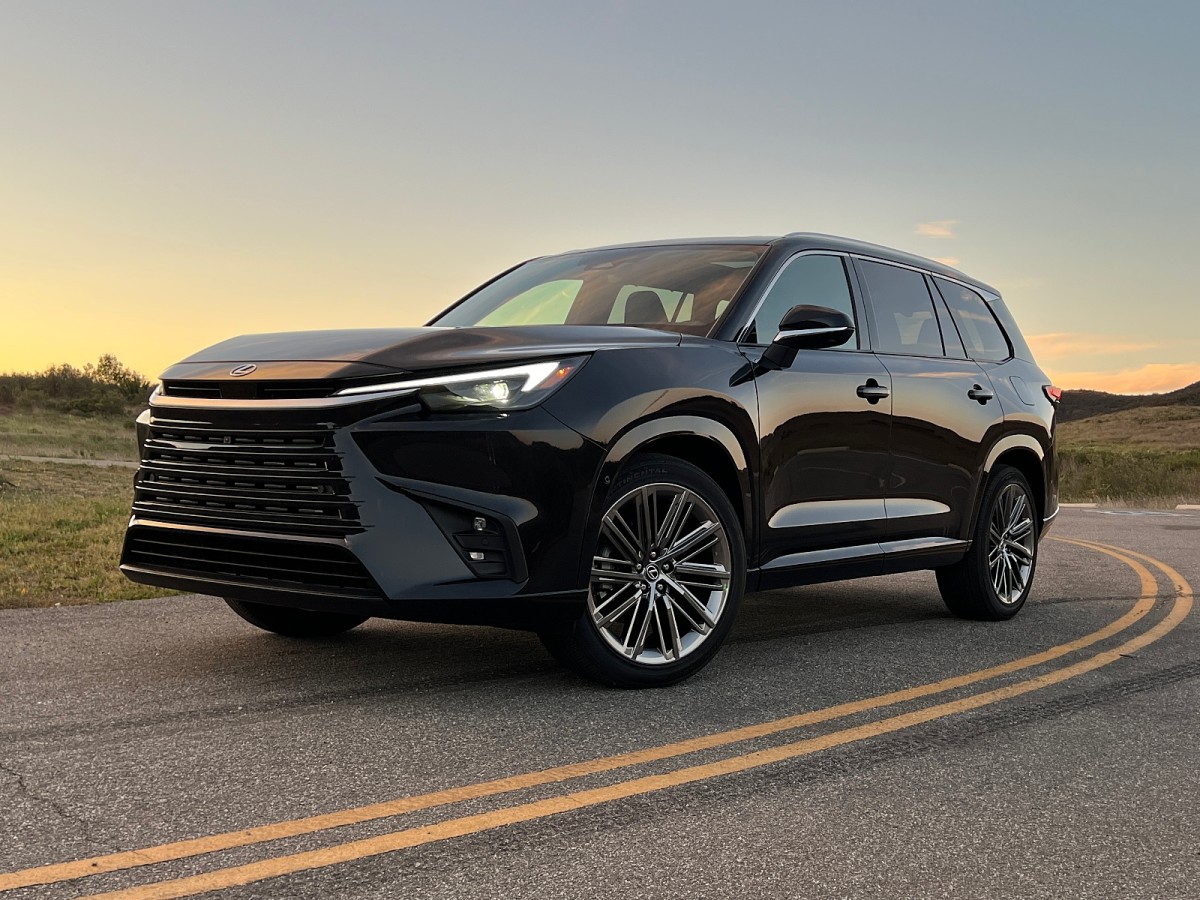
For the 2024 Lexus TX, Lexus based this vehicle on the Toyota Grand Highlander, but the transformation to a luxury SUV was more than convincing. It showcased an upscale appearance that differentiated itself from the Grand Highlander, which resembled a supersized RAV4. The tested model, adorned in Luxury trim, boasted impressive 22-inch silver-finish wheels that significantly enhanced its visual appeal and presence on the road.
Moreover, the TX's design was more subdued compared to other Lexus models. This new direction in styling appeared more conservative and almost anonymous, which might have appealed to those who found prior Lexus designs off-putting. The 2024 Lexus TX came in three trims: TX 350, TX 500h F Sport Performance, and TX 550h+ plug-in hybrid. Prices ranged from $55,050 to $69,350, though the TX 550h+ wasn't available yet; its starting price was projected to exceed $75,000.
The TX 350, likely to be the most sold version, came with a turbocharged four-cylinder engine. Available in base, Premium, or Luxury trims, it could be equipped with either FWD or AWD. The tested TX 350 had FWD, Luxury trim, and a base price of $60,950. With added packages like Convenience and Technology, plus a 21-speaker surround-sound system, the MSRP reached $67,869.
Inside, the Luxury trim provided premium semi-aniline leather and artificial suede upholstery. The Peppercorn interior, a dark brown shade, combined with black-grained trim, made the cabin feel somewhat too dark, even with a panoramic glass sunroof. Yet, overall, the TX 350 Luxury model's interior exuded enough luxury to merit the Lexus badge.
In contrast, the 2024 Kia Sorento underwent its first significant visual update since its debut in 2021, incorporating design elements from the popular Telluride and EV9. This refresh gave the Sorento a more cohesive look with an assertive new front end, sophisticated taillights, and an upscale cockpit.
Externally, the Sorento featured a prominent grille flanked by vertically-stacked LED headlights and wing-like amber LED daytime running lights, giving it a larger, more imposing presence. Higher trims showcased enhanced LED taillights and a series of new wheel designs. The rugged X-Line package and the new X-Pro trim offered more aggressive styling, blacked-out wheels, and all-terrain tires.
Inside, the Sorento sported a new, more streamlined dashboard with combined gauge cluster and infotainment displays under a single glass pane. Higher trims like SX and SX-Prestige featured twin 12.3-inch displays, adding a premium touch. The interior materials improved significantly, with quality stitching, faux open-pore wood grain, and noise-insulating glass in higher trims contributing to an upscale feel.
For those willing to pay, Kia added green and brown interior color options to give the Sorento distinctive character. The 2024 Sorento assembled solidly and felt more upscale compared to other midsize SUVs like the Chevrolet Blazer and Honda Passport.









The 2024 Lexus TX 350 came equipped with a turbocharged 2.4-liter four-cylinder engine, delivering 275 horsepower and 317 pound-feet of torque. It could accelerate to 60 mph in eight seconds with FWD (7.8 seconds with AWD). The engine provided adequate performance for typical driving situations, though it had a grating engine note and hints of torque steer with FWD. Fuel economy for the TX 350 FWD was rated at 23 mpg combined by the EPA, slightly better than its predecessor, the RX L.
The ride and handling of the TX 350 were well-balanced, with a firm yet comfortable suspension. The interior remained quiet on highways, and the steering was accurate with good responsiveness. The brake pedal of the early-build pre-production vehicle felt soft but was easy to modulate.
The 2024 Kia Sorento featured most of its previous mechanical components, with the base 2.5-liter four-cylinder engine producing 191 horsepower and 181 pound-feet of torque. The LX trim’s 0-to-60 mph time was nearly 10 seconds, and its performance was lackluster for a vehicle weighing 3,814 pounds.
Higher trims like EX and above came with a turbocharged 2.5-liter engine generating 281 horsepower and 311 pound-feet of torque. These models had a dual-clutch eight-speed automatic transmission and managed a 0-to-60 time in the mid-seven-second range. They offered lively performance, especially for passing, despite being noisier.
Sorentos were primarily FWD, with AWD available for $2,000 on the S trim and more on EX and SX trims. The AWD models offered the X-Line setup with aesthetic enhancements and additional ground clearance, improving usability without affecting road performance.
The Sorento felt large from behind the wheel, yet it handled corners confidently with well-weighted steering. The brakes performed well, and it offered a quiet, smooth ride. The new X-Pro trim excelled in off-road conditions, equipped with 17-inch rims and all-terrain tires, enhancing ride comfort and traction on loose surfaces. The X-Pro’s engine cooling improvements increased its towing capacity to 4,500 pounds, higher than standard Sorentos’ 2,000 pounds.
While hybrid and PHEV versions of the Sorento offered excellent fuel mileage, the gas-powered models were average, with non-turbo engines achieving 25-to-26 mpg combined and turbo engines only 23 mpg combined.
Lexus's previous attempts at a compelling three-row SUV had fallen short until the 2024 TX addressed all previous issues. The GX and LX prioritized off-roading and came with high price tags, while the RX L was simply too small.
The TX 350 Luxury offered premium semi-aniline leather and artificial suede upholstery with heated and ventilated front seats, heated second-row seats, and a heated steering wheel. The front seats lacked a massage function but were supportive, with a comfortable driving position. The second-row seat, although flat, offered decent comfort with triple-zone climate control and ample USB ports.
Significantly, the TX provided a genuinely habitable third-row seat, unlike the RX L and GX. Adults could even sit comfortably if the second-row seat slid slightly forward. This made the TX far more practical, with enough cargo space even with the third-row in use.
The lack of generous second-row legroom meant sliding the seat forward affected row-two comfort, but this was a trade-off for a better third-row experience. Storage within the cabin was ample, though some compartments were unlined, potentially causing noise. The split front center armrest's narrow opening was less practical, despite noble intentions.
Cargo capacity for the TX was substantial, with 20.2 cubic feet behind the third row, 57.4 cubic feet with the third row folded, and an impressive 97 cubic feet with both rows folded—more than most competitors.
In comparison, the Kia Sorento's cabin remained comfortable in the first two rows but tight in the third. Yet, it offered more advantages over smaller SUVs with standard or optional third-row seats. With 41.4 inches of front legroom and 41.7 inches in the second row, it provided more space than two-row SUVs like the Blazer and Passport. The seats were comfortable and available with heating and ventilation in higher trims.
The third row's 29.6 inches of legroom was better than competitors like the Highlander and Tiguan. While adults wouldn’t enjoy long trips in the back, it was adequate for occasional use by children.
The Sorento’s dashboard layout was ergonomic, with ample small-item storage. However, new dash designs didn’t provide convenient storage areas for purses like the EV9. Cargo space compromised slightly with the third row in use, offering just 12.6 cubic feet. Folding it down expanded the space to 38.5-to-45 cubic feet, and with all seats down, the Sorento offered up to 72.1 cubic feet—more than competitors like the Blazer and almost as much as the Passport. Higher trims also came with a power liftgate for added convenience.
The tested Lexus TX boasted an optional Technology Package with a 12.3-inch digital instrumentation panel, a head-up display, a digital rearview mirror, a surround-view camera, and semi-autonomous parking assist. However, these upgrades came with drawbacks, notably the unmarked dual-purpose steering wheel controls that forced drivers to reference the head-up display—problematic for anyone wearing polarized sunglasses.
Despite these frustrations, the Lexus Interface infotainment system with its 14-inch touchscreen was intuitive, especially with the three-year Drive Connect subscription. This cloud-based navigation and digital assistant featured impressive natural voice recognition capabilities. Wireless Apple CarPlay and Android Auto were easy to connect, and the TX offered 10-year subscriptions to Service Connect and Safety Connect for added connectivity and safety features.
Audiophiles would appreciate the 21-speaker Mark Levinson PurePlay surround-sound system, which delivered exceptional audio fidelity.
In contrast, the 2024 Kia Sorento featured the new “Connected Car Navigation Cockpit” (CCnC) infotainment system, seamlessly integrated into twin 12.3-inch displays on higher trims. Lower trims had a smaller TFT information display. The CCnC system was designed for ease of use, prioritizing popular features on the home screen, with stylish graphics aiding its appeal.
While navigation was standard on all but the base LX, wireless Apple CarPlay and Android Auto connectivity were available on all trims, and the system supported over-the-air updates for future-proofing. However, the voice commands remained a weak point, with inconsistent performance.
The Sorento featured plenty of USB-C outlets in all three rows and an auxiliary jack for older devices. Most trims came with a six-speaker audio system, while the SX-Prestige offered a 12-speaker Bose surround-sound system, delivering impressive audio quality.
SX and SX-Prestige trims also provided the Digital Key 2.0, enabling certain phones and NFC smart cards to lock, unlock, and drive the vehicle without the traditional key—a handy feature for families with teenage drivers.
The 2024 Lexus TX included numerous advanced driving assistance systems (ADAS) grouped under Lexus Safety System+ 3.0. These included adaptive cruise control with curve speed adjustment, forward-collision warning with pedestrian detection, automatic emergency braking, intersection assist, lane-departure warning, lane-keeping assist, lane-centering assist, road sign assist, and automatic high-beam headlights.
Proactive Drive Assist, part of LSS+ 3.0, offered automatic braking to maintain a safe following distance and steering assistance to avoid obstacles. While effective, it wasn't entirely transparent in operation. Additionally, uncertainties over brake light activation when the SUV automatically slowed prompted the feature to be turned off during testing.
Blind-spot monitoring, rear cross-traffic alert, and a safe exit assist system were standard. Options included front and rear parking sensors with automatic braking, front cross-traffic alert, and traffic jam assist for hands-free driving on approved highways.
The overall performance of LSS+ 3.0 systems was smooth and effective, though some annoyances, like the sharp slowing when other vehicles cut in line and the lack of urgency in accelerating back to speed, were noted.
For the 2024 Kia Sorento, the Drivewise suite of active safety features was a highlight, offering an extensive list of standard and optional systems with improved sensors and machine-learning features. Standard features included adaptive cruise control with stop and go, forward automatic emergency braking with pedestrian and cyclist detection, intersection assistance, lane-following and lane-keeping assist, rear cross-traffic alert with emergency braking, blind-spot monitoring, and safe exit warnings.
Advanced options included navigation-based adaptive cruise control, Highway Driving Assist, and on the SX-Prestige, Highway Driving Assist 2 with automated lane changes. The surround-view cameras were helpful for off-road endeavors, and the SX-Prestige offered a rear-view camera mirror for situations where rear visibility was compromised.
The IIHS awarded “Good” ratings for the 2024 Sorento in several tests, though the LATCH system earned an “Acceptable” rating due to deep lower anchors. The NHTSA had yet to evaluate the 2024 Sorento, though previous models received four-star overall ratings.
CarGurus highlights

According to CarGurus experts, the overall rating for the 2024 Lexus TX is 7.2 out of 10, while the 2024 Kia Sorento scores 8.7 out of 10. Based on these ratings, the 2024 Kia Sorento stands out as the better choice, offering a more comprehensive package of features, performance, and comfort at a more accessible price point. If advanced technology, a versatile interior, and a higher value proposition are key factors in your decision, the new Sorento should be your pick. The Lexus TX, however, is an excellent option for those who prioritize luxury, a comfortable third-row, and quieter ride characteristics.
Choose the 2024 Kia Sorento if:
- You want a well-equipped midsize SUV with a diversity of standard and optional advanced safety features.
- The versatility of seating configurations and available features for improved off-road capability and towing capacity matter to you.
- You appreciate upscale interior touches and comprehensive technology offerings at a more accessible price point.


Choose the 2024 Lexus TX if:
- You require a spacious and genuinely usable third-row seat without compromising passenger comfort.
- You desire a quieter, more refined ride with upscale interior materials and finishes.
- Advanced connectivity features and premium audio quality are priorities for your driving experience.


CarGurus highlights
According to CarGurus experts, the overall rating for the 2024 Lexus TX is 7.2 out of 10, while the 2024 Kia Sorento scores 8.7 out of 10. Based on these ratings, the 2024 Kia Sorento stands out as the better choice, offering a more comprehensive package of features, performance, and comfort at a more accessible price point. If advanced technology, a versatile interior, and a higher value proposition are key factors in your decision, the new Sorento should be your pick. The Lexus TX, however, is an excellent option for those who prioritize luxury, a comfortable third-row, and quieter ride characteristics.
Choose the 2024 Kia Sorento if:
Shop Now- You want a well-equipped midsize SUV with a diversity of standard and optional advanced safety features.
- The versatility of seating configurations and available features for improved off-road capability and towing capacity matter to you.
- You appreciate upscale interior touches and comprehensive technology offerings at a more accessible price point.
Choose the 2024 Lexus TX if:
Shop Now- You require a spacious and genuinely usable third-row seat without compromising passenger comfort.
- You desire a quieter, more refined ride with upscale interior materials and finishes.
- Advanced connectivity features and premium audio quality are priorities for your driving experience.

By: CarGurus + AI
At CarGurus, our team of experienced automotive writers remain at the heart of our content operation, conducting hands-on car tests and writing insightful guides that are backed by years of industry experience. To complement this, we are harnessing AI to make our content offering more diverse and more helpful to shoppers than ever. To achieve this, our AI systems are based exclusively on CarGurus content, ratings and data, so that what we produce is both unique to CarGurus, and uniquely helpful to car shoppers.

