2024 Lexus TX Reviews, Pricing & Specs


Pros & cons
What we like
Multiple powertrain options
Comfortable and quiet cabin
Impressive technology
What to consider
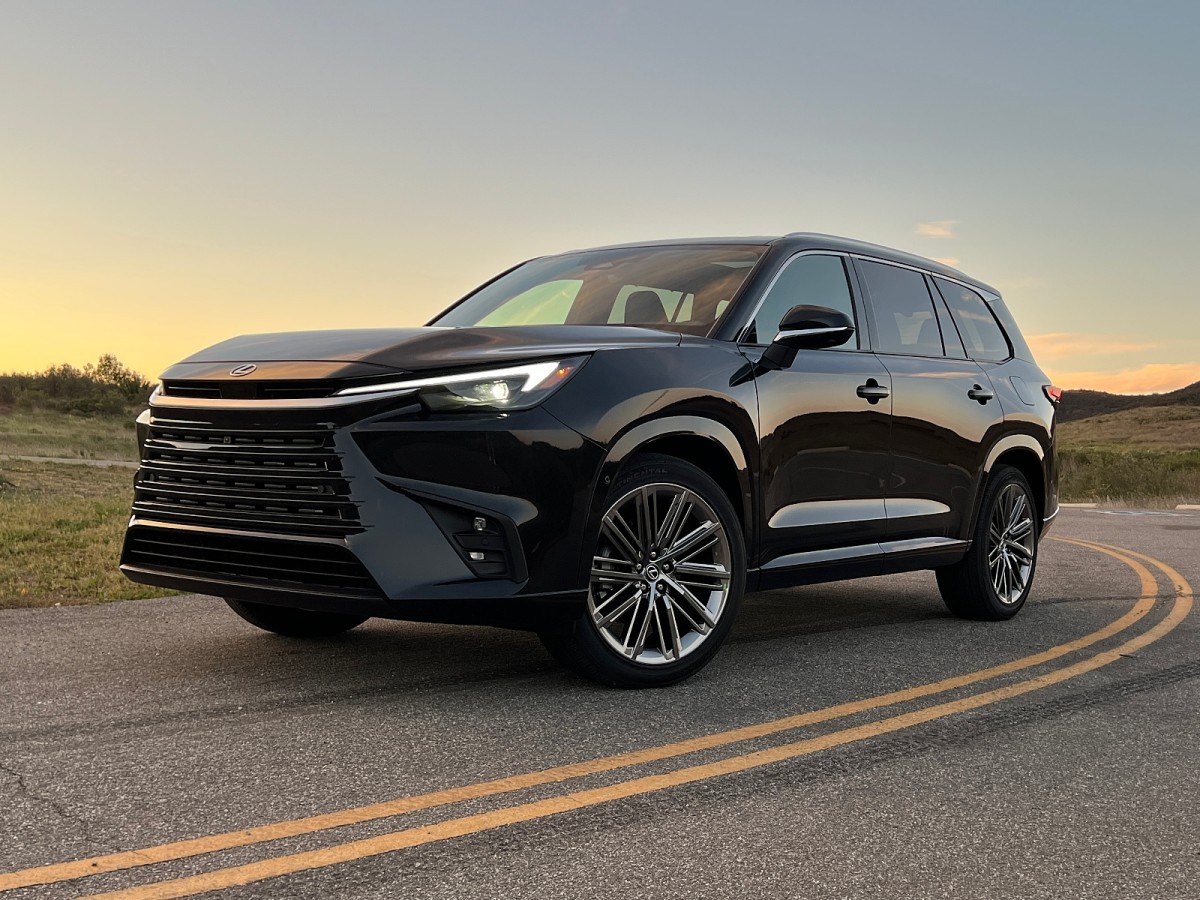
Potentially polarizing front styling
TX 350 engine lacks expected refinement
Aggravating steering-wheel controls
Expert review
With the arrival of the 2024 TX, Lexus finally has a credible three-row crossover SUV.
Verdict: Lexus has sold three-row SUVs in the past. But they were either originally engineered for serious off-roading (GX), too expensive (LX), or too cramped for third-row passengers (RX L). The 2024 Lexus TX is none of these things, making it perfect for the typical three-row luxury SUV buyer who spends almost all their time on paved roads. Overall, based on our week testing a TX 350 Luxury model, this new Lexus SUV gets most things right.
out of 10 expert review
Look & feel
Lexus bases the new 2024 TX on the Toyota Grand Highlander, but the TX is different enough to convincingly serve as a luxury SUV.
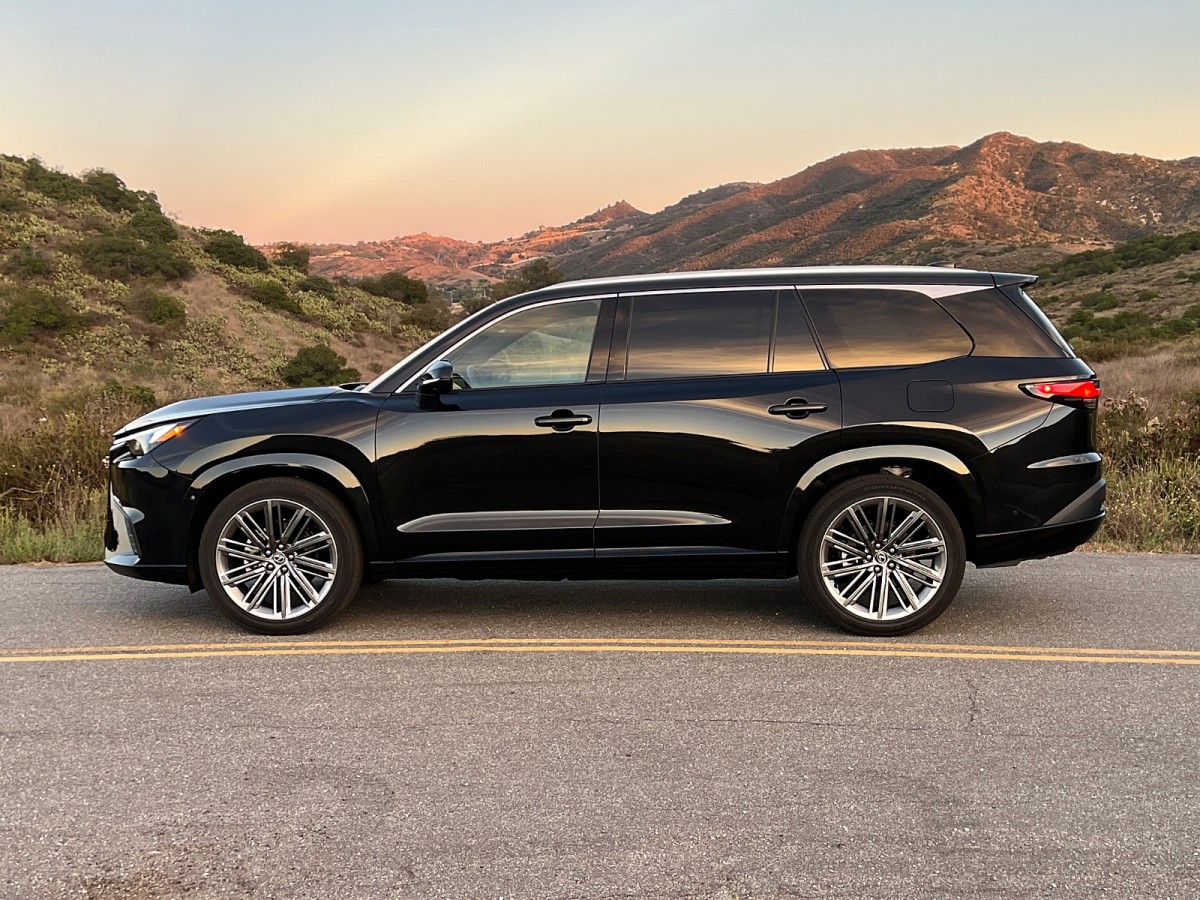
For starters, the Lexus looks upscale, whereas the Grand Highlander resembles a jumbo-sized RAV4. Our test model, equipped with Luxury trim, had great-looking 22-inch wheels in a silver finish, an expensive option that dramatically improves the SUV’s appearance and presence.
In addition, the TX’s styling is toned down compared to other Lexus models. The result is more conservative, bordering on anonymous, but if the automaker’s design has turned you off in the past, you might find the TX just right.
The new 2024 Lexus TX comes in TX 350, TX 500h F Sport Performance, and TX 550h+ plug-in hybrid model series. Prices range from $55,050 to $69,350, but Lexus isn’t selling the TX 550h+ yet, and we wouldn’t be surprised if it started over $75,000. These prices include the $1,350 destination charge.
We elected to test the TX 350 since it will likely be the volume-selling version. It comes in a base level of specification, and you can get Premium or Luxury trim. Every TX 350 has a turbocharged four-cylinder engine and front-wheel drive (FWD) or all-wheel drive (AWD).
Our test vehicle arrived with FWD and Luxury trim, with a base price of $60,950, including the destination charge. It had a Convenience Package, a Technology Package, a 21-speaker surround-sound audio system, side puddle lamps, and rear cargo lamps. All told, the manufacturer’s suggested retail price (MSRP) came to $67,869, including destination.
Luxury trim adds upgraded ambient interior lighting and premium semi-aniline leather upholstery with artificial suede trim to the TX 350. Our test vehicle had a Peppercorn interior, which is a dark brown that is hard to distinguish from black. Combined with the black-grained trim, the cabin looked and felt too dark, even with the panoramic glass sunroof.
However, in most respects, the TX 350 Luxury model’s interior looks and feels luxurious enough for the SUV to wear a Lexus badge.

Performance
Lexus equips the TX 350 with a turbocharged 2.4-liter four-cylinder engine. That sounds like a bad idea in a midsize, three-row, luxury SUV, but it works well enough for typical driving situations with no more than four people aboard. Only its grating engine note and, with FWD, hints of torque steer cause irritation.
The engine makes 275 horsepower and 317 pound-feet of torque, and Lexus claims it accelerates a TX 350 to 60 mph in eight seconds (7.8 seconds with AWD). The SUV feels quicker than that, though, thanks to the swell of torque as it gathers speed. Still, the performance can be described only as adequate.
According to the EPA, the official fuel economy rating for the TX 350 FWD is 23 mpg in combined driving. That’s barely an improvement over the old three-row Lexus RX L with a 3.5-liter V6 engine, which carried an official rating of 22 mpg in combined driving and supplied 290 horsepower and 263 pound-feet of torque. During testing, the TX 350 FWD averaged 20.4 mpg.
Lexus charges $1,600 for AWD. It produces slightly quicker acceleration while reducing the city and highway fuel economy numbers (but not the 23-mpg combined rating). More importantly, it gives you added traction in rain and snow and likely limits the tendency for the FWD model to spin its front wheels when making quick exits from shopping centers and subdivisions onto larger streets and roads. The TX 350 AWD probably doesn’t suffer torque steer, either.
The ride and handling are just right. The TX 350’s suspension is firm enough to give you a sense of the road surface but compliant enough to ensure a comfortable ride. Body motion control is commendable, and the steering is accurate with proper weighting and responsiveness. In addition, on the highway, the interior is quiet.
Our test car, an early-build pre-production vehicle, had a brake pedal that felt too soft. But, it proved easy to modulate, so bringing the TX to a clean, smooth stop was no trouble.

Form & function
Previous attempts by Lexus to build a compelling three-row SUV have fallen short. The Lexus GX is made for off-roading, compromising its on-road driving dynamics. The Lexus LX has the same problem, plus a sky-high price tag. The Lexus RX L was too small, and the third-row seat was useful only for children.
The new 2024 Lexus TX rectifies all these problems, begging the question: “What took so long?”
Our TX 350 Luxury had all the extras, including premium semi-aniline leather and artificial suede upholstery, heated and ventilated front seats, heated second-row seats, and a heated steering wheel. It came with the standard second-row bench seat, but heated and ventilated captain’s chairs are an option.
Though comfortable, the front seats did not have a massage function, which you might expect in this class. Nevertheless, finding a supportive driving position is easy, and the power tilt-and-telescopic steering wheel is comfortable to grip.
Thanks to its relatively flat lower cushion, the second-row seat isn’t quite as welcoming. Still, with triple-zone automatic climate control, dual USB charging ports, and manual side window shades that cover nearly all of the glass, it meets expectations in the segment.
Fortunately for Lexus, the TX provides a habitable third-row seat. Adults fit, making the TX better than the old RX L. The seat isn’t flat on the floor or squished against the tailgate, making the TX better than the old GX. And the TX is considerably more affordable than the LX.
We found that if you slide the second-row seat forward an inch or two, a tall person will be comfortable enough in the third-row seat. The stadium-style bottom cushion sits high enough above the floor to provide leg support, and the side windows are large with a good view. Plus, the TX still offers some cargo space with the third-row seat in use.
Unfortunately, moving the second-row seat forward an inch or two means those passengers are unhappier. The TX doesn’t have generous second-row legroom to start with, so making space for third-row occupants noticeably dents row-two comfort.
As for utility, the Lexus TX has numerous storage slots, cubbies, trays, and bins. Many lack a lining, which might contribute to noise and vibration depending on what’s stored in them. Also, while the split front center armrest design is rooted in good intentions, the narrow opening you get when raising just one armrest to access the storage bin below isn’t worth it.
Cargo space measures 20.2 cubic feet behind the third-row seat, a decent amount. There isn’t much storage under the load floor, and Lexus doesn’t provide wells for gallon-size milk jugs or wine bottles. A couple of hooks might support a few plastic grocery sacks, and the test vehicle had optional cargo area lighting that cost $399.
Power-fold the third-row seats, and the TX provides a generous 57.4 cubic feet of cargo space. That’s plenty for a lengthy road trip. Fold the second-row seats down, and the TX swallows an impressive 97 cubic feet of cargo, considerably more than any other Lexus SUV and most, if not all, competitors.

Technology
Our Lexus TX had the optional Technology Package, which equips the SUV with a 12.3-inch digital instrumentation panel, a head-up display, a digital rearview mirror, a surround-view camera, and a semi-autonomous parking assist system.
If you skip it, you might be happier. You’ll miss having the larger instrumentation display, and the surround-view camera is undeniably helpful. But with this upgrade, Lexus infuriatingly replaces the properly marked steering wheel controls with an unmarked dual-purpose set that distracts drivers by forcing them to reference the head-up display to use them. Worse, the head-up display is frequently invisible to anyone wearing polarized sunglasses.
That approach just doesn’t make any sense and leads to unnecessary dissatisfaction with the SUV, a bullet Lexus could have easily dodged.
Aside from this aggravation, the Lexus Interface infotainment system and its 14-inch touchscreen display are agreeable enough, especially when the complimentary three-year Drive Connect subscription is active. Drive Connect equips the TX with a cloud-based navigation system, but more importantly, it adds a digital assistant with impressive natural voice recognition capability.
Lexus Interface also includes wireless Apple CarPlay and Android Auto. We had no trouble connecting, and it’s easy to switch between the smartphone integration and the native Lexus system.
In addition to Drive Connect, the TX offers free 10-year subscriptions to Service Connect and Safety Connect, the latter equipping the Lexus with automatic collision notification, emergency calling, a stolen vehicle locator, and more. Wi-Fi Connect gives you access to a Wi-Fi hotspot, while Remote Connect provides app-based access to remote engine starting, a car-finder function, and digital key access to the vehicle.
Our test vehicle had the optional 21-speaker Mark Levinson PurePlay surround-sound system, and it provides impressive fidelity, making it worth the upgrade for audiophiles.

Safety
Lexus equips the TX with numerous advanced driving assistance systems (ADAS). Grouped under the Lexus Safety System+ 3.0 (LSS+ 3.0) umbrella, they include adaptive cruise control with curve speed adjustment, forward-collision warning with pedestrian detection, automatic emergency braking, intersection assist, lane-departure warning, lane-keeping assist, lane-centering assist, road sign assist, and automatic high-beam headlights.
Proactive Drive Assist is also part of LSS+ 3.0. If you’ve turned this feature on through the ADAS menu in Lexus Interface, it proactively brakes to help you maintain a safe following distance to vehicles ahead, and it can add steering assistance to avoid obstacles. Generally, it works smoothly, though not transparently. Also, it isn’t clear whether or not the brake lights illuminate when the SUV automatically slows. Ultimately, we turned this feature off.
In addition to LSS+ 3.0, the TX features blind-spot monitoring, rear cross-traffic alert, and a safe exit assist system. Options include front and rear parking sensors with automatic braking, front cross-traffic alert, and traffic jam assist.
The traffic jam assist system works at low speeds to provide hands-free driving on approved, limited-access highways. It was briefly activated during the evaluation and worked well for the short time it took over the driving. Lexus does not offer a higher speed, hands-free driving assist system for the TX.
Overall, LSS+ 3.0 proved smooth, accurate, and effective, and it successfully ignored left and right turning lanes as well as freeway exit and entrance ramps. The exception is when other motorists cut into the gap ahead of the TX. In these situations, the SUV slowed too dramatically, causing aggravation in the drivers following the TX. Worse, the Lexus wasn’t in much of a hurry to accelerate back up to speed.

Cost-effectiveness
We peg the new 2024 Lexus TX as a rival to midsize luxury SUVs with standard three-row seating. The list includes the Acura MDX, Audi Q7, Buick Enclave, Cadillac XT6, Infiniti QX60, Land Rover Discovery, Lincoln Aviator, and Volvo XC90.
Among these, the Lexus TX is more expensive than some but more affordable than others. The Land Rover performs better off-road, while the Audi and Volvo provide an extra dose of class and refinement. None of these rivals comes in a performance-tuned hybrid variant (TX 500h F Sport Performance), and in 2024, only the Volvo XC90 offers a plug-in hybrid powertrain like the Lexus TX 550h+.
But, there are two unexpected alternatives if you step down into premium-brand territory. One is the Jeep Grand Cherokee L in one of its upper trim levels. The other is the Mazda CX-90, which has a sweet turbocharged inline six-cylinder engine, rewarding driving dynamics, and plenty of luxury. You can even get the CX-90 in a plug-in hybrid format.
While we recommend the Mazda for its substance, we recognize that it’s not a product of a luxury brand. So, among the competitors from traditional Lexus rivals, the TX strikes us as an appealing alternative well positioned to carve out a piece of the midsize luxury SUV pie.
Better late than never, right?


What owners say
Trims & specs
Base MSRP $58,540 | Seating 7 |
Engine 2.4L 275 hp I4 | Cargo Capacity 20.2 cu ft |
Combined MPG 23 | Drivetrain AWD |
Base MSRP $56,940 | Seating 7 |
Engine 2.4L 275 hp I4 | Cargo Capacity 20.2 cu ft |
Combined MPG 24 | Drivetrain FWD |
Base MSRP $63,690 | Seating 7 |
Engine 2.4L 275 hp I4 | Cargo Capacity 20.2 cu ft |
Combined MPG 23 | Drivetrain AWD |
Base MSRP $62,090 | Seating 7 |
Engine 2.4L 275 hp I4 | Cargo Capacity 20.2 cu ft |
Combined MPG 24 | Drivetrain FWD |
Base MSRP $59,740 | Seating 7 |
Engine 2.4L 275 hp I4 | Cargo Capacity 20.2 cu ft |
Combined MPG 24 | Drivetrain FWD |
Base MSRP N/A | Seating N/A |
Engine N/A | Cargo Capacity N/A |
Combined MPG N/A | Drivetrain N/A |
Base MSRP $61,340 | Seating 7 |
Engine 2.4L 275 hp I4 | Cargo Capacity 20.2 cu ft |
Combined MPG 23 | Drivetrain AWD |
Base MSRP N/A | Seating N/A |
Engine N/A | Cargo Capacity N/A |
Combined MPG N/A | Drivetrain N/A |


Pricing trends
MSRP range
$53,700 - $61,200
Current avg. market price
$51,846
Trending down by 1.2% this month
May 2026 - October 2026