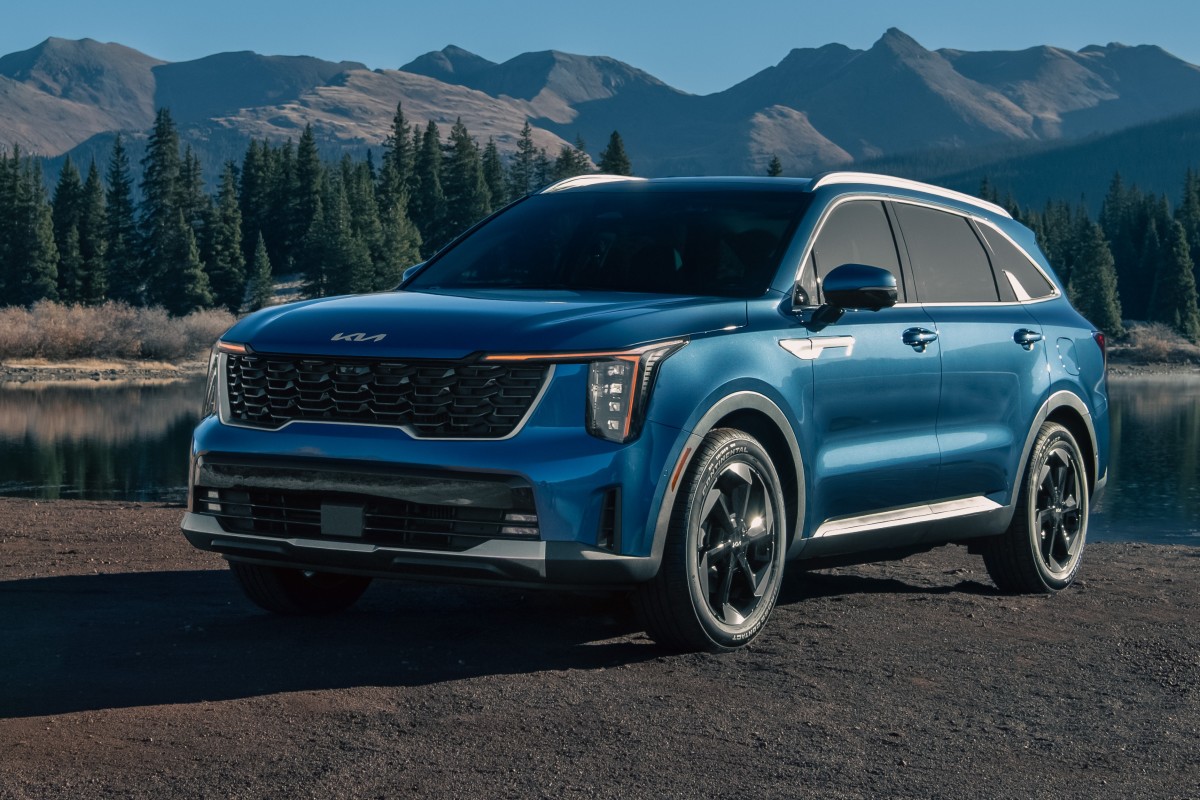
2026 Lexus TX Reviews, Pricing & Specs


Pros & cons
What we like
Multiple powertrain options
Plenty of cargo space
Spacious third row
What to consider
Unintuitive technology
Interior materials feel cheap
The CarGurus verdict
This three-row SUV gives Lexus shoppers a spacious option.
You may not have heard much about the Lexus TX, the company’s full-size three-row SUV. Introduced for the 2024 model year, it’s still a young’un compared to its competition, but has made its mark by offering a spacious interior and three different powertrains, wrapped in a stylish package.
In Lexus’ seven-model SUV lineup, the TX slots between the GX and LX—two body-on-frame models focused on off-roading. You can snag a gas-powered TX or one with a hybrid powertrain, but for this review we're focused on the 550h+ plug-in hybrid model. The PHEV offers the most power and best fuel economy, but also has the highest price.
Verdict: The 2026 Lexus TX 550h+ is a great option for large families that need a spacious third row, but some of the technology comes with a steep learning curve.
out of 10 expert review
Look & feel
For 2026, the TX is available in a variety of trim levels depending on the powertrain. The TX 350 comes in Base, Premium, Luxury, and F Sport Handling specs, while the 500h hybrid can be had in F Sport Performance Premium and F Sport Performance Luxury trims. The 550h+ plug-in hybrid is only available in the top Luxury trim.
There are few changes for the 2026 model year, but the 550h+ now has a standard panoramic glass roof that floods the cabin with sunlight and the newly available Matador Red Mica paint helps the TX stand out from common grays and silvers. Most models get 20-inch wheels, but our 550h+ goes big with standard 22-inch platters that fill out the wheel wells.
The grille is still large, retaining some of the older “spindle grille” shape, but it doesn’t draw focus from the sharp bi-LED headlights. The rear LED lighting spans the width of the vehicle, topped off by a small roof spoiler. Roof rails are also included for those who want to add a rack or other storage.
While most TX models come with two interior color options—a kind of light grey called Birch and your standard Black—the PHEV adds a dark brown called Peppercorn. Ambient lighting brings warmth to the cabin and there is some lovely suede trim over the glovebox on the passenger side. However, overall material quality isn’t up to luxury car standards, with plenty of basic plastic scattered about. If top-notch materials are what you’re after, take a look at the Volvo XC90 or the Mercedes-Benz GLE plug-in hybrids.
Lexus also redesigned the door handles, solving a problem that didn’t exist. On the outside, handles merely react to pressure and don’t actually pull out or engage any kind of mechanical lever to open the door. Inside, you open the door by pushing on a handle, not pulling it. It’s not a deal-breaker but we’d rather have some more attention to detail in the cabin in lieu of reimagined door handles.

Performance
While the base model can eke out 317 horsepower from its turbocharged 2.4-liter four-cylinder engine, our plug-in hybrid test car generated 404 ponies from its 3.5-liter V6 and hybrid system. The onboard seven-kilowatt charger isn’t the quickest, but we were able to get a full battery in just under three hours plugged into a home charger.
We really like all the drive options you get in the TX. If you don’t have access to a home charger, then the TX has a charge mode that uses the gasoline engine to drive the car and simultaneously charge the battery. You can also drive the TX using only electric power, as a standard hybrid, combining gasoline and electricity, or tell it only to use the gas engine, saving the electric power for later. This is especially useful if you live near a city that has congestion charging in place.
You can further dial in your ride by using Normal, Eco, Sport, or Custom drive modes. We spent most of our time in Normal mode, but Sport mode increases throttle sensitivity for a more immediate response. It’s not the most aggressive Sport mode we’ve ever driven, but then again, the TX 550h+ isn’t meant to be a sports car. If you want handling, then the standard 500h hybrid with adaptive suspension and rear steering would be more to your liking, even if it’s down 38 hp on the plug-in hybrid.
The 550h+ gives buyers a quiet and smooth ride, with no jerks or hiccups when it switches between gas and electric power. The suspension easily soaks up bumps and potholes, even on a washboard dirt road, and the brakes are firm and linear without being touchy or grabby. This is the car we’d want for a long road trip.
The all-wheel drive (AWD) system can put all the power to the front wheels, 80% of the power to the rear wheels, or anywhere in between. A Trail Mode helps maintain traction on wet and slippery surfaces, too.

Form & function
Inside the 550h+ you’ll get the standard luxury features you’d expect of a car in this class, but nothing more. Multi-zone climate control is here, as are heated and cooled front seats and heated second-row seats. Our test car came with captain’s chairs in the second row with a removable center console, but some trims have a bench seat.
The third row is remarkably spacious, with a recline function and plenty of headroom, so full-sized adults won’t mind sitting back there. Each seat also gets its own cupholder and USB-C port.
A one-touch button on the shoulder of the second row tilts and slides the seat forward for easy entry into the third row, but it’s a bit more complicated to get that second row to fold flat. A series of levers have to be flipped in a particular order and since the seat automatically moves forward, you might struggle to get it to lie flat, depending on how far back your front-row seat is. With our driving position, we had to consistently fight with the second-row seat to keep it from moving too far forward.
The front seats are roomy, but could do with more thigh support. The heating function is excellent, remaining active through key cycles and never turning itself off. The cupholders are similarly great—able to accommodate both large and small water bottles but also removable if road sodas aren’t your thing.
Most of the climate controls are on the screen, but Lexus had enough sense to keep the temperature controls as physical dials. Drivers can also set the climate controls to an Eco setting to save battery charge, but it really cuts down on the effectiveness. We kept the system in Normal and didn’t feel like it ate into the charge all that much.
A large bin in front of the gearshift can accommodate small items, and the center console is narrow but deep. However, it has a dual-opening lid that limits access. You’re either squeezing your hand through one half of the opening or reaching your arm awkwardly over the lid when both sides are open.
Every TX has excellent cargo space for the class—even models that need to accommodate a battery pack. With all three rows of seats in place, 20.2 cubic feet of cargo space is accessible by an available kick sensor in the liftgate. When the power-folding third row is flat, cargo space expands to 57.4 cubic feet and, when the second row is folded, the total space is 97 cubic feet. All TX models can tow up to 5,000 pounds.

Technology
The tech in the Lexus TX is hit or miss. While the 14-inch color touchscreen is easy to use and reacts quickly to inputs, some features lack polish. We couldn’t find a way to manually input a satellite radio station, so we had to scan the channels from 07 to 311. Granted, once a preset is recorded, this action need not be repeated again, but it seems like a strange bit of code to leave out.
Buttons on the steering wheel control the likes of volume (there's a physical volume knob as well) and adaptive cruise control. However, these are multi-functional buttons and aren’t labeled. Instead, a mirror of the button appears on the 12.3-inch gauge cluster showing their current function. We felt there was no rhyme or reason to get the button to switch between, say, adaptive cruise and regular cruise control functionality, while setting and resuming our speed was complicated.
Wireless Apple CarPlay and Android Auto are standard but sometimes don't play well with the native audio system. A few times, the infotainment system would randomly kick us off satellite radio in favor of Apple CarPlay for no apparent reason.
Still, smartphone connectivity is pretty much a necessity as owners need a subscription to access in-dash navigation. Other subscription offerings include a voice assistant, digital key via the Lexus app and remote start and lock/unlock, but we didn’t have access to an active account to try out these features.
The back-up camera is clear and crisp, and features an available bird’s-eye, see-through view to let drivers know if their tire is about to hit a curb or other obstacle. And if you don’t want to park the car yourself, the available Advanced Park system can take care of shifting, throttle, and steering duties in both parallel and perpendicular spaces. Our tester also came with the available rear-camera mirror, which provides a video feed to the rear view mirror for an unobstructed view.
With seven USB ports and wireless charging, there is no reason for any device to run out of juice. The second row even has an available 120-volt/1500-watt outlet to plug in larger items such as laptops or Starlink WiFi systems.

Safety
Every Lexus TX gets the company’s Safety System+ 3.0 as standard. This includes forward collision warning with automatic emergency braking, Lane Tracing Assist lane centering, lane departure warning with steering assist, traffic sign recognition, and Proactive Driving Assist. The latter acts as a helper, gently applying the brakes or steering if it senses the vehicle is getting too close to another car, pedestrian or bicyclist. Frankly, this is a feature we always turn off in Lexus test cars, because it comes on at what seems like random times.
Once we figured out how to set up the adaptive cruise control through the terribly confusing steering wheel controls, we found that it worked well. The car got on the brakes a bit hard when another driver cut in front of us in stop-and-go traffic and was slow to get back up to speed, but it mostly handled busy scenarios cleanly. You can even go hands-free via a subscription.
The National Highway Traffic Safety Association (NHTSA) hasn’t released safety ratings for the 2026 Lexus TX 550h+, but the TX 350 and the TX 500h both earned five out of five stars. The Insurance Institute for Highway Safety (IIHS) gave the TX a mid score of “Acceptable” in its small overlap front crash test on the driver’s side and a top score of “Good” for the passenger’s side. Driver and passenger injury measures all got a score of “Good”.

Cost-effectiveness
The main benefit of owning a plug-in hybrid is the ability to cruise on electricity alone for short trips but still have the flexibility of a standard hybrid for longer sojourns. Lexus says the 550h+ has an all-electric range of 33 miles and we got closer to 40 miles in testing, but the Mercedes GLE plug-in hybrid tops that with up to 50 miles of electric range.
Once the battery is drained, the TX gets an EPA-estimated 29 mpg combined, which beats the aforementioned GLE as well as the Volvo XC90 and the Mazda CX-90 PHEVs. If total range is what you’re looking for, the Volvo can go 530 miles on a tank of gas and a full battery, while the Lexus manages 450 miles.
Lexus provides pretty standard warranty coverage for the class. You’ll get basic coverage for four years or 50,000 miles, a powertrain warranty of six years or 70,000 miles, and a hybrid battery warranty of 10 years or 150,000 miles. Corrosion and parts warranty are standard, as is complimentary maintenance for the first year or 10,000 miles and four years of roadside assistance.
While the base 2026 Lexus TX 350 with front-wheel drive (FWD) starts at under $60,000 (including $1,450 for destination), our top spec AWD 550h+ costs a good bit more. You’ll be out at least $80,960, but our test vehicle was equipped with the $2,380 Technology package, which includes the digital rearview mirror, head-up display, 360-degree camera system and remote parking. The 120-volt outlet added $560 to the bill and, after a few more dribs and drabs, the total as-tested price is $85,863.
Meanwhile, the plug-in hybrid version of the Mercedes GLE starts at $73,500 with destination and the Volvo XC90 starts at $77,495 in plug-in hybrid form. Neither can compete with the Lexus in terms of space, but both have more refined interiors and the Mercedes has much more intuitive technology. If you really want to save some money, the top Premium Plus trim of the Mazda CX-90 PHEV can be had for just a smidge over $60,000, including destination. Its technology can be a bit frustrating but its driving dynamics are excellent.
While the 2026 Lexus TX 550h+ is a comfortable three-row SUV for families on the go, it lacks the driving dynamics and luxury features of some of its competitors. However, for those who put a high priority on space and comfort, the TX delivers.

What owners say
Trims & specs
Base MSRP $63,690 | Seating 7 |
Engine 2.4L 275 hp I4 | Cargo Capacity 20.2 cu ft |
Combined MPG 23 | Drivetrain AWD |
Base MSRP $62,090 | Seating 7 |
Engine 2.4L 275 hp I4 | Cargo Capacity 20.2 cu ft |
Combined MPG 24 | Drivetrain FWD |
Base MSRP $61,340 | Seating 7 |
Engine 2.4L 275 hp I4 | Cargo Capacity 20.2 cu ft |
Combined MPG 23 | Drivetrain AWD |
Base MSRP N/A | Seating N/A |
Engine N/A | Cargo Capacity N/A |
Combined MPG N/A | Drivetrain N/A |
Base MSRP $59,740 | Seating 7 |
Engine 2.4L 275 hp I4 | Cargo Capacity 20.2 cu ft |
Combined MPG 24 | Drivetrain FWD |
Base MSRP N/A | Seating N/A |
Engine N/A | Cargo Capacity N/A |
Combined MPG N/A | Drivetrain N/A |
Base MSRP N/A | Seating N/A |
Engine N/A | Cargo Capacity N/A |
Combined MPG N/A | Drivetrain N/A |
Base MSRP $56,940 | Seating 7 |
Engine 2.4L 275 hp I4 | Cargo Capacity 20.2 cu ft |
Combined MPG 24 | Drivetrain FWD |
Base MSRP $66,210 | Seating 6 |
Engine 2.4L 275 hp I4 | Cargo Capacity 20.2 cu ft |
Combined MPG 23 | Drivetrain AWD |
Base MSRP $58,540 | Seating 7 |
Engine 2.4L 275 hp I4 | Cargo Capacity 20.2 cu ft |
Combined MPG 23 | Drivetrain AWD |
Base MSRP N/A | Seating N/A |
Engine N/A | Cargo Capacity N/A |
Combined MPG N/A | Drivetrain N/A |
Base MSRP N/A | Seating N/A |
Engine N/A | Cargo Capacity N/A |
Combined MPG N/A | Drivetrain N/A |


Pricing trends
MSRP range
$56,940 - $66,210
Current avg. market price
$62,774
Trending down by 0.7% this month
May 2026 - October 2026