2024 Kia Sorento Reviews, Pricing & Specs
Write a review$31,990 to $47,390
Original MSRP
8.7
of 10
expert review
avg user rating
(0 reviews)
Pros
Practical and family-friendly
Standard advanced safety features
Stylish design
Cons
Larger Telluride doesn’t cost much more
Underwhelming base engine
Cramped third row
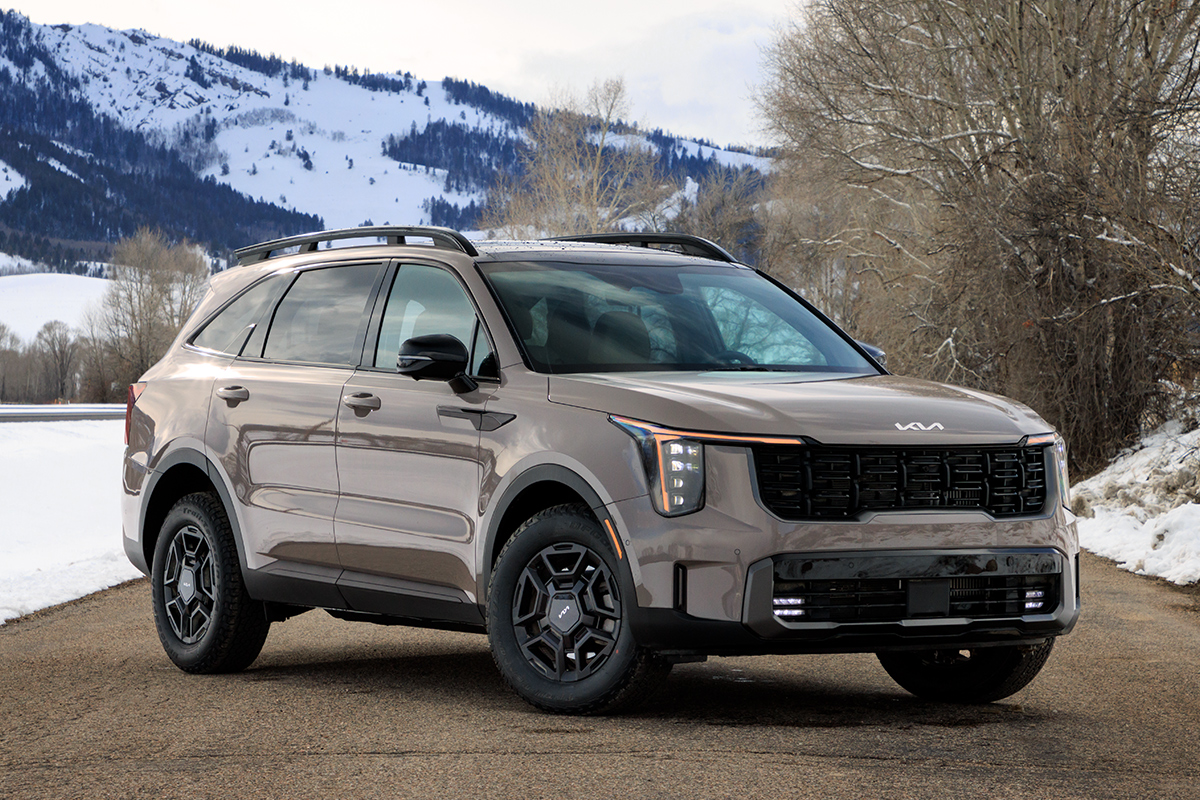
With style and tech upgrades, the 2024 Kia Sorento improves the model’s value-packed, family-friendly recipe.
On the small end of the midsize SUV spectrum, the Sorento is a classic in-betweener. It’s big enough to get a standard third row and has more room than compact crossovers like the Toyota RAV4, but it’s smaller and cheaper than most three-row midsizes, including Kia’s Telluride and the Ford Explorer. Gas-powered 2024 Sorentos get a visual glow-up as well as major infotainment and safety system updates, and a new X-Pro trim. Hybrid and PHEV Sorentos, which we review separately, won’t get these changes until 2025.
Verdict: The 2024 Kia Sorento’s new looks make it seem bigger and fancier, and the X-Pro adds capability. There are more safety features and the Sorento’s tech is even easier to use. Demerits remain, namely the diminutive third row and pricey top trims, but the 2024 Sorento has lots to offer family buyers.

2024 marks the first major visual update for the current-generation Sorento, which was new in 2021. It’s always been pretty, but it didn’t look much like Kia’s other SUVs and was often overshadowed by the very popular Telluride. For 2024, lessons learned from the Telluride and EV9 have made the (gas-powered) Sorento look and feel more like its siblings, with a butch new front end, prettier taillights, and a more contemporary-looking and upscale cockpit.
On the outside, a big, bluff new grille is flanked by vertically-stacked LED projector-beam headlights and wing-like amber LED daytime running lights. Day or night, the new front makes the Sorento look bigger than it actually is, and more intimidating than before. The rear has been updated too, but more subtly, with higher trims getting pretty LED taillights and all versions getting new bumpers. Most versions also get new wheel designs.
The Sorento’s trims, LX, S, EX, SX, and SX-Prestige remain, but the rugged-looking X-Line package now comes on only EX and higher models, and the SX-Prestige now only comes as an X-Line or as the new X-Pro. The new trim looks much like the X-Line but with smaller wheels and all-terrain tires. Both the X-Line and X-Pro get even more aggressive looks than the other Sorentos, with blacked-out wheels and earth-tone paint colors. They’re visually cleaner than Subaru’s Outback Wilderness but just as outdoorsy.
Inside, there’s a new dashboard and a few other interior tweaks. A vast horizontal expanse as in the EV9, this new dash looks much cleaner than the previous one. The gauge cluster and infotainment displays are combined under a single pane of glass on all trims, but SX and SX Prestige get twin 12.3-inch displays.
Though the base models don’t get all the fixings, many of the materials used in the Sorento’s cabin also look and feel nicer than before. The silver-hued plastic of previous years’ central HVAC vents looked cheap, but such imperfections are much harder to find now. The faux open-pore wood grain on the X-Line and X-Pro dashboards looks and feels convincingly luxurious, as does the quality stitching on the optional leather-wrapped steering wheel and seats.
If you’re willing to pay for them, Kia also offers green and brown interior colors, which give the Sorento more character. All told the 2024 Sorento feels solidly assembled and more upscale than some other smallish midsize SUVs like the Chevrolet Blazer or Honda Passport.

Aside from the new X-Pro’s extras, most of the Sorento’s mechanical pieces haven’t changed for 2024. The base engine remains a 2.5-liter four-cylinder engine making 191 horsepower and 181 pound-feet of torque. As in years past, this engine is overmatched by the Sorento’s heft. The base-model LX weighs 3,814 pounds and takes nearly 10 seconds to reach 60 mph. The LX and S trims come only with this powerplant and an eight-speed automatic transmission, but their anemic performance isn’t likely to satisfy.
EX and higher models use a turbocharged 2.5-liter that produces a much more robust 281 horsepower and 311 pound-feet of torque. It’s mated to a dual-clutch eight-speed automatic, a better dance partner than the standard version. Turbocharged Sorentos still only have zero-to-60 times in the mid-seven-second range, and they can make a racket when you push them hard, but they feel lively off the line and there’s no lack of passing power.
Sorentos are front-wheel drive (FWD) by default, but all-wheel drive (AWD) is a $2,000 option on the one-rung-up S. It costs more on the EX and SX trims ($3,700), but opting for AWD on these trims also nets you the entire X-Line setup. That includes more aggressive styling and blacked-out 20-inch wheels, but also 1.2 inches more ground clearance (to 8.2 inches in total), which makes a real difference in usability without compromising on-road behavior.
The Sorento looks big from behind the wheel, but it doesn’t feel that way on the road. It corners with confidence, and its well-weighted steering gives the driver plenty of feedback. The brakes haul it down quickly and without much fade. All Sorentos ride softly and quietly, but the X-Line’s big wheels can transmit vibrations on harsh surfaces. Having taken a 2022 X-Line through an off-road obstacle course with surprisingly positive results, it is truly capable of light off-road duty, but the new X-Pro does even better.
The Sorento X-Pro looks just like the X-Line but swaps the big 20s for 17-inch rims with fat all-terrain tires. This produces a smoother ride and more grip on loose terrain. Our first hours in the X-Pro took us up a 9,800-foot elevation mountain pass in near-blizzard conditions, and the Kia never missed a beat.
There are various drive and terrain modes and hill descent control, and while not quite as capable as Subaru’s X-Mode, the X-Pro works well. It also gets improved engine cooling, which yields a 4,500-pound towing capacity rating to the X-Line’s 3,500 (standard Sorentos are rated at 2,000). It’s not a Toyota 4Runner, but for forest trails or Mad-River-Glen-style snow, it works well.
While the Hybrid and PHEV Sorentos offer excellent fuel mileage, the gas-powered versions are only about average for their class. Non-turbo powertrains earn 25 or 26 mpg combined ratings from the EPA, but Turbos only get 23 mpg combined, with front or all-wheel drive. In about 300 miles of X-Pro testing, we saw just about that figure.

Upscale and modern, the updated 2024 Sorento’s cabin is just as comfy as ever in the first two rows, and just as tight in the third. But there are reasons why buyers like small three-row SUVs, and the Sorento offers meaningful advantages over even smaller models with standard or optional way-back seats like the Mitsubishi Outlander and Volkswagen Tiguan. It’s also not much less roomy than some larger alternatives like the (non-Grand) Toyota Highlander.
With 41.4 inches of legroom in the front seats and 41.7 in the second row (with the standard three-passenger bench or the optional double captain’s chairs), the Sorento has more room where it counts than most two-row SUVs this size like the Chevy Blazer and Honda Passport. The seats are comfy too, and on higher trims there’s even noise-insulating acoustic glass. It’s a comfy ship, and for a price, you can have those front seats heated and ventilated.
In the third row, there are only 29.6 inches of rear legroom. That’s much tighter than the Telluride, but it’s actually not a bad stat. The hyper-popular Toyota Highlander only has 27.7, and it’s a bigger vehicle. The small-fry Tiguan’s optional third row has just 27.6, and the Outlander a pathetic 18.9.
Adults will not want to be in the Sorento’s third row for very long, but it’s not meant for them. If you have two kids and periodically need to be ad-hoc transportation for one or two more, after practice or for a playdate, the Sorento works just fine. Remember, bigger third rows require buying a bigger, pricier vehicle and hauling around more weight than you may need.
With the optional captain’s chairs in the second row, it’s also possible to keep a close eye on what’s happening back there, and even climb into the back without opening the doors, which we tried on our test drive. The Sorento’s new dash does not have any convenient areas to stash a purse like the EV9, but its controls and layout are logically ergonomic. There’s nothing too far out of reach, and there’s plenty of conventional small-item storage space.
Speaking of storage, the Sorento’s third row also means cargo compromises. If the third row is in use, then you’ll have only 12.6 cubic feet of cargo room, which is barely enough for a grocery run for a family of four. Fold it down, however, and you get 38.5 to 45 cubes depending on trim and configuration. With all the seats down there are up to 72.1 cubic feet, which is more than the Blazer and almost as much as the Passport. EX and higher models also get a power liftgate.

Kia, like BMW, has been steadily migrating its gauge and infotainment displays to single-pane, twin-screen setups and the 2024 Sorento is the latest model to follow this pattern. But the change is more than cosmetic, as the Korean automaker has completely redesigned its infotainment system software to make it easier to use and more future-proof.
In years past, lower trims used an 8-inch screen while the others got a 10.3-inch unit, but now all models use a 12.3-inch screen integrated into the big flat panel. The gauge cluster in lower trims now consists of two dials and a 4.3-inch TFT information display, while SX and SX-Prestige models get a second 12.3-inch digital display. In both cases though, the result is a clean, legible, and pretty dashboard.
The central infotainment touchscreen runs entirely new software which Kia calls “Connected Car Navigation Cockpit” (CCnC). Unlike the Sorento’s former system, it does not present you with a bunch of buttons to start, but prioritizes the most popular features and fixes them to the home screen.
Navigation is standard on all but the base-model LX, so most folks will probably prioritize maps and audio displays. If you need a more detailed view of a map or your radio station, tap the function and it’ll take over the screen, and hit the home button to return. There’s a learning curve to any new system, but CCnC is simple to learn and operate. The stylish graphics don’t hurt, either. Voice commands, however, are still a weak point. Our test Sorento wasn’t always able to grasp what seemed like simple, clear-voiced inputs.
If you don’t like Kia’s software, wireless Apple CarPlay and Android Auto connectivity are now standard. In previous years, wireless versions of both were curiously confined to only the lowest trims. The system can also receive over-the-air updates, which should keep it looking fresh for a long time. Kia also piles on the USB-C outlets, with ports in all three rows, and there’s an auxiliary jack for older audio devices.
Most trims get a decent six-speaker audio system, but SX-Prestige models get a boomin’ Bose 12-speaker surround sound setup. It’s not Bentley’s big-bucks Naim system, but Chaka Khan sounded just fine on it.
SX and SX-Prestige models offer one other feature, Digital Key 2.0. This allows certain Apple and Samsung phones, or NFC smart cards, to lock, unlock and drive the vehicle without the key. It also allows you to share access to the vehicle, which might be helpful for parents with teens who are new to driving.

Kia’s Drivewise suite of active safety features has long been a major value add, and on the 2024 Sorento it includes more standard and optional systems than ever. Kia has also redesigned how some of these systems work, adding more sensors and some machine-learning features previously seen on some other Kia and Genesis models. Also included? More available cameras.
Standard driver-assistance features now include adaptive cruise control with stop and go, forward automatic emergency braking with pedestrian and cyclist detection, intersection assistance (meaning oncoming vehicle detection during left turns), lane-following and lane-keeping assist, rear cross-traffic alert with emergency braking, blind-spot monitoring, safe exit warnings, and more. Beyond those standard items are navigation-based adaptive cruise control, Highway Driving Assist (a semi-autonomous adaptive cruise control mode), and on the SX-Prestige, Highway Driving Assist 2, which includes automated lane changes.
Kia says that its adaptive cruise control systems are now more able to learn from driver behavior over time and that their better sensors will help keep distances between cars more precise than before, though foul weather (and resultant dirt and snow) blocked some of the sensors during our testing. In any case, this is a huge amount of gear and it generally performs very well. Honda, Nissan, and Subaru offer similar standard features, but not the advanced optional gear.
Available options include surround-view cameras, ideal if you actually want to take the Sorento off road, and a rear-view camera mirror (on the SX-Prestige only), which is ideal if you regularly load up with luggage that blocks the rear window.
The Insurance Institute for Highway Safety (IIHS) has not yet fully evaluated the 2024 Kia Sorento, but it has earned “Good” ratings in IIHS’ small overlap, original moderate overlap front, and original side tests. Its LATCH system of child-seat tethers and anchors earns only an “Acceptable,” as IIHS feels the lower anchors are too deep in the seat.
The National Highway Traffic Safety Administration (NHTSA) hasn’t yet evaluated the 2024 Sorento, though it did previously give the 2021-2023 models four-star overall ratings.

The Sorento is a value-packed machine, but there’s a bell curve to the best value buys in this extremely wide lineup. The base model, front-wheel-drive-only LX starts at a manufacturer’s suggested retail price (MSRP) $31,990 and the top-trim SX-Prestige X-Pro rings in at $47,390, while the top plug-in hybrid (PHEV) version, which we cover separately, costs more than $50,000.
If fuel economy is your top priority, it might be better to wait until the late summer of 2024, when the updated Hybrid and PHEV Sorentos will arrive as 2025 models. Both of them offer considerably better performance than the basic non-turbo gas-powered models and vastly superior fuel economy. Numbers aren’t in yet for the 2025 models, but the AWD 2024 Sorento hybrid can return 34 mpg combined and the FWD hybrid does 37 combined.
The non-turbo gas Sorentos (LX and S) do return better fuel economy than the turbocharged models (which earn 23 mpg combined ratings) and their low prices are enticing, but their lack of oomph makes them unsatisfying drivers, and you can’t get the X-Line treatment, though AWD is optional on the S. The added power of the Turbo engine more than justifies upgrading to the EX ($37,990). Notably, this is still considerably less than the base Toyota Highlander or V6-powered Chevrolet Blazer, Honda Passport, and Nissan Murano.
The sweet spots in the gas-powered Sorento line are the EX X-Line ($41,690) and SX X-Line ($43,490), both of which open up lots of nice options and come with AWD and the X-Line’s looks and extra ground clearance. On price, they compare to much plainer versions of the Blazer and Highlander, and the EX X-Line still undercuts the Passport’s lofty base price. Most of these rivals can tow more, but only the Highlander has a third row and the Turbo Sorento is the most refined driver of the lot.
At the top end, the SX-Prestige X-Line ($46,390) and X-Pro ($47,390) offer all the toys and the nicest interiors. Plus, the X-Pro has real added capability thanks to its all-terrain tires and higher tow rating. Both cost a little more than rivals like the Blazer RS or Passport Trailsport, but less than larger comparable three-rows. However, if you don’t need all of the fanciest gear, the mid-range Telluride EX X-Line offers even more space and power for not too much more outlay.

User reviews for 2024 Kia Sorento
Write a review2024 Kia Sorento Pricing
Trims & specs
Air Conditioning
Single front air conditioning zones
Airbags
Dual front airbags · Driver knee airbags · Passenger airbag deactivation: occupant sensing deactivation · Rear side airbags · Third row side curtain airbags
Audio System
Antenna Type: mast · Bluetooth auxiliary audio input · Touch screen display radio · Satellite Radio: SiriusXM · Total Number of Speakers: 6
Brakes
ABS: 4-wheel · Braking assist: hill start assist · Electronic parking brake: auto off · Front brake diameter: 12.8 · Front brakes: ventilated disc · Rear brake diameter: 12.0 · Rear brakes: ventilated disc
Comfort Features
Armrests: rear center with cupholders · Center console trim: metallic · Floor Material: carpet · Shift knob trim: urethane · Steering wheel trim: urethane
Convenience Features
Adaptive stop and go cruise control: semi-automatic · Assist handle: front · Cargo area power outlet: 12V · Center console: front console with armrest and storage · Cruise control: adaptive · Cupholders: rear · Easy entry: manual rear seat · Multi-function remote: proximity entry system · One-touch windows: 1 · Power outlet(s): USB third row · Power steering: electric · Power windows: lockout button · Reading lights: rear · Rear power outlet: 12V · Steering wheel: tilt and telescopic · Steering wheel mounted controls: phone · Storage: dual level cargo area · Vanity mirrors: dual illuminating
Driver Seat
Manual adjustments: 6
Drivetrain
Axle ratio: 3.80
Engine
Alternator: 150 amps · Battery: maintenance-free
Exterior Features
Door handle color: body-color · Exhaust tip color: stainless-steel · Fender lip moldings: black · Front bumper color: body-color · Grille color: black · Mirror color: body-color · Rear bumper color: body-color · Rear spoiler: roofline spoiler · Rear spoiler color: black · Rear trunk/liftgate: liftgate · Rocker panel color: black · Window trim: black
Headrests
Front headrests: adjustable · Number of front headrests: 2 · Number of rear headrests: 3 · Number of third row headrests: 2
In Car Entertainment
Connected in-car apps: Google POIs · Infotainment: Kia Connect · Infotainment screen size: 12.3 in. · Smartphone integration: wireless Apple CarPlay
Instrumentation
Fuel economy display: MPG · Instrument cluster screen size: 4 in. · Warnings and reminders: maintenance reminder
Lights
Daytime running lights: LED · Headlights: Auto on/off
Mirrors
Exterior mirrors: integrated turn signals · Inside rearview mirror: manual day/night
Passenger Seat
Manual Adjustments: 4
Rear Seats
Type: 40-60 split bench
Safety
Automatic emergency braking: rear · Camera system: rearview · Child seat anchors: LATCH system · Cross Traffic Alert: rear · Crumple zones: rear · Impact sensor: door unlock · Pre-Collision Warning System: visual warning · Pre-collision warning system: pedestrian detection · Rearview monitor: in dash
Seatbelts
Emergency locking retractors: driver · Front seatbelts: 3-point · Seatbelt force limiters: front · Seatbelt pretensioners: front · Seatbelt warning sensor: driver and passenger · Second row seatbelts: 3-point · Third row seatbelts: 3-point
Seats
Driver seat manual adjustments: height · Front seat type: bucket · Passenger seat manual adjustments: reclining · Rear headrests: adjustable · Rear seat folding: one-touch fold flat · Third row headrests: adjustable · Third row manual adjustments: reclining · Third row seat folding: split · Upholstery: cloth
Security
Power door locks: anti-lockout
Spare Tire
Mount Location: underbody · Size: temporary
Spare Wheel
Rim Type: steel
Steering
Steering ratio: 13.73 · Turns lock-to-lock: 2.6
Suspension
Front Arm Type: lower control arms · Front Shock Type: gas shock absorbers · Front Spring Type: coil springs · Front Suspension Classification: independent · Front Suspension Type: MacPherson struts · Rear Shock Type: gas shock absorbers · Rear Spring Type: coil springs · Rear Suspension Classification: independent · Rear Suspension Type: multi-link · Stabilizer bar(s): front
Telematics
Driver assistance app: roadside assistance · Electronic messaging assistance: with read function · Navigation system: over-the-air map updates (OTA) · Phone: voice activated · Phone wireless data link: Bluetooth · Smart device app compatibility: Kia Access · Smart device app function: lock operation
Third Row Seat
Type: 50-50 split bench
Tires
Type: all season
Tires and Rims
Wheel type: aluminum alloy
Windows
Front wipers: variable intermittent · Laminated glass: acoustic · Liftgate window: fixed · Power windows: with safety reverse · Rear wiper: with washer · Solar-tinted glass: front · Tinted: windshield
Air Conditioning
Automatic climate control front air conditioning · Dual front air conditioning zones
Airbags
Dual front airbags · Driver knee airbags · Passenger airbag deactivation: occupant sensing deactivation · Front side airbags · Front side curtain airbags
Audio System
Antenna Type: mast · Voice recognition audio system · Auxiliary audio input: jack · Touch screen display radio · Satellite Radio: SiriusXM · Total Number of Speakers: 6
Brakes
ABS: 4-wheel · Braking assist: hill start assist · Electronic parking brake: auto off · Front brake diameter: 12.8 · Front brakes: ventilated disc · Rear brake diameter: 12.0 · Rear brakes: ventilated disc
Comfort Features
Armrests: rear center with cupholders · Center console trim: metallic · Floor Material: carpet · Shift knob trim: leather · Steering wheel trim: leather
Convenience Features
Adaptive stop and go cruise control: semi-automatic · Assist handle: front · Autonomous lane guidance: lane centering · Cargo area power outlet: 12V · Center console: front console with armrest and storage · Cruise control: adaptive · Cupholders: rear · Easy entry: power driver seat · Multi-function remote: proximity entry system · One-touch windows: 1 · Power outlet(s): 12V front · Power steering: electric · Power windows: lockout button · Reading lights: rear · Rear power outlet: 12V · Steering wheel: tilt and telescopic · Steering wheel mounted controls: cruise controls · Storage: dual level cargo area · Vanity mirrors: dual illuminating
Driver Seat
Adjustable lumbar support: power · Power adjustments: 10
Drivetrain
Axle ratio: 3.80
Engine
Alternator: 150 amps · Battery: maintenance-free
Exterior Features
Door handle color: body-color · Exhaust tip color: stainless-steel · Fender lip moldings: black · Front bumper color: body-color · Grille color: black · Mirror color: body-color · Rear bumper color: body-color · Rear spoiler: roofline spoiler · Rear spoiler color: black · Rear trunk/liftgate: liftgate · Rocker panel color: black · Window trim: black
Headrests
Front headrests: adjustable · Number of front headrests: 2 · Number of rear headrests: 3 · Number of third row headrests: 2
In Car Entertainment
Connected in-car apps: Google search · Infotainment: Kia Connect · Infotainment screen size: 12.3 in. · Smartphone integration: wireless Apple CarPlay
Instrumentation
Fuel economy display: MPG · Instrument cluster screen size: 4 in. · Warnings and reminders: maintenance reminder
Lights
Daytime running lights: LED · Front fog lights: LED · Headlights: auto delay off
Mirrors
Exterior mirrors: heated · Inside rearview mirror: manual day/night
Passenger Seat
Manual Adjustments: 4
Rear Seats
Type: 40-60 split bench
Roof
Roof rails: black
Safety
Automatic emergency braking: front · Camera system: rearview · Child seat anchors: LATCH system · Cross Traffic Alert: rear · Crumple zones: rear · Impact sensor: door unlock · Parking sensors: front · Pre-Collision Warning System: audible warning · Pre-collision warning system: intersection/junction turn · Rearview monitor: in dash · Traffic sign recognition: adaptive speed limiting
Seatbelts
Emergency locking retractors: driver · Front seatbelts: 3-point · Seatbelt force limiters: front · Seatbelt pretensioners: front · Seatbelt warning sensor: driver and passenger · Second row seatbelts: 3-point · Third row seatbelts: 3-point
Seats
Driver seat power adjustments: height · Front seat type: bucket · Passenger seat manual adjustments: reclining · Rear headrests: adjustable · Rear seat folding: one-touch fold flat · Third row headrests: adjustable · Third row manual adjustments: reclining · Third row seat folding: flat · Upholstery: leatherette
Security
Power door locks: anti-lockout
Spare Tire
Mount Location: underbody · Size: temporary
Spare Wheel
Rim Type: steel
Steering
Steering ratio: 13.73 · Turns lock-to-lock: 2.6
Suspension
Front Arm Type: lower control arms · Front Shock Type: gas shock absorbers · Front Spring Type: coil springs · Front Suspension Classification: independent · Front Suspension Type: MacPherson struts · Rear Shock Type: gas shock absorbers · Rear Spring Type: coil springs · Rear Suspension Classification: independent · Rear Suspension Type: multi-link · Stabilizer bar(s): rear
Telematics
Driver assistance app: roadside assistance · Electronic messaging assistance: with read function · Navigation system: over-the-air map updates (OTA) · Phone: voice activated · Phone wireless data link: Bluetooth · Smart device app compatibility: Kia Access · Smart device app function: maintenance status · Wifi: hotspot
Third Row Seat
Type: 50-50 split bench
Tires
Type: all season
Tires and Rims
Wheels: painted aluminum
Windows
Front wipers: variable intermittent · Laminated glass: acoustic · Liftgate window: fixed · Power windows: with safety reverse · Rear wiper: with washer · Solar-tinted glass: front · Tinted: windshield
Air Conditioning
Automatic climate control front air conditioning · Dual front air conditioning zones
Airbags
Dual front airbags · Driver knee airbags · Passenger airbag deactivation: occupant sensing deactivation · Rear side airbags · Front side curtain airbags
Audio System
Antenna Type: mast · Voice recognition audio system · USB auxiliary audio input · HD radio · Satellite Radio: SiriusXM · Total Number of Speakers: 6
Brakes
ABS: 4-wheel · Braking assist: hill start assist · Electronic parking brake: auto off · Front brake diameter: 12.8 · Front brakes: ventilated disc · Rear brake diameter: 12.0 · Rear brakes: ventilated disc
Comfort Features
Armrests: rear center with cupholders · Center console trim: metallic · Floor Material: carpet · Shift knob trim: leather · Steering wheel trim: leather
Convenience Features
Adaptive stop and go cruise control: semi-automatic · Assist handle: rear · Autonomous lane guidance: lane centering · Cargo area power outlet: 12V · Center console: front console with armrest and storage · Cruise control: adaptive · Cupholders: front · Easy entry: power driver seat · Multi-function remote: trunk release · One-touch windows: 1 · Power outlet(s): 12V front · Power steering: electric · Power windows: lockout button · Reading lights: rear · Rear power outlet: 12V · Steering wheel: tilt and telescopic · Steering wheel mounted controls: phone · Storage: door pockets · Vanity mirrors: dual illuminating
Driver Seat
Adjustable lumbar support: power · Power adjustments: 10
Drivetrain
4WD Type: on demand · Axle ratio: 3.80 · Locking differential: center
Engine
Alternator: 150 amps · Battery: maintenance-free
Exterior Features
Door handle color: body-color · Exhaust tip color: stainless-steel · Fender lip moldings: black · Front bumper color: body-color · Grille color: black · Mirror color: body-color · Rear bumper color: body-color · Rear spoiler: roofline spoiler · Rear spoiler color: black · Rear trunk/liftgate: liftgate · Rocker panel color: black · Window trim: black
Headrests
Front headrests: adjustable · Number of front headrests: 2 · Number of rear headrests: 3 · Number of third row headrests: 2
In Car Entertainment
Connected in-car apps: Google search · Infotainment: Kia Connect · Infotainment screen size: 12.3 in. · Smartphone integration: wireless Android Auto
Instrumentation
Fuel economy display: range · Instrument cluster screen size: 4 in. · Warnings and reminders: low washer fluid
Lights
Daytime running lights: LED · Front fog lights: LED · Headlights: Auto on/off
Mirrors
Exterior mirrors: power · Inside rearview mirror: manual day/night
Passenger Seat
Manual Adjustments: 4
Rear Seats
Type: 40-60 split bench
Roof
Roof rails: black
Safety
Automatic emergency braking: intersection/junction turn · Camera system: rearview · Child seat anchors: LATCH system · Cross Traffic Alert: rear · Crumple zones: rear · Impact sensor: door unlock · Parking sensors: rear · Pre-Collision Warning System: audible warning · Pre-collision warning system: intersection/junction turn · Rearview monitor: in dash · Traffic sign recognition: adaptive speed limiting
Seatbelts
Emergency locking retractors: driver · Front seatbelts: 3-point · Seatbelt force limiters: front · Seatbelt pretensioners: front · Seatbelt warning sensor: driver and passenger · Second row seatbelts: 3-point · Third row seatbelts: 3-point
Seats
Driver seat power adjustments: height · Front seat type: bucket · Passenger seat manual adjustments: reclining · Rear headrests: adjustable · Rear seat folding: one-touch fold flat · Third row headrests: adjustable · Third row manual adjustments: reclining · Third row seat folding: split · Upholstery: leatherette
Security
Power door locks: anti-lockout
Spare Tire
Mount Location: underbody · Size: temporary
Spare Wheel
Rim Type: steel
Steering
Steering ratio: 13.73 · Turns lock-to-lock: 2.6
Suspension
Front Arm Type: lower control arms · Front Shock Type: gas shock absorbers · Front Spring Type: coil springs · Front Suspension Classification: independent · Front Suspension Type: MacPherson struts · Rear Shock Type: gas shock absorbers · Rear Spring Type: coil springs · Rear Suspension Classification: independent · Rear Suspension Type: multi-link · Stabilizer bar(s): rear
Telematics
Driver assistance app: roadside assistance · Electronic messaging assistance: with voice recognition · Navigation system: hard drive navigation system · Phone: voice activated · Phone wireless data link: Bluetooth · Smart device app compatibility: Kia Access · Smart device app function: vehicle location · Wifi: hotspot
Third Row Seat
Type: 50-50 split bench
Tires
Type: all season
Tires and Rims
Wheels: painted aluminum
Windows
Front wipers: variable intermittent · Laminated glass: acoustic · Liftgate window: fixed · Power windows: with safety reverse · Rear wiper: with washer · Solar-tinted glass: front · Tinted: windshield
Air Conditioning
Automatic climate control front air conditioning · Dual front air conditioning zones
Airbags
Dual front airbags · Driver knee airbags · Passenger airbag deactivation: occupant sensing deactivation · Front side airbags · Front side curtain airbags
Audio System
Antenna Type: mast · Voice recognition audio system · USB auxiliary audio input · AM/FM radio · Satellite Radio: SiriusXM · Total Number of Speakers: 6
Brakes
ABS: 4-wheel · Braking assist: hill start assist · Electronic parking brake: auto off · Front brake diameter: 12.8 · Front brakes: ventilated disc · Rear brake diameter: 12.0 · Rear brakes: ventilated disc
Comfort Features
Armrests: rear outboard seats · Center console trim: metallic · Dash trim: simulated wood · Door trim: simulated wood · Floor Material: carpet · Shift knob trim: leather · Steering wheel trim: leather
Convenience Features
Adaptive stop and go cruise control: semi-automatic · Assist handle: rear · Autonomous lane guidance: lane centering · Cargo area power outlet: 12V · Center console: front console with armrest and storage · Cruise control: adaptive · Cupholders: rear · Dimming rearview mirror: auto-dimming · Easy entry: power driver seat · Multi-function remote: trunk release · One-touch windows: 1 · Power outlet(s): USB third row · Power steering: electric · Power windows: lockout button · Reading lights: rear · Rear power outlet: 12V · Steering wheel: tilt and telescopic · Steering wheel mounted controls: cruise controls · Storage: sunglasses holder · Vanity mirrors: dual illuminating
Driver Seat
Adjustable lumbar support: power · Power adjustments: 10
Drivetrain
Axle ratio: 4.85
Engine
Alternator: 150 amps · Battery: maintenance-free
Exterior Features
Door handle color: body-color · Exhaust tip color: stainless-steel · Fender lip moldings: black · Front bumper color: body-color · Grille color: black · Mirror color: body-color · Rear bumper color: body-color · Rear spoiler: roofline spoiler · Rear spoiler color: black · Rear trunk/liftgate: power operated · Rocker panel color: black · Window trim: black
Headrests
Front headrests: adjustable · Number of front headrests: 2 · Number of rear headrests: 2 · Number of third row headrests: 2
In Car Entertainment
Connected in-car apps: Google search · Infotainment: Kia Connect · Infotainment screen size: 12.3 in. · Smartphone integration: wireless Apple CarPlay
Instrumentation
Fuel economy display: MPG · Instrument cluster screen size: 4 in. · Warnings and reminders: maintenance reminder
Lights
Daytime running lights: LED · Front fog lights: LED · Headlights: LED
Mirrors
Exterior mirrors: manual folding
Passenger Seat
Power adjustments: 8
Rear Seats
Type: captains chairs
Roof
Roof rails: black
Safety
Automatic emergency braking: intersection/junction turn · Camera system: rearview · Child seat anchors: LATCH system · Cross Traffic Alert: rear · Crumple zones: front · Impact sensor: door unlock · Parking sensors: rear · Pre-Collision Warning System: audible warning · Pre-collision warning system: intersection/junction turn · Rearview monitor: in dash · Traffic sign recognition: adaptive speed limiting
Seatbelts
Emergency locking retractors: driver · Front seatbelts: 3-point · Seatbelt force limiters: front · Seatbelt pretensioners: front · Seatbelt warning sensor: driver and passenger · Second row seatbelts: 3-point · Third row seatbelts: 3-point
Seats
Driver seat power adjustments: reclining · Front seat type: bucket · Passenger seat power adjustments: reclining · Rear headrests: adjustable · Rear seat folding: one-touch fold flat · Third row headrests: adjustable · Third row manual adjustments: reclining · Third row seat folding: flat · Upholstery: leatherette
Security
Power door locks: anti-lockout
Spare Tire
Mount Location: underbody · Size: temporary
Spare Wheel
Rim Type: steel
Steering
Steering ratio: 13.73 · Turns lock-to-lock: 2.6
Suspension
Front Arm Type: lower control arms · Front Shock Type: gas shock absorbers · Front Spring Type: coil springs · Front Suspension Classification: independent · Front Suspension Type: MacPherson struts · Rear Shock Type: gas shock absorbers · Rear Spring Type: coil springs · Rear Suspension Classification: independent · Rear Suspension Type: multi-link · Stabilizer bar(s): front
Telematics
Driver assistance app: roadside assistance · Electronic messaging assistance: with voice recognition · Navigation system: over-the-air map updates (OTA) · Phone: voice activated · Phone wireless data link: Bluetooth · Smart device app compatibility: Kia Access · Smart device app function: lock operation · Wifi: hotspot
Third Row Seat
Type: 50-50 split bench
Tires
Type: all season
Tires and Rims
Wheels: painted aluminum
Windows
Front wipers: variable intermittent · Laminated glass: acoustic · Liftgate window: fixed · Power windows: with safety reverse · Rear wiper: intermittent · Solar-tinted glass: front · Tinted: windshield
Air Conditioning
Automatic climate control front air conditioning · Dual front air conditioning zones
Airbags
Dual front airbags · Driver knee airbags · Passenger airbag deactivation: occupant sensing deactivation · Rear side airbags · Rear side curtain airbags
Audio System
Antenna Type: diversity · Voice recognition audio system · Bluetooth auxiliary audio input · Touch screen display radio · Satellite Radio: SiriusXM · Total Number of Speakers: 6
Brakes
ABS: 4-wheel · Braking assist: hill start assist · Electronic parking brake: auto off · Front brake diameter: 12.8 · Front brakes: ventilated disc · Rear brake diameter: 12.0 · Rear brakes: ventilated disc
Comfort Features
Armrests: rear outboard seats · Center console trim: metallic · Door sill trim: scuff plate · Floor Material: carpet · Shift knob trim: leather · Steering wheel trim: leather
Convenience Features
Adaptive stop and go cruise control: semi-automatic · Assist handle: front · Autonomous lane guidance: lane changing · Cargo area power outlet: 12V · Center console: front console with armrest and storage · Cruise control: adaptive · Cupholders: front · Dimming rearview mirror: auto-dimming · Easy entry: power driver seat · Multi-function remote: proximity entry system · One-touch windows: 1 · Power outlet(s): USB front · Power steering: electric · Power windows: lockout button · Reading lights: front · Rear power outlet: 12V · Steering wheel: tilt and telescopic · Steering wheel mounted controls: phone · Storage: dual level cargo area · Vanity mirrors: dual illuminating
Driver Seat
Adjustable lumbar support: power · Power adjustments: 10
Drivetrain
Axle ratio: 4.85
Engine
Alternator: 150 amps · Battery: maintenance-free
Exterior Features
Door handle color: body-color with chrome accents · Exhaust tip color: stainless-steel · Fender lip moldings: black · Front bumper color: body-color · Grille color: black · Mirror color: body-color · Rear bumper color: body-color · Rear spoiler: roofline spoiler · Rear spoiler color: black · Rear trunk/liftgate: liftgate · Rocker panel color: black · Window trim: black
Headrests
Front headrests: adjustable · Number of front headrests: 2 · Number of rear headrests: 2 · Number of third row headrests: 2
In Car Entertainment
Connected in-car apps: Google search · Infotainment: Kia Connect · Infotainment screen size: 12.3 in. · Smartphone integration: wireless Android Auto
Instrumentation
Fuel economy display: range · Instrument cluster screen size: 12.3 in. · Warnings and reminders: low oil pressure
Lights
Daytime running lights: LED · Front fog lights: LED · Headlights: auto delay off
Mirrors
Exterior mirrors: integrated turn signals
Passenger Seat
Power adjustments: 8
Rear Seats
Type: captains chairs
Roof
Moonroof: tilt/slide · Moonroof / Sunroof: power sunshade · Roof rails: black
Safety
Automatic emergency braking: rear · Blind spot safety: passenger side camera · Camera system: surround view · Child seat anchors: LATCH system · Cross Traffic Alert: rear · Crumple zones: rear · Evasive steering assist: head-on collision avoidance · Impact sensor: door unlock · Parking sensors: front · Pre-Collision Warning System: visual warning · Pre-collision warning system: pedestrian detection · Rearview monitor: in dash · Traffic sign recognition: adaptive speed limiting
Seatbelts
Emergency locking retractors: driver · Front seatbelts: 3-point · Seatbelt force limiters: front · Seatbelt pretensioners: front · Seatbelt warning sensor: driver and passenger · Second row seatbelts: 3-point · Third row seatbelts: 3-point
Seats
Driver seat power adjustments: height · Front seat type: bucket · Passenger seat power adjustments: height · Rear headrests: adjustable · Rear seat folding: one-touch fold flat · Third row headrests: adjustable · Third row manual adjustments: reclining · Third row seat folding: split · Upholstery: leatherette
Security
Power door locks: anti-lockout
Spare Tire
Mount Location: underbody · Size: temporary
Spare Wheel
Rim Type: steel
Steering
Steering ratio: 13.73 · Turns lock-to-lock: 2.6
Suspension
Front Arm Type: lower control arms · Front Shock Type: gas shock absorbers · Front Spring Type: coil springs · Front Suspension Classification: independent · Front Suspension Type: MacPherson struts · Rear Shock Type: gas shock absorbers · Rear Spring Type: coil springs · Rear Suspension Classification: independent · Rear Suspension Type: multi-link · Stabilizer bar(s): rear
Telematics
Driver assistance app: roadside assistance · Electronic messaging assistance: with voice recognition · Navigation system: with voice recognition · Phone: voice activated · Phone wireless data link: Bluetooth · Smart device app compatibility: Kia Access · Smart device app function: maintenance status · Wifi: hotspot
Third Row Seat
Type: 50-50 split bench
Tires
Type: all season
Tires and Rims
Wheels: painted aluminum
Windows
Front wipers: variable intermittent · Laminated glass: acoustic · Liftgate window: fixed · Power windows: with safety reverse · Rear wiper: with washer · Solar-tinted glass: front · Tinted: windshield
Air Conditioning
Automatic climate control front air conditioning · Dual front air conditioning zones
Airbags
Dual front airbags · Driver knee airbags · Passenger airbag deactivation: occupant sensing deactivation · Rear side airbags · Front side curtain airbags
Audio System
Antenna Type: mast · Voice recognition audio system · Bluetooth auxiliary audio input · Touch screen display radio · Satellite Radio: SiriusXM · Total Number of Speakers: 6
Brakes
ABS: 4-wheel · Braking assist: hill start assist · Electronic parking brake: auto off · Front brake diameter: 12.8 · Front brakes: ventilated disc · Rear brake diameter: 12.0 · Rear brakes: ventilated disc
Comfort Features
Armrests: rear outboard seats · Center console trim: metallic · Dash trim: simulated wood · Door trim: simulated wood · Floor Material: carpet · Shift knob trim: leather · Steering wheel trim: leather
Convenience Features
Adaptive stop and go cruise control: semi-automatic · Assist handle: front · Autonomous lane guidance: lane centering · Cargo area power outlet: 12V · Center console: front console with armrest and storage · Cruise control: adaptive · Cupholders: rear · Dimming rearview mirror: auto-dimming · Easy entry: manual rear seat · Multi-function remote: trunk release · One-touch windows: 1 · Power outlet(s): USB rear · Power steering: electric · Power windows: lockout button · Reading lights: rear · Rear power outlet: 12V · Steering wheel: tilt and telescopic · Steering wheel mounted controls: audio · Storage: door pockets · Vanity mirrors: dual illuminating
Driver Seat
Adjustable lumbar support: power · Power adjustments: 10
Drivetrain
4WD Type: on demand · Axle ratio: 4.85 · Locking differential: center
Engine
Alternator: 150 amps · Battery: maintenance-free
Exterior Features
Door handle color: body-color · Exhaust tip color: stainless-steel · Fender lip moldings: black · Front bumper color: body-color · Grille color: black · Mirror color: black · Rear bumper color: body-color · Rear spoiler: roofline spoiler · Rear spoiler color: black · Rear trunk/liftgate: power operated · Rocker panel color: black · Skid plate(s): front and rear · Window trim: black
Headrests
Front headrests: adjustable · Number of front headrests: 2 · Number of rear headrests: 2 · Number of third row headrests: 2
In Car Entertainment
Connected in-car apps: Google POIs · Infotainment: Android Auto ready · Infotainment screen size: 12.3 in.
Instrumentation
Fuel economy display: MPG · Instrument cluster screen size: 4 in. · Warnings and reminders: low washer fluid
Lights
Front fog lights: LED · Headlights: LED
Mirrors
Exterior mirrors: heated
Passenger Seat
Power adjustments: 8
Rear Seats
Type: captains chairs
Roof
Moonroof: one-touch open/close · Moonroof / Sunroof: power sunshade · Roof rails: black
Safety
Automatic emergency braking: front · Camera system: rearview · Child seat anchors: LATCH system · Cross Traffic Alert: rear · Crumple zones: rear · Impact sensor: door unlock · Parking sensors: front · Pre-Collision Warning System: audible warning · Pre-collision warning system: pedestrian detection · Rearview monitor: in dash · Traffic sign recognition: adaptive speed limiting
Seatbelts
Emergency locking retractors: driver · Front seatbelts: 3-point · Seatbelt force limiters: front · Seatbelt pretensioners: front · Seatbelt warning sensor: driver and passenger · Second row seatbelts: 3-point · Third row seatbelts: 3-point
Seats
Driver seat power adjustments: height · Front seat type: bucket · Passenger seat power adjustments: height · Rear headrests: adjustable · Rear seat folding: one-touch fold flat · Third row headrests: adjustable · Third row manual adjustments: reclining · Third row seat folding: flat · Upholstery: leatherette
Security
Power door locks: anti-lockout
Spare Tire
Mount Location: underbody · Size: temporary
Spare Wheel
Rim Type: steel
Steering
Steering ratio: 13.73 · Turns lock-to-lock: 2.6
Suspension
Front Arm Type: lower control arms · Front Shock Type: gas shock absorbers · Front Spring Type: coil springs · Front Suspension Classification: independent · Front Suspension Type: MacPherson struts · Rear Shock Type: gas shock absorbers · Rear Spring Type: coil springs · Rear Suspension Classification: independent · Rear Suspension Type: multi-link · Stabilizer bar(s): front
Telematics
Driver assistance app: roadside assistance · Electronic messaging assistance: with voice recognition · Navigation system: with voice recognition · Phone: voice activated · Phone wireless data link: Bluetooth · Smart device app compatibility: Kia Access · Smart device app function: horn/light operation · Wifi: hotspot
Third Row Seat
Type: 50-50 split bench
Tires
Type: all season
Tires and Rims
Wheels: painted aluminum
Windows
Front wipers: variable intermittent · Laminated glass: acoustic · Liftgate window: fixed · Power windows: with safety reverse · Rear wiper: intermittent · Solar-tinted glass: front · Tinted: windshield
Air Conditioning
Automatic climate control front air conditioning · Dual front air conditioning zones
Airbags
Dual front airbags · Driver knee airbags · Passenger airbag deactivation: occupant sensing deactivation · Front side airbags · Front side curtain airbags
Audio System
Antenna Type: mast · Voice recognition audio system · Bluetooth auxiliary audio input · AM/FM radio · Satellite Radio: SiriusXM · Total Number of Speakers: 6
Brakes
ABS: 4-wheel · Braking assist: hill start assist · Electronic parking brake: auto off · Front brake diameter: 12.8 · Front brakes: ventilated disc · Rear brake diameter: 12.0 · Rear brakes: ventilated disc
Comfort Features
Armrests: rear outboard seats · Center console trim: metallic · Door sill trim: scuff plate · Floor Material: carpet · Shift knob trim: leather · Steering wheel trim: leather
Convenience Features
Adaptive stop and go cruise control: semi-automatic · Assist handle: rear · Autonomous lane guidance: lane changing · Cargo area power outlet: 12V · Center console: front console with armrest and storage · Cruise control: adaptive · Cupholders: rear · Dimming rearview mirror: auto-dimming · Easy entry: power driver seat · Multi-function remote: proximity entry system · One-touch windows: 1 · Power outlet(s): USB rear · Power steering: electric · Power windows: lockout button · Reading lights: front · Rear power outlet: 12V · Steering wheel: tilt and telescopic · Steering wheel mounted controls: voice recognition controls · Storage: cargo tie-down anchors and hooks · Vanity mirrors: dual illuminating
Driver Seat
Adjustable lumbar support: power · Power adjustments: 10
Drivetrain
4WD Type: on demand · Axle ratio: 4.85 · Locking differential: center
Engine
Alternator: 150 amps · Battery: maintenance-free
Exterior Features
Door handle color: body-color with chrome accents · Exhaust tip color: stainless-steel · Fender lip moldings: black · Front bumper color: body-color · Grille color: black · Mirror color: black · Rear bumper color: body-color · Rear spoiler: roofline spoiler · Rear spoiler color: black · Rear trunk/liftgate: power operated · Rocker panel color: black · Window trim: black
Headrests
Front headrests: adjustable · Number of front headrests: 2 · Number of rear headrests: 2 · Number of third row headrests: 2
In Car Entertainment
Connected in-car apps: Google POIs · Infotainment: Kia Connect · Infotainment screen size: 12.3 in.
Instrumentation
Fuel economy display: range · Instrument cluster screen size: 12.3 in. · Warnings and reminders: low washer fluid
Lights
Daytime running lights: LED · Front fog lights: LED · Headlights: auto delay off
Mirrors
Exterior mirrors: power
Passenger Seat
Power adjustments: 8
Rear Seats
Type: captains chairs
Roof
Moonroof: one-touch open/close · Moonroof / Sunroof: power sunshade · Roof rails: black
Safety
Automatic emergency braking: front pedestrian · Blind spot safety: passenger side camera · Camera system: surround view · Child seat anchors: LATCH system · Cross Traffic Alert: rear · Crumple zones: rear · Evasive steering assist: head-on collision avoidance · Impact sensor: door unlock · Parking sensors: rear · Pre-Collision Warning System: audible warning · Pre-collision warning system: pedestrian detection · Rearview monitor: in dash · Traffic sign recognition: adaptive speed limiting
Seatbelts
Emergency locking retractors: driver · Front seatbelts: 3-point · Seatbelt force limiters: front · Seatbelt pretensioners: front · Seatbelt warning sensor: driver and passenger · Second row seatbelts: 3-point · Third row seatbelts: 3-point
Seats
Driver seat power adjustments: height · Front seat type: bucket · Passenger seat power adjustments: height · Rear headrests: adjustable · Rear seat folding: split · Third row headrests: adjustable · Third row manual adjustments: reclining · Third row seat folding: flat · Upholstery: leatherette
Security
Power door locks: anti-lockout
Spare Tire
Mount Location: underbody · Size: temporary
Spare Wheel
Rim Type: steel
Steering
Steering ratio: 13.73 · Turns lock-to-lock: 2.6
Suspension
Front Arm Type: lower control arms · Front Shock Type: gas shock absorbers · Front Spring Type: coil springs · Front Suspension Classification: independent · Front Suspension Type: MacPherson struts · Rear Shock Type: gas shock absorbers · Rear Spring Type: coil springs · Rear Suspension Classification: independent · Rear Suspension Type: multi-link · Stabilizer bar(s): front
Telematics
Driver assistance app: roadside assistance · Electronic messaging assistance: with voice recognition · Navigation system: over-the-air map updates (OTA) · Phone: voice activated · Phone wireless data link: Bluetooth · Smart device app compatibility: Kia Access · Smart device app function: vehicle location · Wifi: hotspot
Third Row Seat
Type: 50-50 split bench
Tires
Type: all season
Tires and Rims
Wheels: painted aluminum
Windows
Front wipers: rain sensing · Laminated glass: acoustic · Liftgate window: fixed · Power windows: with safety reverse · Rear wiper: with washer · Solar-tinted glass: front · Tinted: windshield
Air Conditioning
Automatic climate control front air conditioning · Dual front air conditioning zones
Airbags
Dual front airbags · Driver knee airbags · Passenger airbag deactivation: occupant sensing deactivation · Rear side airbags · Rear side curtain airbags
Audio System
Antenna Type: mast · Voice recognition audio system · Bluetooth auxiliary audio input · Premium Brand: Bose · AM/FM radio · Satellite Radio: SiriusXM · 1 subwoofer · Surround audio: 5.1 · Total Number of Speakers: 11
Brakes
ABS: 4-wheel · Braking assist: hill start assist · Electronic parking brake: auto off · Front brake diameter: 12.8 · Front brakes: ventilated disc · Rear brake diameter: 12.0 · Rear brakes: ventilated disc
Comfort Features
Armrests: rear outboard seats · Center console trim: metallic · Dash trim: simulated wood · Door sill trim: stainless steel · Door trim: simulated wood · Floor Material: carpet · Headliner trim: Alcantara · Shift knob trim: leather · Steering wheel trim: leather
Convenience Features
Adaptive stop and go cruise control: semi-automatic · Assist handle: rear · Autonomous lane guidance: lane changing · Cargo area power outlet: 12V · Center console: front console with armrest and storage · Cruise control: adaptive · Cupholders: front · Dimming rearview mirror: auto-dimming · Easy entry: power driver seat · Memorized settings: 2 driver · Multi-function remote: keyless entry with panic alarm · One-touch windows: 4 · Power outlet(s): USB third row · Power steering: electric · Power windows: lockout button · Reading lights: rear · Rear power outlet: 115V · Rearview mirror: camera-based · Steering wheel: tilt and telescopic · Steering wheel mounted controls: cruise controls · Storage: front seatback · Sunshade: side window · Universal garage door opener: Homelink · Vanity mirrors: dual illuminating
Driver Seat
Adjustable lumbar support: 4-way power · Power adjustments: 14
Drivetrain
4WD Type: on demand · Axle ratio: 4.85 · Locking differential: center
Engine
Alternator: 150 amps · Battery: maintenance-free
Exterior Features
Door handle color: body-color with chrome accents · Exhaust tip color: stainless-steel · Fender lip moldings: black · Front bumper color: body-color · Grille color: black · Mirror color: black · Rear bumper color: body-color · Rear spoiler: roofline spoiler · Rear spoiler color: black · Rear trunk/liftgate: power operated · Rocker panel color: black · Skid plate(s): front and rear · Window trim: black
Headrests
Front headrests: adjustable · Number of front headrests: 2 · Number of rear headrests: 2 · Number of third row headrests: 2
In Car Entertainment
Connected in-car apps: Google search · Infotainment: Kia Connect · Infotainment screen size: 12.3 in. · Smartphone integration: wireless Apple CarPlay
Instrumentation
Fuel economy display: MPG · Instrument cluster screen size: 12.3 in. · Warnings and reminders: low oil pressure
Lights
Daytime running lights: LED · Front fog lights: LED · Headlights: auto delay off
Mirrors
Exterior mirrors: power folding
Passenger Seat
Adjustable lumbar support: power · Power adjustments: 10
Rear Seats
Type: captains chairs
Roof
Moonroof: one-touch open/close · Moonroof / Sunroof: power sunshade · Roof rails: black
Safety
Automatic emergency braking: intersection/junction cross · Blind spot safety: passenger side camera · Camera system: surround view · Child seat anchors: LATCH system · Cross Traffic Alert: rear · Crumple zones: front · Evasive steering assist: head-on collision avoidance · Impact sensor: door unlock · Parking sensors: front · Pre-Collision Warning System: audible warning · Pre-collision warning system: pedestrian detection · Rearview monitor: in dash · Traffic sign recognition: adaptive speed limiting
Seatbelts
Emergency locking retractors: driver · Front seatbelts: 3-point · Seatbelt force limiters: front · Seatbelt pretensioners: front · Seatbelt warning sensor: driver and passenger · Second row seatbelts: 3-point · Third row seatbelts: 3-point
Seats
Driver seat power adjustments: reclining · Front seat type: bucket · Passenger seat power adjustments: reclining · Rear headrests: adjustable · Rear seat folding: split · Third row headrests: adjustable · Third row manual adjustments: reclining · Third row seat folding: flat · Upholstery: perforated
Security
Power door locks: anti-lockout
Spare Tire
Mount Location: underbody · Size: temporary
Spare Wheel
Rim Type: steel
Steering
Steering ratio: 13.73 · Turns lock-to-lock: 2.6
Suspension
Front Arm Type: lower control arms · Front Shock Type: gas shock absorbers · Front Spring Type: coil springs · Front Suspension Classification: independent · Front Suspension Type: MacPherson struts · Rear Shock Type: gas shock absorbers · Rear Spring Type: coil springs · Rear Suspension Classification: independent · Rear Suspension Type: multi-link · Stabilizer bar(s): front
Telematics
Driver assistance app: roadside assistance · Electronic messaging assistance: with voice recognition · Navigation system: hard drive navigation system · Phone: voice activated · Phone wireless data link: Bluetooth · Smart device app compatibility: Kia Access · Smart device app function: horn/light operation · Wifi: hotspot
Third Row Seat
Type: 50-50 split bench
Tires
Type: all season
Tires and Rims
Wheels: painted aluminum
Windows
Front wipers: variable intermittent · Laminated glass: acoustic · Liftgate window: fixed · Power windows: with safety reverse · Rear wiper: intermittent · Solar-tinted glass: front · Tinted: windshield
Air Conditioning
Automatic climate control front air conditioning · Dual front air conditioning zones
Airbags
Dual front airbags · Driver knee airbags · Passenger airbag deactivation: occupant sensing deactivation · Rear side airbags · Front side curtain airbags
Audio System
Antenna Type: diversity · Voice recognition audio system · USB auxiliary audio input · Premium Brand: Bose · HD radio · Satellite Radio: SiriusXM · 1 subwoofer · Surround audio: 5.1 · Total Number of Speakers: 11
Brakes
ABS: 4-wheel · Braking assist: hill start assist · Electronic parking brake: auto off · Front brake diameter: 12.8 · Front brakes: ventilated disc · Rear brake diameter: 12.0 · Rear brakes: ventilated disc
Comfort Features
Armrests: rear outboard seats · Center console trim: metallic · Dash trim: simulated wood · Door sill trim: stainless steel · Door trim: simulated wood · Floor Material: carpet · Headliner trim: Alcantara · Shift knob trim: leather · Steering wheel trim: leather
Convenience Features
Adaptive stop and go cruise control: semi-automatic · Assist handle: front · Autonomous lane guidance: lane changing · Cargo area power outlet: 12V · Center console: front console with armrest and storage · Cruise control: adaptive · Cupholders: front · Dimming rearview mirror: auto-dimming · Easy entry: manual rear seat · Memorized settings: side mirrors · Multi-function remote: trunk release · One-touch windows: 4 · Power outlet(s): USB third row · Power steering: electric · Power windows: lockout button · Reading lights: rear · Rear power outlet: 12V · Rearview mirror: camera-based · Steering wheel: tilt and telescopic · Steering wheel mounted controls: voice recognition controls · Storage: sunglasses holder · Sunshade: side window · Universal garage door opener: Homelink · Vanity mirrors: dual illuminating
Driver Seat
Adjustable lumbar support: 4-way power · Power adjustments: 14
Drivetrain
4WD Type: on demand · Axle ratio: 4.85 · Locking differential: center
Engine
Alternator: 150 amps · Battery: maintenance-free
Exterior Features
Door handle color: body-color with chrome accents · Exhaust tip color: stainless-steel · Fender lip moldings: black · Front bumper color: body-color · Grille color: black · Mirror color: black · Rear bumper color: body-color · Rear spoiler: roofline spoiler · Rear spoiler color: black · Rear trunk/liftgate: sensor-activated · Rocker panel color: black · Skid plate(s): front and rear · Window trim: black
Headrests
Front headrests: adjustable · Number of front headrests: 2 · Number of rear headrests: 2 · Number of third row headrests: 2
In Car Entertainment
Connected in-car apps: Google search · Infotainment: Kia Connect · Infotainment screen size: 12.3 in.
Instrumentation
Fuel economy display: MPG · Instrument cluster screen size: 12.3 in. · Warnings and reminders: low oil pressure
Lights
Daytime running lights: LED · Front fog lights: LED · Headlights: LED
Mirrors
Exterior mirrors: power folding
Passenger Seat
Adjustable lumbar support: power · Power adjustments: 10
Rear Seats
Type: captains chairs
Roof
Moonroof: one-touch open/close · Moonroof / Sunroof: power sunshade · Roof rails: black
Safety
Automatic emergency braking: intersection/junction turn · Blind spot safety: passenger side camera · Camera system: surround view · Child seat anchors: LATCH system · Cross Traffic Alert: rear · Crumple zones: front · Evasive steering assist: head-on collision avoidance · Impact sensor: door unlock · Parking sensors: front · Pre-Collision Warning System: audible warning · Pre-collision warning system: intersection/junction turn · Rearview monitor: in dash · Traffic sign recognition: adaptive speed limiting
Seatbelts
Emergency locking retractors: driver · Front seatbelts: 3-point · Seatbelt force limiters: front · Seatbelt pretensioners: front · Seatbelt warning sensor: driver and passenger · Second row seatbelts: 3-point · Third row seatbelts: 3-point
Seats
Driver seat power adjustments: reclining · Front seat type: bucket · Passenger seat power adjustments: reclining · Rear headrests: adjustable · Rear seat folding: one-touch fold flat · Third row headrests: adjustable · Third row manual adjustments: reclining · Third row seat folding: split · Upholstery: perforated
Security
Power door locks: anti-lockout
Spare Tire
Mount Location: underbody · Size: temporary
Spare Wheel
Rim Type: steel
Steering
Steering ratio: 13.73 · Turns lock-to-lock: 2.6
Suspension
Front Arm Type: lower control arms · Front Shock Type: gas shock absorbers · Front Spring Type: coil springs · Front Suspension Classification: independent · Front Suspension Type: MacPherson struts · Rear Shock Type: gas shock absorbers · Rear Spring Type: coil springs · Rear Suspension Classification: independent · Rear Suspension Type: multi-link · Stabilizer bar(s): front
Telematics
Driver assistance app: roadside assistance · Electronic messaging assistance: with read function · Navigation system: over-the-air map updates (OTA) · Phone: voice activated · Phone wireless data link: Bluetooth · Smart device app compatibility: Kia Access · Smart device app function: horn/light operation · Wifi: hotspot
Third Row Seat
Type: 50-50 split bench
Tires
Type: all terrain
Tires and Rims
Wheels: painted aluminum
Windows
Front wipers: rain sensing · Laminated glass: acoustic · Liftgate window: fixed · Power windows: with safety reverse · Rear wiper: intermittent · Solar-tinted glass: front · Tinted: windshield

