2023 Toyota Prius vs 2024 Honda Civic Hatchback

Overview | |
MSRP$27,450 | MSRP$24,950 |
Listings281 | Listings853 |
Ratings & Reviews | |
User Reviews | User Reviews |
Expert reviews7.5 out of 10 | Expert reviews7.7 out of 10 |
Pros
Cons
| Pros
Cons
|
2023 Toyota Prius Reviews SummaryAfter decades of being the frumpy leader of the fuel-efficiency movement, the Prius emerges as one of the better-looking new cars to hit the market recently. This fifth-generation revelation in looks is then backed up by a huge jump in power without sacrificing any of the fuel-sipping ways of the earlier model. Add in impressive standard safety features and a reasonable suite of interior tech and comfort goodies, and you have an impressive hatchback that just now happens to be a hybrid. | |
2024 Honda Civic Hatchback Reviews SummaryFew cars can put a smile on your face when driving and making the monthly payment like a 2024 Civic can. That’s especially true when it comes to the hatchback version, which adds significant utility and an available manual transmission to the mix. Last redesigned for 2022, the Civic hasn’t seen any major changes since then. But next year, the 2025 Civic Hybrid arrives in both hatch and sedan flavors. Verdict: We’re big fans of the 2024 Honda Civic. Unless you want all-wheel drive, you can’t go wrong with this excellent compact car. It’s practical and safe, affordable yet first-rate, and thanks to its available turbocharged engine is a blast to drive. Instead of getting a small SUV like everyone else, strongly consider a Civic Hatchback instead. | |
No video found | |
Popular Features & Specs | |
Engine2.0L 194 hp I4 Hybrid | Engine2.0L 158 hp I4 |
Drive TrainFWD | Drive TrainFWD |
Seating Capacity5 | Seating Capacity5 |
Horsepower | Horsepower158 hp @ 6500 rpm |
EV Battery Capacity0.9 kWh | EV Battery Capacity |
MPG City57 | MPG City30 |
MPG Highway56 | MPG Highway38 |
Engine | |
Engine Name2.0L 194 hp I4 Hybrid | Engine Name2.0L 158 hp I4 |
Torque | Torque138 lb-ft @ 4200 rpm |
Horsepower | Horsepower158 hp @ 6500 rpm |
DrivetrainFWD | DrivetrainFWD |
Fuel Economy | |
EV Battery Capacity0.9 kWh | EV Battery Capacity |
MPG City57 | MPG City30 |
MPG Highway56 | MPG Highway38 |
Interior | |
Seating Capacity5 | Seating Capacity5 |
Safety | |
Front Crash Overall5 | Front Crash Overall4 |
Side Crash Overall5 | Side Crash Overall5 |
Dimensions & Capacity | |
Cargo Space23.8 cu ft | Cargo Space24.5 cu ft |
Curb Weight3097 lbs | Curb Weight2928 lbs |
Height55.9 in | Height55.7 in |
Length181.1 in | Length179.0 in |
Width70.2 in | Width70.9 in |
Wheelbase108.3 in | Wheelbase107.7 in |
Maximum Payload860 lbs | Maximum Payload |
Number of doors4 | Number of doors4 |
Overview | ||
MSRP | $27,450 | $24,950 |
Listings | ||
Ratings & Reviews | ||
User reviews | ||
Expert reviews | 7.5 out of 10Read full review | 7.7 out of 10Read full review |
Pros & cons | Pros
Cons
| Pros
Cons
|
Summary | After decades of being the frumpy leader of the fuel-efficiency movement, the Prius emerges as one of the better-looking new cars to hit the market recently. This fifth-generation revelation in looks is then backed up by a huge jump in power without sacrificing any of the fuel-sipping ways of the earlier model. Add in impressive standard safety features and a reasonable suite of interior tech and comfort goodies, and you have an impressive hatchback that just now happens to be a hybrid. | Few cars can put a smile on your face when driving and making the monthly payment like a 2024 Civic can. That’s especially true when it comes to the hatchback version, which adds significant utility and an available manual transmission to the mix. Last redesigned for 2022, the Civic hasn’t seen any major changes since then. But next year, the 2025 Civic Hybrid arrives in both hatch and sedan flavors. Verdict: We’re big fans of the 2024 Honda Civic. Unless you want all-wheel drive, you can’t go wrong with this excellent compact car. It’s practical and safe, affordable yet first-rate, and thanks to its available turbocharged engine is a blast to drive. Instead of getting a small SUV like everyone else, strongly consider a Civic Hatchback instead. |
Video | No video found | |
Popular Features & Specs | ||
Engine | 2.0L 194 hp I4 Hybrid | 2.0L 158 hp I4 |
Drive Train | FWD | FWD |
Seating Capacity | 5 | 5 |
Horsepower | 158 hp @ 6500 rpm | |
EV Battery Capacity | 0.9 kWh | |
MPG City | 57 | 30 |
MPG Highway | 56 | 38 |
Engine | ||
Engine Name | 2.0L 194 hp I4 Hybrid | 2.0L 158 hp I4 |
Torque | 138 lb-ft @ 4200 rpm | |
Horsepower | 158 hp @ 6500 rpm | |
Drivetrain | FWD | FWD |
Fuel Economy | ||
EV Battery Capacity | 0.9 kWh | |
MPG City | 57 | 30 |
MPG Highway | 56 | 38 |
Interior | ||
Seating Capacity | 5 | 5 |
Safety | ||
Front Crash Overall | 5 | 4 |
Side Crash Overall | 5 | 5 |
Dimensions & Capacity | ||
Cargo Space | 23.8 cu ft | 24.5 cu ft |
Curb Weight | 3097 lbs | 2928 lbs |
Height | 55.9 in | 55.7 in |
Length | 181.1 in | 179.0 in |
Width | 70.2 in | 70.9 in |
Wheelbase | 108.3 in | 107.7 in |
Maximum Payload | 860 lbs | |
Number of doors | 4 | 4 |
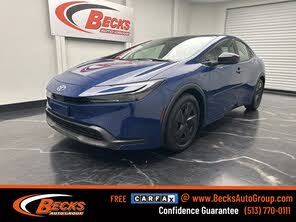
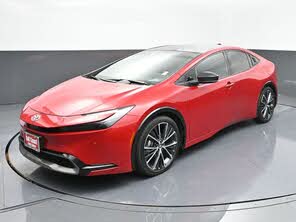
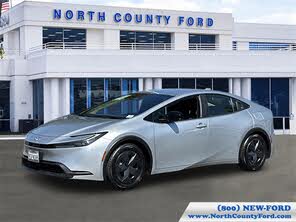
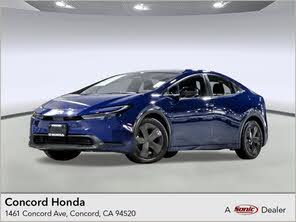
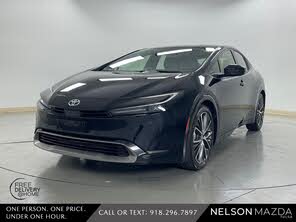
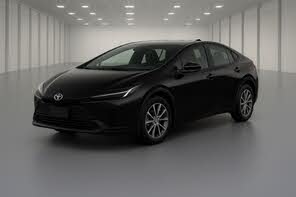
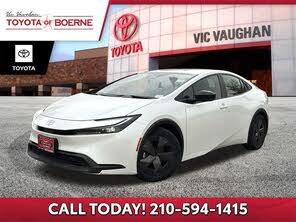
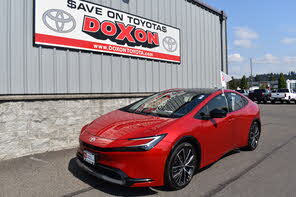
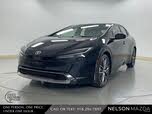
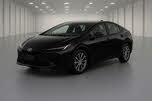
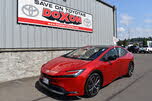
Toyota gave the 2023 Toyota Prius a complete makeover, finally giving the hybrid head-turning style that had long been missing from the lineup. After years of putting efficiency first and everything else second, new competition from cheaper electric vehicles and other hybrid cars pushed the automaker to admit that the Prius needed to be both an efficient car and an appealing one.
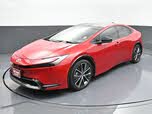
This new Prius was undeniably sleeker on the outside, its look a savvy blend of curves and edges that gave the model a futuristic appearance without alienating more conservative shoppers. The wheels were pushed further into the corners for better handling and added the benefit of making the new Prius look more planted and athletic. The car was also longer, lower, and wider than its predecessor.
This model rode on an excellent platform that felt solid and stout when driven over rough surfaces; it wasn’t a tinny or lightweight-feeling type of cheap hybrid. The doors closed with a reassuring ‘thunk,’ and inside, materials and the fit and finish were top-notch. Nothing felt like a cut-rate economy car.
A pair of screens greeted the driver: an instrument panel in front of them and a dashboard-mounted infotainment screen. This setup was a welcome departure from the previous Prius, which used a center-mounted display for the instrument panel.
The cabin itself was more function over form, with few decorative trim pieces or forward-looking materials to bring in character or warmth. Nevertheless, the new Prius was a comfortable place to spend some time.
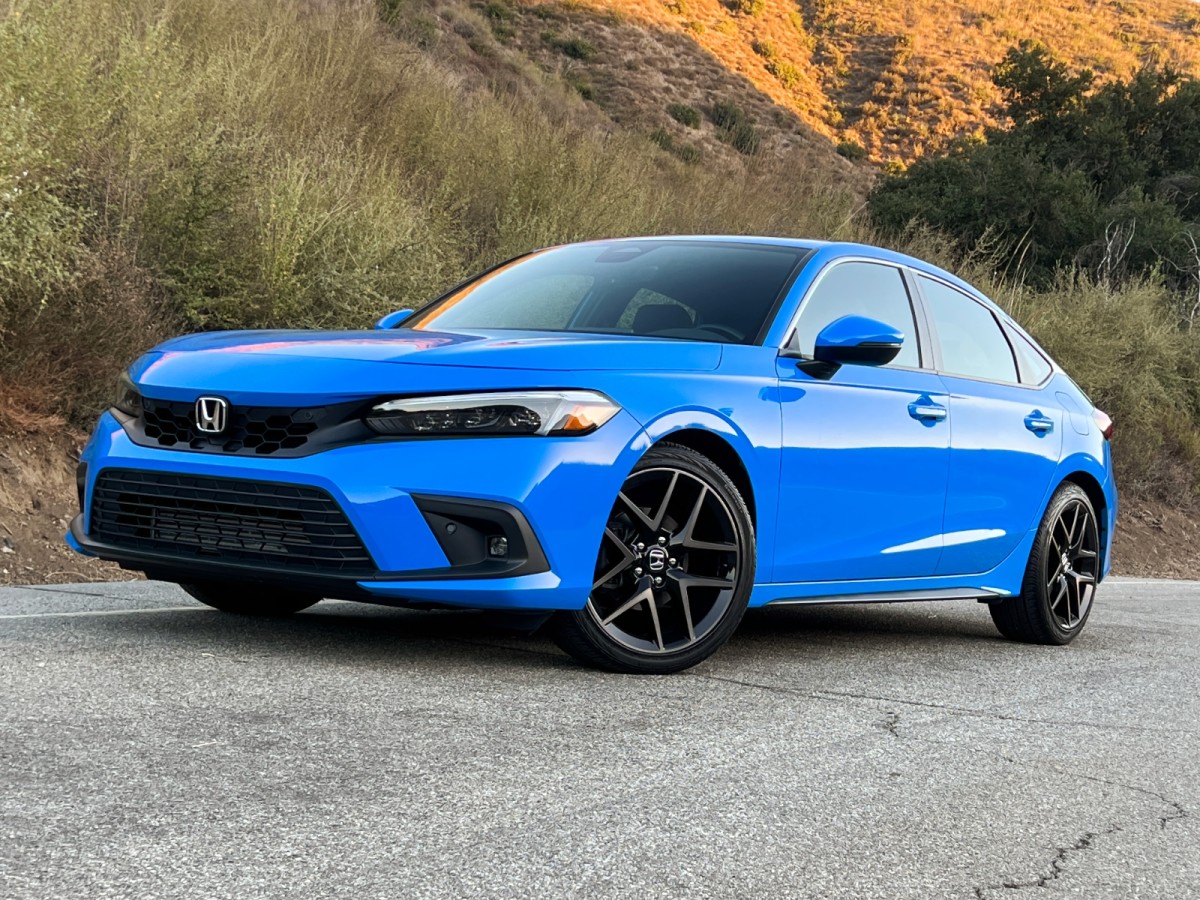
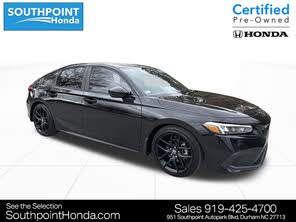
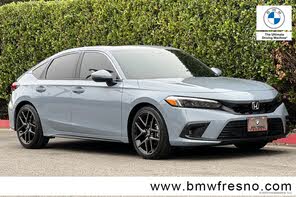
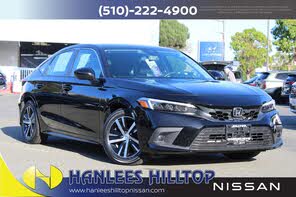
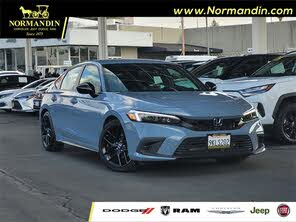
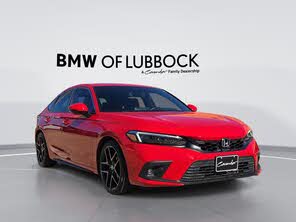
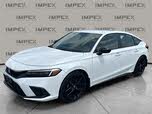
The 2024 Honda Civic Hatchback, meanwhile, was a bit of a chameleon, depending on angles, lighting, paint color, and wheels. This generation could look dowdy and homely or sporty and attractive.
The test car, dressed in Sport Touring trim with stylish 18-inch alloy wheels and an eye-catching Boost Blue color, mostly appealed to onlookers. The car’s rear end remained a little stubby, but otherwise, the Civic Sport Touring’s styling was agreeable.
The Sport Touring sat atop the Civic Hatchback lineup, which also included the base LX, the value-oriented Sport, and the upscale EX-L with a leather interior. Base prices ranged from $24,950 to $31,450, not including a $1,095 destination charge. Boost Blue was an extra-cost paint color, so the Sport Touring test car’s MSRP tallied up to an even $33,000, including the destination.
Opening the driver’s door, the Civic Sport Touring justified its high price with quality materials, elegant detailing, and just the right amount of technology. The attention to detail was remarkable, particularly concerning the metal honeycomb mesh decorating the dashboard, the knurled knobs for stereo volume and climate controls, and the high-resolution digital instrumentation and infotainment screens.


The 2023 Prius used a new 2.0-liter four-cylinder engine, a bump in size from the 1.8-liter unit in the older Prius. This engine, combined with a more powerful electric motor and lithium-ion battery, meant that this latest powertrain iteration packed 194 total horsepower in front-wheel-drive (FWD) models and 196 total horsepower in models with optional all-wheel drive (AWD). That was a significant boost over the 121 total horsepower in the outgoing model. This engine was hooked up to a continuously variable automatic transmission.
In everyday driving, the new Prius certainly felt more athletic and eager than before, with no lag to speak of, and it provided ample acceleration no matter the driving situation. The car scooted ahead on command, and the power was welcome but nowhere near excessive or even head-turning. It simply felt appropriate; a sports car this wasn’t, but it was also not the lifeless econobox earlier versions had felt like.
Given the newfound power, 0-60 acceleration times—if that sort of thing was important to hybrid shoppers—had dropped significantly from the older model. Budget 7.1 seconds now versus 10.5 seconds previously.
Road and wind noise were nicely isolated, save for when drivers pushed the Prius hard for acceleration; then, too much of the engine’s loud droning flowed into the cabin, but at least these intrusions were short-lived.
The Prius’ handling also felt agile and athletic thanks to the revised suspension and that longer wheelbase that tucked the wheels into the car’s corners. Harsh roads or unexpected bumps did little to upset the car or its passengers. The brakes had a small bit of squishiness that was endemic to hybrids, but it was minor.
All told, this new model was more than enough of a comfortable, engaging daily driver for its audience.
The 2024 Honda Civic Hatchback offered varying performance depending on the chosen trim. With the LX or Sport trim, buyers got a 2.0-liter four-cylinder engine generating 158 horsepower at 6,500 rpm and 138 pound-feet of torque at 4,200 rpm. This setup required revving the engine to access the maximum power.
In Sport trim, a six-speed manual gearbox was available in place of the standard continuously variable transmission (CVT), offering more control over the power. However, the CVT in Sport trim also included a Sport driving mode and paddle shifters to simulate a more engaging experience.
For those desiring more speed without stepping up to the Civic Si sedan or Civic Type R hatch, the EX-L and Sport Touring featured a turbocharged 1.5-liter four-cylinder engine producing 180 hp at 6,000 rpm and 177 lb-ft of torque between 1,700 rpm and 4,500 rpm. The power was more accessible and satisfying.
The Sport Touring trim allowed buyers to choose between a six-speed manual and a CVT with paddle shifters and a Sport driving mode. The EX-L only came with a CVT. The test car had the CVT and 18-inch wheels with 235/40 Continental ContiPro Contact all-season tires. Although not as fun as with the manual transmission, the CVT made good use of the turbo engine’s torque.
Feeling light, lively, and lithe from behind the steering wheel, the Civic Sport Touring was delightful to drive no matter the situation. It added zing and zest to daily commutes, errands, and even spirited drives on twisty roads. It offered a level of driving enjoyment that rivaled the Mazda3 Hatchback.
However, highway rides revealed that the Civic was loud inside. Those driving on less-than-perfectly smooth pavement might have wished for earplugs.
Depending on the chosen Civic hatch, it returned between 29 mpg and 35 mpg in combined driving. The test car earned the most efficient rating of 35 mpg, but averaged just 30.2 mpg on the evaluation loop while driving in Normal mode in the city and on the highway, and running the car on mountain and canyon roads in Sport mode. Enthusiastic driving likely accounted for the lower fuel economy figures.
Despite growing on the outside, the interior of the new Prius was slightly smaller in some dimensions than the previous version. Headroom was the main victim here, dropping in both the front and rear seats versus the previous model. But legroom was up throughout, and taller passengers fit comfortably in the rear seats.
Budget permitting, we recommended opting for the fixed glass roof that was optional on the mid-grade XLE trim (standard on the Limited but not offered on the base LE). This two-panel setup (one above the front passengers, one above the rear seats) did a nice job of opening up what might otherwise be a slightly claustrophobic cabin, although we wished the glass sections themselves opened for airflow.
Cargo space also took a hit, dropping to 20 cubic feet on XLE and Limited models and 24 cubic feet on the LE. Forward visibility was generally good, though the loss of the split rear window on this generation meant rear visibility was hampered somewhat.
The rest of the cabin featured nice touches to keep things organized and comfortable. There was a smattering of cupholders throughout, plus a slick pocket in the center console on XLE and Limited trims that wirelessly charged smartphones while holding them snugly in place. A tray below the dashboard held other items and hid a hidden compartment beneath it. USB-C charging ports were available in both front and rear seats.
The cargo section had small cubbies for underfloor storage, which would have been more helpful if they formed one big pocket, but it was better than nothing. Notably, the Prius’ rear window had a flexible cargo cover built in to better hide belongings when parked.
In contrast, when upgrading from the relatively basic LX and Sport trims to the EX-L and Sport Touring, the Honda Civic Hatchback offered many appealing extras.
These higher trims included dual-zone automatic climate control, heated exterior mirrors, heated front seats, leather upholstery, and a power sunroof. The driver’s seat offered eight-way power adjustment, and there was a rear center armrest.
The test car’s power driver’s seat and tilt-and-telescopic steering wheel ensured a perfect driving position. The seat was exceptionally comfortable with great long-distance support. The center console included a sliding center armrest for added satisfaction.
However, the front passenger’s seat lacked height adjustment. While Sport Touring trim added four-way power operation for the seat, we would have traded it for a manual seat-height adjuster.
The Civic Hatchback’s rear seat was roomy enough for two adults or three kids. It offered good support and, with Sport Touring trim, a couple of 2.5-amp USB quick-charge ports. Unfortunately, there were no air conditioning vents, which one might expect at this price.
Behind the back seat, the Civic offered 24.5 cubic feet of cargo space, nearly 10 cubic feet more volume than the Civic Sedan’s trunk. Honda did not provide a measurement for when the 60/40-split rear seat was folded down, but it was reasonable to assume the cargo space doubled.
The base LE and mid-grade XLE models of the 2023 Toyota Prius came with an 8-inch color touchscreen infotainment system with wireless Apple CarPlay and Android Auto connectivity. The XLE could be optioned with a larger 12.3-inch touchscreen for an additional $735, a feature standard on the top Limited trim. We recommended the upgrade, as the extra real estate on the screen was helpful, and the screen itself was responsive and the menus intuitive. The navigation system used cloud connectivity for real-time updates, but required a $160 annual subscription to Toyota’s Drive Connect system, which was frustrating.
All models had a 7-inch digital instrument cluster in front of the driver, which we found too busy. Toyota crammed too much info into too small a screen, though it was an improvement over the center-mounted display on the older Prius.
There were six USB-C charge ports throughout the cabin. XLE and Limited models came standard with wireless smartphone charging, and all trims came standard with an AT&T Wi-Fi hotspot, though a subscription was required for this too.
There was a trio of subscription-based connectivity bundles: Remote Connect linked the Prius with Google Assistant and Amazon Alexa for various remote functionalities; Safety Connect added roadside assistance, collision notification, a stolen vehicle locator, and an emergency assistance button; Drive Connect provided cloud navigation using Google’s points of interest, voice-activated features, and 24/7 connectivity to a live person for destination assistance.
In comparison, with the LX, Sport, and EX-L trims, the Civic Hatchback had a 7-inch digital instrumentation panel and a 7-inch touchscreen infotainment system. Both were basic, and not up to par with rivals like the Mazda3 and Toyota Corolla Hatchback. Even the base Subaru Impreza’s tech was more appealing.
However, with the Civic Sport Touring, buyers received an exclusive 10.2-inch digital instrumentation display and a 9-inch touchscreen infotainment system. Both added color, improved graphics, and sophistication to the Civic’s cabin. The Civic icon in the middle of the digital gauges showed when headlights and taillights, turn signals, hazard flashers, and brake lights illuminated.
Sport Touring trim added wireless Apple CarPlay and Android Auto (as opposed to wired), SiriusXM satellite radio, HD Radio, a navigation system, and wireless smartphone charging. A 12-speaker Bose premium sound system was standard in the Sport Touring trim.
We had no complaints with how easy it was to pair an iPhone to the infotainment system, run Apple CarPlay, or use the voice-recognition system. It responded quickly and accurately to spoken commands and queries.
The 2023 Prius came with Toyota’s latest suite of active safety features bundled under Toyota Safety Sense 3.0. This included radar-based adaptive cruise control that worked at any speed, pre-collision braking with pedestrian and cyclist detection, lane-departure alerts with steering assist, lane-tracing assist, and Proactive Driving Assist, a feature that used the car’s radar and cameras to detect curves in the road or obstacles and slowed the Prius accordingly.
The system functioned well, feeling minimally intrusive. It mimicked EV regenerative braking when approaching objects, and we adapted to it quickly. The system could be disabled within the car’s menu screen for those preferring an analog experience.
These driver assistance features were standard on all 2023 Prius models, regardless of trim level.
Other non-active safety features included stability control, traction control, eight airbags, and blind-spot monitoring with rear cross-traffic alerts. The top-end Limited trim could be optioned with Advanced Park, a feature for hands-free automatic parallel parking.
The 2024 Honda Civic Hatchback came equipped with Honda Sensing, a package of advanced driving assistance systems (ADAS).
The features included:
- Forward-collision warning
- Automatic emergency braking
- Lane-departure warning
- Lane-keeping assist
- Lane-centering assist
- Adaptive cruise control
- Traffic jam assist and low-speed follow capability (only with CVT)
- Automatic high-beam headlights
- Driver monitoring system
- Traffic sign recognition system
Blind-spot warning was available only with the more expensive EX-L and Sport Touring trims. Only the Sport Touring had rear cross-traffic alert and front and rear parking sensors with low-speed automatic braking, which was disappointing to see excluded from lower trims.
Overall, Honda Sensing technology was refined, sophisticated, and accurate. It handled the curves and nuances of the Pacific Coast Highway without incident and performed well on freeways and rural roads. The driver assistance activity graphic within the digital instrumentation was helpful.
However, the adaptive cruise control responded slowly when slower vehicles ahead moved out of the lane. We experienced brief, unnecessary emergency braking due to parked cars and inaccurate attempted steering into a left turn lane.
The Civic Hatchback earned Good ratings in nearly all assessments by the Insurance Institute for Highway Safety (IIHS). In a new side-impact test, it received an Acceptable rating. The National Highway Traffic Safety Administration (NHTSA) gave the Civic Hatchback an overall crashworthiness rating of five stars, the highest possible rating. It even earned a rare five-star rollover resistance rating.
CarGurus highlights
According to CarGurus experts, the overall rating for the 2023 Toyota Prius was 7.5 out of 10, while the 2024 Honda Civic Hatchback scored 7.7 out of 10. The higher rating affirms that the 2024 Honda Civic Hatchback offers a more balanced mix of performance, technology, and practicality. Buyers seeking driving enjoyment, advanced tech, and better cargo capacity would likely find the Civic Hatchback a more compelling choice.
Choose the 2023 Toyota Prius if:
- You prioritize fuel efficiency and want a hybrid with a significantly improved powertrain.
- You desire advanced safety features standard across all trims for comprehensive coverage.
- You appreciate a more futuristic and sleek design coupled with a solid, well-built feel.


Choose the 2024 Honda Civic Hatchback if:
- You value a higher level of driving enjoyment and the option for a manual transmission in certain trims.
- You seek a roomier rear seat and greater cargo capacity for practicality and usability.
- You want advanced technology features including a larger digital instrumentation display and premium Bose sound system in the Sport Touring trim.




CarGurus highlights
According to CarGurus experts, the overall rating for the 2023 Toyota Prius was 7.5 out of 10, while the 2024 Honda Civic Hatchback scored 7.7 out of 10. The higher rating affirms that the 2024 Honda Civic Hatchback offers a more balanced mix of performance, technology, and practicality. Buyers seeking driving enjoyment, advanced tech, and better cargo capacity would likely find the Civic Hatchback a more compelling choice.
Choose the 2023 Toyota Prius if:
Shop Now- You prioritize fuel efficiency and want a hybrid with a significantly improved powertrain.
- You desire advanced safety features standard across all trims for comprehensive coverage.
- You appreciate a more futuristic and sleek design coupled with a solid, well-built feel.





Choose the 2024 Honda Civic Hatchback if:
Shop Now- You value a higher level of driving enjoyment and the option for a manual transmission in certain trims.
- You seek a roomier rear seat and greater cargo capacity for practicality and usability.
- You want advanced technology features including a larger digital instrumentation display and premium Bose sound system in the Sport Touring trim.








By: CarGurus + AI
At CarGurus, our team of experienced automotive writers remain at the heart of our content operation, conducting hands-on car tests and writing insightful guides that are backed by years of industry experience. To complement this, we are harnessing AI to make our content offering more diverse and more helpful to shoppers than ever. To achieve this, our AI systems are based exclusively on CarGurus content, ratings and data, so that what we produce is both unique to CarGurus, and uniquely helpful to car shoppers.