2021 Hyundai Tucson vs 2021 Ford Edge

Overview | |
MSRP$23,700 | MSRP$32,750 |
Listings174 | Listings202 |
Ratings & Reviews | |
User Reviews | User Reviews |
Expert reviews7.7 out of 10 | Expert reviews7.2 out of 10 |
Pros
Cons
| Pros
Cons
|
2021 Hyundai Tucson Reviews SummaryIt’s no secret that small SUVs are among the most popular new-car segments. You see them everywhere on the road today. Automakers put a lot of pressure on themselves to continually offer the latest and greatest. But that also means even the not-so-new are still terrific vehicles and provide a great value. Case in point: the 2021 Hyundai Tucson. The current generation of this compact SUV was introduced for the 2016 model year, and this 2021 edition represents the final model year before a new generation is ushered in. So why go with the older model? Because Hyundai has loaded it up with plenty of tech and safety features and it is offered at a competitive price. | |
2021 Ford Edge Reviews SummaryThe Ford Edge proves that trends run in cycles. Launched in the early 2000s, the original Edge was one of the first midsize crossover SUVs, sporting car-like styling that sharply contrasted the more traditional-looking Ford Explorer of the time. However, new-car buyers realized they liked the roominess of three-row SUVs like the Explorer more, and interest in the two-row Edge waned. Now, however, car shoppers are once again eyeing two-row midsize SUVs, this time as an alternative to sedans. The Edge is now part of a growing market segment that includes the Chevrolet Blazer, Honda Passport, Hyundai Santa Fe, Jeep Grand Cherokee, Nissan Murano, and Volkswagen Atlas Cross Sport. Yet while market dynamics have changed, the Edge hasn’t. The current second-generation Edge dates back to the 2015 model year, and even a substantial update undertaken for the 2019 model year is quickly receding in the rearview mirror. The Edge now sits between the much newer Explorer and Ford Escape in the automaker's SUV-heavy lineup. Aside from some new tech features, the 2021 Ford Edge doesn’t get many significant changes, so we can evaluate it based on our experience with previous model years. As with the 2020 model year, trim levels include SE, SEL, ST-Line, Titanium, and ST. | |
No video found | No video found |
Popular Features & Specs | |
Engine2.0L 161 hp I4 | Engine2.0L 250 hp I4 |
Drive TrainFWD | Drive TrainFWD |
Seating Capacity5 | Seating Capacity5 |
Horsepower161 hp @ 6200 rpm | Horsepower250 hp @ 5500 rpm |
MPG City23 | MPG City21 |
MPG Highway28 | MPG Highway29 |
Engine | |
Engine Name2.0L 161 hp I4 | Engine Name2.0L 250 hp I4 |
Torque150 lb-ft @ 4700 rpm | Torque280 lb-ft @ 3000 rpm |
Horsepower161 hp @ 6200 rpm | Horsepower250 hp @ 5500 rpm |
DrivetrainFWD | DrivetrainFWD |
Fuel Economy | |
MPG City23 | MPG City21 |
MPG Highway28 | MPG Highway29 |
Interior | |
Seating Capacity5 | Seating Capacity5 |
Safety | |
Front Crash Overall5 | Front Crash Overall5 |
Side Crash Overall5 | Side Crash Overall5 |
Dimensions & Capacity | |
Cargo Space31.0 cu ft | Cargo Space39.2 cu ft |
Curb Weight3309 lbs | Curb Weight3960 lbs |
Height64.8 in | Height68.3 in |
Length176.4 in | Length188.8 in |
Width72.8 in | Width85.8 in |
Wheelbase105.1 in | Wheelbase112.2 in |
Maximum Payload1146 lbs | Maximum Payload1310 lbs |
Number of doors4 | Number of doors4 |
Maximum Towing Capacity1500 lbs | Maximum Towing Capacity1500 lbs |
Overview | ||
MSRP | $23,700 | $32,750 |
Listings | ||
Ratings & Reviews | ||
User reviews | ||
Expert reviews | 7.7 out of 10Read full review | 7.2 out of 10Read full review |
Pros & cons | Pros
Cons
| Pros
Cons
|
Summary | It’s no secret that small SUVs are among the most popular new-car segments. You see them everywhere on the road today. Automakers put a lot of pressure on themselves to continually offer the latest and greatest. But that also means even the not-so-new are still terrific vehicles and provide a great value. Case in point: the 2021 Hyundai Tucson. The current generation of this compact SUV was introduced for the 2016 model year, and this 2021 edition represents the final model year before a new generation is ushered in. So why go with the older model? Because Hyundai has loaded it up with plenty of tech and safety features and it is offered at a competitive price. | The Ford Edge proves that trends run in cycles. Launched in the early 2000s, the original Edge was one of the first midsize crossover SUVs, sporting car-like styling that sharply contrasted the more traditional-looking Ford Explorer of the time. However, new-car buyers realized they liked the roominess of three-row SUVs like the Explorer more, and interest in the two-row Edge waned. Now, however, car shoppers are once again eyeing two-row midsize SUVs, this time as an alternative to sedans. The Edge is now part of a growing market segment that includes the Chevrolet Blazer, Honda Passport, Hyundai Santa Fe, Jeep Grand Cherokee, Nissan Murano, and Volkswagen Atlas Cross Sport. Yet while market dynamics have changed, the Edge hasn’t. The current second-generation Edge dates back to the 2015 model year, and even a substantial update undertaken for the 2019 model year is quickly receding in the rearview mirror. The Edge now sits between the much newer Explorer and Ford Escape in the automaker's SUV-heavy lineup. Aside from some new tech features, the 2021 Ford Edge doesn’t get many significant changes, so we can evaluate it based on our experience with previous model years. As with the 2020 model year, trim levels include SE, SEL, ST-Line, Titanium, and ST. |
Video | No video found | No video found |
Popular Features & Specs | ||
Engine | 2.0L 161 hp I4 | 2.0L 250 hp I4 |
Drive Train | FWD | FWD |
Seating Capacity | 5 | 5 |
Horsepower | 161 hp @ 6200 rpm | 250 hp @ 5500 rpm |
MPG City | 23 | 21 |
MPG Highway | 28 | 29 |
Engine | ||
Engine Name | 2.0L 161 hp I4 | 2.0L 250 hp I4 |
Torque | 150 lb-ft @ 4700 rpm | 280 lb-ft @ 3000 rpm |
Horsepower | 161 hp @ 6200 rpm | 250 hp @ 5500 rpm |
Drivetrain | FWD | FWD |
Fuel Economy | ||
MPG City | 23 | 21 |
MPG Highway | 28 | 29 |
Interior | ||
Seating Capacity | 5 | 5 |
Safety | ||
Front Crash Overall | 5 | 5 |
Side Crash Overall | 5 | 5 |
Dimensions & Capacity | ||
Cargo Space | 31.0 cu ft | 39.2 cu ft |
Curb Weight | 3309 lbs | 3960 lbs |
Height | 64.8 in | 68.3 in |
Length | 176.4 in | 188.8 in |
Width | 72.8 in | 85.8 in |
Wheelbase | 105.1 in | 112.2 in |
Maximum Payload | 1146 lbs | 1310 lbs |
Number of doors | 4 | 4 |
Maximum Towing Capacity | 1500 lbs | 1500 lbs |
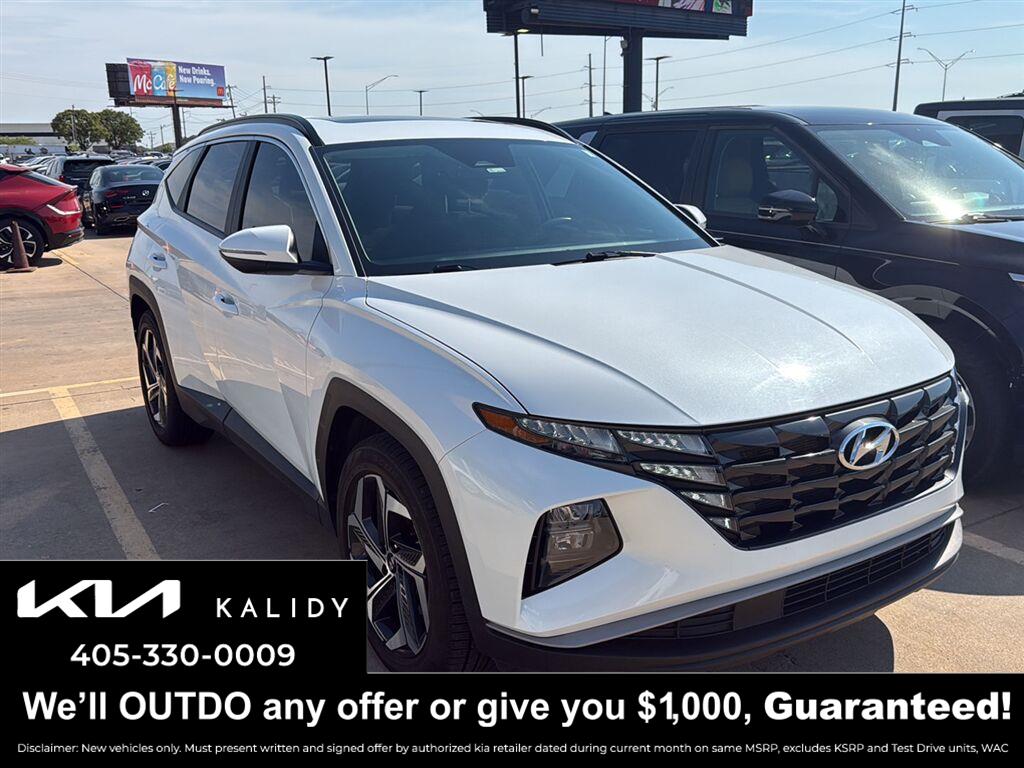
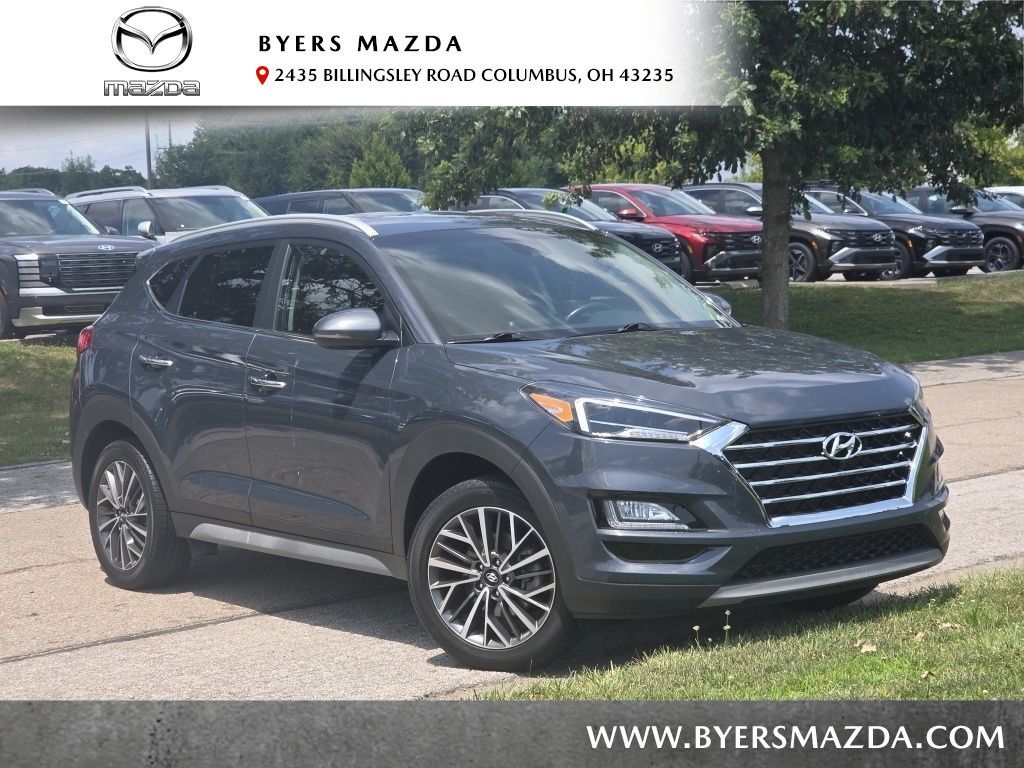
The 2021 Hyundai Tucson offered a practical yet stylish package for those interested in a small crossover. Its upright design contributed to a commanding view of the road. Inside, the Tucson featured a modern dashboard with a seamless blend of technology and aesthetics, ensuring that every button and dial was user-friendly.
The Tucson came in six trims: SE, Value, SEL, Sport, Limited, and Ultimate. The base SE model boasted 17-inch alloy wheels, manually adjustable front seats, a digital driver information display, and a 7-inch touchscreen infotainment system with Apple CarPlay and Android Auto.
Upgrading to the Value trim added LED headlight accents, heated side mirrors, roof rails, an eight-way power-adjustable driver’s seat, heated front seats, HD radio, satellite radio, and a one-touch function for the driver’s power window.
The SEL trim introduced 18-inch alloy wheels, dual-zone automatic climate control, upgraded lower exterior accents, and a rear-seat USB power outlet. Moving to the Sport trim brought 19-inch alloy wheels, LED head-and-taillights, and a hands-free power liftgate. It also featured wireless device charging, a leather-wrapped steering wheel, a leather-wrapped shift-knob, and an Infinity premium audio system.
The Limited trim offered a 360-degree camera system, integrated side-mirror turn signals, and chrome exterior accents, along with leather upholstery, an eight-way power-adjustable front-passenger seat, and a heated steering wheel. The top-tier Ultimate trim included a color trip computer, rain-sensing wipers, an 8-inch touchscreen, heated and ventilated front seats, heated rear seats, and a panoramic sunroof.
The 2021 Ford Edge retained most of the design elements introduced in its 2019 refresh, which aligned its exterior with other recent Ford models. It presented a cleaner alternative to more aggressive designs like the Chevy Blazer and Hyundai Santa Fe. The Titanium trim added extra chrome accents for a touch of luxury, while the ST trim featured a blacked-out grille, standard 20-inch wheels, and a body kit. The ST-Line offered the same styling without the high-performance features and price tag.
Inside, the Edge showed its age with a design that felt less cohesive than the exterior. Tweaks over the years to fit new tech, such as a larger touchscreen, were somewhat awkward. The Titanium trim featured leather upholstery, while the ST trim added sporty front seats with extra bolstering and a leather-wrapped steering wheel, both with contrast stitching.


The 2021 Hyundai Tucson had a base 2.0-liter four-cylinder engine delivering 161 horsepower and 150 lb-ft of torque. The SEL, Sport, Limited, and Ultimate trims featured a more robust 2.4-liter four-cylinder engine producing 181 hp and 175 lb-ft of torque. Both engines came paired with a six-speed automatic transmission and offered standard front-wheel drive (FWD) or optional all-wheel drive (AWD).
The base engine felt underpowered for both city driving and highway speeds. The 2.4-liter engine was a recommended upgrade, providing a more lively driving experience around town, although it still required effort at higher speeds. The Tucson balanced a comfortable, refined ride without feeling overly soft or overly athletic.
Towing capacity for the Tucson varied by engine: 1,500 pounds for the 2.0-liter and up to 2,000 pounds for the 2.4-liter engine, as quoted by Hyundai.
Most 2021 Ford Edge models featured a 2.0-liter turbocharged EcoBoost four-cylinder engine, delivering a substantial 250 horsepower and 275 lb-ft of torque. This engine was paired with an eight-speed automatic transmission and came with either FWD or optional AWD.
For performance enthusiasts, the Edge ST offered an EcoBoost twin-turbo 2.7-liter V6 producing 335 hp and 380 lb-ft of torque on 93-octane fuel. It came standard with AWD, an eight-speed automatic transmission, and a model-specific suspension. An upgraded brake package and 21-inch wheels with summer tires were available options.
The Edge’s maximum towing capacities were competitive, with 3,958 pounds for the base FWD four-cylinder model, 4,122 pounds for the AWD four-cylinder model, and 4,525 pounds for the V6-powered Edge ST. While respectable, these towing capacities fell short of some rivals like the Honda Passport and VW Atlas Cross Sport, which could tow up to 5,000 pounds when equipped with AWD and a robust engine.
The 2021 Hyundai Tucson had 31 cubic feet of cargo space behind the rear seats, which expanded to 61.9 cubic feet with the seats folded down. Though on the lower side within its segment, it provided adequate room for weekend trips and larger items. Higher trims like the Sport featured a hands-free power liftgate for added convenience.
Despite its compact size, the Tucson provided solid front-seat headroom and legroom. The seats were comfortable and supportive, suitable for long journeys. The rear seats were slightly less spacious but still accommodating for adult passengers on road trips. The cabin was equipped with numerous storage compartments and functional trays for personal items.
The 2021 Ford Edge maintained a competitive edge in interior space, boasting 39.2 cubic feet of cargo room behind the rear seats and an impressive 73.4 cubic feet when the seats were folded down. This made the Edge one of the roomiest options among midsize two-row crossovers, trailing only the Honda Passport and VW Atlas Cross Sport.
Rear-seat headroom in the Edge was the best among its rivals, and legroom in both first and second rows was commendable, second only to the Hyundai Santa Fe. Standard dual-zone automatic climate control added to passenger comfort. A foot-activated power liftgate was available on higher trim levels for easy cargo access.
Ford’s rotary shift knob aimed to free up center console space, but the narrow console still limited storage room. Additionally, the storage nook under the console was hard to reach and often led to forgotten items.
The 2021 Hyundai Tucson came standard with a 7-inch touchscreen infotainment system that included Apple CarPlay and Android Auto. Higher trims like the Ultimate featured an upgraded 8-inch touchscreen, which was also optional on other trims. The touchscreens were user-friendly, with logical menu layouts and helpful hard buttons for backup. Additional available features included navigation, satellite radio, and wireless device charging.
Ford kept the 2021 Edge technologically advanced with the inclusion of the latest Sync 4 infotainment system. This system featured standard wireless Apple CarPlay and Android Auto, a 12-inch touchscreen, Bluetooth, SiriusXM with 360L satellite radio (including a three-month free trial), and a 4G LTE WiFi hotspot. The Edge ST models came with a 12-speaker Bang & Olufsen audio system for premium sound quality.
The Edge also featured four USB ports, including a new rear USB-C port for 2021. Sync 4 praised for its simple graphics and intuitive menu layouts, making it easy for new users to navigate. It was worth noting that not all competitors offered wireless Apple CarPlay and Android Auto, which added to the Edge’s appeal.
The 2021 Hyundai Tucson came with a strong lineup of standard driver-assistance features, including automatic emergency braking, forward collision warning, lane departure warning, lane-keeping assist, and driver drowsiness monitoring. For additional safety features like adaptive cruise control, pedestrian detection, automatic high-beams, 360-degree parking monitor, and blind-spot monitoring, consumers needed to opt for higher trims.
In safety testing, the Tucson earned five out of five stars from the National Highway Traffic Safety Administration (NHTSA) and received a "Top Safety Pick" rating from the Insurance Institute for Highway Safety (IIHS).
Similarly, the 2021 Ford Edge was named a “Top Safety Pick” by the IIHS, achieving top “Good” ratings in all crash tests. It also scored high with a “Superior” rating for front crash prevention in vehicle-to-vehicle scenarios but received a lower “Advanced” rating for vehicle-to-pedestrian scenarios. Additionally, it had mixed ratings for LATCH child-seat anchor ease of use and headlight performance.
The NHTSA awarded the Edge a five-star overall safety rating, with high marks in frontal and side crash tests and a four-star rating in rollover tests.
The Edge’s standard safety features under the Ford Co-Pilot360 banner included automatic high beams, blind-spot monitoring, lane-keep assist, forward collision warning, automatic emergency braking (with pedestrian detection), post-collision braking, dynamic brake support, and rear parking sensors. Adaptive cruise control and Evasive Steering Assist were standard on all trims except the base Edge SE.
CarGurus highlights

According to CarGurus experts, the overall rating for the 2021 Hyundai Tucson was 7.7 out of 10, while the 2021 Ford Edge scored 7.2 out of 10. Given the ratings, the Hyundai Tucson edged out the Ford Edge in this comparison. The Tucson's superior safety features, user-friendly technology, and balanced ride quality contributed to its higher score. Therefore, for those weighing their options between these two models, the 2021 Hyundai Tucson emerged as the better choice based on expert evaluations and ratings.
Choose the 2021 Hyundai Tucson if:
- You prefer a crossover with a user-friendly infotainment system and seamless tech integration.
- A comfortable and balanced ride for daily driving and long trips is essential to you.
- You value a high safety rating and a comprehensive suite of standard driver-assistance features.






Choose the 2021 Ford Edge if:
- You need a midsize crossover with generous rear-seat headroom and cargo space.
- Advanced infotainment features like wireless Apple CarPlay and Android Auto are important to you.
- You want a range of standard safety features and have a preference for sporty trims with performance-oriented characteristics.


CarGurus highlights
According to CarGurus experts, the overall rating for the 2021 Hyundai Tucson was 7.7 out of 10, while the 2021 Ford Edge scored 7.2 out of 10. Given the ratings, the Hyundai Tucson edged out the Ford Edge in this comparison. The Tucson's superior safety features, user-friendly technology, and balanced ride quality contributed to its higher score. Therefore, for those weighing their options between these two models, the 2021 Hyundai Tucson emerged as the better choice based on expert evaluations and ratings.
Choose the 2021 Hyundai Tucson if:
Shop Now- You prefer a crossover with a user-friendly infotainment system and seamless tech integration.
- A comfortable and balanced ride for daily driving and long trips is essential to you.
- You value a high safety rating and a comprehensive suite of standard driver-assistance features.
Choose the 2021 Ford Edge if:
Shop Now- You need a midsize crossover with generous rear-seat headroom and cargo space.
- Advanced infotainment features like wireless Apple CarPlay and Android Auto are important to you.
- You want a range of standard safety features and have a preference for sporty trims with performance-oriented characteristics.

By: CarGurus + AI
At CarGurus, our team of experienced automotive writers remain at the heart of our content operation, conducting hands-on car tests and writing insightful guides that are backed by years of industry experience. To complement this, we are harnessing AI to make our content offering more diverse and more helpful to shoppers than ever. To achieve this, our AI systems are based exclusively on CarGurus content, ratings and data, so that what we produce is both unique to CarGurus, and uniquely helpful to car shoppers.

