2020 Cadillac Escalade vs 2020 Land Rover Range Rover Velar

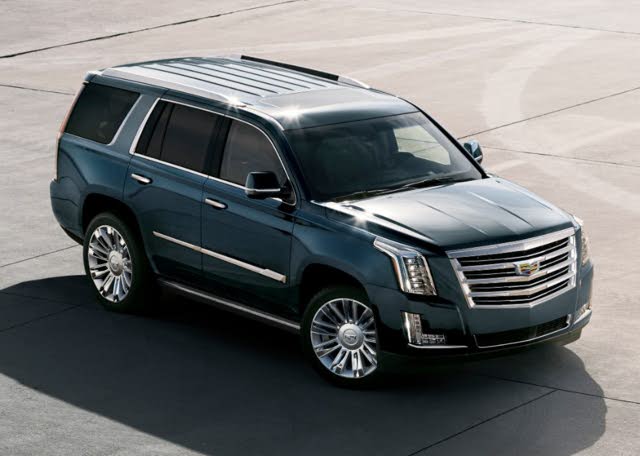
Overview | |
MSRP$56,300 | MSRP$75,195 |
Listings110 | Listings205 |
Ratings & Reviews | |
User Reviews | User Reviews |
Expert reviews7.3 out of 10 | Expert reviews |
Pros
Cons
| |
2020 Land Rover Range Rover Velar Reviews SummaryThe original Land Rover Range Rover revolutionized the SUV game by combining off-road capability with a modicum of civility. Land Rover is now trying to milk that success by creating a “family” of Range Rover models, including some with more car-like styling and character. That’s where the Land Rover Range Rover Velar comes in. Launched for the 2018 model year, it sits above the Range Rover Evoque, but below the Range Rover Sport, in size and price (the traditional Range Rover remains the brand’s flagship). Land Rover chose the Velar name as a nod to the original 1969 Range Rover prototypes, which were badged Velar to hide their origin. The main change for the 2020 model year is the addition of an SVAutobiography Dynamic Edition to the lineup. It’s a one-year-only special that packs a V8 engine instead of the usual V6 or turbo-four. This is the version we tested as, aside from what’s under the hood, it is representative of other Velar models. | |
2020 Cadillac Escalade Reviews Summary | |
No video found | No video found |
Popular Features & Specs | |
Engine2.0L 247 hp I4 | Engine6.2L 420 hp V8 |
Drive TrainAWD | Drive TrainRWD |
Seating Capacity5 | Seating Capacity8 |
Horsepower247 hp @ 5500 rpm | Horsepower420 hp @ 5600 rpm |
MPG City21 | MPG City14 |
MPG Highway27 | MPG Highway23 |
Engine | |
Engine Name2.0L 247 hp I4 | Engine Name6.2L 420 hp V8 |
Torque269 lb-ft @ 1200 rpm | Torque460 lb-ft @ 4100 rpm |
Horsepower247 hp @ 5500 rpm | Horsepower420 hp @ 5600 rpm |
DrivetrainAWD | DrivetrainRWD |
Fuel Economy | |
MPG City21 | MPG City14 |
MPG Highway27 | MPG Highway23 |
Interior | |
Leather SeatsStandard | Leather Seats |
Seating Capacity5 | Seating Capacity8 |
Key Features | |
Navigation SystemStandard | Navigation SystemStandard |
Sunroof/MoonroofStandard | Sunroof/Moonroof |
Safety | |
Side Crash Overall | Side Crash Overall5 |
Dimensions & Capacity | |
Cargo Space29.4 cu ft | Cargo Space15.2 cu ft |
Curb Weight4217 lbs | Curb Weight5578 lbs |
Height66.3 in | Height74.4 in |
Length188.9 in | Length203.9 in |
Width84.4 in | Width80.5 in |
Wheelbase113.1 in | Wheelbase116.0 in |
Maximum Payload1293 lbs | Maximum Payload1460 lbs |
Number of doors4 | Number of doors4 |
Maximum Towing Capacity5291 lbs | Maximum Towing Capacity8300 lbs |
Standard Towing Capacity | Standard Towing Capacity8300 lbs |
Overview | ||
MSRP | $56,300 | $75,195 |
Listings | ||
Ratings & Reviews | ||
User reviews | ||
Expert reviews | 7.3 out of 10Read full review | |
Pros & cons | Pros
Cons
| |
Summary | The original Land Rover Range Rover revolutionized the SUV game by combining off-road capability with a modicum of civility. Land Rover is now trying to milk that success by creating a “family” of Range Rover models, including some with more car-like styling and character. That’s where the Land Rover Range Rover Velar comes in. Launched for the 2018 model year, it sits above the Range Rover Evoque, but below the Range Rover Sport, in size and price (the traditional Range Rover remains the brand’s flagship). Land Rover chose the Velar name as a nod to the original 1969 Range Rover prototypes, which were badged Velar to hide their origin. The main change for the 2020 model year is the addition of an SVAutobiography Dynamic Edition to the lineup. It’s a one-year-only special that packs a V8 engine instead of the usual V6 or turbo-four. This is the version we tested as, aside from what’s under the hood, it is representative of other Velar models. | |
Video | No video found | No video found |
Popular Features & Specs | ||
Engine | 2.0L 247 hp I4 | 6.2L 420 hp V8 |
Drive Train | AWD | RWD |
Seating Capacity | 5 | 8 |
Horsepower | 247 hp @ 5500 rpm | 420 hp @ 5600 rpm |
MPG City | 21 | 14 |
MPG Highway | 27 | 23 |
Engine | ||
Engine Name | 2.0L 247 hp I4 | 6.2L 420 hp V8 |
Torque | 269 lb-ft @ 1200 rpm | 460 lb-ft @ 4100 rpm |
Horsepower | 247 hp @ 5500 rpm | 420 hp @ 5600 rpm |
Drivetrain | AWD | RWD |
Fuel Economy | ||
MPG City | 21 | 14 |
MPG Highway | 27 | 23 |
Interior | ||
Leather Seats | Standard | |
Seating Capacity | 5 | 8 |
Key Features | ||
Navigation System | Standard | Standard |
Sunroof/Moonroof | Standard | |
Safety | ||
Side Crash Overall | 5 | |
Dimensions & Capacity | ||
Cargo Space | 29.4 cu ft | 15.2 cu ft |
Curb Weight | 4217 lbs | 5578 lbs |
Height | 66.3 in | 74.4 in |
Length | 188.9 in | 203.9 in |
Width | 84.4 in | 80.5 in |
Wheelbase | 113.1 in | 116.0 in |
Maximum Payload | 1293 lbs | 1460 lbs |
Number of doors | 4 | 4 |
Maximum Towing Capacity | 5291 lbs | 8300 lbs |
Standard Towing Capacity | 8300 lbs | |


By: CarGurus + AI
At CarGurus, our team of experienced automotive writers remain at the heart of our content operation, conducting hands-on car tests and writing insightful guides that are backed by years of industry experience. To complement this, we are harnessing AI to make our content offering more diverse and more helpful to shoppers than ever. To achieve this, our AI systems are based exclusively on CarGurus content, ratings and data, so that what we produce is both unique to CarGurus, and uniquely helpful to car shoppers.

