2020 Honda Pilot vs 2020 Audi Q7
Overview | |
MSRP$31,650 | MSRP$54,800 |
Listings179 | Listings155 |
Ratings & Reviews | |
User Reviews | User Reviews |
Expert reviews8.0 out of 10 | Expert reviews7.7 out of 10 |
Pros
Cons
| Pros
Cons
|
2020 Honda Pilot Reviews SummaryThe Honda Pilot was once the leader of the midsize 3-row SUV pack. But several rivals from Hyundai, Kia, and Mazda have caught up to (and in some cases, surpassed) the Pilot. Still, the Pilot offers tons of cargo space, an adult-friendly third row, and an impressive list of standard safety features. But Honda’s choices on driver controls and in-car tech are its biggest shortcomings. Read on to learn how the Pilot stacks up against the competition, and to learn the CarGurus recommended trim. | |
2020 Audi Q7 Reviews SummaryFrom its styling and interior to its powertrain and technology, the 2020 Audi Q7 gets a thorough update that brings it in line with other high-end cars and SUVs wearing four chrome rings on their grilles. Simultaneously, the changes for the 2020 model year keep this Audi competitive against the BMW X5 and Mercedes-Benz GLE-Class, its primary rivals in the midsize luxury SUV class. We packed a Q7 Prestige full of family and luggage and set off for Lake Tahoe to assess this Audi’s improvements on the open road. | |
No video found | No video found |
Popular Features & Specs | |
Engine3.5L 280 hp V6 | Engine2.0L 248 hp I4 |
Drive TrainFWD | Drive TrainAWD |
Seating Capacity8 | Seating Capacity7 |
Horsepower280 hp @ 6000 rpm | Horsepower248 hp @ 5000 rpm |
MPG City19 | MPG City19 |
MPG Highway27 | MPG Highway23 |
Engine | |
Engine Name3.5L 280 hp V6 | Engine Name2.0L 248 hp I4 |
Torque262 lb-ft @ 4700 rpm | Torque273 lb-ft @ 1600 rpm |
Horsepower280 hp @ 6000 rpm | Horsepower248 hp @ 5000 rpm |
DrivetrainFWD | DrivetrainAWD |
Fuel Economy | |
MPG City19 | MPG City19 |
MPG Highway27 | MPG Highway23 |
Interior | |
Leather Seats | Leather SeatsStandard |
Seating Capacity8 | Seating Capacity7 |
Key Features | |
Navigation System | Navigation SystemStandard |
Sunroof/Moonroof | Sunroof/MoonroofStandard |
Safety | |
Front Crash Overall4 | Front Crash Overall |
Side Crash Overall5 | Side Crash Overall5 |
Dimensions & Capacity | |
Cargo Space16.5 cu ft | Cargo Space14.2 cu ft |
Curb Weight4036 lbs | Curb Weight4784 lbs |
Height70.6 in | Height68.5 in |
Length196.5 in | Length199.6 in |
Width78.6 in | Width87.1 in |
Wheelbase111.0 in | Wheelbase117.9 in |
Maximum Payload1509 lbs | Maximum Payload1367 lbs |
Number of doors4 | Number of doors4 |
Maximum Towing Capacity3500 lbs | Maximum Towing Capacity4400 lbs |
Overview | ||
MSRP | $31,650 | $54,800 |
Listings | ||
Ratings & Reviews | ||
User reviews | ||
Expert reviews | 8.0 out of 10Read full review | 7.7 out of 10Read full review |
Pros & cons | Pros
Cons
| Pros
Cons
|
Summary | The Honda Pilot was once the leader of the midsize 3-row SUV pack. But several rivals from Hyundai, Kia, and Mazda have caught up to (and in some cases, surpassed) the Pilot. Still, the Pilot offers tons of cargo space, an adult-friendly third row, and an impressive list of standard safety features. But Honda’s choices on driver controls and in-car tech are its biggest shortcomings. Read on to learn how the Pilot stacks up against the competition, and to learn the CarGurus recommended trim. | From its styling and interior to its powertrain and technology, the 2020 Audi Q7 gets a thorough update that brings it in line with other high-end cars and SUVs wearing four chrome rings on their grilles. Simultaneously, the changes for the 2020 model year keep this Audi competitive against the BMW X5 and Mercedes-Benz GLE-Class, its primary rivals in the midsize luxury SUV class. We packed a Q7 Prestige full of family and luggage and set off for Lake Tahoe to assess this Audi’s improvements on the open road. |
Video | No video found | No video found |
Popular Features & Specs | ||
Engine | 3.5L 280 hp V6 | 2.0L 248 hp I4 |
Drive Train | FWD | AWD |
Seating Capacity | 8 | 7 |
Horsepower | 280 hp @ 6000 rpm | 248 hp @ 5000 rpm |
MPG City | 19 | 19 |
MPG Highway | 27 | 23 |
Engine | ||
Engine Name | 3.5L 280 hp V6 | 2.0L 248 hp I4 |
Torque | 262 lb-ft @ 4700 rpm | 273 lb-ft @ 1600 rpm |
Horsepower | 280 hp @ 6000 rpm | 248 hp @ 5000 rpm |
Drivetrain | FWD | AWD |
Fuel Economy | ||
MPG City | 19 | 19 |
MPG Highway | 27 | 23 |
Interior | ||
Leather Seats | Standard | |
Seating Capacity | 8 | 7 |
Key Features | ||
Navigation System | Standard | |
Sunroof/Moonroof | Standard | |
Safety | ||
Front Crash Overall | 4 | |
Side Crash Overall | 5 | 5 |
Dimensions & Capacity | ||
Cargo Space | 16.5 cu ft | 14.2 cu ft |
Curb Weight | 4036 lbs | 4784 lbs |
Height | 70.6 in | 68.5 in |
Length | 196.5 in | 199.6 in |
Width | 78.6 in | 87.1 in |
Wheelbase | 111.0 in | 117.9 in |
Maximum Payload | 1509 lbs | 1367 lbs |
Number of doors | 4 | 4 |
Maximum Towing Capacity | 3500 lbs | 4400 lbs |
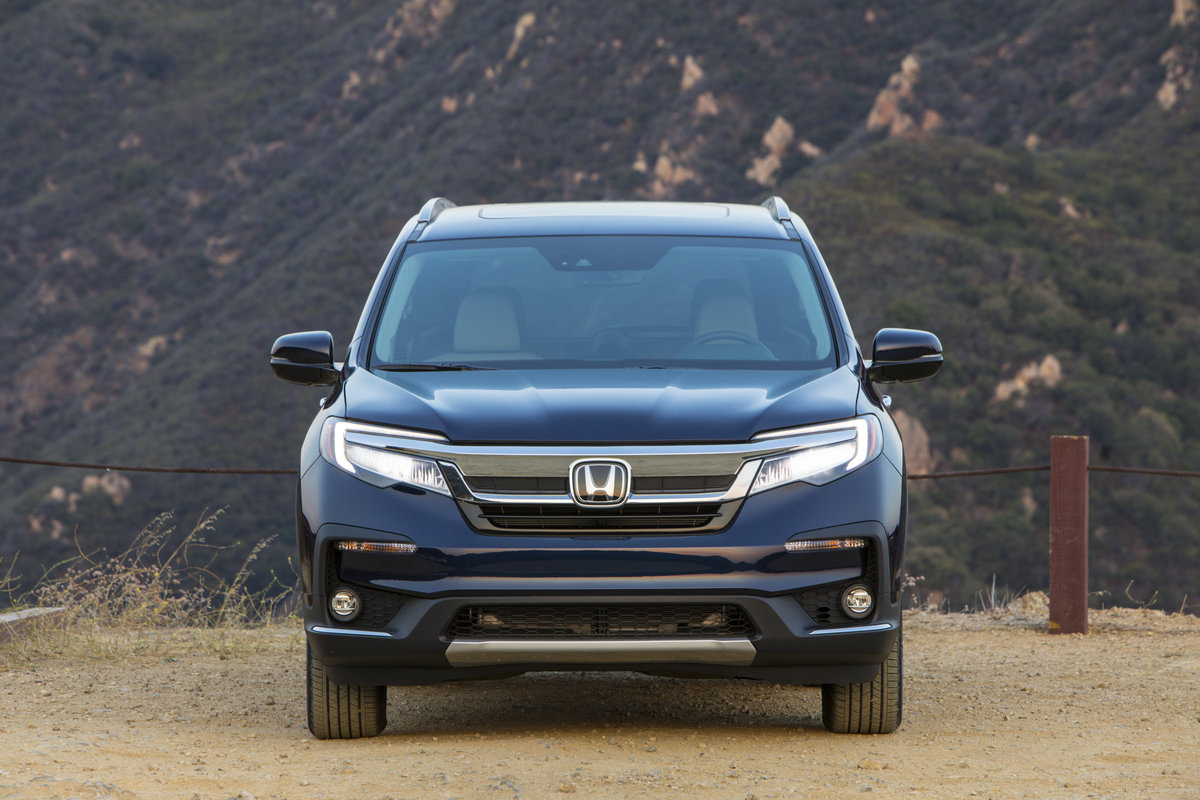
The 2020 Honda Pilot took inspiration from the dynamic styling of the rest of its Honda lineup. This SUV featured thin LED headlights and a multi-tiered grille, accompanied by a subtle uptick in the beltline around the rear side windows, which masked its size, giving it a sleek appearance despite its bulk. Inside, the Pilot boasted a modern cabin with a semi-digital instrument panel, where fuel and engine-temperature gauges retained traditional analog form while other information was displayed digitally in front of the driver. The cabin offered comfort and ample space, with a decent level of refinement marred slightly by the prevalence of hard plastics. This was particularly so when compared to competitors like the Kia Telluride, Hyundai Palisade, and Mazda CX-9, which had more upscale interiors.
Trim-wise, the Honda Pilot started with the LX trim, which included basics like 18-inch alloy wheels, push-button start, and power windows. Moving up to the EX trim, it added conveniences like remote start, Apple CarPlay, and Android Auto along with tri-zone climate control and heated front seats. The EX-L introduced leather upholstery, a power liftgate, and a power moonroof. The Touring trim kicked it up a notch with 20-inch wheels and blue ambient lighting, while the Elite trim added even more luxury features like a massive panoramic sunroof and heated steering wheel. The top-tier Black Edition incorporated unique black styling elements and nearly all features from the Elite trim.
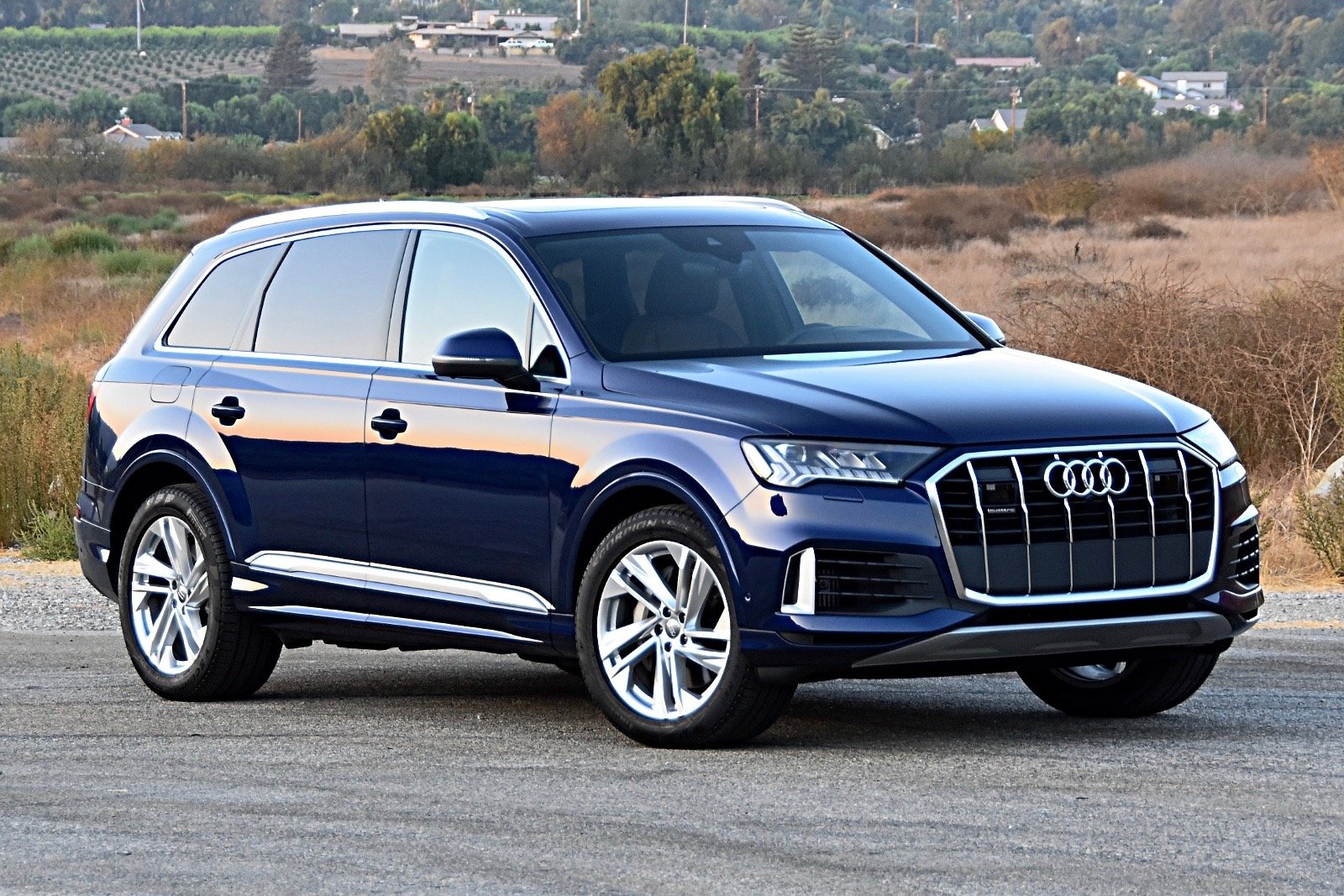
In contrast, the 2020 Audi Q7 offered multiple variations with respective designations tied to their engines. The 45 TFSI featured a turbocharged 2.0-liter engine, while the 55 TFSI came with a mild-hybrid turbocharged 3.0-liter V6. A new performance-tuned SQ7 variant with a twin-turbo 4.0-liter V8 was also available. We examined the 55 TFSI, which started at $60,800 and featured design changes that aligned more closely with the flagship Q8 model.
The upgraded Q7 had new front and rear styling, along with new wheels and lighting elements, improving its aesthetic appeal. The interior mirrored the high-tech Q8, with most physical controls substituted with three digital displays. The test Q7's cabin shone with Okapi Brown leather and Gray/Brown Fine Grain Ash wood inlays, enhanced further at night with multi-color ambient lighting. However, the Q7's digital screens, though modern, were prone to be dust and fingerprint magnets.


The 2020 Honda Pilot was powered by a 3.5-liter V6 engine across all trims, producing 280 horsepower and 262 pound-feet of torque. Depending on the trim, power delivery was handled by either a 6-speed automatic or a more refined 9-speed automatic transmission. Front-wheel drive was standard, with all-wheel drive as an option. The V6 provided robust acceleration and easily handled highway merging and passing, though it wasn’t the leader in its segment. Honda’s proprietary shifter buttons replaced a traditional shifter, resulting in a cumbersome experience. Ride quality was comfortable, designed for smooth commutes and road trips, yet it lacked any real sportiness. The Intelligent Traction Management System allowed drivers to switch between Normal, Snow, Mud, and Sand modes for varying conditions, although it wasn't designed for serious off-roading.
Meanwhile, the 2020 Audi Q7 55 TFSI debuted with a new 3.0-liter turbocharged V6 engine producing 335 horsepower and 369 pound-feet of torque, including a 48-volt mild-hybrid system to enhance fuel efficiency. This engine, paired with an eight-speed automatic transmission and the Quattro all-wheel-drive system, pushed the Q7 from 0 to 60 mph in an impressive 5.7 seconds. The SUV boasted a maximum towing capacity of 7,700 pounds and had an EPA rating of 18 mpg combined, with real-world results close to 21 mpg. On-road, the Q7’s adaptive air suspension and multiple drive modes provided a varied and engaging driving experience, from city agility to spirited mountain driving. The cabin remained exceptionally quiet thanks to dual-pane acoustic side windows, enhancing the overall luxury feel.
The 2020 Honda Pilot offered a cavernous interior that could accommodate up to eight passengers, with second-row bench seating standard. Higher trims featured second-row captain’s chairs, reducing seating capacity to seven. Unlike some competitors, the Pilot’s third-row seats were genuinely suitable for adult passengers. The second and third rows folded to offer 83.9 cubic feet of cargo space, making it competitive within its class, although it fell slightly short compared to rivals like the Kia Telluride and Subaru Ascent. Honda's utilization of space was intelligent, with numerous compartments for family essentials, mirroring its minivan roots. Features like a power liftgate and a hands-free tailgate on higher trims added practical convenience.
In contrast, the 2020 Audi Q7’s third row was much more restrictive, primarily suitable for children. When used, second-row seats needed to be slid forward to accommodate this seating, significantly reducing cargo space. With the third row folded, it expanded to 35.7 cubic feet and maxed out at 69.6 cubic feet with both rear rows down. While comfortable for five adult passengers, the Q7 failed in practical storage, offering limited space for personal items due to design choices that prioritized technology and upscale materials. However, features like four-zone climate control, heated second-row seats, and a panoramic sunroof enhanced the overall comfort experience.
The base 2020 Honda Pilot LX came with a 5-inch color LCD screen operating a basic 215-watt stereo system. More sophisticated trims featured Honda’s Display Audio 8-inch touchscreen with Apple CarPlay and Android Auto. However, the system’s layout and interface left much to be desired, with a lack of tuning knobs and a confusing touch interface. The higher trims added features like HD Radio, SiriusXM satellite radio, Cabin Control Remote Capability, an optional rear-seat entertainment system, and in certain trims, a 590-watt premium audio system. Mobile hotspot capability and wireless charging were available in the Elite and Black Edition trims. Despite the array of features, the infotainment system's usability was frequently criticized.
By contrast, the 2020 Audi Q7 introduced the advanced MMI Touch Response technology with dual touchscreens—an upper 10.1-inch and a lower 8.6-inch display. It provided access to a plethora of SUV's systems, incorporating natural voice recognition and wireless Apple CarPlay and Android Auto integration. However, usage was sometimes hampered by unresponsive virtual buttons due to dry fingertips. Additionally, while polarized sunglasses rendered the head-up display invisible, the overall system was intuitive and comprehensive once set up. The standard 4G LTE WiFi hotspot supported remote working and virtual learning, turning the Q7 into a mobile office. The Prestige trim, in addition to high-tech features, had a Bose premium sound system, although future models replaced it with a superior Bang & Olufsen system.
The 2020 Honda Pilot was replete with the HondaSensing suite, offering a comprehensive set of driver-assistance features including forward-collision avoidance, automatic emergency braking, lane-departure warning, adaptive cruise control, and automatic high beams. Standard safety equipment included front and side-impact airbags, child-seat anchors, Vehicle Stability Assist, and traction control, with optional front and rear parking sensors as well as blind-spot monitoring. It received a five-star overall crash test rating from NHTSA and top scores from IIHS in crash prevention technologies.
For the 2020 Audi Q7, the HD Matrix LED headlights offered remarkable illumination, though IIHS rated them poorly for glare issues. The ADAS suite included Emergency Assist and Turn Assist along with Adaptive Cruise Assist, which sometimes misinterpreted relevant traffic signs. Active Lane Assist also proved finicky in certain conditions. Yet, in overall collision protection, the Q7 received top ratings from IIHS, barring the headlight-related deductions.
CarGurus highlights
According to CarGurus experts, the overall rating for the 2020 Honda Pilot was 8.0 out of 10, while the 2020 Audi Q7 scored 7.7 out of 10. Final recommendation: Given the expert ratings, the 2020 Honda Pilot emerges as the better-reviewed choice. Its combination of spaciousness, practicality, and family-oriented features make it a compelling option for those seeking a reliable and versatile SUV. While the Audi Q7 impresses with its luxury, performance, and advanced technology, the Honda Pilot offers a more well-rounded package for the average consumer.
Choose the 2020 Honda Pilot if:
- You need a family-friendly SUV with spacious seating for up to eight passengers and a functional third row.
- You desire a balance of standard safety features with top-rated crash test scores.
- You appreciate an SUV with practical cargo and storage solutions.


Choose the 2020 Audi Q7 if:
- You seek a luxurious, technologically advanced SUV with high-quality materials and multi-functional digital displays.
- You value a powerful and responsive driving experience with refined handling and advanced suspension systems.
- You require a vehicle with significant towing capacity and impressive performance stats.


CarGurus highlights
According to CarGurus experts, the overall rating for the 2020 Honda Pilot was 8.0 out of 10, while the 2020 Audi Q7 scored 7.7 out of 10. Final recommendation: Given the expert ratings, the 2020 Honda Pilot emerges as the better-reviewed choice. Its combination of spaciousness, practicality, and family-oriented features make it a compelling option for those seeking a reliable and versatile SUV. While the Audi Q7 impresses with its luxury, performance, and advanced technology, the Honda Pilot offers a more well-rounded package for the average consumer.
Choose the 2020 Honda Pilot if:
Shop Now- You need a family-friendly SUV with spacious seating for up to eight passengers and a functional third row.
- You desire a balance of standard safety features with top-rated crash test scores.
- You appreciate an SUV with practical cargo and storage solutions.
Choose the 2020 Audi Q7 if:
Shop Now- You seek a luxurious, technologically advanced SUV with high-quality materials and multi-functional digital displays.
- You value a powerful and responsive driving experience with refined handling and advanced suspension systems.
- You require a vehicle with significant towing capacity and impressive performance stats.

By: CarGurus + AI
At CarGurus, our team of experienced automotive writers remain at the heart of our content operation, conducting hands-on car tests and writing insightful guides that are backed by years of industry experience. To complement this, we are harnessing AI to make our content offering more diverse and more helpful to shoppers than ever. To achieve this, our AI systems are based exclusively on CarGurus content, ratings and data, so that what we produce is both unique to CarGurus, and uniquely helpful to car shoppers.

