2021 Mazda MAZDA3 vs 2020 Dodge Charger
Overview | |
MSRP$29,995 | MSRP$20,650 |
Listings241 | Listings48 |
Ratings & Reviews | |
User Reviews | User Reviews |
Expert reviews8.5 out of 10 | Expert reviews8.3 out of 10 |
Pros
Cons
| Pros
Cons
|
2020 Dodge Charger Reviews SummaryThe Dodge Charger represents an all-in-one approach to modern performance. Unlike its Challenger coupe counterpart, the Charger is a sedan, providing the usability of four full doors and five-passenger seating. It offers a wide variety of potent powertrains, as well as the availability of all-wheel drive (AWD). The Charger also provides the latest tech and infotainment features. It may be a classic nameplate, but it is a very different approach to the family sedan. This also makes it a breath of fresh air in the modern sedan market. Thanks to its wide variety of performance models, the Charger's exact competition is hard to pin down. V6-powered versions like the SXT and GT compete with the likes of the Toyota Avalon, Nissan Maxima, and Chevrolet Impala. But the available performance on tap with R/T and Hellcat models opens it up to a world of sports cars and muscle cars. Which model you select determines its rivals. No matter the trim selected, the Charger provides a baseline of athleticism paired with a spacious cabin, large rear seats, and a large trunk. Together, these make the Charger a fun and functional new car, with styling that helps it stand out in a crowd. | |
2021 Mazda MAZDA3 Reviews SummaryMazdas are fun. All of them. Even the SUVs. But until recently, they weren’t particularly fast. The joy in driving a Mazda derived from the expertly tuned ride and handling qualities that made piloting the automaker’s products a sheer delight. And then Mazda started turbocharging cars and SUVs equipped with its 2.5-liter 4-cylinder engine. Now, the 2021 Mazda3 2.5 Turbo arrives, one of the last members of Mazda’s fleet to add forced induction for boosted power and performance. The result, as you might guess, is absolutely delightful. | |
No video found | |
Popular Features & Specs | |
Engine3.6L 292 hp V6 | Engine2.0L 155 hp I4 |
Drive TrainRWD | Drive TrainFWD |
Seating Capacity5 | Seating Capacity5 |
Horsepower292 hp @ 6350 rpm | Horsepower |
MPG City19 | MPG City28 |
MPG Highway30 | MPG Highway36 |
Engine | |
Engine Name3.6L 292 hp V6 | Engine Name2.0L 155 hp I4 |
Torque260 lb-ft @ 4800 rpm | Torque |
Horsepower292 hp @ 6350 rpm | Horsepower |
DrivetrainRWD | DrivetrainFWD |
Fuel Economy | |
MPG City19 | MPG City28 |
MPG Highway30 | MPG Highway36 |
Interior | |
Seating Capacity5 | Seating Capacity5 |
Safety | |
Front Crash Overall4 | Front Crash Overall5 |
Side Crash Overall5 | Side Crash Overall5 |
Dimensions & Capacity | |
Cargo Space16.5 cu ft | Cargo Space13.2 cu ft |
Curb Weight3964 lbs | Curb Weight3100 lbs |
Height57.8 in | Height56.9 in |
Length198.4 in | Length183.5 in |
Width82.7 in | Width70.7 in |
Wheelbase120.0 in | Wheelbase107.3 in |
Maximum Payload1136 lbs | Maximum Payload923 lbs |
Number of doors4 | Number of doors4 |
Maximum Towing Capacity1000 lbs | Maximum Towing Capacity |
Overview | ||
MSRP | $29,995 | $20,650 |
Listings | ||
Ratings & Reviews | ||
User reviews | ||
Expert reviews | 8.5 out of 10Read full review | 8.3 out of 10Read full review |
Pros & cons | Pros
Cons
| Pros
Cons
|
Summary | The Dodge Charger represents an all-in-one approach to modern performance. Unlike its Challenger coupe counterpart, the Charger is a sedan, providing the usability of four full doors and five-passenger seating. It offers a wide variety of potent powertrains, as well as the availability of all-wheel drive (AWD). The Charger also provides the latest tech and infotainment features. It may be a classic nameplate, but it is a very different approach to the family sedan. This also makes it a breath of fresh air in the modern sedan market. Thanks to its wide variety of performance models, the Charger's exact competition is hard to pin down. V6-powered versions like the SXT and GT compete with the likes of the Toyota Avalon, Nissan Maxima, and Chevrolet Impala. But the available performance on tap with R/T and Hellcat models opens it up to a world of sports cars and muscle cars. Which model you select determines its rivals. No matter the trim selected, the Charger provides a baseline of athleticism paired with a spacious cabin, large rear seats, and a large trunk. Together, these make the Charger a fun and functional new car, with styling that helps it stand out in a crowd. | Mazdas are fun. All of them. Even the SUVs. But until recently, they weren’t particularly fast. The joy in driving a Mazda derived from the expertly tuned ride and handling qualities that made piloting the automaker’s products a sheer delight. And then Mazda started turbocharging cars and SUVs equipped with its 2.5-liter 4-cylinder engine. Now, the 2021 Mazda3 2.5 Turbo arrives, one of the last members of Mazda’s fleet to add forced induction for boosted power and performance. The result, as you might guess, is absolutely delightful. |
Video | No video found | |
Popular Features & Specs | ||
Engine | 3.6L 292 hp V6 | 2.0L 155 hp I4 |
Drive Train | RWD | FWD |
Seating Capacity | 5 | 5 |
Horsepower | 292 hp @ 6350 rpm | |
MPG City | 19 | 28 |
MPG Highway | 30 | 36 |
Engine | ||
Engine Name | 3.6L 292 hp V6 | 2.0L 155 hp I4 |
Torque | 260 lb-ft @ 4800 rpm | |
Horsepower | 292 hp @ 6350 rpm | |
Drivetrain | RWD | FWD |
Fuel Economy | ||
MPG City | 19 | 28 |
MPG Highway | 30 | 36 |
Interior | ||
Seating Capacity | 5 | 5 |
Safety | ||
Front Crash Overall | 4 | 5 |
Side Crash Overall | 5 | 5 |
Dimensions & Capacity | ||
Cargo Space | 16.5 cu ft | 13.2 cu ft |
Curb Weight | 3964 lbs | 3100 lbs |
Height | 57.8 in | 56.9 in |
Length | 198.4 in | 183.5 in |
Width | 82.7 in | 70.7 in |
Wheelbase | 120.0 in | 107.3 in |
Maximum Payload | 1136 lbs | 923 lbs |
Number of doors | 4 | 4 |
Maximum Towing Capacity | 1000 lbs | |
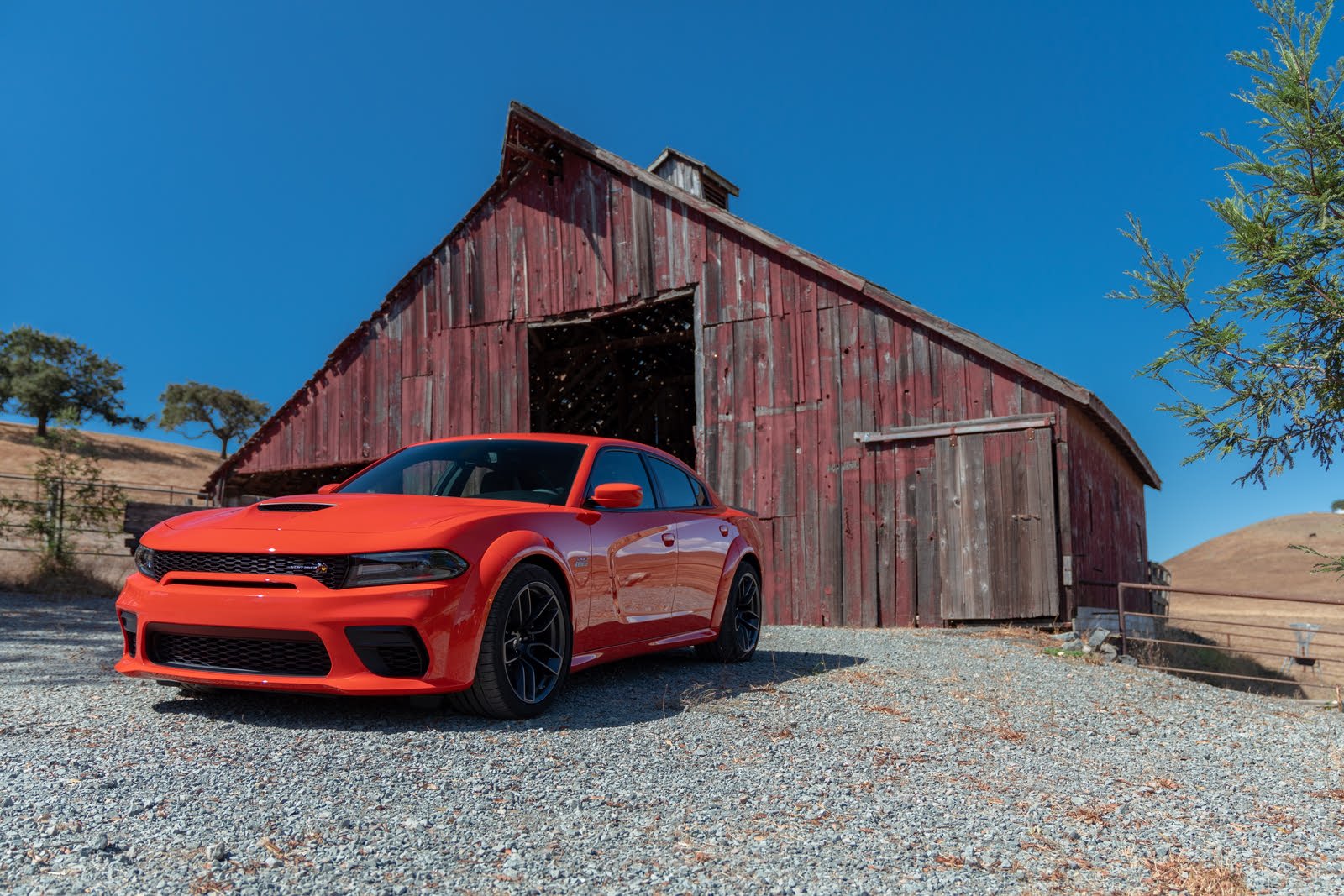
In 2006, Dodge brought back the Charger nameplate with a modern take on the muscle car silhouette. This iteration of the Charger, embodying menacing headlights and a gaping grille, continued into the current-generation model that debuted in 2011. In 2015, the Charger received a significant facelift, though it kept much of its original underpinnings and interior aesthetics. The 2015 refresh introduced a thinner inlet in the grille and opened up the lower front grille area below the bumper. Additionally, the headlights underwent a dramatic redesign, reinforcing the "menacing" appearance that is quintessentially Dodge.
Inside, the Charger's cabin echoed its retro roots while seamlessly integrating modern digital displays. Large vintage-looking bezels housed these screens, lending a blend of old and new. The rear-wheel-drive (RWD) platform necessitated a raised transmission tunnel, creating a cockpit-like atmosphere, particularly for the driver and front passenger.
The 2020 Charger was available in several trims: SXT, GT, R/T, and Hellcat, with additional sub-trims under R/T and Hellcat. Standard features in the SXT trim included 17-inch alloy wheels, remote start, push-button start, power-adjustable front seats, rear parking sensors, and a 7-inch touchscreen infotainment system.
The GT trim added several visual enhancements, such as 20-inch wheels, a more pronounced lower front spoiler, a rear trunk lip spoiler, and a hood scoop. Inside, the GT provided dual-zone climate control, a WiFi hotspot, HD radio, and an upgraded 8.4-inch infotainment screen. It also boasted houndstooth patterned fabric seats, offering an alternative to leather.
The R/T and GT trims shared many visual and cabin features, but the R/T stood out with its V8 engine. Meanwhile, the Charger Hellcat was the pinnacle of the lineup, featuring leather upholstery, heated and ventilated front seats, heated rear seats, and advanced safety features like blind-spot monitoring. The Hellcat, along with the R/T Scat Pack variant, came with a widebody kit, featuring more pronounced fenders and wider wheels and tires.
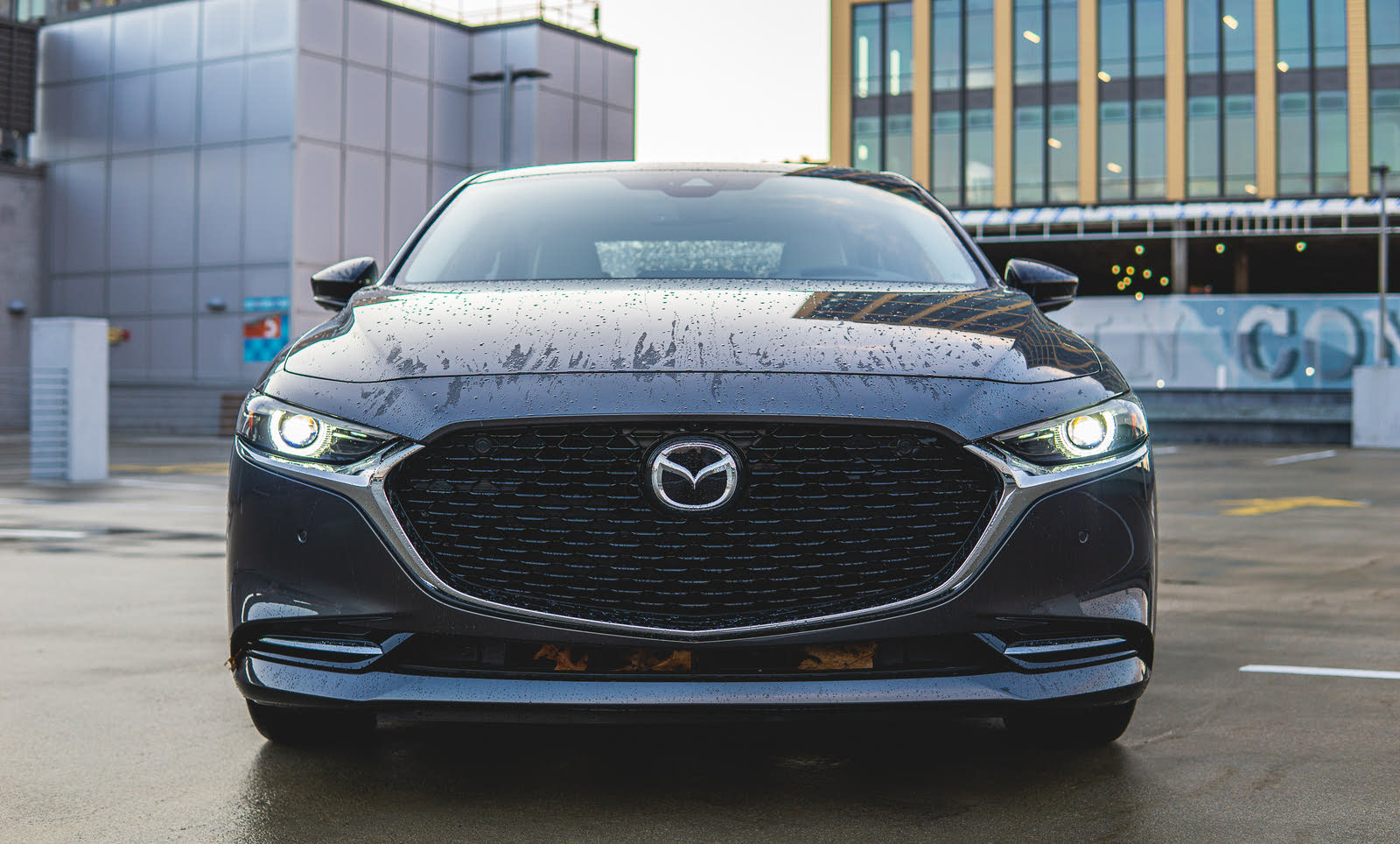
The 2021 Mazda MAZDA3 built upon its award-winning 2019 redesign, which had captivated audiences with its dramatic yet refined bodywork. Available as both a conservative 4-door sedan and a more aggressive 5-door hatchback, the MX-5 presented an aesthetic dichotomy: sophistication and daring in one package. The hatchback, with its pugilistic stance and lidded stare, looked forward-leaning and assertive. However, the sedan offered a more restrained yet equally enticing visual appeal.
For 2021, the Mazda3 2.5 Turbo sat at the top of an expanded lineup. Available in both body styles, it included all-wheel drive (AWD) and came standard or in Premium Plus trim. The base price started at $29,900 for the most affordable sedan, while a hatchback with Premium Plus trim came in at $33,750. The test sedan, with Premium Plus trim and Machine Gray Metallic paint, was priced at $33,890, inclusive of destination charges.
Interior options varied by trim and body style. Both sedan and hatchback offered black or greige leatherette in standard specification, with upgrades to supple Nappa leather available in Premium Plus trims. The hatchback also offered black and red leather options, while the sedan featured black or white leather.
In the test model, the white leather smelled luxurious and presented a high-contrast two-tone interior that could elevate Mazda's branding into the premium segment. Extensive attention to design detail was evident, with bright metallic accents and one of the clearest, most legible gauge sets in a modern car.
Despite the prevalent use of hard plastic in the lower half of the cabin, the Mazda3 maintained a high level of quality. The Mazda Connect infotainment system integrated seamlessly into the dashboard, emphasizing the driver-centric design ethos. The interior layout ensured that the driver remained the focal point, wrapped in an environment crafted for control and engagement.


The Dodge Charger offered multiple pathways to driving enjoyment, with each trim level paired with a distinct powertrain. The SXT and GT trims were equipped with a 3.6-liter V6 engine, delivering 292 horsepower in the SXT and an even 300 horsepower in the GT. Power was routed to the rear wheels via an 8-speed automatic transmission with manual tap-shift functionality, and AWD was an option for both the SXT and GT.
The R/T trim featured a robust 5.7-liter Hemi V8 engine, producing 370 horsepower and 395 lb-ft of torque. This variant also included an upgraded performance suspension and an active exhaust system that could amplify or dampen the engine sound, creating a visceral driving experience.
The R/T Scat Pack took performance to another level with a 6.4-liter Hemi V8 that churned out 485 horsepower and 475 lb-ft of torque. This trim also included Brembo high-performance disc brakes and a launch assist feature, optimizing acceleration from a standstill. CarGurus even touted this model as the ultimate high-horsepower bargain at around $40,000. The widebody variant of the R/T Scat Pack introduced unique bodywork and a wider track, enhancing the vehicle's performance capabilities.
At the pinnacle of the lineup was the Charger SRT Hellcat Widebody, equipped with a supercharged 6.2-liter V8 that delivered a staggering 707 horsepower and 650 lb-ft of torque. Both widebody models featured Bilstein adaptive suspension, each uniquely tuned, enabling precise cornering despite the car’s considerable weight. The upgraded suspension, coupled with Brembo brakes, facilitated exceptional control on winding roads, providing a driving experience that seamlessly balanced power and precision.
The Charger’s Performance Pages located in the center touchscreen provided a plethora of data, from lap times and acceleration runs to engine performance statistics. This feature also allowed drivers to customize drive modes, adjusting throttle response, transmission mapping, steering feel, suspension, and traction control to suit their preferences.
Mazda made only minor tweaks to the standard suspension for the 2021 Mazda3 Turbo, aside from its turbocharged powertrain. The turbocharged 2.5-liter four-cylinder engine, also found in models like the Mazda6 and CX-5, generated 250 horsepower at 5,000 rpm and 320 lb-ft of torque at 2,500 rpm when fueled with 93-octane gas. On 87-octane fuel, the engine produced 227 horsepower and 310 lb-ft of torque.
Unlike its naturally aspirated counterparts, the Mazda3 Turbo paired exclusively with a six-speed automatic transmission, featuring Sport and Manual modes. The powertrain fed into a next-gen i-Activ AWD system, capable of delivering three times the motive force to the rear wheels compared to earlier versions. This setup significantly improved the car's corner-exit capability, making the Mazda3 a formidable performer in dynamics.
The turbocharged powertrain added minimal weight to the Mazda3, yet magnified its performance dramatically by adding 64 extra horsepower and 134 additional lb-ft of torque. This transformation was both substantial and noticeable, as the application was tuned for smooth, predictable, and consistent engine and transmission responses.
Mazda’s engineering focus on achieving smoothness and consistency paid off, providing stunning speed without the frenetic character typical of high-powered compact cars. In Sport mode, the transmission offered more precise and direct shifts, enhanced by the G-Vectoring Control Plus (GVC+) software. This software synchronized transmission downshifting with braking, optimizing turn-in during cornering and ensuring a seamless driving experience on twisty roads.
The 2021 Mazda3 Turbo boasted improved steering feel and response, with stiffer front suspension springs and dampers to handle the additional weight over the front axle. Though equipped with the same brakes as non-turbo models, the Turbo rode on 18-inch wheels with 215/45 Bridgestone Turanza all-season tires. No summer tire option was available, but a set of 18-inch BBS forged aluminum wheels could be purchased for under a grand.
Despite not being labeled as a Mazdaspeed3, the Mazda3 2.5 Turbo elicited spirited driving, accompanied by an enhanced engine note through the car's speakers. The powertrain and dynamic tuning achieved all set goals, delivering smoothness, consistency, and predictability that inspired driver confidence.
Practically speaking, the test model averaged 20.4 mpg, falling short of the EPA estimate of 27 mpg in combined driving. This discrepancy was attributed more to the driving style during the test rather than any inherent inefficiency in the powertrain.
Compared to other high-performance sedans like the BMW M5 or Audi RS6, the Dodge Charger stood out with its spaciousness. While rear seats in many performance sedans often seemed like an afterthought, the Charger provided ample legroom, ensuring backseat passengers would sit comfortably even with the front seats fully adjusted. The front bucket seats were spacious and well-bolstered, providing head and legroom fit for taller drivers and passengers.
The Charger’s practicality extended to its storage solutions, with door trays, cup holders, and a versatile center console that accommodated a variety of personal items. The trunk area was notably large, offering 16.5 cubic feet of space—superior to many high-performance and family sedans alike. Additionally, the Charger featured a standard 60/40 split-fold rear bench, enhancing its storage capabilities further.
The Mazda3 2.5 Turbo, equipped with Nappa leather and heated front seats, created a luxurious ambiance. However, it lacked a few elements you’d expect from a car aiming for premium status. Specifically, the driver's seat was power-adjustable in eight ways, but the front passenger seat wasn't, and neither seat offered ventilation. Rear-seat passengers faced particularly cramped conditions with no air conditioning vents or USB charging ports available in the back.
Interior storage was adequate but not exceptional. Space sufficed for regular small personal items, but opting for wireless smartphone charging placed the charger at the bottom of the center console bin, effectively eliminating its primary storage capacity.
The sedan's trunk offered 13.2 cubic feet of cargo space, competitive within the compact sedan segment. However, those looking for more utility were better served by the hatchback variant, which provided 20.1 cubic feet of space behind the rear seat and 47.1 cubic feet with the rear seats folded down.
The 2020 Charger came standard with a 7-inch touchscreen infotainment system, with higher trims featuring an 8.4-inch screen. Both were equipped with FCA's highly regarded Uconnect infotainment system, which included Bluetooth, USB connectivity, satellite radio, HD radio, Apple CarPlay, and Android Auto.
Uconnect’s standout feature was its simplicity. A lower dock with icons for media, climate, controls, phone, and settings remained constant across all menus, ensuring quick and intuitive navigation. Even with Apple CarPlay engaged, Uconnect allowed users to switch seamlessly between the integrated system and their mobile device's interface, avoiding the cumbersome steps required by some rival systems.
The digital display within the instrument cluster was intuitive, controlled via a directional pad on the steering wheel. This screen provided essential information such as trip data, digital speedometer, vehicle settings, radio stations, and phone calls. It also displayed turn-by-turn navigation when the feature was enabled.
The Mazda Connect infotainment system integrated an 8.8-inch display with Apple CarPlay, Android Auto, and a three-year trial of Mazda Connected Services. It offered a WiFi hotspot (free for six months or up to 2GB of data), and the MyMazda app allowed for remote functionalities like locking and unlocking the car.
However, the screen wasn’t touch-sensitive, a design choice aimed at reducing driver distraction. This limitation highlighted the deficiencies in Mazda Connect’s voice-recognition technology, often failing to respond accurately to commands. A Mazda spokesperson suggested relying on smartphone-based digital assistants, but this wasn't an ideal solution given the system's limitations.
Navigating through the system to change radio stations or presets required using the cumbersome center console control knob and menu navigation, with no shortcuts provided on the steering wheel controls. These flaws in the infotainment system proved to be a significant source of frustration for many users.
Fortunately, the Bose 12-speaker premium sound system paired with Mazda Connect delivered high-quality audio, particularly when playing FLAC files. However, satellite radio could sometimes cause the subwoofer to distort.
The Active Driving Display, or head-up display (HUD), was standard on the Mazda3 2.5 Turbo. It was user-friendly and remained visible even when the driver wore polarized sunglasses. The HUD displayed essential information, including current speed, posted speed limits, and the status of safety features like blind-spot monitoring.
The 2020 Dodge Charger came equipped with essential safety features such as a full array of front- and side-impact airbags, traction control, and rear parking sensors. Additional safety enhancements included forward-collision avoidance with automatic emergency braking, lane-departure warning, lane-keeping assist, adaptive cruise control, and automatic high-beams. While these features were available, many competitors offered them as standard equipment.
Optional safety features for the Charger included blind-spot monitoring and rear cross-traffic alert, along with rain-sensing windshield wipers. In the IIHS crash tests, the Charger’s optional crash prevention technology received the highest score of Superior, contrasting with some rivals like the Toyota Avalon that offered these features as standard.
Mazda's i-ActiveSense suite of advanced driving assistance systems (ADAS) was designed to support, not replace, the driver. The adaptive cruise control featured stop-and-go capability, while the automatic high-beam LED headlights incorporated an Adaptive Front Lighting System to enhance visibility around curves.
Premium Plus trims of the Mazda3 Turbo included exclusive safety features: a high-definition surround-view camera, front and rear parking sensors, low-speed reverse automatic braking, and Traffic Jam Assist. Unlike Level 2 ADAS systems, Traffic Jam Assist provided lane-centering assistance at speeds below 40 mph while maintaining driver control over steering.
i-ActiveSense ADAS operated subtly and effectively, encouraging driver usage rather than deactivation. In terms of crash safety, the 2021 Mazda MAZDA3 excelled, earning five-star ratings in all NHTSA assessments, including rollover resistance.
CarGurus highlights
According to CarGurus experts, the overall rating for the 2020 Dodge Charger was 8.5 out of 10, while the 2021 Mazda MAZDA3 scored 8.3 out of 10. Given these ratings, the 2020 Dodge Charger emerges as the preferred choice. With its blend of modern technology, retro styling, spacious interior, and powerful engine options, it delivers a compelling package for those who prioritize performance and practicality. While the 2021 Mazda MAZDA3 offers excellent driving dynamics, luxury touches, and top-notch safety features, it falls slightly short in comparison. Therefore, the Charger, with its higher rating, stands out as the better overall vehicle according to expert evaluations.
Choose the 2021 Mazda MAZDA3 if:
- You want a car with striking design, excellent build quality, and a driver-focused interior.
- Superior safety ratings and a comprehensive suite of advanced driving assistance systems are important to you.
- You seek a compact car that combines luxury with sporty performance, particularly with the highly capable Turbo model.


Choose the 2020 Dodge Charger if:
- You desire a spacious, retro-styled cabin with modern digital displays and plenty of passenger room.
- High performance is a priority, with potential options ranging from a V6 to a supercharged V8 with over 700 horsepower.
- You appreciate straightforward and user-friendly infotainment systems that integrate seamlessly with mobile devices.


CarGurus highlights
According to CarGurus experts, the overall rating for the 2020 Dodge Charger was 8.5 out of 10, while the 2021 Mazda MAZDA3 scored 8.3 out of 10. Given these ratings, the 2020 Dodge Charger emerges as the preferred choice. With its blend of modern technology, retro styling, spacious interior, and powerful engine options, it delivers a compelling package for those who prioritize performance and practicality. While the 2021 Mazda MAZDA3 offers excellent driving dynamics, luxury touches, and top-notch safety features, it falls slightly short in comparison. Therefore, the Charger, with its higher rating, stands out as the better overall vehicle according to expert evaluations.
Choose the 2021 Mazda MAZDA3 if:
Shop Now- You want a car with striking design, excellent build quality, and a driver-focused interior.
- Superior safety ratings and a comprehensive suite of advanced driving assistance systems are important to you.
- You seek a compact car that combines luxury with sporty performance, particularly with the highly capable Turbo model.
Choose the 2020 Dodge Charger if:
Shop Now- You desire a spacious, retro-styled cabin with modern digital displays and plenty of passenger room.
- High performance is a priority, with potential options ranging from a V6 to a supercharged V8 with over 700 horsepower.
- You appreciate straightforward and user-friendly infotainment systems that integrate seamlessly with mobile devices.

By: CarGurus + AI
At CarGurus, our team of experienced automotive writers remain at the heart of our content operation, conducting hands-on car tests and writing insightful guides that are backed by years of industry experience. To complement this, we are harnessing AI to make our content offering more diverse and more helpful to shoppers than ever. To achieve this, our AI systems are based exclusively on CarGurus content, ratings and data, so that what we produce is both unique to CarGurus, and uniquely helpful to car shoppers.

