2019 Subaru Forester vs 2019 Toyota RAV4
Overview | |
MSRP$25,650 | MSRP$24,295 |
Listings254 | Listings223 |
Ratings & Reviews | |
User Reviews | User Reviews |
Expert reviews8.0 out of 10 | Expert reviews8.2 out of 10 |
Pros
Cons
| Pros
Cons
|
2019 Toyota RAV4 Reviews SummaryThere’s a reason small SUVs like the 2019 Toyota RAV4 are among the most popular vehicles on the new car market. Consider the RAV4 and its rivals, the Honda CR-V, Mazda CX-5, and Ford Escape—what do they have in common? To put it simply, these vehicles are asked to do it all. Daily commuter car? Check. Family-hauler to school, practice, and the mall? Check, check, and check. Road-trip vehicle? Yeah, that too. On top of it all, these vehicles have to be affordable, efficient, and reliable. Sales of traditional sedans have been dwindling, but if sedans could do as much as crossovers can, they would still be popular vehicles. The RAV4 is one of the oldest vehicles in the segment, and its story tells us how these small SUVs became so popular. The previous RAV4 was an extremely competent vehicle for Toyota, covering all the things we ask of compact SUVs. But the new 2020 RAV4 goes a few steps further. It has standout Tonka-truck styling, a surprisingly upscale interior, and something that it had lost since debuting more than two decades ago: a bit of off-road ability. We’ll see whether this makes it better than the RAV4 it replaces, and if it allows the 2020 RAV4 to stand out in a crowded small SUV market. | |
2019 Subaru Forester Reviews SummaryConsumers are hungry for all-weather capability, plenty of space for passengers, and plenty of space for the gear that comes with those passengers. Crossovers can offer all of this, while also providing solid fuel economy. So, it makes sense that crossovers of different sizes and price ranges are dominating the new car market. Nearly every automaker out there today offers at least one, if not multiple crossovers, in their showrooms. But while this is a new trend for some brands, Subaru has been offering multiple vehicles that fit the crossover formula for decades. In particular, the Subaru Forester has been around since 1997. When it arrived, the Forester provided standard all-wheel drive, reasonable fuel economy, plenty of cargo space, and an affordable base price. It was not the first vehicle to come standard with all-wheel drive—that would be the AMC Eagle of the 1970s. But the AMC brand is no more, and the '97 Forester offered all these attributes while also being incredibly reliable, and thus set the blueprint for the modern crossover craze. The modern compact SUV market includes popular vehicles like the Honda CR-V, Toyota RAV4, Mazda CX-5, Volkswagen Tiguan, and more. With all these rivals, can the all-new 2019 Subaru Forester once again set the curve in this segment? | |
Popular Features & Specs | |
Engine2.5L 203 hp I4 | Engine2.5L 182 hp H4 |
Drive TrainFWD | Drive TrainAWD |
Seating Capacity5 | Seating Capacity5 |
Horsepower203 hp @ 6000 rpm | Horsepower182 hp @ 5800 rpm |
MPG City26 | MPG City26 |
MPG Highway35 | MPG Highway33 |
Engine | |
Engine Name2.5L 203 hp I4 | Engine Name2.5L 182 hp H4 |
Torque184 lb-ft @ 5000 rpm | Torque178 lb-ft @ 4400 rpm |
Horsepower203 hp @ 6000 rpm | Horsepower182 hp @ 5800 rpm |
DrivetrainFWD | DrivetrainAWD |
Fuel Economy | |
MPG City26 | MPG City26 |
MPG Highway35 | MPG Highway33 |
Interior | |
Seating Capacity5 | Seating Capacity5 |
Safety | |
Front Crash Overall4 | Front Crash Overall5 |
Side Crash Overall5 | Side Crash Overall5 |
Dimensions & Capacity | |
Cargo Space37.5 cu ft | Cargo Space35.4 cu ft |
Curb Weight3370 lbs | Curb Weight3449 lbs |
Height67.0 in | Height67.5 in |
Length180.9 in | Length182.1 in |
Width73.0 in | Width80.9 in |
Wheelbase105.9 in | Wheelbase105.1 in |
Maximum Payload1240 lbs | Maximum Payload1442 lbs |
Number of doors4 | Number of doors4 |
Maximum Towing Capacity1500 lbs | Maximum Towing Capacity1500 lbs |
Overview | ||
MSRP | $25,650 | $24,295 |
Listings | ||
Ratings & Reviews | ||
User reviews | ||
Expert reviews | 8.0 out of 10Read full review | 8.2 out of 10Read full review |
Pros & cons | Pros
Cons
| Pros
Cons
|
Summary | There’s a reason small SUVs like the 2019 Toyota RAV4 are among the most popular vehicles on the new car market. Consider the RAV4 and its rivals, the Honda CR-V, Mazda CX-5, and Ford Escape—what do they have in common? To put it simply, these vehicles are asked to do it all. Daily commuter car? Check. Family-hauler to school, practice, and the mall? Check, check, and check. Road-trip vehicle? Yeah, that too. On top of it all, these vehicles have to be affordable, efficient, and reliable. Sales of traditional sedans have been dwindling, but if sedans could do as much as crossovers can, they would still be popular vehicles. The RAV4 is one of the oldest vehicles in the segment, and its story tells us how these small SUVs became so popular. The previous RAV4 was an extremely competent vehicle for Toyota, covering all the things we ask of compact SUVs. But the new 2020 RAV4 goes a few steps further. It has standout Tonka-truck styling, a surprisingly upscale interior, and something that it had lost since debuting more than two decades ago: a bit of off-road ability. We’ll see whether this makes it better than the RAV4 it replaces, and if it allows the 2020 RAV4 to stand out in a crowded small SUV market. | Consumers are hungry for all-weather capability, plenty of space for passengers, and plenty of space for the gear that comes with those passengers. Crossovers can offer all of this, while also providing solid fuel economy. So, it makes sense that crossovers of different sizes and price ranges are dominating the new car market. Nearly every automaker out there today offers at least one, if not multiple crossovers, in their showrooms. But while this is a new trend for some brands, Subaru has been offering multiple vehicles that fit the crossover formula for decades. In particular, the Subaru Forester has been around since 1997. When it arrived, the Forester provided standard all-wheel drive, reasonable fuel economy, plenty of cargo space, and an affordable base price. It was not the first vehicle to come standard with all-wheel drive—that would be the AMC Eagle of the 1970s. But the AMC brand is no more, and the '97 Forester offered all these attributes while also being incredibly reliable, and thus set the blueprint for the modern crossover craze. The modern compact SUV market includes popular vehicles like the Honda CR-V, Toyota RAV4, Mazda CX-5, Volkswagen Tiguan, and more. With all these rivals, can the all-new 2019 Subaru Forester once again set the curve in this segment? |
Video | ||
Popular Features & Specs | ||
Engine | 2.5L 203 hp I4 | 2.5L 182 hp H4 |
Drive Train | FWD | AWD |
Seating Capacity | 5 | 5 |
Horsepower | 203 hp @ 6000 rpm | 182 hp @ 5800 rpm |
MPG City | 26 | 26 |
MPG Highway | 35 | 33 |
Engine | ||
Engine Name | 2.5L 203 hp I4 | 2.5L 182 hp H4 |
Torque | 184 lb-ft @ 5000 rpm | 178 lb-ft @ 4400 rpm |
Horsepower | 203 hp @ 6000 rpm | 182 hp @ 5800 rpm |
Drivetrain | FWD | AWD |
Fuel Economy | ||
MPG City | 26 | 26 |
MPG Highway | 35 | 33 |
Interior | ||
Seating Capacity | 5 | 5 |
Safety | ||
Front Crash Overall | 4 | 5 |
Side Crash Overall | 5 | 5 |
Dimensions & Capacity | ||
Cargo Space | 37.5 cu ft | 35.4 cu ft |
Curb Weight | 3370 lbs | 3449 lbs |
Height | 67.0 in | 67.5 in |
Length | 180.9 in | 182.1 in |
Width | 73.0 in | 80.9 in |
Wheelbase | 105.9 in | 105.1 in |
Maximum Payload | 1240 lbs | 1442 lbs |
Number of doors | 4 | 4 |
Maximum Towing Capacity | 1500 lbs | 1500 lbs |
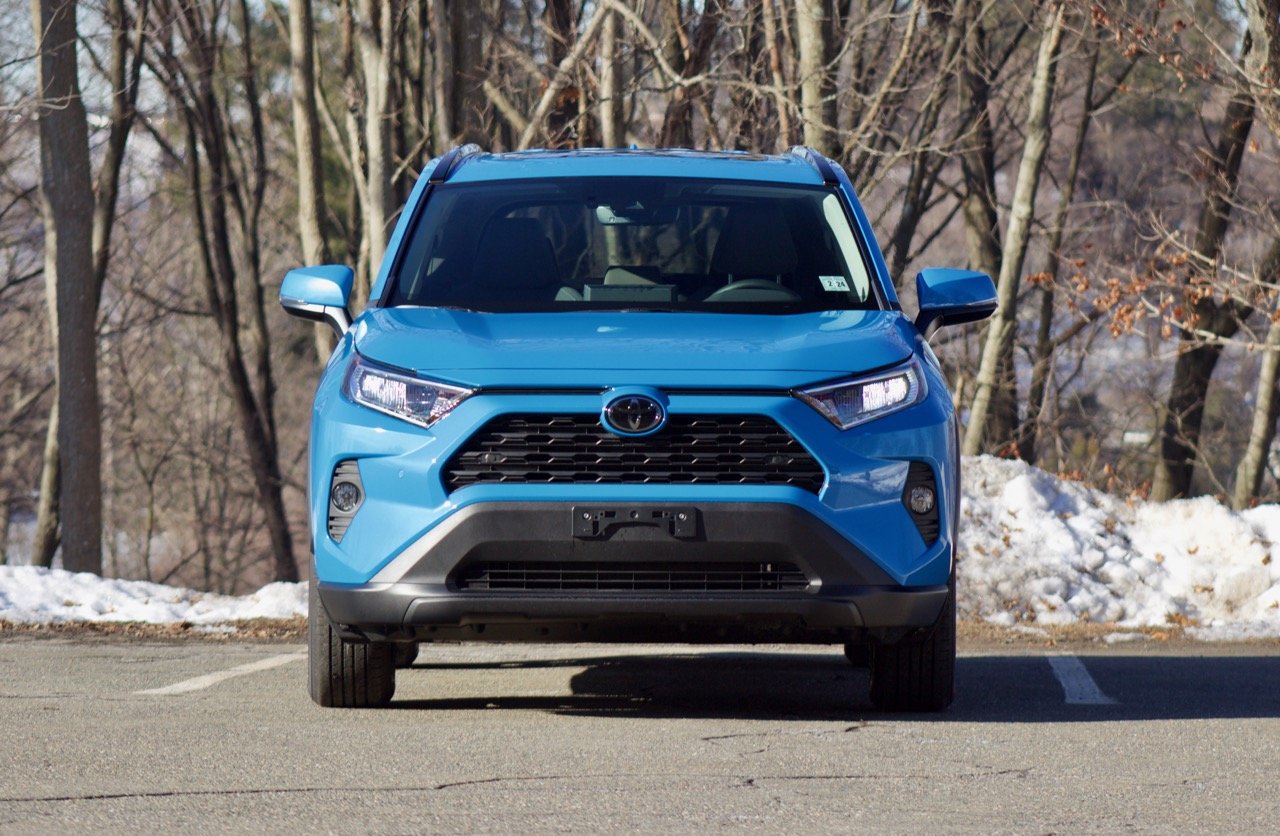
The 2019 Toyota RAV4 presented itself with a bold, chunky design heavily inspired by the Toyota Tacoma pickup. Its sharp edges and aggressive lines contributed to a futuristic appearance that conveyed strength. This design ethos was consistent throughout the vehicle, including the side-profile and the rear, where the taillights seemed to take cues from Toyota’s luxury brand, Lexus. The RAV4 featured a distinct character line on the rear C-pillar, a common design trait in new vehicles, though its aesthetic appeal was debatable. Around half of the RAV4's color options matched the body to the roof, while seven options offered a contrasting color roof, either in gray or black. For two-tone configurations, the black strip across the rear pillar was logical, but it felt like unnecessary clutter for the monotone schemes.
Inside, the RAV4 surprised many with its simplicity and elegance, counterbalancing its busy exterior. A prominent floating touchscreen centralized many of the vehicle's functionalities, while a “pod” stretched from the center dash to the cupholders housing the rest of the controls. Trims available included LE, XLE, XLE Premium, Adventure, and Limited. The LE trim offered standard features like 17-inch wheels with plastic covers, LED lighting, power mirrors, low-profile black roof rails, and privacy-tinted windows, while the XLE added amenities like alloy wheels, automatic high beams, integrated fog lights, color-keyed mirrors with turn signals, a moonroof, push-button start, sport bucket seats, and dual-zone climate control.
XLE Premium further upgraded to 19-inch alloy wheels, a powered rear liftgate, an 8-way power driver’s seat, a leather-wrapped steering wheel and shift lever, and SofTex leatherette seats. The Adventure trim veered towards ruggedness with features such as exclusive 19-inch wheels, unique grille designs, black fender cladding, enhanced roof rails, and orange-accented interiors. The top-tier Limited trim pursued upscale appeal with chrome-finished wheels, a unique grille, puddle approach lights, chrome door handles, heated front seats, ambient lighting, and comprehensive upgrades like a panoramic moonroof and heated/ventilated seats.
The 2019 Subaru Forester, on the other hand, grew slightly larger and wider than its predecessor, with exterior design mimicking a scaled-down version of the Subaru Ascent. This resemblance was found inside as well, where the cabin design prioritized function over luxury. Available trims included Base, Premium, Sport, Limited, and Touring. All trims came standard with LED headlights, Subaru’s symmetrical all-wheel drive (AWD), and EyeSight driver-assistance systems. The Base trim covered fundamental needs with features such as 60/40 split-folding rear seats, dual front USB ports, a 6.5-inch touchscreen, and an under-floor storage tray.
Progressing to the Premium trim introduced 17-inch alloy wheels, a roof spoiler, raised roof rails, body-colored mirrors, and a panoramic moonroof, alongside interior improvements such as 10-way power front seats, a leather-wrapped steering wheel and shift knob, reclining rear seatbacks, and 4G Wi-Fi capability. The Sport trim added unique styling touches like orange and black accents, larger disc brakes, 18-inch wheels, LED fog lights, a chrome exhaust outlet, push-button start, heated front seats, dual rear USB ports, and an upgraded display.
The Limited trim, which we examined, featured unique 18-inch wheels, fog lights, LED steering-responsive headlights, leather upholstery, a power rear tailgate, dual-zone climate control, and a larger 8-inch touchscreen. The top-tier Touring trim offered similar fog lights, satin chrome mirrors with integrated turn signals, a 10-way power-adjustable driver’s seat, heated rear seats and steering wheel, navigation, and quick-release folding rear seats.


The 2019 Toyota RAV4 came equipped across all trims with a 2.5-liter 4-cylinder engine generating 203 horsepower and 184 lb-ft of torque, paired with an 8-speed automatic transmission. This engine powered either the front wheels or an available AWD system. The AWD came in two variants: a base configuration, present in most trims, and a more sophisticated torque-vectoring AWD available in the Adventure and Limited trims. Our tested XLE model had the base AWD setup, featuring drive modes such as Snow, Sand & Mud, and Rock & Dirt to enhance rugged capability.
The torque-vectoring AWD enhanced real-time power distribution to the wheels needing it most, promoting better off-road performance and substituting terrain-selection buttons for a drive-mode dial. The 2.5-liter engine provided satisfactory highway acceleration but felt sluggish in stop-and-go situations due to limited low-end power. It also produced significant noise whether accelerating from a standstill or overtaking on the highway. The ride quality remained generally good, although some body roll and twitchy steering were noticeable, particularly in fast corners, making for an awkward experience compared to more refined competitors like the Honda CR-V or athletic alternatives such as the Ford Escape and Mazda CX-5.
Fuel economy for the front-wheel-drive RAV4 stood at 26 mpg city, 35 highway, and 30 combined, while the AWD achieved 27 mpg city, 34 highway. Our test car recorded a combined 29.3 mpg. The torque-vectoring AWD version delivered 25 mpg city, 33 highway, and 28 combined.
The 2019 Subaru Forester featured a 2.5-liter 4-cylinder boxer engine producing 182 horsepower and 176 lb-ft of torque. While this was an improvement over the previous model, the increase in torque was minimal, impacting initial acceleration. Notably, the 2018 Forester offered a turbocharged 2.0XT trim with significantly higher power, but this option was absent in 2019. Subaru's implementation of the boxer engine contributed to a lower center of gravity, favoring smoothness and stability.
Power was routed through a continuously variable transmission (CVT) to the Forester's standard symmetrical AWD. Though designed for efficiency, the CVT resulted in lackluster acceleration, though SI-Drive offered across trims helped enhance throttle response. The system provided Intelligent and Sport modes for varying driving conditions. Complementing the AWD was the X-Mode terrain management system, available in dual-mode setups in higher trims, optimizing power delivery through different conditions like snow, dirt, and mud.
The Forester excelled with its smooth ride, light maneuverability, and minimal body roll, making it a comfortable choice for both urban and highway driving. Fuel economy was 26 mpg city, 33 highway, and 29 combined, closely matching the RAV4’s efficiency, with recorded mixed driving conditions yielding 28.9 mpg.
Inside the 2019 Toyota RAV4, the clean and upscale design prioritized practicality with ample cargo space and roomy seating. Its center stack contained all essential controls, minimizing clutter with a short, stocky shifter. The RAV4 offered 37.6 cubic feet of cargo space with the rear seats up, expanding to 69.8 cubic feet when folded. Though slightly reduced from the previous year, it competed well against rivals like the Mazda CX-5 and Jeep Cherokee, but lagged behind the Forester and Honda CR-V, which offered around 75 cubic feet. Additional storage solutions included deep center-console trays and bins, and a hidden tray above the glove box.
The 2019 Subaru Forester, larger than its predecessor, offered a class-leading 76.1 cubic feet of cargo space in the base trim, with other trims providing 70.9 cubic feet. The vehicle’s extended wheelbase improved backseat space, and an enhanced tailgate opening facilitated easier loading. The Forester’s 8.7 inches of ground clearance benefited both off-road capability and ease of access, particularly for older drivers. The function-first cabin design featured numerous cubbies and bottle holders, a tall greenhouse ensuring ample legroom and headroom, and exceptional rearward visibility, thanks to its large windows and minimalist C-pillars.
The 2019 Toyota RAV4’s LE trim included a 7-inch touchscreen with Entune 3, supporting Apple CarPlay but not Android Auto. Standard features also included Bluetooth, a USB port, and WiFi hotspot. The XLE trim added multiple USB ports and the Adventure upgraded to a panoramic reversing camera and a larger 8-inch Entune screen. Layout simplicity marked the infotainment system with real dials for key functions, countering the trend of proprietary controller systems seen in other brands. The big update for 2019 was indeed the addition of Apple CarPlay, though Android Auto was still absent.
In contrast, the 2019 Subaru Forester’s Starlink infotainment system was available with either a 6.5-inch or an 8-inch touchscreen, standardizing Apple CarPlay and Android Auto across trims. The system's high resolution and intuitive navigation made it user-friendly, and smooth transitions between Starlink and CarPlay enhanced the overall experience. Subaru's EyeSight suite offered technologically advanced safety features, including Lead Vehicle Alert, warning inattentive drivers when traffic ahead moved.
The 2019 Toyota RAV4 came with various standard safety features: front and side airbags, a reversing camera, traction control, tire-pressure monitoring, and Toyota Safety Sense 2.0. This suite included forward-collision warning, lane-departure warning, automatic high-beams, dynamic radar cruise control, traffic-sign detection, and Lane-Tracing Assist, which kept the vehicle centered in its lane.
The 2019 Subaru Forester also boasted comprehensive safety features via Subaru’s EyeSight system, including forward-collision warning, adaptive cruise control, lane-departure warning, adaptive headlights, lane-keeping assist, full front and side airbags, and a reversing camera. The Forester's excellent visibility further augmented these features, ensuring a high level of road awareness.
CarGurus highlights

According to CarGurus experts, the overall rating for the 2019 Toyota RAV4 stood at 8.0 out of 10, while the 2019 Subaru Forester scored 8.2 out of 10. Based on these ratings, the 2019 Subaru Forester edged out the RAV4, offering a slightly higher level of overall satisfaction. The Forester's superior cargo capacity, exceptional safety features, and function-first design make it the better choice in this comparison.
Choose the 2019 Subaru Forester if:
- You need a vehicle with superior cargo space, perfect for hauling family belongings or outdoor gear.
- You prioritize function-oriented design with features that enhance visibility and ease of access.
- You appreciate advanced safety technology with Subaru's EyeSight system, offering peace of mind on the road.


Choose the 2019 Toyota RAV4 if:
- You prefer a bold, aggressive design with an upscale, yet functional interior.
- You value a variety of rugged trims and the option for advanced torque-vectoring AWD.
- You seek a vehicle with a user-friendly infotainment system, generous cargo space, and comprehensive safety features.


CarGurus highlights
According to CarGurus experts, the overall rating for the 2019 Toyota RAV4 stood at 8.0 out of 10, while the 2019 Subaru Forester scored 8.2 out of 10. Based on these ratings, the 2019 Subaru Forester edged out the RAV4, offering a slightly higher level of overall satisfaction. The Forester's superior cargo capacity, exceptional safety features, and function-first design make it the better choice in this comparison.
Choose the 2019 Subaru Forester if:
Shop Now- You need a vehicle with superior cargo space, perfect for hauling family belongings or outdoor gear.
- You prioritize function-oriented design with features that enhance visibility and ease of access.
- You appreciate advanced safety technology with Subaru's EyeSight system, offering peace of mind on the road.
Choose the 2019 Toyota RAV4 if:
Shop Now- You prefer a bold, aggressive design with an upscale, yet functional interior.
- You value a variety of rugged trims and the option for advanced torque-vectoring AWD.
- You seek a vehicle with a user-friendly infotainment system, generous cargo space, and comprehensive safety features.

By: CarGurus + AI
At CarGurus, our team of experienced automotive writers remain at the heart of our content operation, conducting hands-on car tests and writing insightful guides that are backed by years of industry experience. To complement this, we are harnessing AI to make our content offering more diverse and more helpful to shoppers than ever. To achieve this, our AI systems are based exclusively on CarGurus content, ratings and data, so that what we produce is both unique to CarGurus, and uniquely helpful to car shoppers.

