2020 Mazda MAZDA3 vs 2019 Toyota Camry
Overview | |
MSRP$24,095 | MSRP$21,500 |
Listings1117 | Listings154 |
Ratings & Reviews | |
User Reviews | User Reviews |
Expert reviews7.8 out of 10 | Expert reviews7.8 out of 10 |
Pros
Cons
| Pros
Cons
|
2019 Toyota Camry Reviews SummaryBlame the Toyota Avalon for the Toyota Camry’s flaws. In order to put daylight between itself and Toyota’s larger full-size sedan, the midsize Camry is now smaller than some of its competitors, while simultaneously offering fewer of the increasingly expected features in the segment. Still, there are several good reasons to consider a 2019 Camry, from its outstanding safety ratings to its free scheduled maintenance plan. It’s also one of a handful of family sedans that still offers a 6-cylinder engine. | |
2020 Mazda MAZDA3 Reviews SummaryMazda redesigned the Mazda3 in 2019, taking what was already one of the best-looking compact cars on the market, and attempting to dress it up even further. The goal was to elevate the brand into near-luxury territory. While the 2020 Mazda3 may not compete on the same plane as a Mercedes-Benz CLA-class or a BMW 2 Series, it feels undeniably premium when benchmarked against more mass-market competitors. | |
Popular Features & Specs | |
Engine2.5L 203 hp I4 | Engine2.5L 186 hp I4 |
DrivetrainFWD | DrivetrainFWD |
Seating Capacity5 | Seating Capacity5 |
Horsepower | Horsepower186 hp @ 6000 rpm |
MPG City29 | MPG City27 |
MPG Highway41 | MPG Highway36 |
Engine | |
Engine Name2.5L 203 hp I4 | Engine Name2.5L 186 hp I4 |
Torque | Torque186 lb-ft @ 4000 rpm |
Horsepower | Horsepower186 hp @ 6000 rpm |
DrivetrainFWD | DrivetrainFWD |
Fuel Economy | |
MPG City29 | MPG City27 |
MPG Highway41 | MPG Highway36 |
Interior | |
Seating Capacity5 | Seating Capacity5 |
Safety | |
Front Crash Overall5 | Front Crash Overall5 |
Side Crash Overall5 | Side Crash Overall5 |
Dimensions & Capacity | |
Cargo Space14.1 cu ft | Cargo Space13.2 cu ft |
Curb Weight3241 lbs | Curb Weight3071 lbs |
Height56.9 in | Height56.9 in |
Length192.1 in | Length183.5 in |
Width72.4 in | Width70.7 in |
Wheelbase111.2 in | Wheelbase107.3 in |
Maximum Payload925 lbs | Maximum Payload1008 lbs |
Number of doors4 | Number of doors4 |
Overview | ||
MSRP | $24,095 | $21,500 |
Listings | ||
Ratings & Reviews | ||
User reviews | ||
Expert reviews | 7.8 out of 10Read full review | 7.8 out of 10Read full review |
Pros & cons | Pros
Cons
| Pros
Cons
|
Summary | Blame the Toyota Avalon for the Toyota Camry’s flaws. In order to put daylight between itself and Toyota’s larger full-size sedan, the midsize Camry is now smaller than some of its competitors, while simultaneously offering fewer of the increasingly expected features in the segment. Still, there are several good reasons to consider a 2019 Camry, from its outstanding safety ratings to its free scheduled maintenance plan. It’s also one of a handful of family sedans that still offers a 6-cylinder engine. | Mazda redesigned the Mazda3 in 2019, taking what was already one of the best-looking compact cars on the market, and attempting to dress it up even further. The goal was to elevate the brand into near-luxury territory. While the 2020 Mazda3 may not compete on the same plane as a Mercedes-Benz CLA-class or a BMW 2 Series, it feels undeniably premium when benchmarked against more mass-market competitors. |
Video | ||
Popular Features & Specs | ||
Engine | 2.5L 203 hp I4 | 2.5L 186 hp I4 |
Drivetrain | FWD | FWD |
Seating Capacity | 5 | 5 |
Horsepower | 186 hp @ 6000 rpm | |
MPG City | 29 | 27 |
MPG Highway | 41 | 36 |
Engine | ||
Engine Name | 2.5L 203 hp I4 | 2.5L 186 hp I4 |
Torque | 186 lb-ft @ 4000 rpm | |
Horsepower | 186 hp @ 6000 rpm | |
Drivetrain | FWD | FWD |
Fuel Economy | ||
MPG City | 29 | 27 |
MPG Highway | 41 | 36 |
Interior | ||
Seating Capacity | 5 | 5 |
Safety | ||
Front Crash Overall | 5 | 5 |
Side Crash Overall | 5 | 5 |
Dimensions & Capacity | ||
Cargo Space | 14.1 cu ft | 13.2 cu ft |
Curb Weight | 3241 lbs | 3071 lbs |
Height | 56.9 in | 56.9 in |
Length | 192.1 in | 183.5 in |
Width | 72.4 in | 70.7 in |
Wheelbase | 111.2 in | 107.3 in |
Maximum Payload | 925 lbs | 1008 lbs |
Number of doors | 4 | 4 |
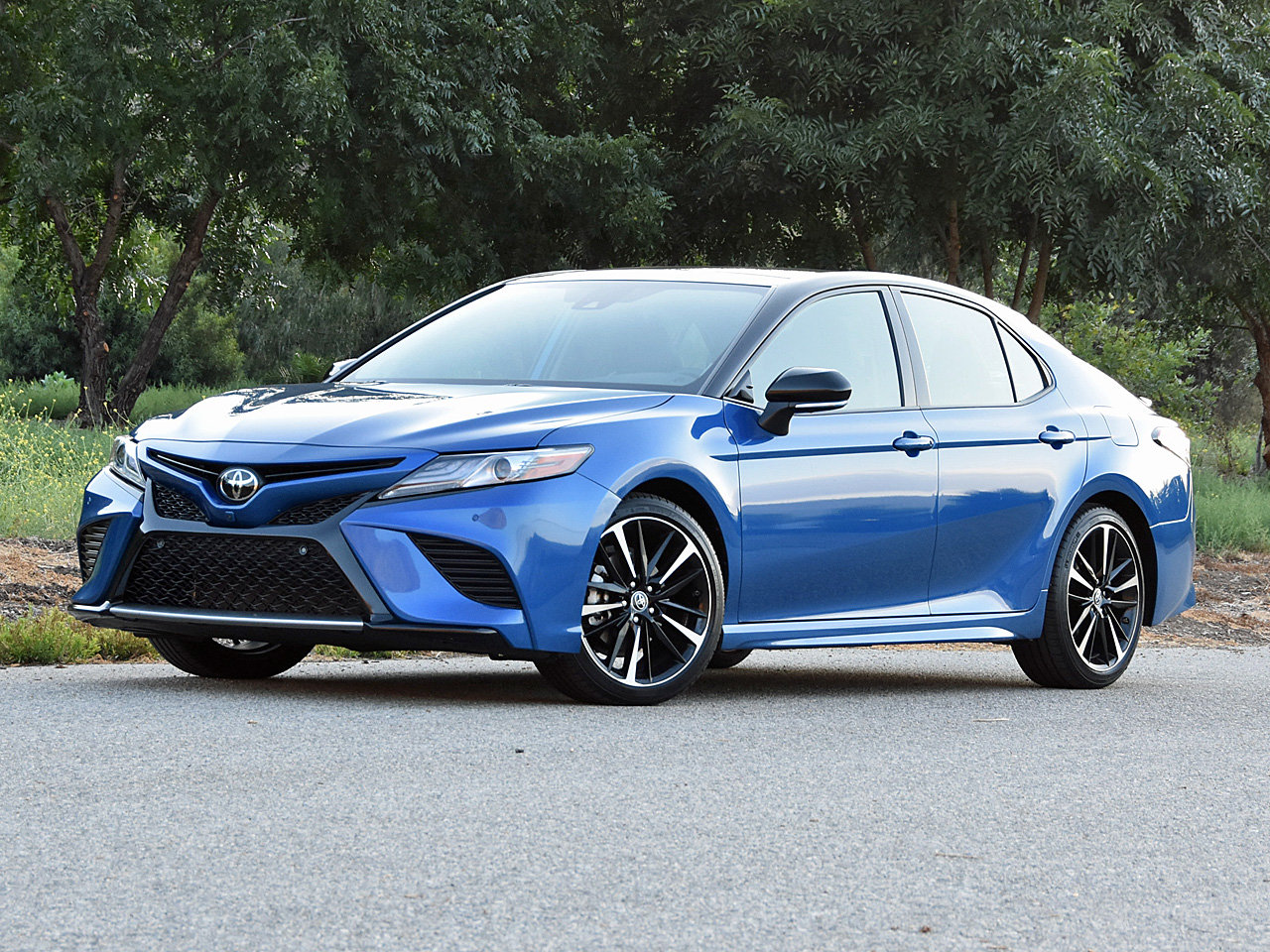
The 2019 Toyota Camry offered buyers a choice between standard and sporty styling along with three powertrain options: a 4-cylinder, a V6, and a hybrid. Trim levels varied based on the engine selection, ranging from L, LE, and XLE, to SE and XSE. The model reviewed was the Camry XSE, equipped with a V6 engine, Toyota's Driver Assist package, carpeted floor mats, and a distinctive Blue Streak paint with a Midnight Black roof, all summing up to a sticker price of $39,669.
In terms of looks, the Camry XSE V6 was quick and entertaining to drive, a quality not typically associated with Camrys. However, reviewers suggested that the standard 2.5-liter 4-cylinder engine in the LE trim offered a better value. Despite the hybrid's excellent gas mileage, it came at a higher initial cost—$3,800 more for an LE hybrid trim compared to a standard LE—and would take nearly a decade to realize cost savings at the pump.
The exterior styling of the Camry proved controversial. Toyota made aggressive design changes moving away from its previously bland designs. Nevertheless, the design appeared unresolved and oversized for the car’s proportions, unlike the more successful designs of the Toyota Avalon and Corolla. The Camry's interior, however, shone with high-quality materials and soft-touch surfaces. But the hefty price tag highlighted areas that could use improvement, such as the lack of a classy fabric wrap on the windshield pillars and a more refined look for some switchgear.
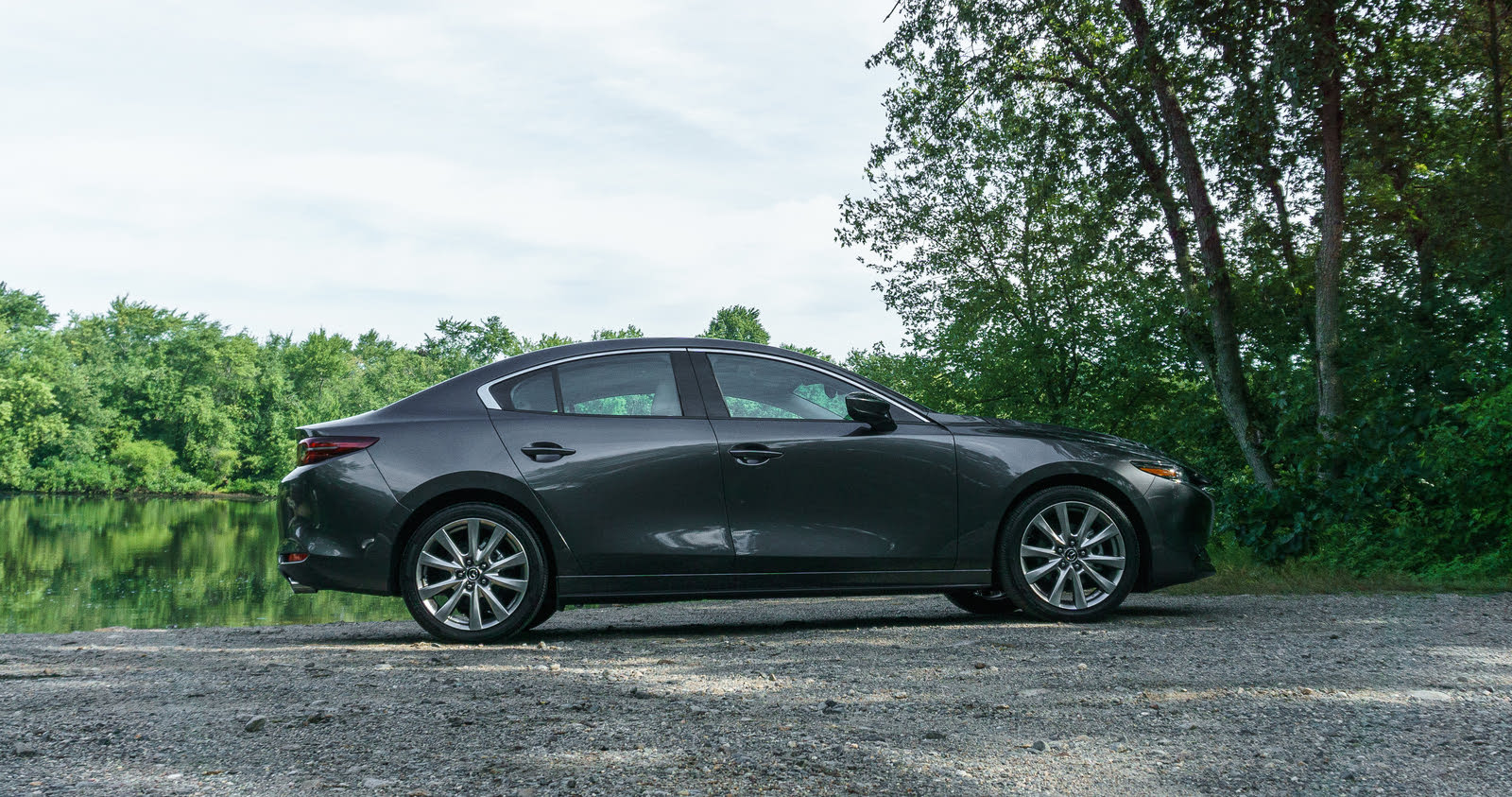
Turning to the 2020 Mazda MAZDA3, consumers could choose between sedan and hatchback body styles. The hatchback, with its distinctive silhouette, was heavily showcased in press materials, appealing to those seeking a unique look. The sedan, while also stylistically special, directly competed with premium offerings, notably responding to preferences for sedans in the U.S.
The test vehicle was a sedan with the Premium Package and AWD, featuring 18-inch alloy wheels and a stunning blacked-out mesh front grille with round running lamps. This Mazda3 stood out for its sculptured side profile and curvilinear design, unlike competitors like the Honda Civic and Toyota Corolla, which opted for more angular styling. However, the sedan's rear proportions felt a bit off, although this issue was less noticeable in the hatchback variant.
Inside, the Mazda3 aimed for premium minimalism with soft-padded materials and a clean layout. The creamy white leather and well-maintained upholstery even after 10,000 miles on the odometer showcased durability. However, a notable downside was the large transmission hump in the rear middle seat, impacting comfort. Overall, the Mazda3’s design placed itself firmly in the premium territory, aiming to compete with higher-end brands like Volvo in terms of interior quality.


For the 2019 Toyota Camry, the standard 2.5-liter 4-cylinder engine with 203 horsepower sufficed for everyday driving. Yet, the 301-hp, 3.5-liter V6 engine provided a substantial 83 additional pound-feet of torque, offering a thrilling driving experience not usually associated with a Camry. Despite the extra weight over the car’s front end, handling remained sprightly. The 8-speed automatic transmission delivered smooth, precise shifts, especially in Sport mode with paddle shifters.
The sport-tuned suspension and 19-inch aluminum wheels with 235/40 tires on the Camry XSE offered responsive handling without the harshness typical of sport-sedan suspensions. Steering felt naturally firm, enhancing the driving experience. However, repeated braking tests revealed a lack of refinement with a “thunk” sound upon quick pedal release, diminishing perceptions of quality. Fuel economy fell short at just 21.9 mpg, well below the EPA’s 26-mpg combined rating, likely due to enthusiastic driving of the V6 engine.
In comparison, the 2020 Mazda MAZDA3 faced criticism for its redesigned suspension. Switching from a multi-link rear suspension to a torsion beam setup, the car compromised the smoothness of ride typically associated with its predecessors. Despite this, most consumers might not notice the difference. The 2.5-liter SkyActiv four-cylinder engine produced 186 horsepower and 186 pound-feet of torque, marking an improvement over the previous generation's engines.
While lacking the immediate punch of turbocharged engines, the Mazda3’s naturally aspirated engine was predictable and reliable. Anticipating the needs of enthusiast buyers, Mazda offered a six-speed manual transmission, although only with specific configurations. The majority of buyers, including those of the test vehicle, would encounter a six-speed automatic transmission as standard. This limitation in transmission options highlighted Mazda’s market strategy, assuming consumers willing to pay extra for a manual transmission’s driving experience.
The 2019 Toyota Camry’s interior offered a mix of ample storage solutions and some limitations. A large center console bin and a hidden compartment under the wireless charging pad provided useful storage, whereas the small glove box and narrow door-panel pockets were less convenient. The trunk space was modest at 15.1 cubic feet, smaller compared to its rivals like the Honda Accord, which offers 16.7 cubic feet.
Front seats in the Camry were highly adjustable and heated, although lacking ventilation. Rear-seat space was less generous, with narrow door openings and a low seating position making ingress and egress challenging. Rear-seat passengers in upper trims enjoyed air conditioning vents, but this feature was not available in lower trims.
The 2020 Mazda MAZDA3 sedans measured 183.5 inches in length on a 107.3-inch wheelbase, with the hatchback slightly shorter at 175.6 inches. The interior was designed to maximize space, offering good headroom for the driver and soft, supportive seats. However, rear legroom was tight, mitigated somewhat by soft front seatbacks.
A significant drawback was the large transmission hump in the rear middle seat, affecting comfort regardless of whether the car was FWD or AWD. The sedan’s trunk capacity was 13.2 cubic feet, smaller than the Camry’s, while the hatchback offered a more generous 20.1 cubic feet of cargo space.
The 2019 Toyota Camry featured a dramatic yet functional dashboard layout. The Entune 3.0 infotainment system was intuitive, offering Apple CarPlay but lacking Android Auto until 2020. A Qi-compatible wireless charging pad effectively held phones in place even during spirited driving. The navigation system, though reliable, occasionally lagged in loading traffic data, underlining the importance of using third-party apps like Google Maps for navigation. The 9-speaker JBL audio system failed to impress, with a bass-heavy, muddy sound quality. A 10-inch head-up display (HUD) provided easy-to-read information without being obstructed by polarized sunglasses.
Conversely, the 2020 Mazda MAZDA3 placed its 8.8-inch infotainment display high on the dashboard, blending it seamlessly into the overall design. Mazda eliminated touch functionality, arguing that touchscreens pose a safety risk. Instead, navigation and infotainment were controlled via a rotary dial and dedicated buttons between the front seats, emphasizing ease of use once familiarized. Apple CarPlay, Android Auto, Bluetooth connectivity, and Sirius XM satellite radio were included. The system was faster and visually sharper than previous versions. The HUD now reflected off the windshield, enhancing its usability and fitting well with the car's minimalist interior design.
Safety was a standout feature for the 2019 Toyota Camry. It achieved 5-star ratings in all NHTSA assessments, including rollover resistance, and was awarded a Top Safety Pick+ rating by the IIHS. The car came equipped with the Toyota Safety Sense suite, including adaptive cruise control, forward-collision warning, automatic emergency braking, lane-departure warning, lane-keeping assist, and automatic high-beam headlights. While the standard ADAS wasn’t the latest version, it was effective and reliable. Toyota also provided a three-year subscription to Safety Connect services, offering emergency assistance and more.
The 2020 Mazda MAZDA3 also excelled in safety, earning a Top Safety Pick+ from the IIHS and a five-star overall rating from the NHTSA. It featured comprehensive ADAS including forward-collision warning, lane-departure warning, adaptive cruise control, and more. Notably, these features were standard, emphasizing Mazda’s commitment to safety across all models.
CarGurus highlights
According to CarGurus experts, the overall rating for the 2019 Toyota Camry was 7.8 out of 10, while the 2020 Mazda MAZDA3 also scored 7.8 out of 10. Given this tie in ratings, the decision comes down to personal preference and specific needs. For those prioritizing safety, reliability, and straightforward technology, the 2019 Toyota Camry proves to be a solid choice. Conversely, if you seek a vehicle with standout interior design, precise handling, and are drawn to hatchback utility, the 2020 Mazda MAZDA3 emerges as the preferable option.
Choose the 2020 Mazda MAZDA3 if:
- You desire a stylish, premium interior with a minimalist, modern design.
- You appreciate precise handling and are willing to compromise slightly on ride comfort.
- You require a hatchback for its superior cargo capacity compared to the sedan.


Choose the 2019 Toyota Camry if:
- You prioritize top-tier safety ratings and comprehensive standard ADAS.
- You prefer a more traditional, accessible interior with touchscreen functionality.
- You value Toyota’s reputation for reliability and a strong resale value.


CarGurus highlights
According to CarGurus experts, the overall rating for the 2019 Toyota Camry was 7.8 out of 10, while the 2020 Mazda MAZDA3 also scored 7.8 out of 10. Given this tie in ratings, the decision comes down to personal preference and specific needs. For those prioritizing safety, reliability, and straightforward technology, the 2019 Toyota Camry proves to be a solid choice. Conversely, if you seek a vehicle with standout interior design, precise handling, and are drawn to hatchback utility, the 2020 Mazda MAZDA3 emerges as the preferable option.
Choose the 2020 Mazda MAZDA3 if:
Shop Now- You desire a stylish, premium interior with a minimalist, modern design.
- You appreciate precise handling and are willing to compromise slightly on ride comfort.
- You require a hatchback for its superior cargo capacity compared to the sedan.
Choose the 2019 Toyota Camry if:
Shop Now- You prioritize top-tier safety ratings and comprehensive standard ADAS.
- You prefer a more traditional, accessible interior with touchscreen functionality.
- You value Toyota’s reputation for reliability and a strong resale value.

By: CarGurus + AI
At CarGurus, our team of experienced automotive writers remain at the heart of our content operation, conducting hands-on car tests and writing insightful guides that are backed by years of industry experience. To complement this, we are harnessing AI to make our content offering more diverse and more helpful to shoppers than ever. To achieve this, our AI systems are based exclusively on CarGurus content, ratings and data, so that what we produce is both unique to CarGurus, and uniquely helpful to car shoppers.

