2025 Ford Bronco Sport Reviews, Pricing & Specs
Pros & cons
What we like
Great handling
Standard all-wheel drive
Stylish design
What to consider
Excessive touchscreen controls
Mediocre fuel economy
Expert review
Updates to Ford’s baby Bronco give it even more off-road capability.
Launched for the 2021 model year, the Ford Bronco Sport is a compact crossover SUV that combines the platform of the Ford Escape with the styling and off-road focus of its namesake. Ford doubles down on that for 2025, adding new option packages to further increase off-road capability, along with tech, styling, and interior updates.
Verdict: The Bronco Sport was designed primarily with off-road enthusiasts in mind, but it’s still a good all-around crossover.
out of 10 expert review
Look & feel
The Bronco Sport shares the C2 unibody platform with the Ford Escape, but its styling goes in a completely different direction. With the Escape designed to appeal to buyers of the sedans and hatchbacks Ford no longer sells in the U.S., the Bronco Sport is free to lean into ruggedness.
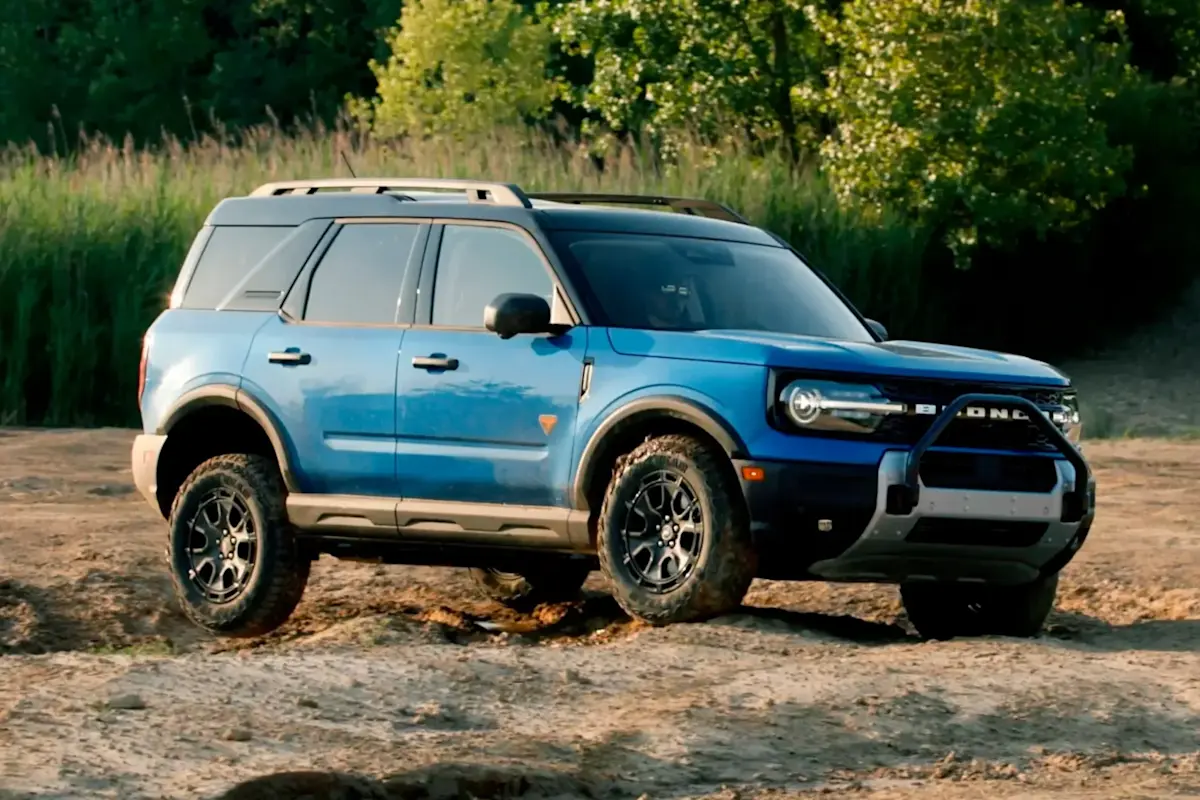
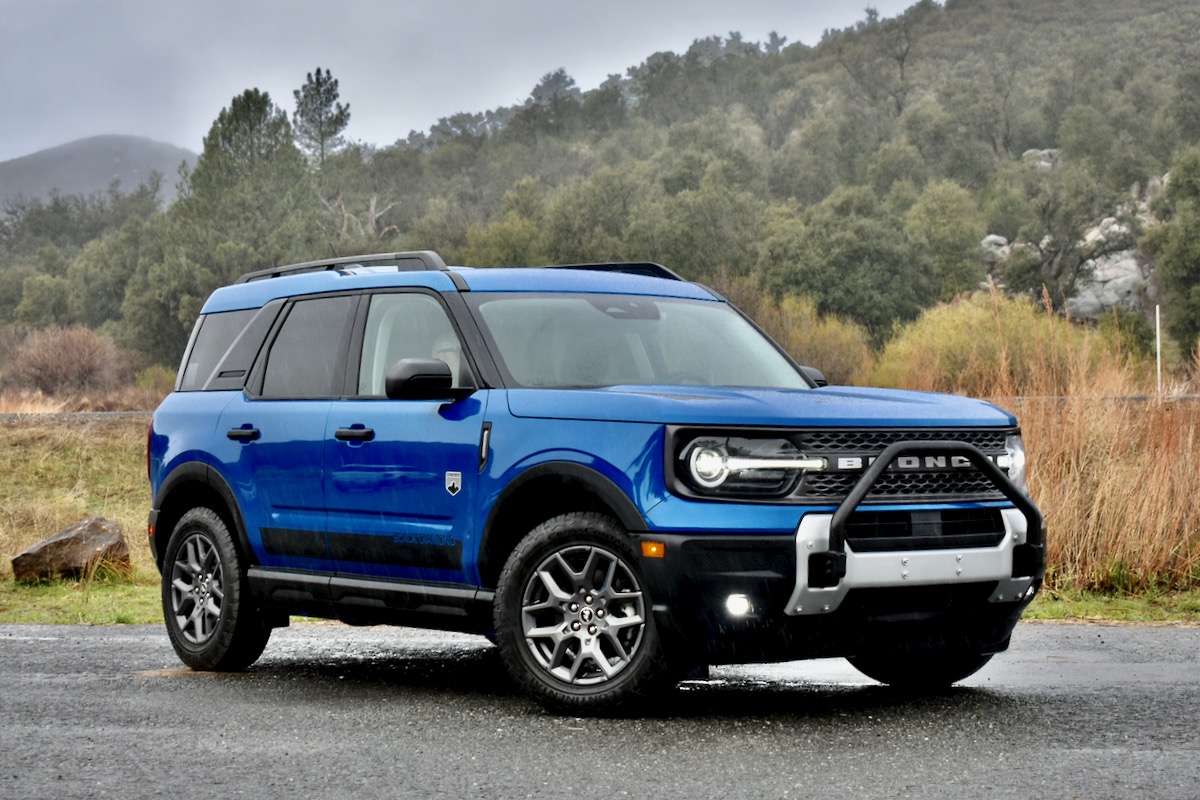
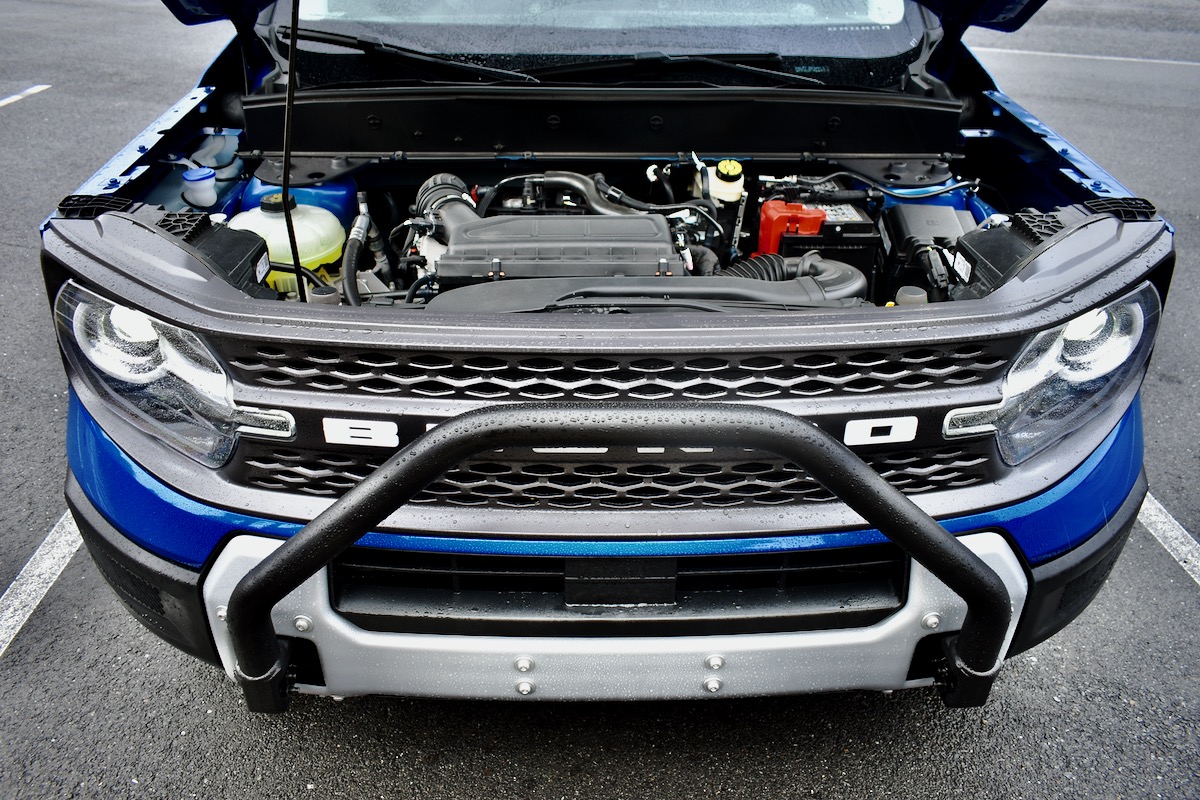
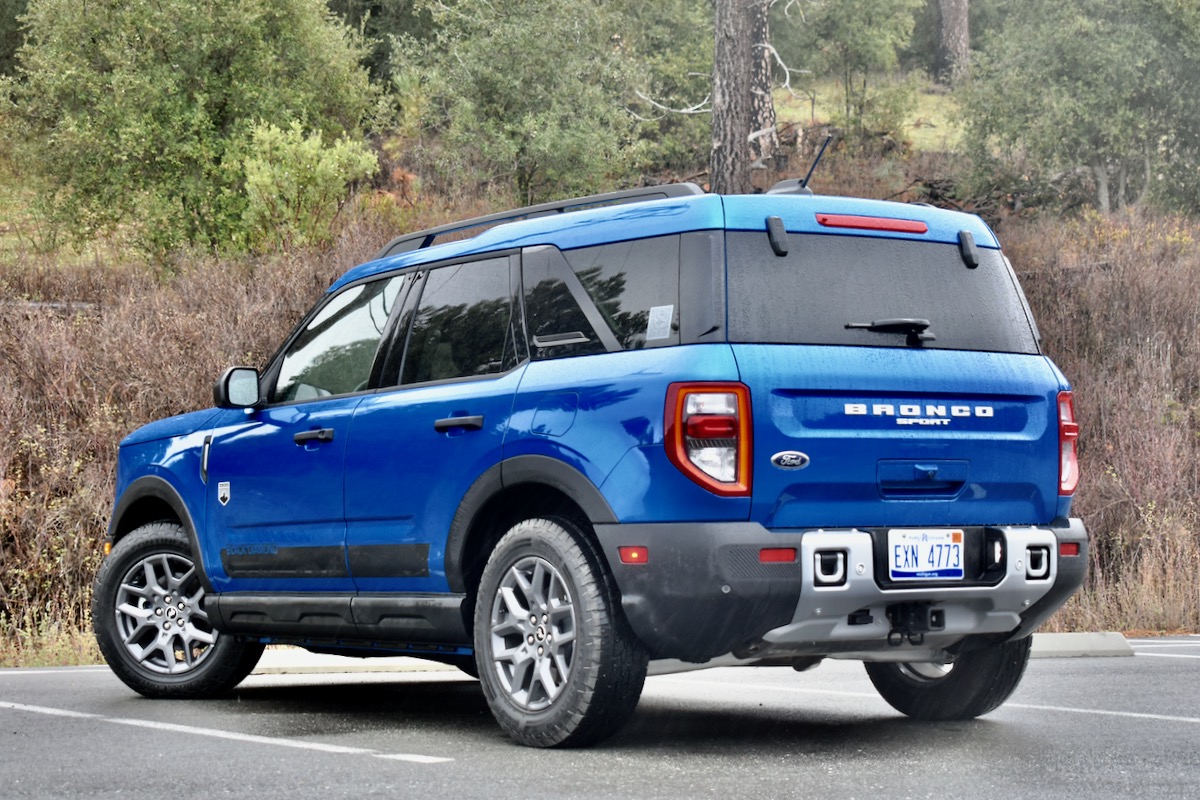
A rectangular grille with inset round headlights and “Bronco” lettering is a miniature version of the standard Bronco’s grille. And while the Bronco Sport isn’t a convertible with removable doors like the big Bronco, it has the same square silhouette, with a long, flat hood and upright greenhouse. These styling elements combine with the Bronco Sport’s small size to make it cute and approachable rather than aggressive, while still looking like a proper Bronco.
The styling hasn’t changed much for 2025, unless you go for the newly available off-road packages. The Black Diamond Package (available on the Big Bend trim level) and Sasquatch Package (available on the Outer Banks and Badlands) include modular steel front and rear bumpers with accessory mounting points. The rear bumper includes a pair of cast D-rings, while the front bumper includes a removable nudge bar. Underneath, steel bash plates and skid plates provide underbody protection while off-roading.
Like the big Bronco, the Bronco Sport also has prominent brows on its front fenders that act as Ford calls “trail sights,” making it easy to judge where the corners of the vehicle are. For 2025, the Bronco Sport also adds tie-down points like those on the big Bronco, although instead of being on the tops of the fenders they fold out from the sides.
The interior is less distinctive than the exterior, with big air vents and some Bronco badging as the only real distinguishing elements from other Ford interiors. But it’s certainly functional, adding center-console grab handles for 2025 (so passengers will have something to hold onto while off-roading) and available auxiliary switches for lights or other aftermarket accessories. Materials also feel pretty good for the price point, with nothing that appeared too delicate for the Bronco Sport’s off-road raison d’être.
Performance
Powertrain offerings carry over from the 2024 model year. Most trim levels come with a 1.5-liter turbocharged three-cylinder engine generating 180 horsepower and 200 pound-feet of torque, while Ford Bronco Sport Badlands models have a 2.0-liter turbocharged four-cylinder engine making 250 hp and 280 lb-ft of torque.
An eight-speed automatic transmission is standard with both engines (2.0-liter models get manual-shifting capability) as is all-wheel drive (AWD). In keeping with the Bronco Sport’s focus on off-roading, the AWD system includes a dual-clutch rear-drive unit for torque vectoring, which in this case is used as a sort of substitute for the locking differentials in traditional 4x4s, ensuring that power always has a way to get to the wheel with the most traction.
There’s no shortage of off-road packages for compact crossovers, but the Bronco Sport is more serious than most. In addition to its high ground clearance and torque-vectoring rear drive unit, the Bronco Sport is available with Trail Control, which acts as a low-speed cruise control for off-roading, letting the driver focus on taking the right line and dodging obstacles instead of maintaining accelerator pedal pressure. A one-pedal feature is new for 2025, which automatically brakes while the driver adjusts speed with the right pedal.
These features are included in the new-for-2025 Sasquatch Package, along with 29-inch all-terrain tires, off-road suspension, and steel underbody protection. The Sasquatch Package is available on both the Outer Banks and Badlands trim levels, with the latter adding Bilstein position-sensitive dampers that allow additional travel, an upgraded cooling fan, and an auxiliary oil cooler.
Like the big Bronco, the Bronco Sport includes multiple drive modes called G.O.A.T. modes—as in “goes over any terrain,” the mantra of the original Bronco development team in the 1960s. Most models have Normal, Eco, Slippery, Sport, and Off-Road modes, while Badlands Sasquatch models add Rally and Rock Crawl Modes.
Driving a Sasquatch through the desert near Borrego Springs, California, it was great being able to transition from carving through sand in Rally Mode to climbing a steep, technical rocky outcropping in Rock Crawl mode. The latter was especially impressive for a small crossover, although we likely would’ve had an easier time in a more traditional off-roader like the Bronco Sport’s big sibling.
Those traditional off-roaders usually aren’t very pleasant to driver on the road, though, and that’s where the Bronco Sport really shines. Even with all-terrain tires and lifted suspension, the Bronco Sport was composed, comfortable, and quiet on long drives to and from San Diego to the off-road site. Handling is typical of a vehicle designed for off-roading, but the Bronco Sport’s small size helped make up for that. That the Bronco Sport’s considerable off-road capability doesn’t ruin its on-road driving dynamics is truly impressive. It’s a breadth of talent we’d expect in a Land Rover, not a compact Ford.
Form & function
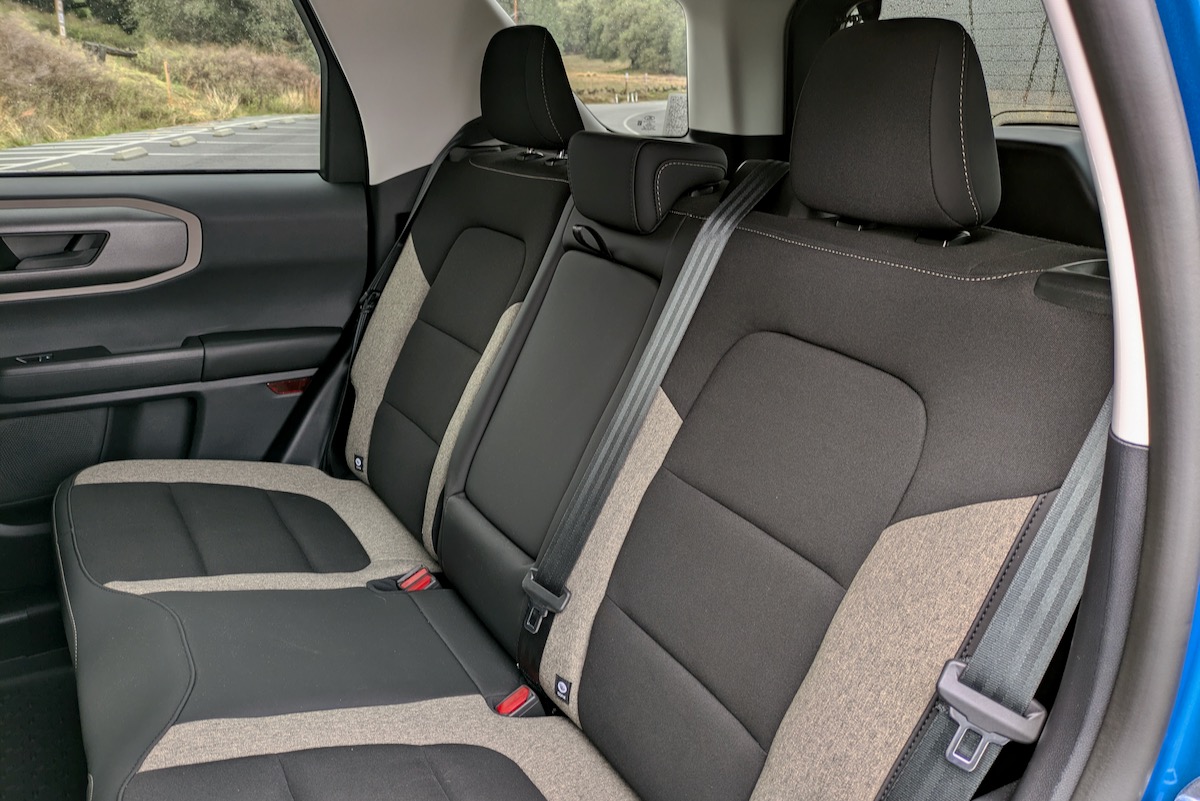
The Bronco Sport’s off-road emphasis doesn’t detract from its practicality. The five-seat Ford offers more headroom in both its first and second rows of seats than a Jeep Compass Trailhawk, Subaru Forester Wilderness, or Toyota RAV4 TRD Off-Road—the off-road versions of the Compass, Forester, and RAV4. The Ford also offers more first-row legroom than all except the Wilderness (which remains on the previous-generation Forester platform for 2025), but it’s back of the pack when it comes to second-row legroom.
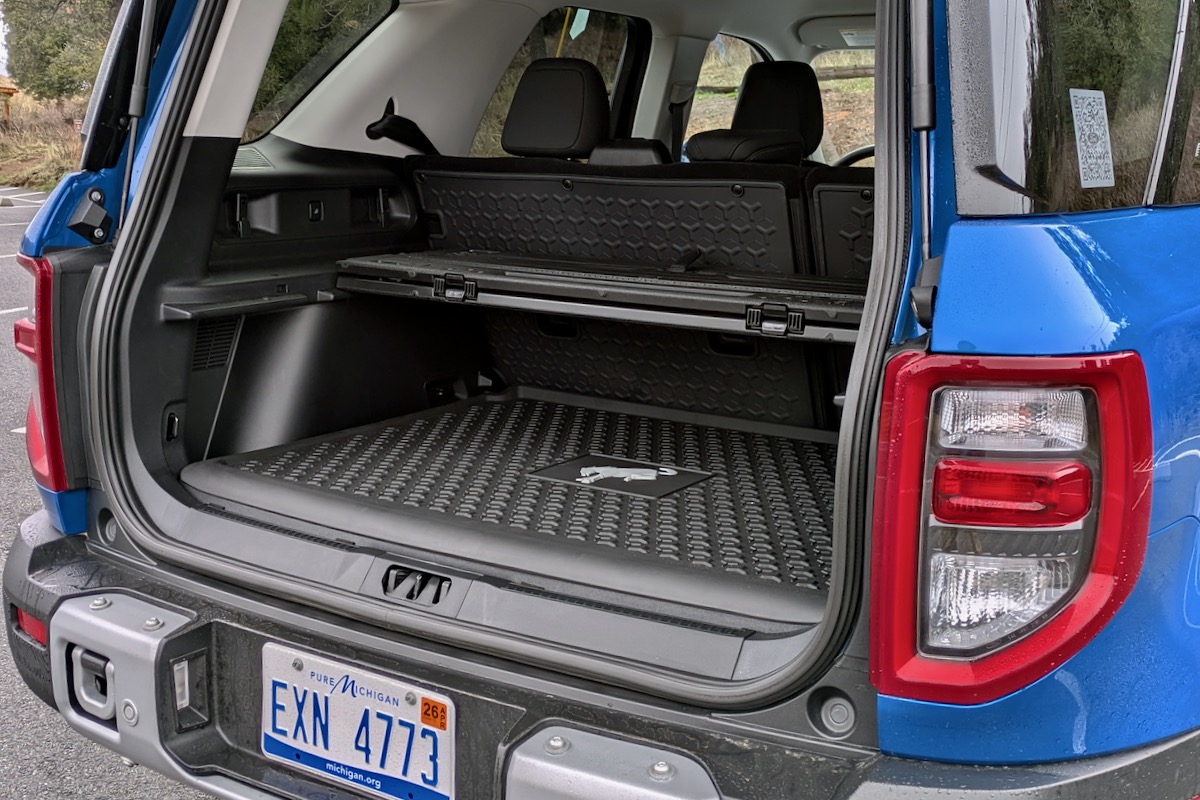
Ford claims 32.5 cubic feet of cargo space with the rear seats up and 65.2 cubic feet with the rear seats folded as standard, although that shrinks to 29.4 cubic feet with the rear seats up and 60.6 cubic feet with the rear seats down on certain higher trim levels. That’s pretty competitive either way, although a Forester Wilderness or RAV4 TRD Off-Road will carry more stuff with their rear seats folded.
In addition to the expected generous cupholders—made possible in part by the Bronco Sport’s space-efficient rotary shifter—and wireless charging pad, Ford includes a dedicated device tray on top of the dashboard with two USB ports and mounting points for positioning a phone or GoPro to record off-road adventures. More USB ports are available alongside the wireless charging pad, inside the center console storage bin, and on the back of the console, for rear-seat passengers.
The Bronco Sport will also tow up to 2,200 pounds with the turbo-three engine or 2,700 pounds with the turbo-four engine, when properly equipped. That’s more than the 2,000-pound maximum of the Jeep Compass Trailhawk, but less than the 3,000-pound towing capacity of the Subaru Forester Wilderness. Towing packages with Ford’s Trailer Sway Control driver aid are included with the Black Diamond and Sasquatch Packages.
Technology
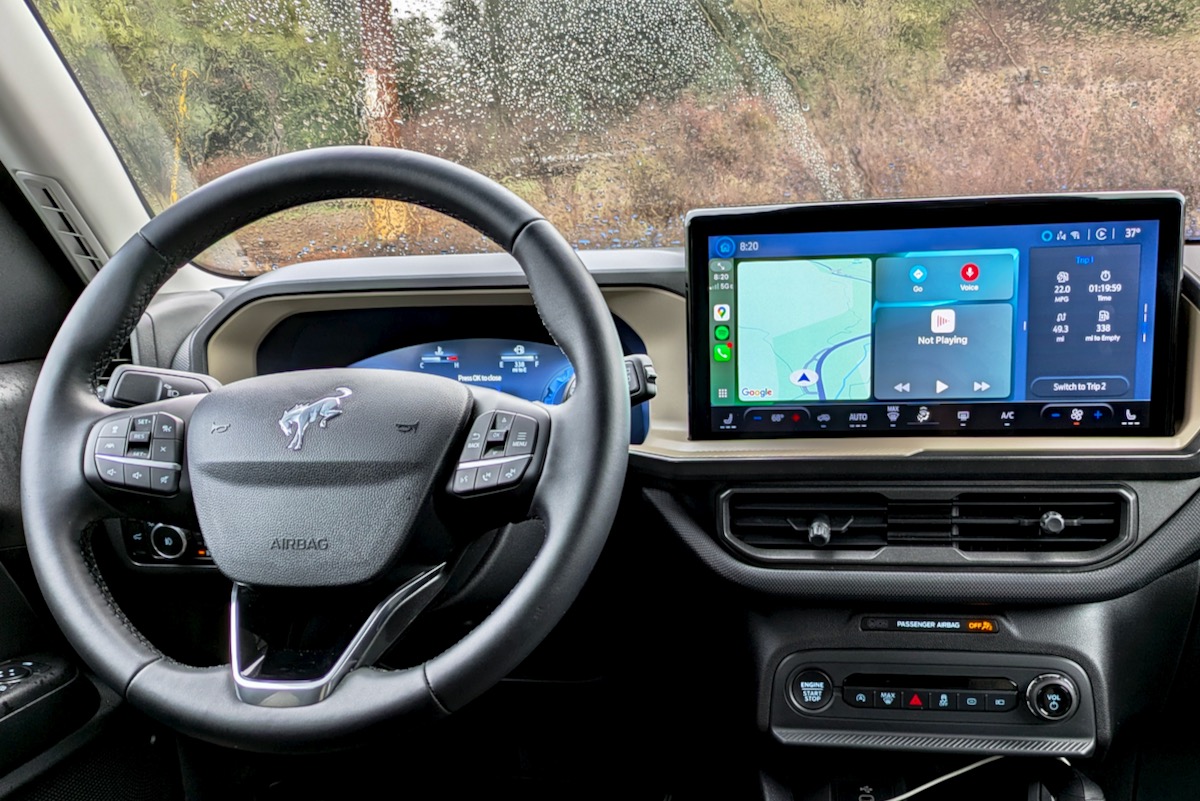
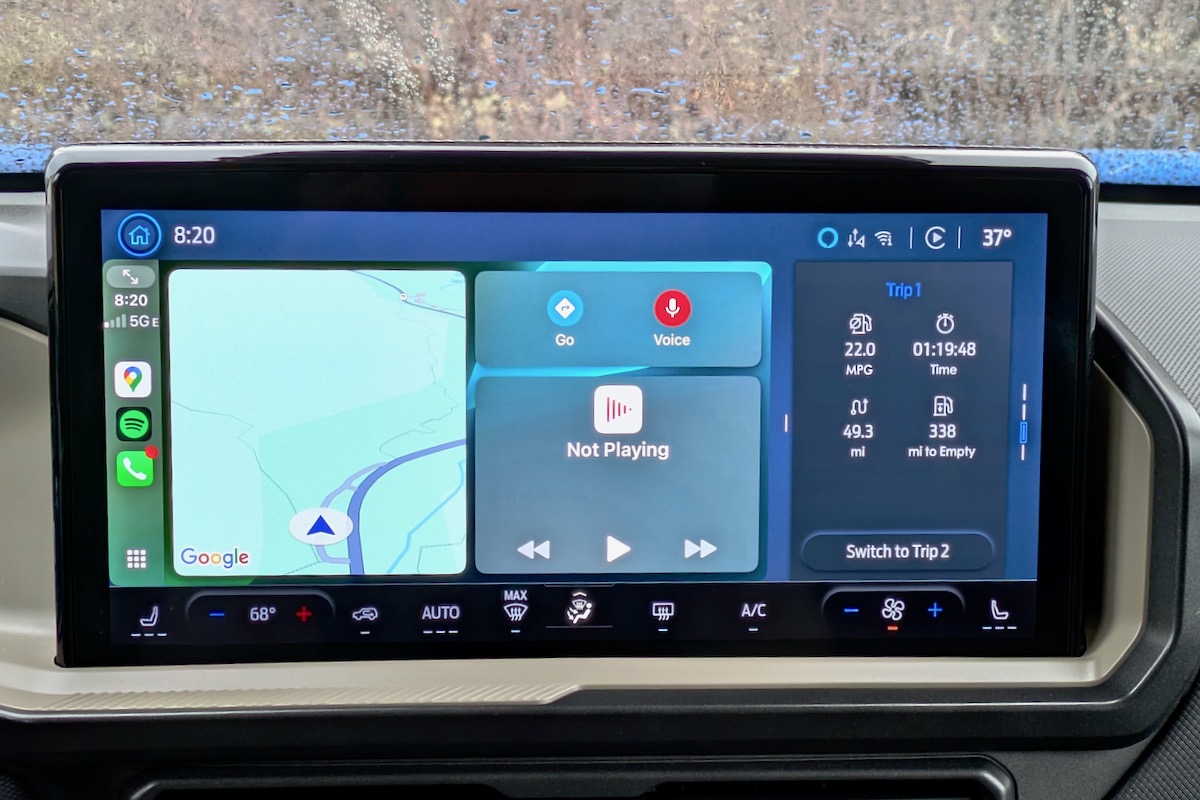
For 2025, the Bronco Sport finally upgrades to the current-generation Ford Sync 4 infotainment system, which replaces the Sync 3 system that was already outdated when the Bronco Sport launched with it as a 2021 model. The upgrade also brings a larger 13.2-inch touchscreen, 12.3-inch digital instrument cluster, and wireless Apple CarPlay and Android Auto connectivity.
Both the bigger touchscreen and digital cluster are standard, giving the Bronc Sport a more premium feel that’s reinforced by the quality of the graphics. Whether it’s the detailed animations of the vehicle that accompany the drives modes or the easy-to-read text, they’re a big upgrade over the previous infotainment system.
Using Apple CarPlay with a connected iPhone was trouble-free, and the split-screen setup for CarPlay neatly presented all of the information we wanted to see. The native infotainment menus were well-designed also, but we would’ve preferred not to rely on the touchscreen for functions like seat heaters and climate control.
An available 360-degree camera system functions as both a safety feature and off-road driving aid. In any of the off-road drive modes, the cameras turn on automatically and, unlike in conventional on-road driving, stay on regardless of speed. A split-screen function accommodates both an overhead view and low-angle front view, making it easy to spot obstacles. The system can also show an overlay of the tires that Ford claims is accurate to the width of the tires on a given Bronco Sport model.
Safety
The National Highway Traffic Safety Administration (NHTSA) gave the 2025 Ford Bronco Sport a five-star overall safety rating, with five-star frontal and side crash-test ratings and a four-star rollover crash-test rating.
The Insurance Institute for Highway Safety (IIHS) had only released partial safety ratings for the 2025 Bronco Sport at press time, including top “Good” scores in the small overlap front test, original moderate overlap front test, and original side-impact test, as well as an “Acceptable” rating in the updated side-impact test. The IIHS also gave the Bronco Sport a “Good” headlight rating.
Standard driver-assist features as part of Ford’s Co-Pilot360 safety kit suite include: forward collision warning, automatic emergency braking, blind spot monitoring, rear cross traffic alert, lane keep assist, lane departure warning, adaptive cruise control (with stop-and-go and lane centering), and automatic high beams. Reverse automatic emergency braking and traffic sign recognition are optional on the Bronco Sport Outer Banks and standard on the Bronco Sport Badlands.
Cost-effectiveness
Bronco Sport models with the 1.5-liter turbo-three engine are EPA-rated at 27 mpg combined (25 mpg city, 30 mpg highway). Fuel efficiency-wise, that’s in line with the 2025 Subaru Forester Wilderness, as well as the smaller Subaru Crosstrek Wilderness, but 2.0-liter turbo-four Bronco Sports are rated at 23 mpg combined (21 mpg city, 27 mpg highway).
Ford’s warranty coverage—a three-year/36,000-mile bumper-to-bumper warranty and five-year/60,000-mile powertrain warranty—is competitive with other brands offering small, rugged crossovers.
Pricing starts at $31,590 for the Bronco Sport Big Bend base model (all prices include a $1,595 destination charge). The Outer Banks and Badlands trim levels start at $36,890 and $41,710, respectively. The design-focused Heritage ($34,990) and Free Wheeling ($34,730) trims are also expected to return for 2025. The Black Diamond off-road package adds $2,570 to the price of a Bronco Sport Big Bend, while the Sasquatch Package is a $3,535 option on the Outer Banks and a $2,990 option on the Badlands trim level.
Equipped with either of those packages, the Bronco Sport offers unrivalled off-road capability in its market segment, but the aforementioned Subaru Wilderness models will still get you pretty far off the beaten path for less money. So will a Jeep Compass Trailhawk, although its interior is a step below the Ford’s in terms of quality and functionality. And if you just need a small SUV, there are many more choices available. The Bronco Sport checks most of the boxes for a vehicle in this segment, but it makes the most sense for buyers looking for maximum off-road capability.

What owners say
Trims & specs
Base MSRP $40,115 | Seating 5 |
Engine 2.0L 238 hp I4 | Cargo Capacity 29.4 cu ft |
Combined MPG 24 | Drivetrain AWD |
Base MSRP $36,795 | Seating 5 |
Engine 1.5L 180 hp I3 | Cargo Capacity 32.5 cu ft |
Combined MPG 27 | Drivetrain AWD |
Base MSRP $33,135 | Seating 5 |
Engine 1.5L 180 hp I3 | Cargo Capacity 32.5 cu ft |
Combined MPG 27 | Drivetrain AWD |
Base MSRP $33,995 | Seating 5 |
Engine 1.5L 180 hp I3 | Cargo Capacity 32.5 cu ft |
Combined MPG 27 | Drivetrain AWD |
Base MSRP $31,695 | Seating 5 |
Engine 1.5L 180 hp I3 | Cargo Capacity 32.5 cu ft |
Combined MPG 27 | Drivetrain AWD |


Pricing trends
MSRP range
$31,695 - $40,115
Current avg. market price
$27,736
Trending down by 2.1% this month
May 2026 - November 2026