2019 Jaguar I-PACE Reviews, Pricing & Specs




The CarGurus verdict
The first electric Jaguar is also the first luxury EV to genuinely challenge Tesla.
For car owners who still cringe upon reading “electric” and “Jaguar” in the same sentence, fear not. The 2019 I-Pace has gone through the most thorough development cycle in the British automaker’s history. Depending on how you view battery-electric vehicles, it’s either the most- or least-relevant Jaguar on sale today. But no one can argue against the speed, surefooted handling, and racy styling that identify this expensive, quasi-crossover hatch as a Jaguar. No one can disprove that, as of early 2019, it’s the best competitor on sale to fight the Tesla Model S. We’ve just logged 700 miles in the I-Pace during the winter, stretched its battery to the limit, and lived with the daily inconveniences of a fledgling fast-charge network. But you want an EV: Will the I-Pace tickle your kilowatts, or do its limitations make it nearly impossible to own?
out of 10 expert review
Look & feel
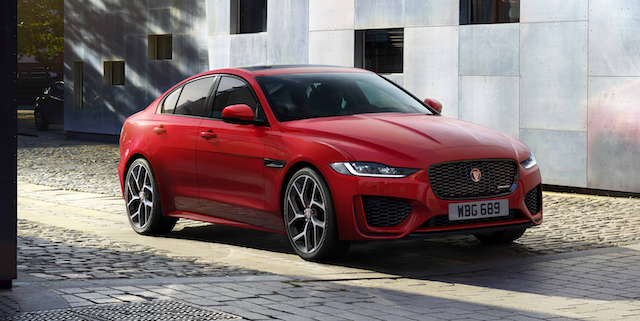
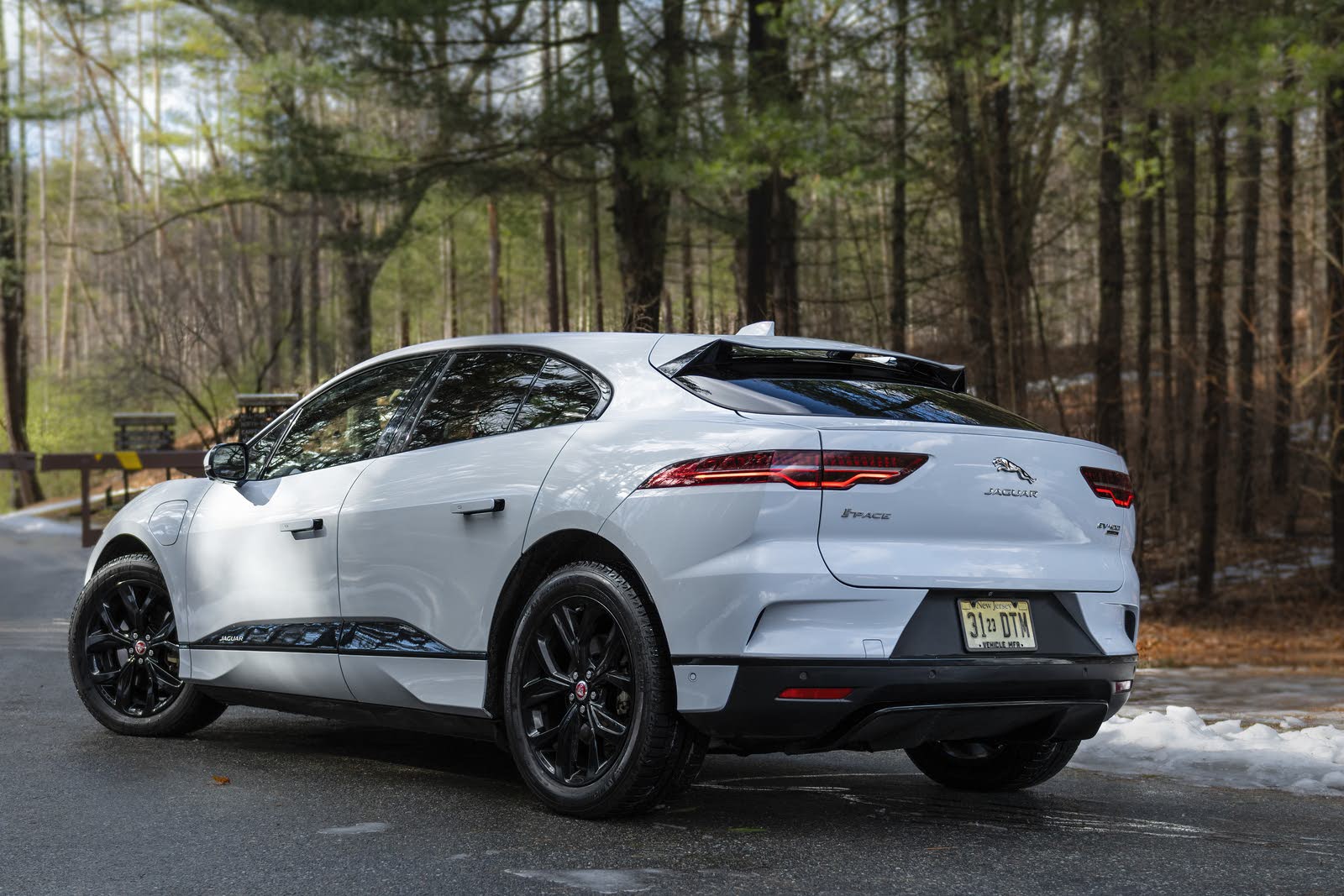
Jaguar’s PACE lineup features some of the best-looking crossovers, anywhere. The E-Pace, the smallest and strictly a gasoline model, mimics the gorgeous F-Type coupe. The midsize F-Pace is arguably better looking than a Porsche Cayenne. With its adjustable air suspension set to off-road height, the I-Pace imitates the squat stance of a Baja dune buggy. The tall roof and large tailgate add to the SUV effect. But a Subaru Forester can drive over taller obstacles than a raised I-Pace (which sits nearly an inch lower), so any 4WD pretensions stop there. This is a unique 4-door that combines elements of sports cars, sedans, and crossovers into a sensual shape, all while optimizing the body for maximum aerodynamics.
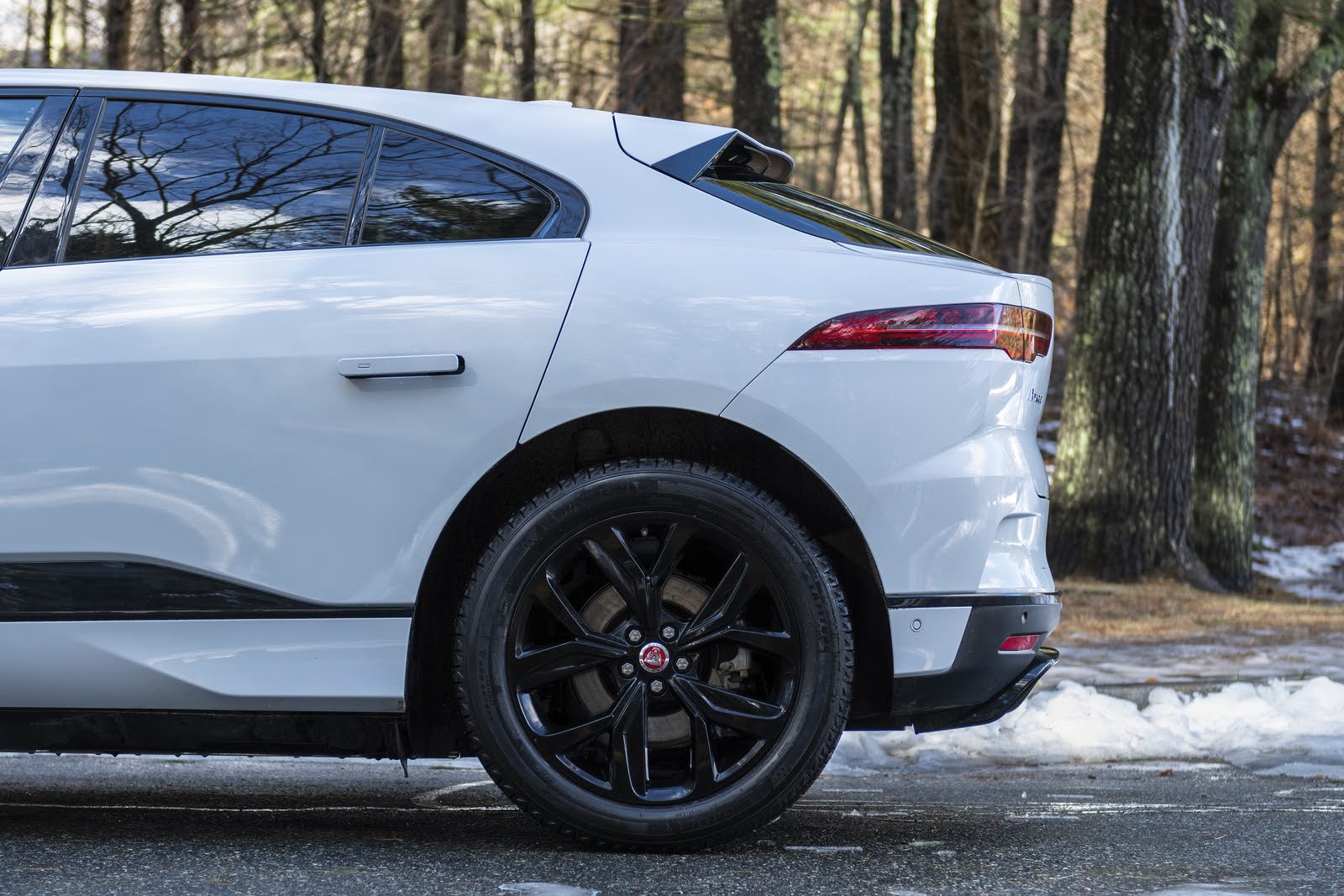
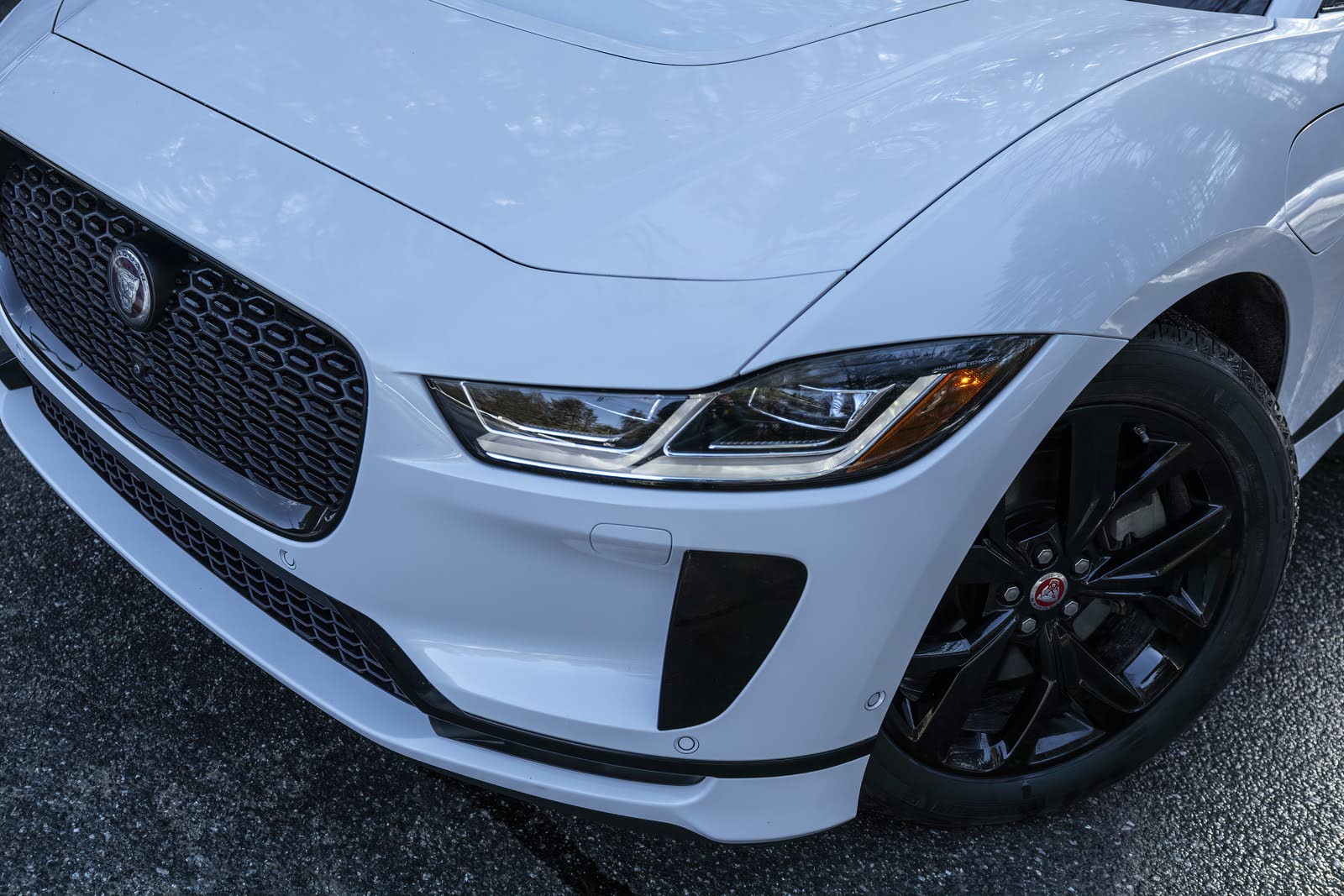
That’s why the rear end is so blunt and tall. I don’t love it as much as I love the back of an XF Sportbrake, for instance. But the venturi splitter below the bumper, chiseled taillights, and wide spoiler convince me it works. The S-duct on the hood, which channels air through the top of the grille and directly onto the windshield, is another aero trick. This is track-proven in Formula 1 and Formula E (Jaguar races in the electric series) to smooth airflow and generate downforce. It also looks rad. So do the deployable door handles that stay flush with the body upon locking. Our test car’s gloss black trim and 20-inch black wheels set against bright white paint highlighted every nuance and curve on the body. From any angle (but particularly the side and front), the I-Pace catches eyes.
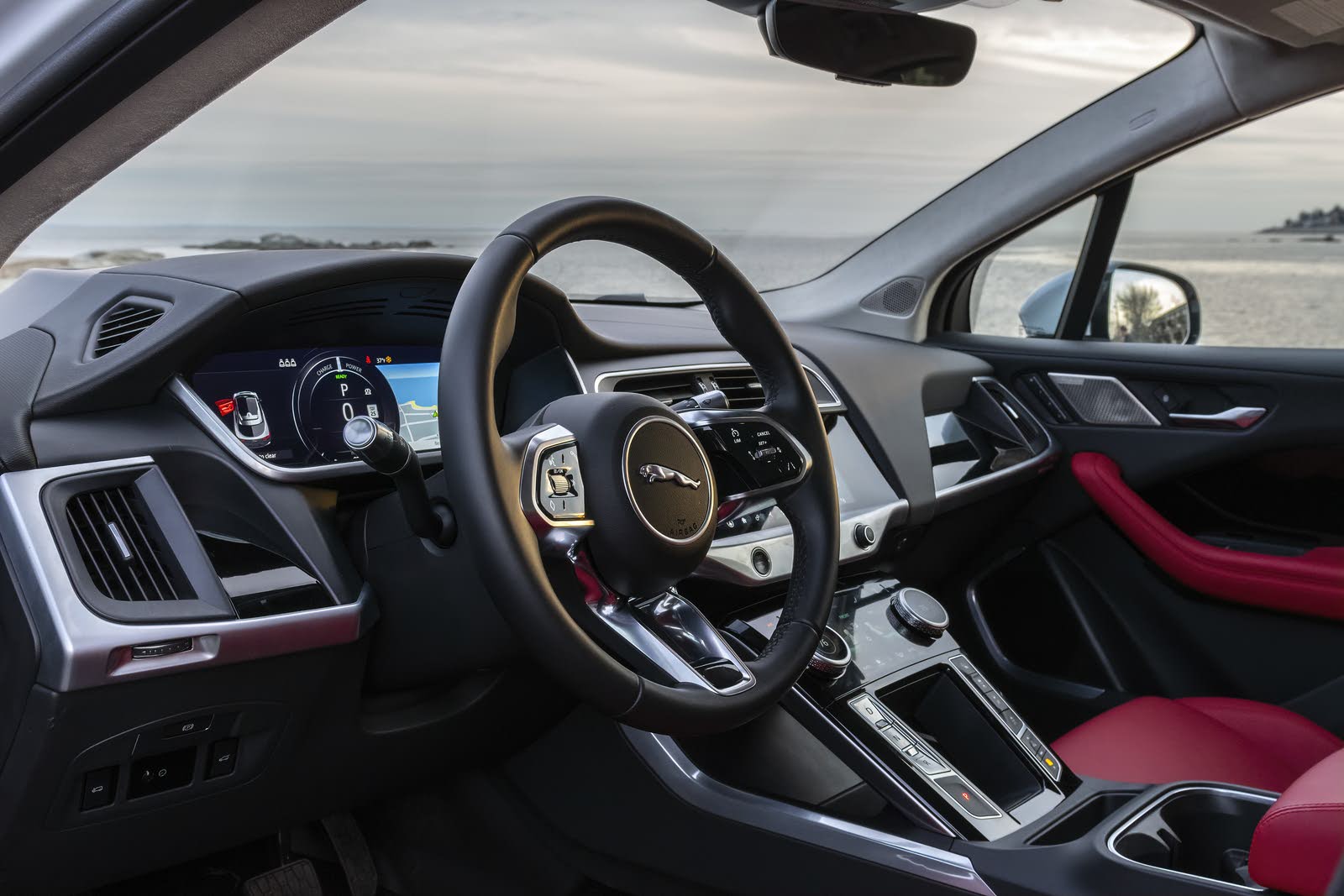
It gets supreme inside, with red leather, a cream microsuede headliner, and more gloss black trim set under a massive, tinted glass roof without a shade. You'll also find thin, one-piece performance bucket seats with silver neck cutouts and trimmed in the softest hides. Cloth and a lower-grade leather are optional, while synthetic leather (called LuxTec) is standard. However it’s trimmed, the I-Pace feels like a time machine. The steering wheel’s hub is deeply inset and very small, like the kinds seen on concept cars. The dashboard has touch-sensitive controls and a triangular center stack that tapers toward the console. High-res screens are everywhere. Even the climate knobs have screens inside them. In terms of quality, the only demerit is the hard plastic by passengers’ knees. Everything else looks, feels, and operates with the build quality and opulence missing in Tesla interiors.
Performance
Jaguar sells the I-Pace with one powertrain configuration, called the EV400. It’s comparable to the Model S 75D or the Model 3 Mid-Range in terms of punch and range. There is no lack of thrust, trust me. Two electric motors—one on each axle—combine to produce 394 horsepower and 512 pound-feet of torque. The motors provide the I-Pace with all-wheel drive (AWD), and all that power routes through a single-gear transmission. Like any electric car, acceleration is smooth and immediate, since electric motors provide full torque at zero rpm, and there are no gear ratios or belts in the transmission to move. The I-Pace catapults forward in Comfort or Dynamic drive modes, most noticeably in mid-range acceleration (30 to 50 mph, for example). At times, hitting the accelerator pressed my neck into the backrest like I was Tom Cruise doing stunt-driving takes. It’s so snappy quick, it’ll catch you off-guard. That kind of speed—whether you're getting past a tractor-trailer or time-warping away from that tailgating jerk—is as soothing as it is addictive.
Even though the car weighs nearly 5,000 pounds, the I-Pace does actually live up to the cliché of "handling on rails." The adaptive dampers (a $700 option on top of the standard air suspension) do an amazing job of cutting body roll, just as the motors instantly route torque, and the brake pads squeeze the inner wheels to make the I-Pace feel almost invincible. And that’s on cold, wet roads with winter tires. In warm weather on summer tires, the I-Pace has even more guts. Steering feel is incredible, too, with perfect weighting and off-center reactions that encouraged me to drive harder. Bury the pedal, and the car’s stereo will simulate the thrumming of a gasoline engine—like you even missed it. Back off, and the I-Pace glides silently and rolls over road imperfections like they were never there. Because there’s a gaping hole in the roof, there is some chassis flex that results in a few too many squeaks when driving slowly over speed bumps. At low speeds, the brake pedal also feels mushy and emitted the occasional groan, but at higher speeds—the preferred way to drive any Jaguar—the feel is remarkably solid. I liked driving with the regenerative braking set to low, but drivers who like hard deceleration and one-pedal operation can choose the High setting.
Jaguar claims its 90-kilowatt-hour battery will deliver up to 234 miles per charge, as estimated by the EPA. But like all EVs, that number can only be met (or exceeded) in the most ideal conditions: Warm weather, flat roads, and plenty of opportunity for regenerative braking. It also assumes you’re not operating most of the vehicle’s accessories (such as the climate control). My experience in Connecticut and Massachusetts during the dead of winter was like the first meeting of the Jamaican bobsled team. The I-Pace couldn’t have been any more unprepared if it tried. On a warmer day in the 50s, the car came to my home fully charged showing 210 miles of range. Every other day when it dipped below freezing, the range was no more than 160 miles on a full charge. That’s nearly a third of the battery's range wiped out, without even stepping on the accelerator.
And I’m no crazy hypermiler who lives for discomfort—I had the heat and seat heaters cranked with the rear defroster activated for the first 20 minutes before dialing them all way down. It didn’t matter. A 150-mile trip from my home to southern Massachusetts should have been cake for the I-Pace, even at sustained 70-mph speeds. But the margin between the estimated mileage and my actual distance to my destination was less than 10 miles, in both directions. That caused me to stop at a 40-kilowatt DC fast-charge station in Providence on the way there and again on my way back. On my return, since a BMW i3 owner was using the only plug and I needed at least 100 miles of recharging to make it home, a trip that takes two hours turned into four. Nowhere in Jaguar’s advertisements does it show I-Pace owners eating flatbread at a Hilton Garden Inn. Nowhere does any government, automaker, or environmental group talk about how desperate EV drivers are as they discover charging stations in obscure areas, expensive prices, and timed sessions that shut off the station before you’re ready to leave. Broken stations are common. Some accept credit cards, some won’t. Some charge at 50 kW, some at 24 kW, and all reduce power when more than one vehicle is connected. Supposedly there are 100-kW stations that rival Tesla’s Supercharger network. But even in one of the busiest parts of southern Connecticut where I live, and along the Massachusetts Turnpike where clumps of DC fast-chargers are situated, it was impossible to find any operating at that power. Charging from near-dead to full took almost 3 hours on a 50-kilowatt connection. On a more-common 230-volt connection, it takes 10. On a household outlet, days.
The I-Pace's EPA gasoline-equivalent rating is well below other EVs at 76 MPGe combined, which contributes to its deficiency in cold weather. That means the I-Pace burns through more electrons per mile. Regardless, the I-Pace suffers the same disadvantages as all modern EVs, including Teslas, in the exact same way. The EV charging network is simply not up to speed with the car. And the I-Pace, when charged, still performs incredibly for a luxury performance car.
Form & function
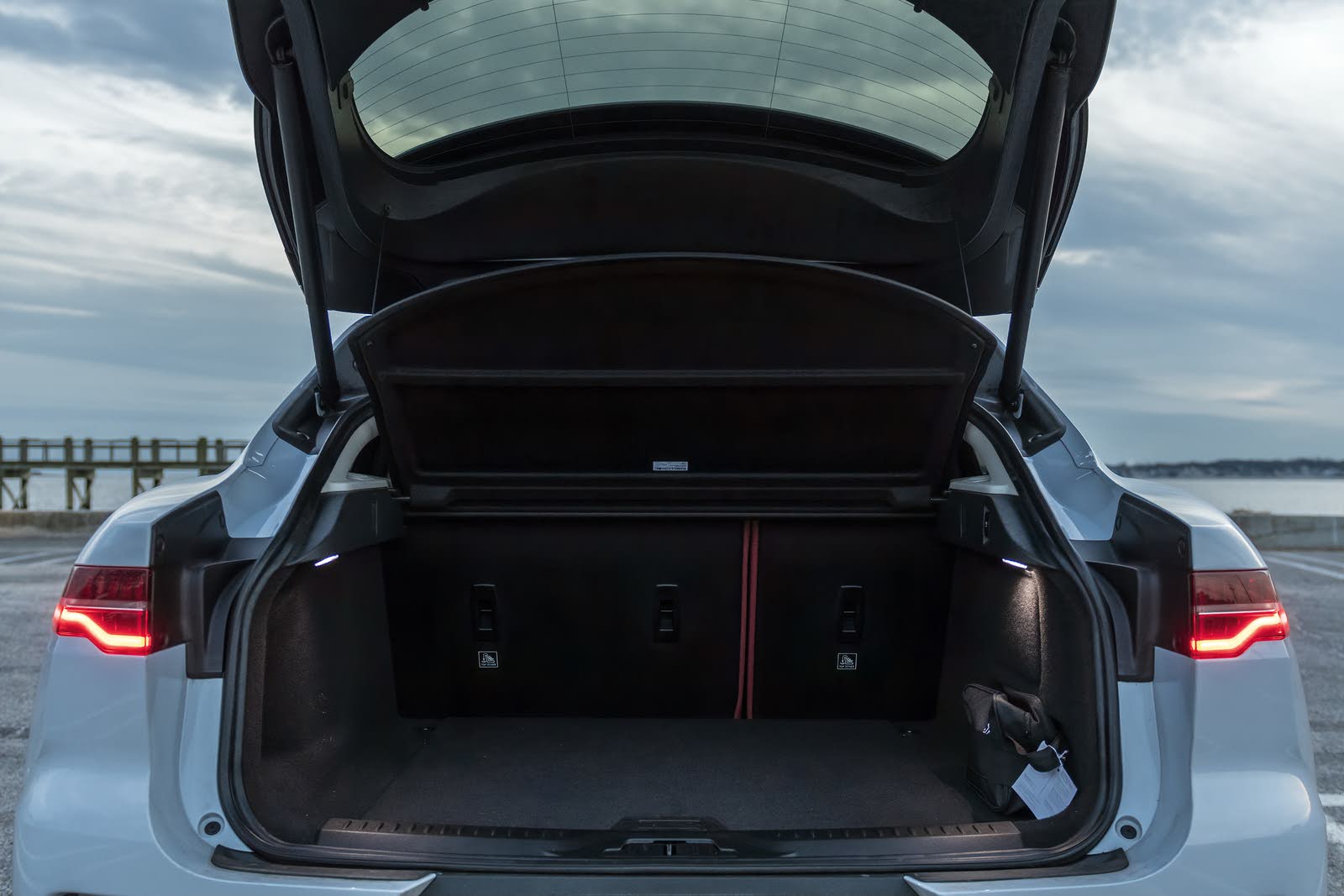
Charging aside, the blind spots and tiny rear window are the biggest drawbacks to everyday practicality. That’s likely why parking sensors and rear cross-traffic alert come standard (although if you’re trying to keep costs down, you may wish to do without the 360-degree cameras that add $6,115 in options to the base model). I kept getting confused with Jaguar’s push-button gear selector labeled in reverse order—DNRP instead of PRND. But once you’re acclimated, the I-Pace puts four passengers in comfort with generous legroom, headroom, and shoulder space for a compact vehicle. The glass roof makes the cabin airier without impeding on headroom, too. A large center armrest cubby and open storage beneath the center stack allow for decent interior storage. Anything bigger will fit in the cargo hold, which measures 25.3 cubic feet and expands to 51 with the seats down. Pop the hood for an extra cubic foot—there’s a bin randomly placed above a swarm of electronics and radiators.
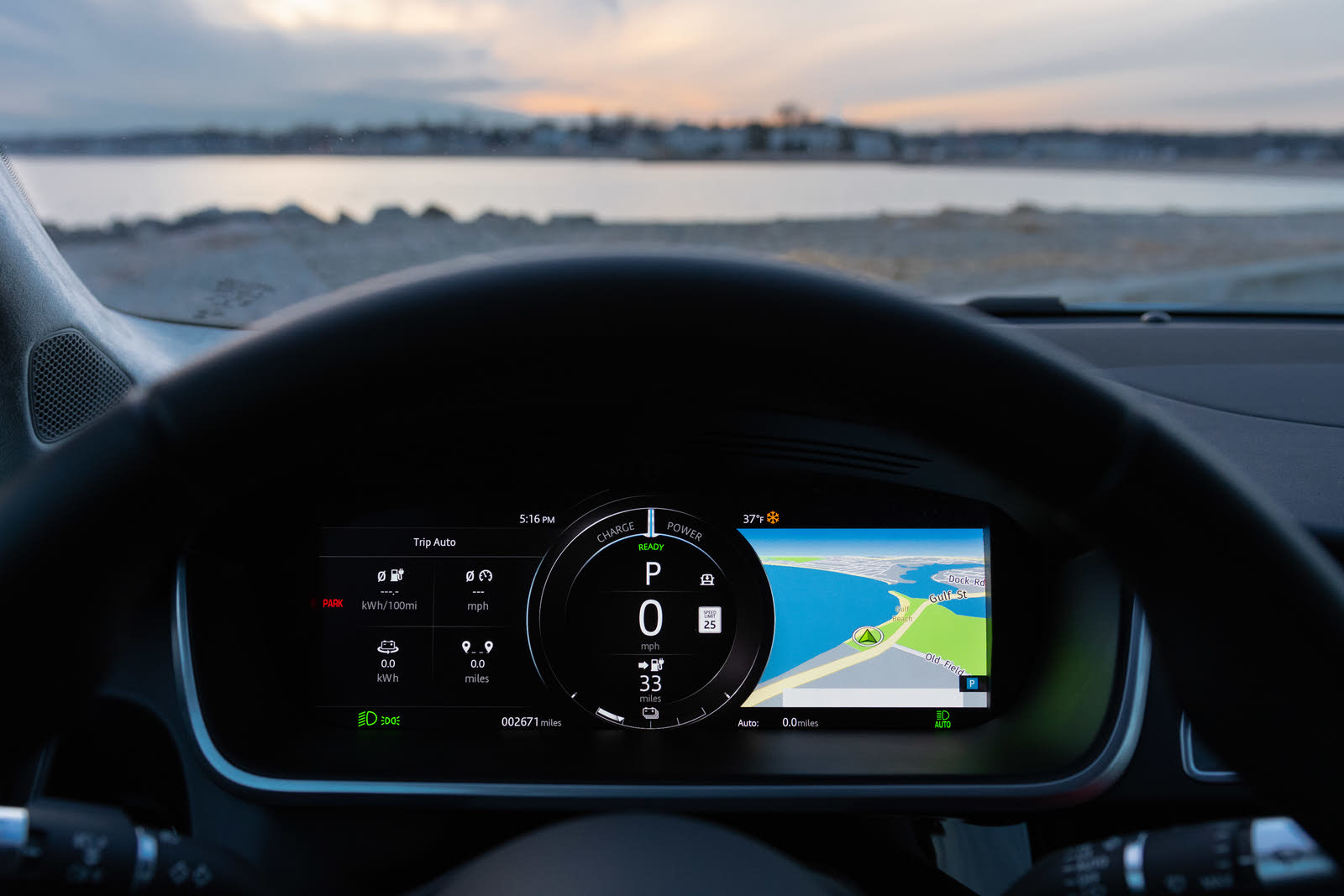
The instrument panel, infotainment, and climate screens are all easy to decipher and use. The all-in-one climate knobs change function whether you pull (for fan speed) or push (for seat heating/cooling). Twisting will change the desired level. With our car’s four-zone climate controls, I could set the temperature for the rear seats from the front and switch off the driver’s cushion heating, a plus when all you want is a warm back. I wish Jaguar’s instrument cluster made it simpler to switch modes—from one central dial, to two dials, to full-screen maps—like Audi models do. But the functionality is there.
Technology
Unfortunately, Jaguar still cannot deliver a fully functional infotainment system or reliable electronics. On many startups, the seat climate settings would be inactive unless I switched the car off and then on again. On other occasions, the climate dials would revert to Celsius and immediately switch back to Fahrenheit upon twisting them. The main touchscreen threw out rendering errors on another occasion, which prevented me from operating the stereo or nav. What’s really unacceptable in an electric car is a navigation system that still puts gas stations on the points of interest list—huh? Furthermore, the navigation automatically routed me to Tesla Supercharger stations that I couldn’t use in a Jaguar. The station list wouldn’t even load when I chose to filter it by connector type (I wanted to use only fast-charging stations with the SAE combo plug). I had to use several apps (PlugShare, EVGo, and Chargepoint) on my iPhone for the most-updated locations. Rely only on the car’s system, and its inaccuracy and glaring errors could strand you.
What saves the Jaguar from being a tech dud are its crisp displays, excellent map renderings, and advanced semi-automated driving functions that do a great job of guiding the car around marked highway lanes at speed and in heavy traffic. The LED headlights are bright, and the auto-high beams are smart. The head-up display is clear and shows detailed icons for the cruise control and upcoming turns. Backlit controls on the steering wheel combine volume, seeking, and instrument-panel menu options in a simple way. Voice recognition is finally available for the navigation, though it’s not as fast or accurate as that in BMW or even Hyundai models. When everything works, the system is quick to respond, offers 4G WiFi, and is full of customizations (like vehicle preconditioning, driving modes, and ambient lighting). But unfortunately, everything doesn't always work. And for some reason, despite a flat space under the center stack for phones, Jaguar doesn’t offer wireless charging or any open USB ports. There are ports within the armrest cubby, but no charging pad, not even as an option.
Safety
Cost-effectiveness
What owners say
Compared to Tesla Model Y , this is by far a superior vehicle with impeccable fit and finish. The driving dynamics and quite controlled ride cant be matched by Tesla Model Y. Jaguar also does OTA SW updates that recently improved upon its 234 miles EPA rating and can now achieve 246 mile range. Only other vehicle thing that came close is the Audi E -Tron but it lacks the driving fun factor. The ipace is one SEXY ride. For those Tesla fans the quality of Tesla vehicles is its biggest shortcomings and they seem to not get it. Since the introduction of Model S (2012) its been plagued with shoddy workmanship to this day.
July 4, 2020Performance and styling were great as was as the attention to detail in the cars interior. Did not like the red interior.
July 11, 2020Trims & specs
Base MSRP $71,300 | Seating 5 |
Engine 394 hp Electric | Cargo Capacity 26.3 cu ft |
Combined MPG 86 | Drivetrain AWD |
Base MSRP $85,900 | Seating 5 |
Engine 394 hp Electric | Cargo Capacity 26.3 cu ft |
Combined MPG 76 | Drivetrain AWD |
Base MSRP $76,250 | Seating 5 |
Engine 394 hp Electric | Cargo Capacity 26.3 cu ft |
Combined MPG 76 | Drivetrain AWD |
Base MSRP $69,850 | Seating 5 |
Engine 394 hp Electric | Cargo Capacity 26.3 cu ft |
Combined MPG 76 | Drivetrain AWD |