
Backup cameras became mandatory equipment in U.S.-market vehicles as of May 2018—nearly 30 years after they first began to appear in production cars. Here, we discuss what this piece of tech does, why it became a requirement, and what innovations automakers have made to it.
When Did Backup Cameras Become Standard?
- What Is a Backup Camera?
- Do All New Cars Have Backup Cameras?
- The Rise of Backup Cameras
- Do Backup Cameras Work?
- Other Reverse-Driving Safety Features
What Is a Backup Camera?
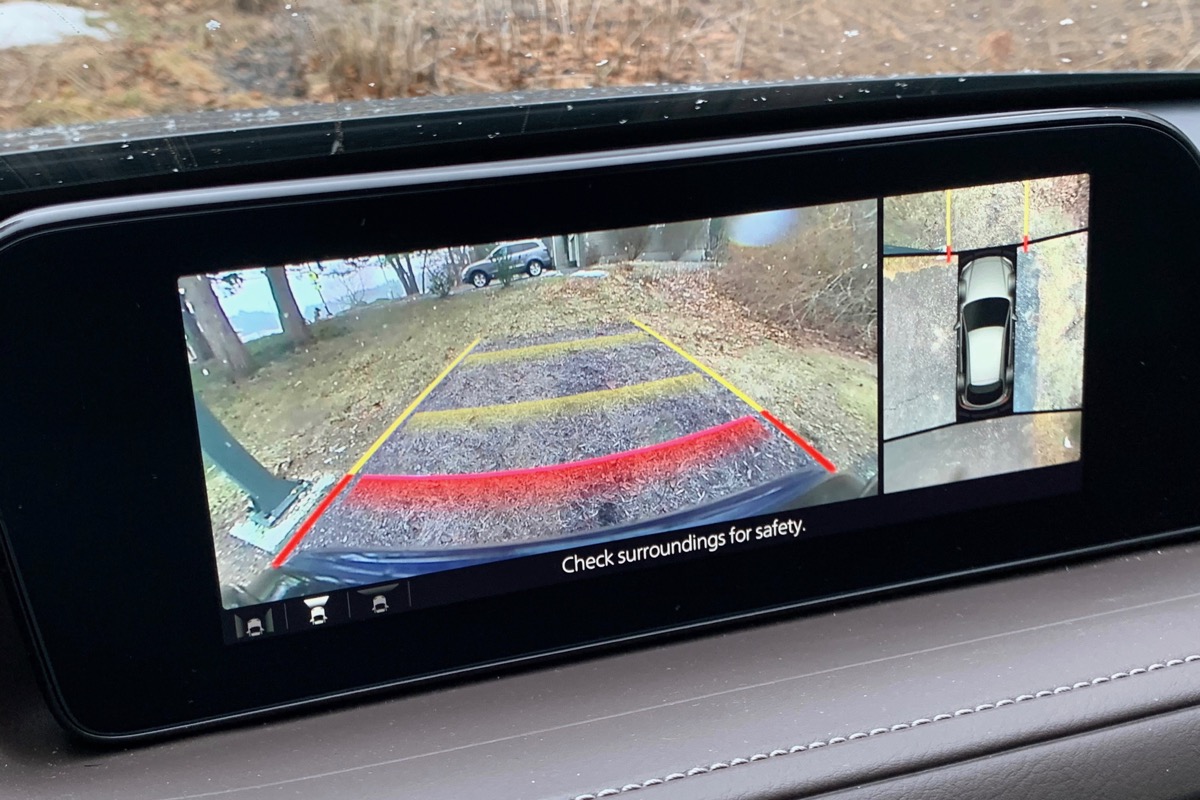
A backup camera, also called a rearview camera or a reversing camera, is a lens mounted at the rear of a vehicle that captures the view behind it and displays the footage on the car’s infotainment screen in real time. This way, the driver can see more of what’s behind them than the rearview and side mirrors show.
Many systems also superimpose grid lines over the field of view, so you can see the trajectory of the car as you rotate the steering wheel. This makes it a lot easier for the driver to back their vehicle into a parking space.
Do All New Cars Have Backup Cameras?
Yes. The Department of Transportation’s (DOT) National Highway Traffic Safety Administration (NHTSA) mandated that all new vehicles weighing less than 10,000 pounds and built on or after May 1 2018 must have a backup camera.
This requirement came about after the Cameron Gulbransen Kids Transportation Safety Act of 2007 passed in Congress. The bill, named for a child killed in a backover incident, directed the DOT to come up with and enforce new safety standards for passenger vehicles, including the installation of backup cameras for improved rear visibility.

The Rise of Backup Cameras
The idea of a backup camera dates back to the 1950s, when one was displayed on the Buick Centurion concept car, but it wasn’t until 1991 that such tech became a production-car reality, when the Japan-market Toyota Soarer was the first to offer a reversing camera. A decade later, Nissan’s luxury arm, Infiniti, brought the feature to the U.S. on its flagship sedan, the Q45.
Backup cameras proliferated over time, trickling down from luxury cars into mainstream vehicles. By 2014, when the NHTSA issued its final ruling to mandate backup cameras, about half of vehicles on the road—including affordable models such as the Honda Fit and the Chevrolet Trax—already had them as standard equipment in the U.S.
Do Backup Cameras Work?
Research from the Insurance Institute for Highway Safety (IIHS) shows that rearview cameras reduce the rate of backover pedestrian incidents and backing-up crashes by about 17% for the general population and 36% for drivers 70 and older.
The frequency of such collisions is reduced by a huge 78% when other reverse-driving aids, such as parking sensors and automatic emergency braking, accompany the cameras.
Backup cameras also benefit drivers with limited mobility, by minimizing the need for extensive head-turning to see blind spots.

Other Reverse-Driving Safety Features
Along with backup cameras, automakers have developed additional reverse-driving features to enhance auto safety and convenience. They include:
Parking sensors: Often visible as small circles on a car’s bumpers, these sensors detect the proximity of nearby objects by emitting ultrasonic waves and measuring how long it takes for them to bounce back. As you back up toward something, the car—relying on this sensor data—will alert you with warning beeps that intensify as it gets closer to an object.
Rear cross-traffic alert (RCTA): When you’re trying to back out of a space in a parking lot, neighboring vehicles may limit your view of approaching pedestrians. RCTA uses ultrasonic or radar sensors to detect and warn you about such obstacles.
Rear automatic emergency braking (AEB): Rear AEB goes one step further than RCTA in preventing backing-up incidents, as it automatically applies the brakes when the car’s reversing detect an imminent rearward collision.
360-degree camera systems: Also known as a surround-view or bird’s-eye-view camera system, this feature combines feeds from multiple cameras around the car to create a complete picture of the vehicle’s surroundings, including an overhead shot, each automaker’s system is a little different. For instance, Nissan’s Intelligent Around View Monitor tech allows you to look at two views (such as an aerial view and a closeup bumper shot) at once, while the HD Surround Vision system available with General Motors vehicles offers video recording.
Hitch guidance: Typically offered with pickup trucks, such as the Ford F-150 and the Chevrolet Silverado, this driver aid helps you to align your hitch to a stationary trailer by adding guidelines atop the footage shown on the infotainment screen.
Rearview camera mirrors: Cadillac, among other manufacturers, has started fitting screens to the rearview mirrors of certain models, so drivers can switch between the traditional reflected view and a wider-angle, unobscured camera view.
You may be able to retrofit this type of technology to your car if it doesn’t have it, as the aftermarket sells all kinds of rearview monitors and rear cameras.


