
What's the Difference Between kW and kWh in EVs?
Simply put, a kilowatt (kW) is a measure of power. In cars, kW are used to measure their power output, similar to how horsepower is used.
A kilowatt-hour (kWh), on the other hand, is a measure of energy storage. In electric cars, kWh describes how much energy a battery can store, in the same way ‘gallons’ describes how much energy a gas tank can store.
An easy way to remember kW vs. kWh: a kW is the maximum power a motor can produce in a moment, while a kWh of energy is how much power that can be delivered over a period of time.
- What is a kilowatt (kW)?
- What does kW refer to in cars?
- What is a kilowatt-hour (kWh)?
- What does kWh refer to in cars?

What is a kilowatt (kW)?
A kilowatt is a measure of power in the International System of Measure, also known as an SI Unit. One kilowatt is equal to 1,000 watts (W). Kilowatts are commonly used to measure the power output of an engine or motor.
Many electrical appliances commonly found around the house will have a wattage power rating. As a much smaller-scale example, lightbulbs typically range from 5 to 60W. If you want a brighter light, you buy a higher wattage.
A lower wattage generally translates to a lower power consumption. Space heaters are often rated in watts; you will usually see this written as 1,500 Watts, which equals 1.5 kW. Audiophiles will be familiar with watts as a measurement of power output, as home and car audio systems typically rate amplifier power in terms of watts. And again, the bigger the number, the better, or louder in this case.

What does kW refer to in cars?
As a unit of power, kW are commonly used to measure the power output of vehicles.
Without getting too technical, one watt is the amount of power required to move one joule for one second. Multiply that number by one thousand, and you get one kilowatt.
Simple, isn’t it?
One horsepower, on the other hand, is the amount of power required to lift 550 pounds one foot in one second.
Kilowatts come from the International System of Units, the modern form of the metric system. A quick conversion is 1 kilowatt is equal to 1.34 horsepower. For example, a 150-kW engine produces 201 horsepower (150 x 1.34 = 201).
In the good old US of A, we measure our power output in horsepower and pound-feet of torque, instead of kilowatts and newton-meters.
As we move away from gas-powered cars and replace them with more battery electric vehicles (BEVs), and hybrid electric vehicles (HEVs), people are finding a need for a standardized unit of measure. Where this really shines is when calculating the energy efficiency of various fuel sources.
Kilowatts as a measurement are still are uncommon in the U.S. However, our friends across the pond in the UK and Europe, as well as Australia, have been using these measurements for years.
As EVs become more mainstream, we’re seeing more and more of these power measurements. You will be able to find a kW rating for most of the electric vehicles on the market. For example, a Volkswagen iD.4 is rated at 150 kW, or 201 hp, and a Hyundai Ioniq 5 is rated at “up to 320 hp or 239 kW”.
As automakers prep consumers for this shift in power measurement, you’re even seeing gas-powered vehicles being labeled with their kW output; this includes brands like Range Rover and Cadillac.
What This Means for Charging an EV:
Kilowatts are also used to rate the power out of chargers for EV charging. Generally speaking, the bigger the number, the faster your car will charge. Plugging into a standard 120-volt outlet will deliver a power output around 1 kW, while Level 2 chargers generally deliver up to 11 kW of power.
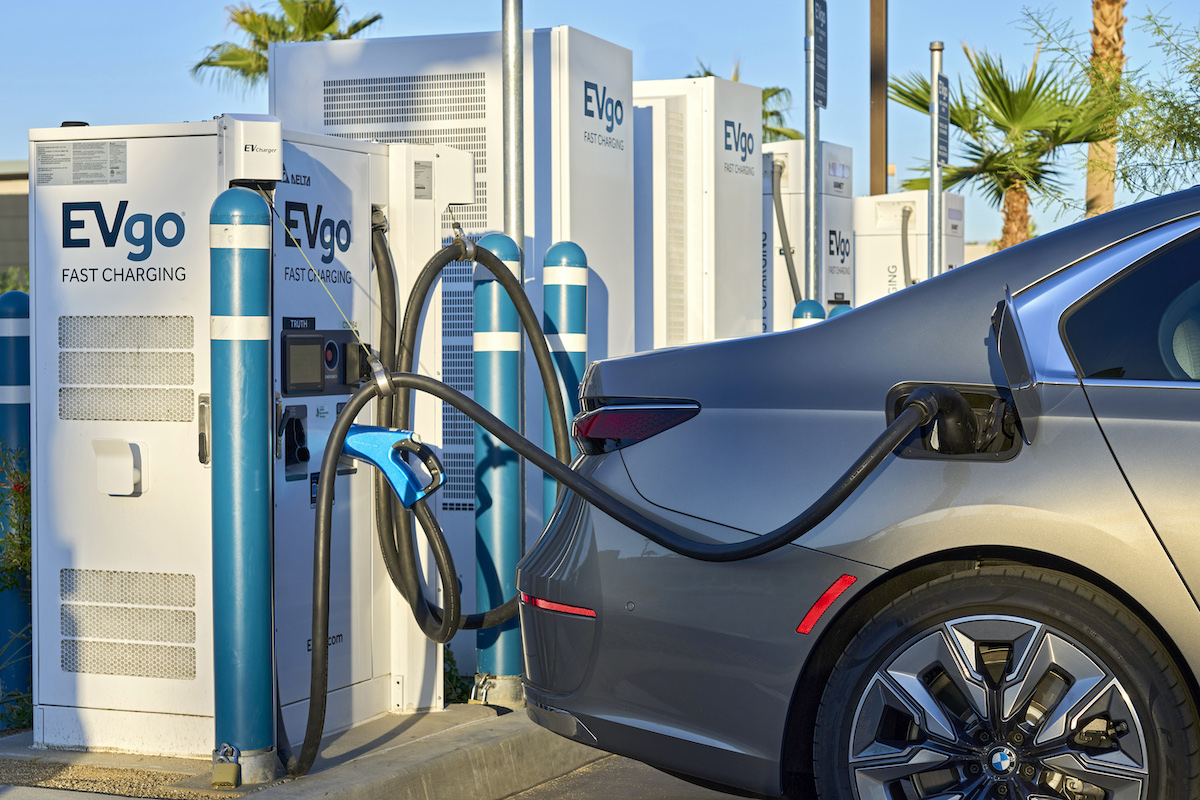
Level 3 chargers, also known as DC Fast Chargers, are the headline-grabbing setups that can charge a car in 20 minutes (a Hyundai Ioniq 5 can charge from 10 to 80% in as little as 18 minutes at a ‘fast-charger’).
The power of these Level 3 chargers can vary quite a bit, from 50 kW all the way up to 350 kW. Generally speaking, the more powerful the charger, the faster you car will charge.
It is important to know how much power your car can receive. While a 350-kW charger should theoretically provide the fastest charging for any EV, in reality, some cars cannot take advantage of the additional power.
For example, a Mustang Mach-E can only use about 150 kW at its maximum speed. Manufacturers list this information in their owner’s manuals and on their websites.
Drivers can also follow along in real time while the car is charging, as charging speeds are displayed both on the charger and on the dashboard.
What is a kilowatt-hour (kWh)?
A kilowatt-hour is a unit of energy, defined as the energy delivered by a kilowatt for one hour. The kWh unit is used to describe how much energy a battery can store, in the same way gallons describe how much energy, or fuel, a gas tank can store in an internal combustion car.
A car with an 80-kWh battery can deliver 80 kW of power over one hour. A bigger number indicates a bigger battery capacity. In the Chevrolet Silverado EV, for example, the 205-kWh battery can deliver 205 kilowatts of power over one hour.
Homeowners and renters used to paying utility bills may be quite familiar with kWh: This is the unit used by electric companies to measure your energy usage every month, and it forms the basis of your electricity bill. The more energy you use, the higher the bill.
What This Means for Charging an EV:
You can also use this knowledge to calculate the amount of time it will take to charge your car.
Let’s use an EV with an 80-kWh battery as an example. If you have a Level 2 charger at home that’s rated at 10 kW, it should take about 8 hours to charge from 0% to 100%. A Level 1 charger the delivers about 1 kW will take about 80 hours to go from 0% to 100%.
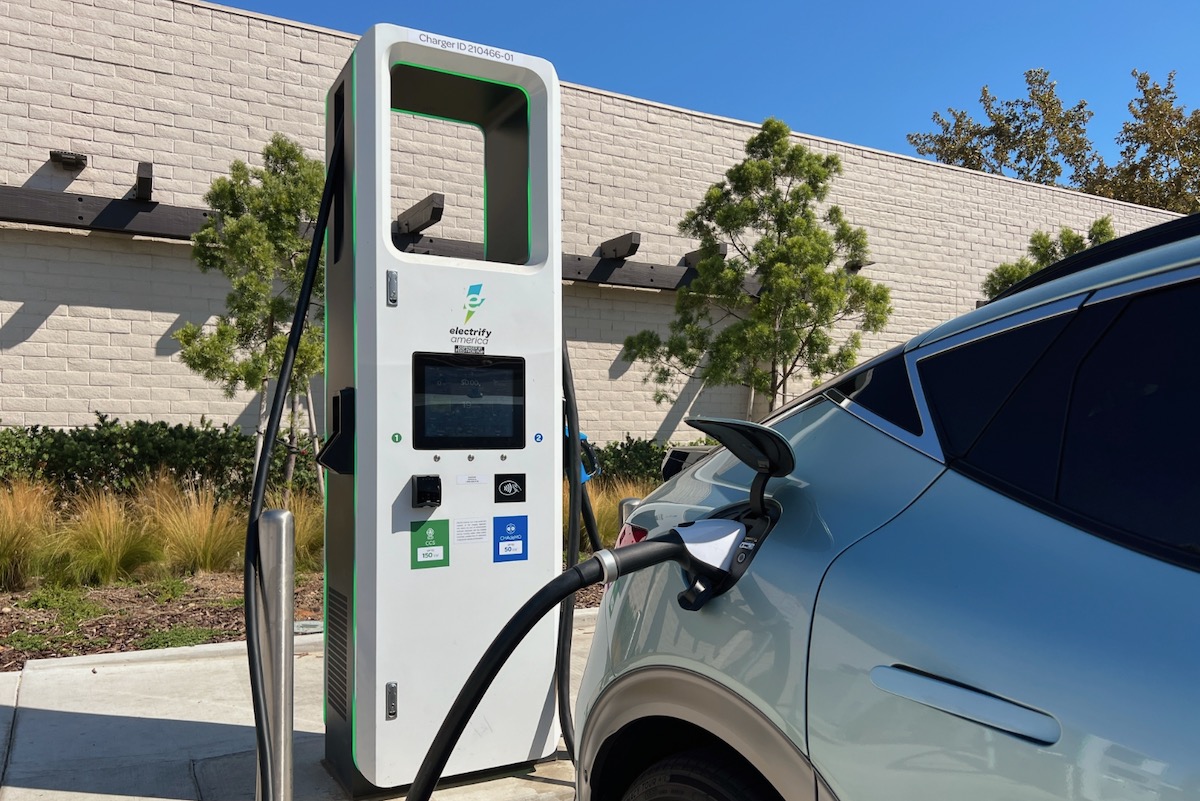
It gets a little more complicated when you get to Level 3 DC Fast Charging.
Assuming our battery can charge at 150-kW speeds, a 150-kW charger could theoretically charge our car in 32 minutes. However, with the amount of electricity involved, heat rises, and batteries will warm up.
To protect the battery, the car will request lower charging speeds as your charge session progresses. This is why many manufacturers advertise a 10-90% charge time. The last 10% can take quite a while to charge, as charging speeds ramp down to protect the health of the battery.
What does kWh refer to in cars?
A kilowatt-hour, or kWh, in electric vehicles is a measure of how much energy your car can store, the same way a fuel tank stores gasoline or diesel in an internal combustion car.
In most cases, the bigger the kWh rating, the more range your car has. However, it’s not exactly a one-to-one correlation. Bigger batteries weigh more, and they’re often paired with bigger electric motors to provide more total energy for impressive power outputs and fast acceleration.
For example, the entry-level Hyundai Ioniq 5 SE Standard Range has a single motor and a 58-kWh battery pack and is rated at 220 miles of range.
The top-trim Limited AWD has two motors and a 77.4-kWh battery pack, and it’s rated at 260 miles of range. Even though the Limited has over 30% more capacity, you do not see a 30% increase in range.
Most cars will have a battery capacity around 80 kWh these days. The ubiquitous Tesla Model 3 offers up to an 82-kWh battery pack. Smaller, compact EVs typically have much smaller batteries; for example, the Nissan Leaf offers a 62-kWh battery pack.
A smaller battery does mean a smaller amount of energy, but since these cars are also paired with smaller motors, and aerodynamic shapes, range can still impress.
Trucks are where you see the big numbers. The new Chevy Silverado EV has big motors, a big battery, and big charging speeds. It has a massive 205-kWh battery pack (among the largest battery packs on the market), and the energy consumption of this truck is impressive.
Luckily, charge times are equally impressive. Chevrolet claims the Silverado EV can average 198 kW when charging from 10%-90% at an appropriate Level 3 station. This battery dwarfs even the one found in the impressive Rivian R1T, which offers up to a 141-kWh battery pack.
Calculating efficiency for EVs is now measured in miles per kilowatt-hour instead of miles per gallon. You may need to readjust your expectations: three miles per kWh may not sound like a lot, but it’s actually impressive efficiency and translates to about 100 miles per gallon of gasoline equivalent (MPGe).
In most EVs, you have to trust the display on the dash. Most manufacturers will only show battery level as a percentage, making the exact kWh usage difficult to find.