
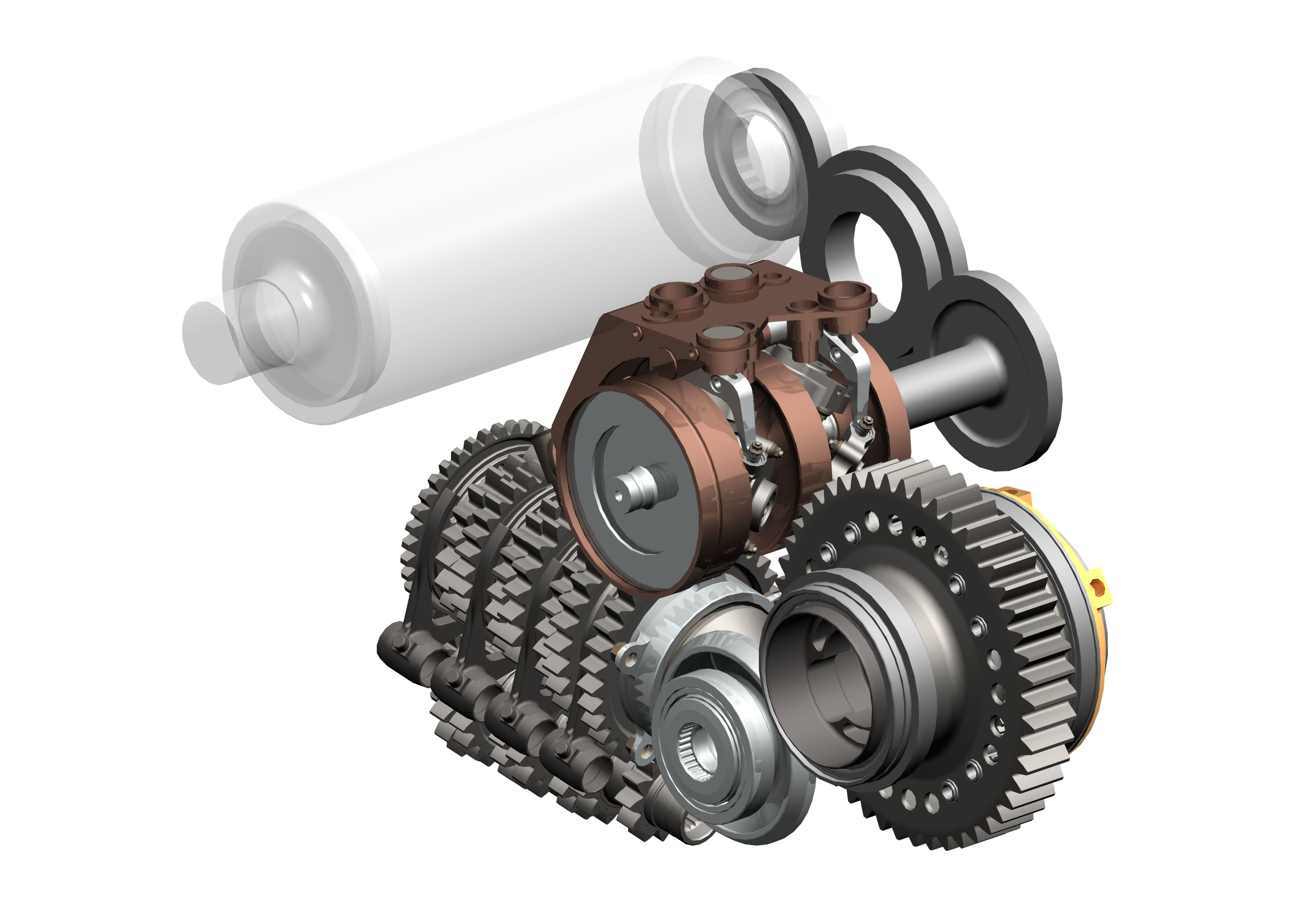
A traditional automatic transmission has a set number of gears—typically between six and 10 in a modern automobile—while a continuously variable transmission, or CVT, has none. Instead, this type of automatic transmission uses a pulley system to send the engine’s torque to the wheels.
CVTs work like this: a flexible belt or chain slides along a pair of variable-width pulleys, one running from the engine and the other to the wheels. As the drive pulley expands, the driven pulley contracts, and the belt moves at a slower speed, mimicking a low gear. When the drive pulley contracts, the driven pulley expands, and the belt moves at a quicker speed, mimicking a high gear. As a result, the CVT has a near-infinite number of gear ratios from which to choose.
That’s not the case for a traditional automatic transmission, which has fixed gear ratios (based on the unchanging number of teeth around the actual gear). The transmission selects the best gear for the current engine speed, but it’s often a compromise.
(There’s also something called an eCVT, which uses an electric motor and a planetary gearset instead of a pulley system to provide near-infinite gear ratios, but that’s a topic for another piece).
Here’s what you need to know about CVT systems, which are commonly found in used and new cars from Ford, Honda, Mitsubishi, Nissan, Toyota, and Subaru, among other automakers.
What to Know About CVT Transmissions
- Why Are Continuously Variable Transmissions (CVTs) Popular?
- Benefits of CVT Transmissions
- Drawbacks of CVT Transmissions
- How Long Do CVT Transmissions Last?
- What’s Wrong With Nissan CVT Transmissions?
- Can CVT Transmissions Be Repaired?
Why Are Continuously Variable Transmissions (CVTs) Popular?
CVTs are everywhere these days, and there are really two reasons for that. Firstly, they are less complex and have and fewer moving parts than a traditional automatic transmission, so they’re cheaper to build. Secondly, they contribute to better gas mileage, which helps consumers save money at the pump and automakers achieve government fuel economy targets.
Benefits of CVT Transmissions
For consumers, the biggest benefit of a CVT is increased fuel efficiency. As an example, Subaru redesigned its Legacy sedan in 2015, carrying over the 3.6-liter six-cylinder engine from the 2014 car, but swapping its five-speed automatic for a CVT. Even though the newer model weighed about 120 pounds more than its predecessor, it saw a 3 mpg improvement on the EPA’s combined test cycle. That’s a measurable gain.
Also, because these transmission systems don’t swap physical gears like traditional automatics, there’s never a noticeable disruption in the torque transfer between the engine and the transmission. You won’t feel the CVT shifting because it doesn’t actually shift. The belt just moves to a new position in the pulley system to match the engine speed. It’s a seamless, stepless transition to a new gear ratio.

Drawbacks of CVT Transmissions
Many drivers are used to the subtle jostling of an automatic transmission shifting gears, accompanied by the rise and fall in engine sound. Certain CVTs, such as the G-Design Shift Control unit used in some Honda models, simulate shifts to counteract this, but many don’t.
A CVT operates at the optimal gear ratio for the engine speed, which, during acceleration, can result in an unpleasant drone. You may also encounter the “rubber-band effect”, whereby the engine spools up to a higher and louder engine rpm, but acceleration lags slightly behind.
How Long Do CVT Transmissions Last?
The components of a CVT aren’t as robust as those of a conventional automatic transmission and usually don’t last as long. That said, a well-maintained CVT should hold up for 100,000 miles.
Using the correct transmission fluid and following the manufacturer’s suggested service intervals is critical to prolonging a CVT’s life, and doing otherwise can void the warranty.
What’s Wrong With Nissan CVT Transmissions?
Nissan was an early adopter of CVTs. The 2003 Murano was the first U.S.-market Nissan to have one, but the automaker started putting them in vehicles elsewhere as far back as 1992, and has since deployed this kind of transmission liberally throughout its lineup.
While you’d expect that familiarity to produce good results, it hasn’t. The company has faced multiple class-action lawsuits in relation to transmission problems. Many car owners have reported whining or grinding sounds that change with the speed of the vehicle and a burning smell when they stress the vehicle with a long drive or an uphill climb. Vehicles have even gone into a limp mode due to the transmission overheating. Nissan once recommended installing an external transmission cooler, but that often didn’t help, and some owners have alleged the automaker knew of these issues for years and failed to address them.
In addition to paying hundreds of millions of dollars to resolve such claims, Nissan has extended its transmission warranty and reimbursed owners for repairs made to defective CVTs.
As of the 2025 model year, Nissan still installs CVTs in many models, including the popular Altima sedan and the Rogue SUV. However, in some of its more powerful vehicles, such as the Nissan Pathfinder and the Murano, it has moved away from the CVT in favor of conventional automatic transmissions. It’s also worth noting that the Nissan CVT can be found in the Mitsubishi Outlander, which is closely related to the Rogue.
Can CVT Transmissions Be Repaired?
A dealership or repair shop can sometimes fix a defective CVT, depending on the problem, but oftentimes, it will need to be replaced—and that’s not cheap. If your car is out of warranty, swapping in a new CVT could cost anywhere from $3,000 to $8,000.


