Chevrolet Silverado EV:
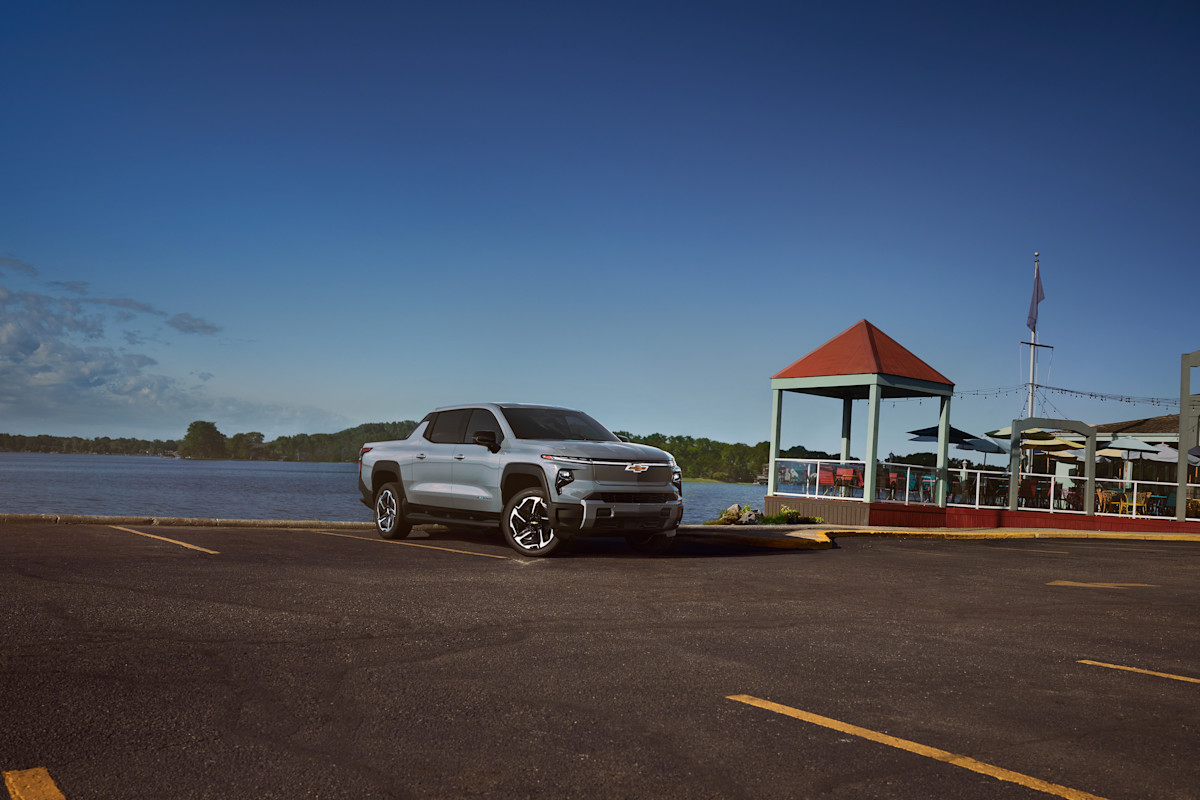
The yeoman in GM’s robust EV lineup, the Silverado EV WT Max Range boasts 493 miles on a single charge thanks to its massive battery pack that’s double stacked with 24 modules.
Dual-motor all-wheel drive is standard through the lineup. It’s not efficient, getting 2 miles per kWh.
Battery size: The Standard Range pack is 119 kWh; the Extended Range pack is 170 kWh and costs about $13,500 more; the Max Range is 205 kWh and $8,000 more than the Extended Range.
Range:
WT Standard Range, 286 miles, $54,895
WT Extended Range, 424 miles, $68,295
WT Max Range, 493 miles, $76,295
LT Standard Range, 283 miles, $62,995
LT Extended Range, 410 miles, $71,195
LT Max Range, 478 miles, $91,295
Trail Boss Extended Range, 410 miles, $72,095
Trail Boss Max Range, 478 miles, $88,695
GMC Sierra EV:
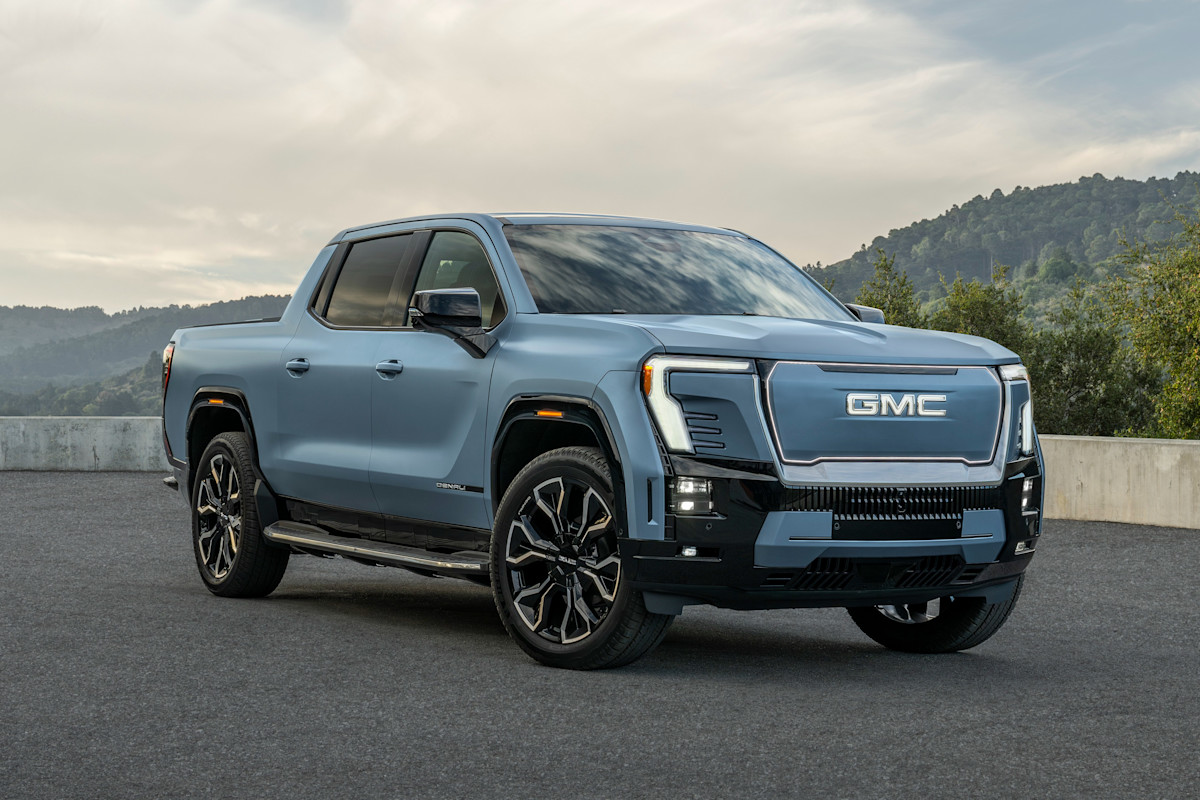
A premium take on the Silverado EV, the Sierra EV expands its trim offerings beyond the luxury-leaning Denali for 2026. The new AT4 Max Range can lumber on for 478 miles, according to GM. The weight of the Sierra EV Max Range precludes it from an official efficiency estimate from the EPA, but it’s not efficient.
Battery size: The Standard Range pack is 119 kWh; the Extended Range pack is 170 kWh and costs about $8,000 more; the Max Range is 205 kWh and $10,300 more than the Extended Range.
Range:
Elevation Standard Range, 283 miles, $64,495
Elevation Extended Range, 410 miles, $72,695
Denali Standard Range, 283 miles, $71,795
Denali Extended Range, 410 miles, $79,995
AT4 Extended Range, 390 miles, $81,395
AT4 Max Range, 478 miles, $91,695
Denali Max Range, 478 miles, $100,695
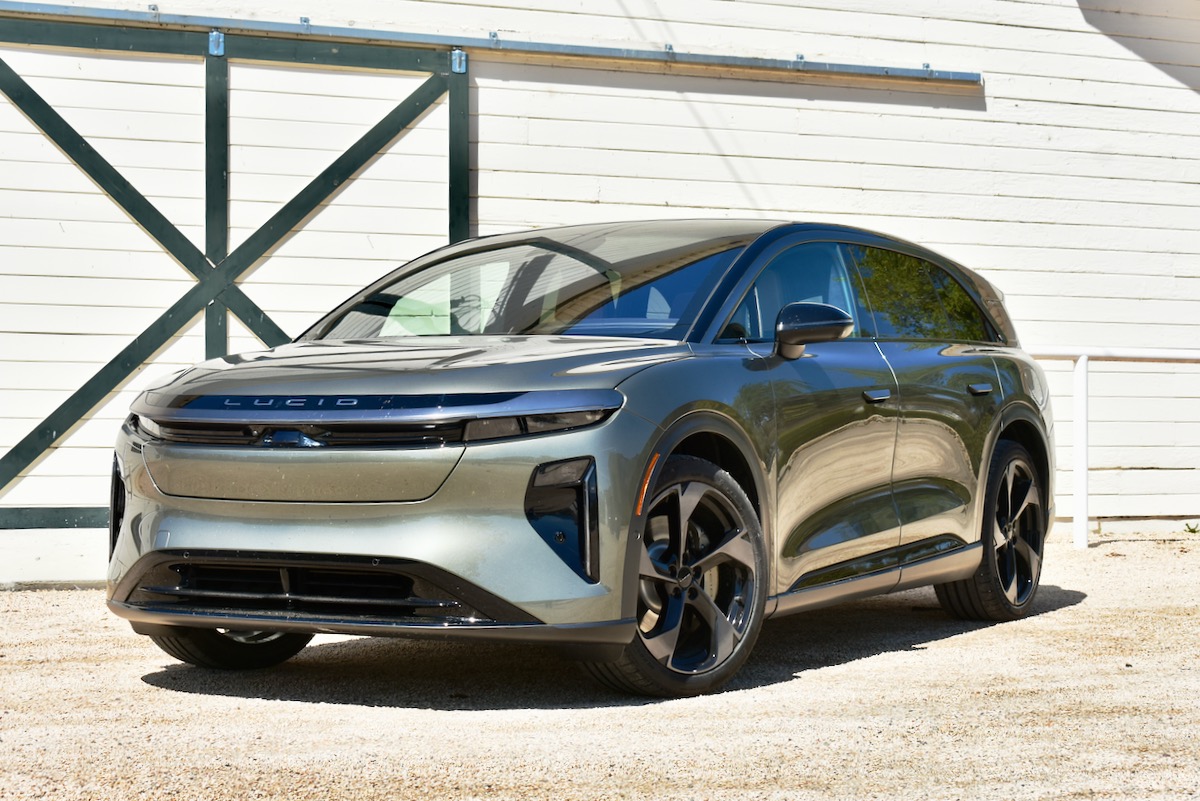
Lucid Gravity GT:
Lucid’s new wagon-like SUV — its second model after the Air sedan — has a range of up to 450 in its five-seat configuration with 20-inch-front and 21-inch-rear wheels. The Gravity has a new iteration of Lucid’s battery pack, rated at 123 kWh instead of the 112-kWh pack on the Air sedan.
The Gravity can be equipped with a third row of seats, and every model has dual-motor all-wheel drive and an air spring suspension. A 34-inch curved display highlights some of the luxury appointments.
Battery size: 123 kWh
Range:
Lucid Gravity Grand Touring, 450 miles, $96,550
Lucid Gravity Touring (late 2025 availability), 450 miles, $76,550
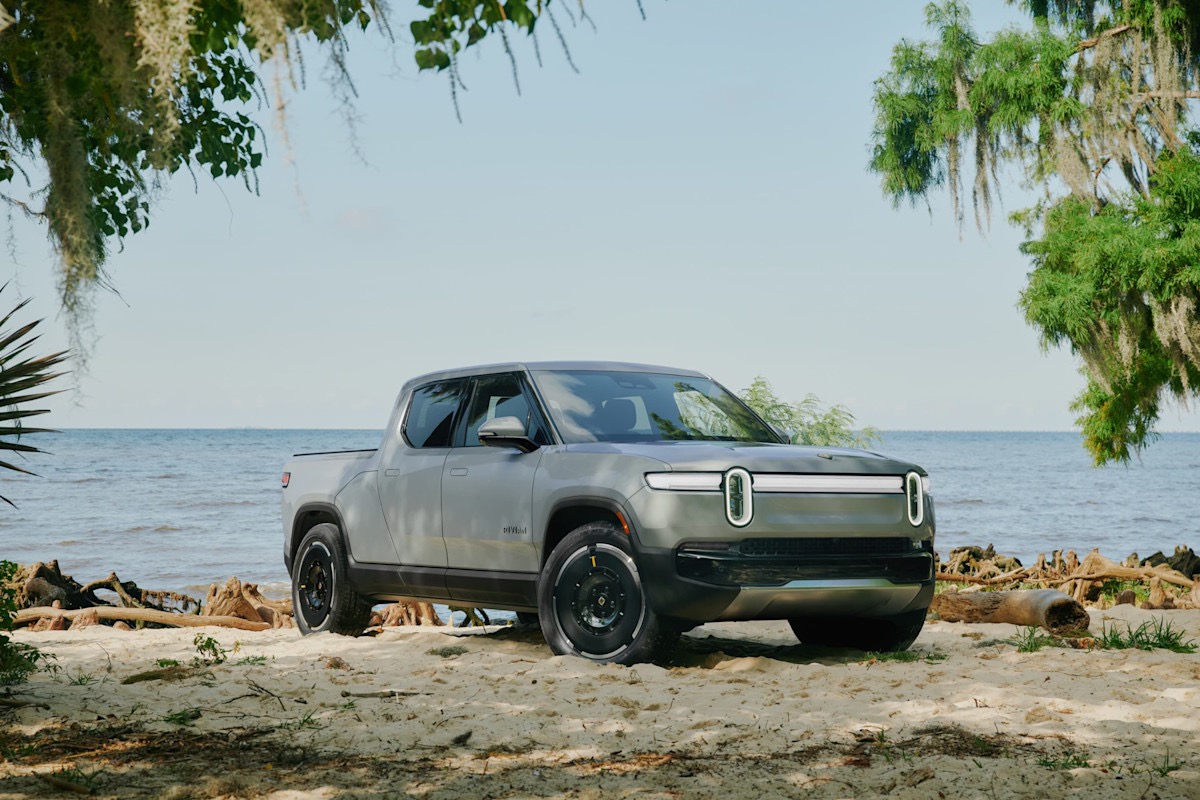
Rivian R1T:
This recently-refreshed pickup (and its innovative cargo tunnel) can travel 420 miles in Dual-Motor Max spec. Three battery sizes and three motor configurations, including a blistering 1,025 horsepower Quad-Motor model with a 0-60 mph time of 2.5 seconds, give shoppers all kinds of choice. The bed may not be as large as half-ton trucks, but between its water-fording ability and off-road ability, the R1T and its clever packaging does what most trucks cannot.
Battery size: Standard 90 kWh; Large 109 kWh; Max 141 kWh
Range:
Dual-Motor Standard Pack, 270 miles, $73,000
Dual Motor Large Pack, 329 miles, $80,000
Dual-Motor Max Pack, 420 miles, $87,000
Tri-Motor Max Pack, 371 miles, $103,000
Quad-Motor Max, starts just under $118,000
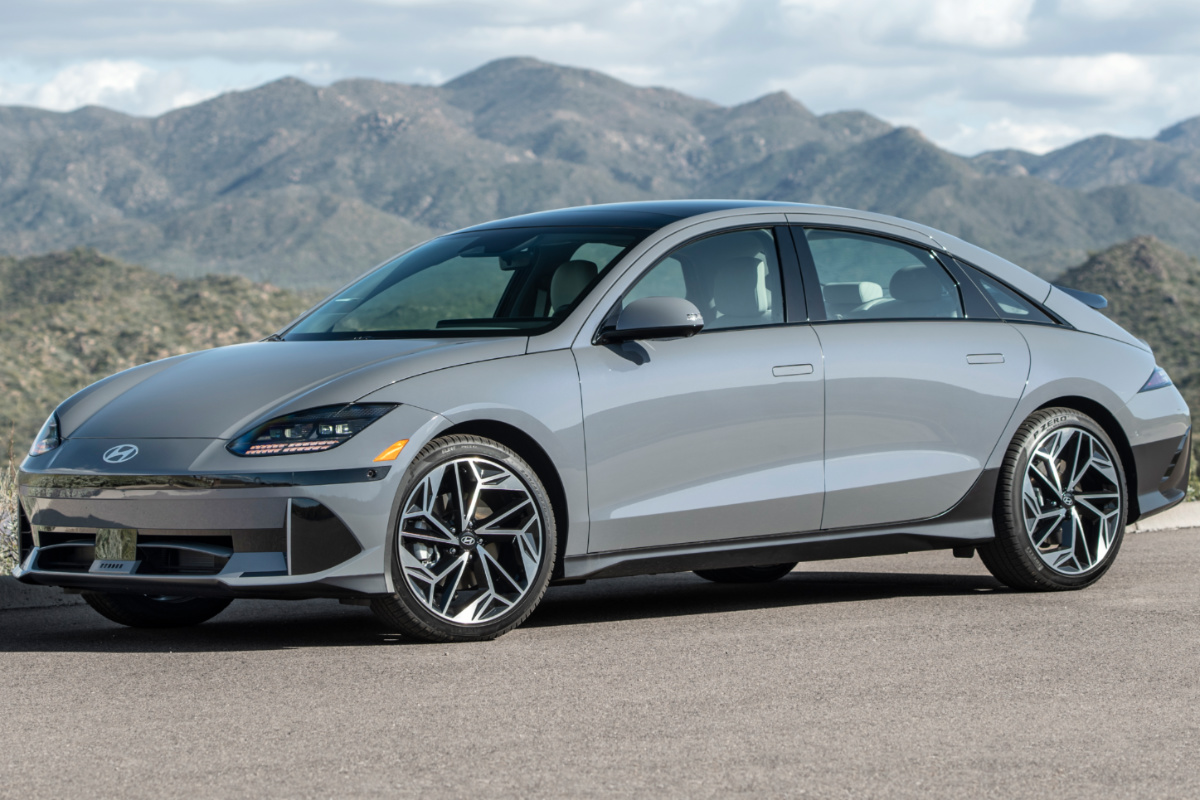
Hyundai Ioniq 6:
Another affordable electric sedan with distinctively aerodynamic styling, the Ioniq 6 with rear-wheel drive and 18-inch wheels nets 342 miles of range.
It’s one of the quicker DC-fast charging cars, and one of the most efficient, netting 4 miles per kWh on the base model. That makes it a strong value.
Battery size: 53-kWh Standard, 77.4-kWh otherwise
Range:
SE Standard RWD, 240 miles, $39,095
SE RWD, 342 miles, $44,045
SE AWD, 316 miles, $47,545
SEL RWD, 291 miles, $46,845
SEL AWD, 270 miles, $50,145
Limited RWD, 291 miles, $52,345
Limited AWD, 270 miles, $55,845
Beyond the Top 20, there are several honorable mentions, including the Ford F-150 Lightning (320 miles), Kia EV6 (319 miles), Porsche Taycan (318 miles in Performance Battery Plus guise), Hyundai Ioniq 5 (318 miles), BMW i4 (318 miles), Ford Mustang Mach-E (312 miles), Kia EV9 (304 miles), and many more.
How Far Can Electric Cars Go on a Single Charge?
Electric cars often are measured by range, or how far they can go on a single charge. This differs from gas cars, which are often measured by their rated miles per gallon. The electric metric measures capability and the gas metric measures efficiency.
Why the difference? Range anxiety, or running out of power before arriving at one’s destination, is the primary concern for many EV shoppers. Every car can run out of range regardless of powertrain type, but gas stations are still more common than public charging stations. The efficiency metric is a primary concern for shoppers of an internal combustion engine (ICE) car.
The Monroney label, or window sticker, on new cars shows a vehicle’s efficiency. The EPA uses a MPG conversion to show the equivalent efficiency of electric cars, dubbed MPGe. The Monroney for electric cars also shows estimated range. It should show a gas car’s estimated range (fuel tank size multiplied by estimated MPG combined rating), as well, but maybe that will come in the next update.
An EV’s maximum range estimates how far it can go under ideal conditions in real-world driving, both short and long distances. Just like an ICE vehicle, there are numerous factors that can result in an EV falling short of its maximum range. Here’s what you need to know to understand how range works.
Factors that affect electric car range
Powertrain: Not all EVs are created equal. Some have single electric motors while others are dual-motor. Dual-motor models are typically all-wheel drive (AWD), while single-motor models tend to be rear-wheel drive (RWD) or front-wheel drive (FWD).
Some EVs have more than two motors, though that extra juice doesn’t always contribute to longer driving range and often bumps other performance metrics, such as horsepower and torque.
Driving habits and driving style: Driving smoothly and predictably is key to maximizing your EV’s range. That means avoiding sudden stops and starts, limiting hard acceleration, and being mindful of the fact that high speeds, such as highway driving, limit range.
Practice using your car’s regenerative braking system to brake efficiently and maximize the energy recaptured through braking. Keep in mind, too, that towing and hauling also cause a drop in range due to the extra load on the vehicle’s powertrain. Filling every seat in that three-row SUV adds weight and also lowers that vehicle’s range.
Climate: Extreme temperatures and climates affect an EV’s range, both in everyday use and over time. For example, an EV stored outside during cold winter weather will lose battery power more quickly than it would in more moderate temperatures, and over time, that can accelerate the battery’s degradation.
Typically, very cold temperatures are worse for EV batteries than very hot temperatures, though warm climates will also have an adverse effect because using an EV’s climate controls to maintain comfortable cabin conditions will also draw from the battery.
For cold weather owners, seek out an EV with a heat pump. A heat pump compresses ambient heat from the mechanical systems to warm the cabin instead of using the battery to pull in cold air, heat it, and spread it through the cabin. In essence, a heat pump spares the battery and is a more efficient way to heat the car.
Battery capacity: Keep in mind that experts advise charging your EV’s battery only to 80%, whenever possible. Regularly charging to 100% accelerates wear and tear on the EV battery and should only be done when absolutely necessary.
So, when considering how far you can actually travel with a particular EV, subtract about 20% from its maximum range to get an idea of its real-world use case.
Most EVs significantly slow their charging speed upon achieving an 80% state of charge. Note that if you’re at a public charger, charging from 80% to 100% can take as long as charging from empty to 80%.
Battery health and age: Over time, an EV’s battery will degrade, much like that of a laptop, smartphone, or even like a 12-volt lead acid car battery. Over time, it’ll hold less energy, and that energy will be depleted more quickly through regular use, though unlike a smartphone or a computer, the battery in an EV is much more expensive and worth learning to care for properly.
Read the owner’s manual for your vehicle for the automaker’s recommended best practices to maintain battery health over time. If you’re shopping for a used EV, keep in mind there’s no way to know how its current maximum range varies from its maximum advertised range when new.
These best practices may include mastering the art of regenerative braking, which can maximize the amount you can travel on a charge and therefore reduce how often you need to charge; using your EV’s preconditioning settings to optimize battery temperature before charging; avoiding both 100% charges and letting your battery run fully empty; and ensuring your vehicle is properly maintained.
Range needs based on different types of drivers: Drivers should keep their needs in mind when shopping for an EV. The length and conditions of daily driving matter, though access to charging is another factor.
For example, a driver who has a short or average commute, with a home charger and perhaps even access to charging at work, has much different needs than a driver who has a long daily commute or must rely on public charging networks. These factors affect how much range is necessary in an EV for that particular driver.
Key Features to Look for in Electric Cars with Long Range:
If you’re shopping for an electric car with good range, it’s worth understanding the features and technologies that make it possible to travel hundreds of miles on electricity alone.
Key elements of an EV’s operation include its battery capacity and the technology used to design the battery, its efficiency and regenerative braking system, which is a key contributor to efficiency, and the available charging infrastructure, whether at home, on the road, or anywhere in between.
Battery capacity and technology: Today’s EVs have numerous features to help prolong battery life and help drivers be aware of how an EV’s powertrain works. New battery technology enables batteries to be smaller and lighter than they were even just a few years ago, which helps make the entire vehicle more efficient since battery weight is a substantial factor in the battery efficiency of an EV — in other words, the bigger and heavier the battery, the more of the battery’s energy is dedicated to hauling itself around.
In addition to the increased efficiency of smaller and lighter batteries, they’re beneficial in other ways, like using fewer rare-earth metals and other nonrenewable resources. Other features include smartphone integration that enable you to manage charging remotely, schedule service, and keep an eye on battery health.
These are all made possible by increasingly sophisticated software that also helps manage the battery capacity, including thermal management systems that keep batteries at the optimal temperature of between 50 and 86 degrees Fahrenheit. Many of these features can be accessed through the touchscreen or infotainment interface.
Battery warranty: According to federal regulations, all automakers must warranty an EV’s battery pack and components for at least eight years or 100,000 miles. Electric vehicles sold in California must comply with an even stricter requirement of 10 years or 150,000 miles, while some automakers offer that coverage even in areas where it’s not required.
Furthermore, while Tesla’s battery warranty varies somewhat by make and model, the company does commit to its batteries maintaining at least 70% capacity during the warranty period, and if it fails to meet that standard, the battery will be replaced for free.
Tesla says that the remainder of a battery warranty will transfer to a vehicle’s second owner as long as the vehicle was sold through Tesla rather than a private party. This is worth keeping in mind for consumers who are shopping for a used EV but are concerned about battery health.
Efficiency and regenerative braking: Range isn’t the whole story when it comes to shopping for an EV. That’s because there are ways to help replenish range even on the road, thanks to regenerative braking. Regenerative braking is a system in hybrid cars as well as EVs that enables the car to be as efficient as possible.
When you’re driving an ICE vehicle without regenerative braking, and you use the friction brakes, all that energy is lost. With regenerative braking, the car’s electric motor captures that kinetic energy and stores it to be reused. Of course, EVs have traditional friction brakes as well as regen braking.
While most hybrid vehicles with regenerative braking have a mechanical system, EVs and some hybrids have electric regenerative braking. These types of systems feel different — regen braking has a learning curve in terms of how it affects a car’s driving dynamics — but both types benefit a vehicle’s efficiency.
Regenerative braking reduces the amount of energy wasted during braking, which is typically significant, and it also reduces wear on the car’s braking system.
There are limits to how much range can be preserved or recaptured with regenerative braking, but for shoppers who want to go as far as possible between charges, it’s worth researching which vehicles have the most efficient regenerative braking systems and practicing using this technology to its fullest potential.
EV cost of ownership: Be aware of the different costs maintenance costs incurred by an EV versus an ICE car. You won’t ever have to change the oil on an EV or pay for a transmission flush. Brakes typically last longer, too. On the flip side, an EV typically needs new tires more frequently.
Charging infrastructure and options: Finally, before shopping for an electric vehicle, especially for first-time EV owners, it’s worth learning about charging infrastructure and options.
Again, take lifestyle into account, with questions such as:
- Is there a place to install a home charger?
- Will the household’s electrical system need to be updated?
- How much will it cost? (These questions can be easily answered by contacting a licensed electrical contractor.)
Even within the home charging industry, there are options to consider. For example, do you want a “smart” charger connected to your home’s Wi-Fi? These chargers can typically be monitored and managed remotely via smartphone, which has some appeal.
Or, you can get a simple, non-connected charger to plug your car in at night and be done with it without constantly checking up on it.
Do you want to add a solar array to your home, so you can charge with renewable energy, or contact your local utility company to inquire if they offer any programs that promise to charge EVs with renewable energy from the local grid?
For potential EV owners who can’t charge at home, what’s the plan? Are there chargers available near work, or are there public chargers convenient for regular errands, like grocery shopping?
In other words, make sure your lifestyle is suited to EV ownership or that you’re willing to make the necessary changes before worrying about details like smartphone apps, charging speed, and the like. All of these questions are worth considering whether or not you have one of the longest-range electric cars.
EV Range History:
It wasn’t long ago that the automotive industry targeted a range of 200 miles to get shoppers onboard. An early deterrent to electric vehicle adoption was range anxiety, which is the fear that an EV will run out of range and strand the driver. Most new EVs have a 300-mile range, so the road trip isn’t as time-consuming.
The public charging infrastructure continues to grow due to nearly every major automaker switching to the North American Charging Standard (NACS) created by Tesla. Owners of any make and model can charge up at Tesla’s vast Supercharger network, and other alternatives such as Ionna continue to roll out across the U.S.
The public charging infrastructure is not as robust as gas stations, even as many conventional gas stations start swapping out some gas pumps for DC fast-charging cabinets.
The early adoption phase has entered mass adoption, with dozens of electric vehicles from every major automaker accounting for around 8 percent of new car sales, according to the U.S. Energy Information Administration.
There’s still plenty of work to go on getting electric cars on a price and accessibility parity with gas cars, and the legislation mandating electric vehicle adoption as well as other political wrangling muddles the automotive segment as a whole. It’s clear globally, however, that EVs are not going away, even if they’re not adopted as quickly as automakers expected.
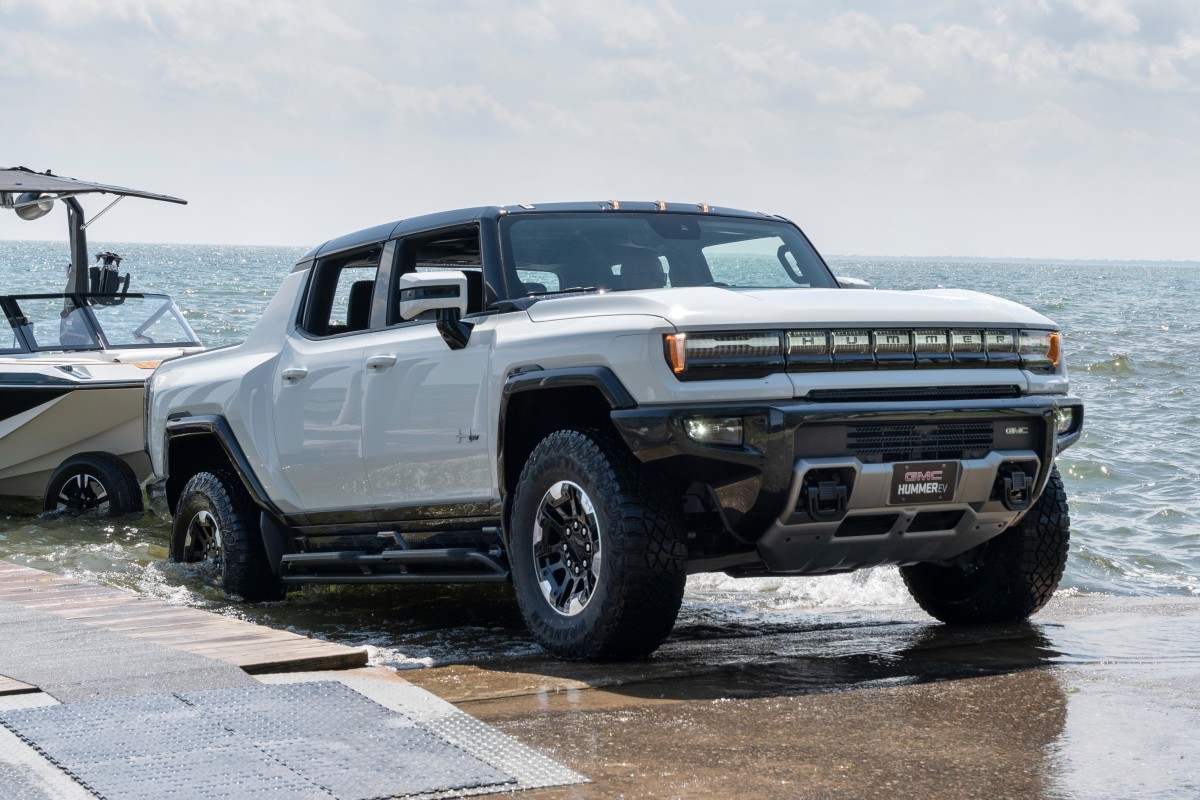
Range still remains a priority for shoppers and a bragging point for automakers. But keep in mind that longest range does not mean efficiency. General Motors, for instance, has a bunch of long-range EVs equipped with massive 205-kWh battery packs that are more than double the size of most other EVs. Large battery packs weigh more, and when they’re equipped to blocky vehicles such as the Hummer EV Pickup and Chevrolet Silverado EV, they are far from efficient.
Also, wheel and tire combos have a big effect on range as larger sizes and the larger contact patch meets more friction and thus, reduces range. Swap in 21-inch wheels instead of the standard 19-inch wheels and the Lucid Air Grand Touring range drops from 512 miles to 446 miles, for example.
Climate and how you drive makes a big difference, too. Light on the throttle, liberal use of regenerative braking, and going downhill the whole way can return big gains in range. Doing the opposite can have the opposite effect, of course. As ever, your mileage may vary.